Action Alert: Comment on changes to the Fur Farm Regulation

A marten sitting on a tree branch (Getty Images / Matt Gibson)

The Government of British Columbia announced on November 5, 2021 that it will phase out mink farming in BC. The phase out is planned as follows:

  • A permanent mink breeding ban is effective immediately
  • A permanent ban on live mink by April 2023
  • All mink farms must cease all operations by 2025

With the announcement to prohibit mink farming in BC, the government is asking British Columbians to provide comments on this decision and amendments to the Fur Farm Regulation, the legislation that governs fur farming in the province. Click here to view the regulations. There is an open question of whether other species of animals listed in the regulations will still be allowed to be farmed for their fur. Other than mink, the animals that are listed in the regulations are chinchillas, fishers, foxes, martens, and nutria. Currently, there are nine mink farms operating in BC and one chinchilla farm. Although the government took the necessary measures to reduce the public health risks of mink farming, officials haven’t provided a risk assessment to demonstrate that intensively farming other wild animals won’t lead to the same public health threats as mink farming. Nor have they addressed the animal welfare concerns of breeding and confining wild animals for their fur. 

The World Health Organization published a risk assessment and identified Canada has having a “very likely” likelihood of introduction and spread of SARS-CoV-2 within fur farms, and a “likely” likelihood of transmission of the SARS-CoV-2 virus from fur farms to susceptible wildlife populations.

The government needs to take a precautionary approach that is consistent with its prohibition on mink farming and disallow any new fur farm applications.We commend the government for taking action on mink farming, but more needs to be done so that new fur farms aren’t opened up in British Columbia or that the hundreds of thousands of mink cages in BC won’t be filled with an entirely new species of animal.

Take Action!

Submit feedback to the Ministry of Agriculture to share your thoughts about the prohibition on mink farming and changes to the Fur Farm Regulation. The email for comments from the public is FurFarmRegulationAmendments@gov.bc.ca. For background on the phase-out and more information, read this goverment bulletin.

The deadline for comments is Monday November 15, 2021.

Some points that can be included in your email:

  • Acknowledging the work and thanking the ministry for taking action to prohibit mink farming.
  • The Ministry of Agriculture should not accept any more applications for new fur farms and decline existing applications if there are any.
  • The government should extend the prohibition on mink farming to all species.
  • There are no provincial animal care standards or NFACC Codes of Practice developed for the intensive farming of fishers, chinchillas, martens, or nutria.
  • Nutria are native to South America and are listed by the BC government as a “high risk” prohibited species. Allowing nutria to be kept on commercial fur farms risks these non-native animals escaping from fur farms and establishing themsleves in BC’s natural environment. Nutria are semi-aquatic animals and their natural habitats are marshes, wetlands, and other aquatic environments. Acquiring these animals from other countries will also contribute to the inhumane global wildlife trade and risks spreading dangerous pathogens across international borders.
  • Fishers, martens, and foxes are all wild animals who make their home in British Columbia’s natural spaces. These animals should remain wild and free, not confined in small wire cages on industrial fur farms.
  • There is one chinchilla farm in British Columbia. Like the mink farms, the government should support this farm in transitioning to other sustainable industries.
  • Fur farming is opposed by the majority of the public. A 2020 public opinion poll found that 85% of British Columbians are opposed to killing animals for their fur.

Why is Europe returning to the dark days of Covid?

Exposing the Big Game's avatarThe Extinction Chronicles

Christmas markets in Austria
In Austria, the Christmas markets will only be open for those who are either vaccinated against or recovered from Covid.Photograph: Jan Hetfleisch/Getty

https://www.theguardian.com/world/2021/nov/13/why-is-europe-returning-to-the-dark-days-of-covid

The continent is now the centre of the global epidemic – again. As countries from the Baltic to the Med brace for harsher winter measures, we look at what’s driving the fourth waveJon Henley, Europe correspondent andPhilip Oltermannin BerlinSat 13 Nov 2021 09.15 EST

It was almost as if the pandemic had never happened. In Cologne, thousands of revellers in fancy-dress jostled side by side in a tightly packed throng as they counted down to the start of the annual carnival season at 11am on 11 November.

In Paris, the bars and clubs were open late and filled to bursting on Wednesday, with Armistice Day a national holiday. In Amsterdam, it was business as usual in the overflowing cafes and coffee shops…

View original post 1,698 more words

How SARS-CoV-2 in American deer could alter the course of the global pandemic

Exposing the Big Game's avatarThe Extinction Chronicles

November 12, 2021 by Michaeleen Doucleff, NPR News

A head-and-shoulders portrait of a white-tailed deer
A new study suggests that white-tailed deer, like the one here, could carry the virus SARS-CoV-2 indefinitely and spread it back to humans periodically. (Matt Stone/MediaNews Group/Boston Herald via Getty Images)

Scientists have evidence that SARS-CoV-2 spreads explosively in white-tailed deer and that the virus is widespread in this deer population across the United States.Audio Player00:0000:00Use Up/Down Arrow keys to increase or decrease volume.

Researchers say the findings are quite concerning and could have vast implications for the long-term course of the coronavirus pandemic.

Since SARS-CoV-2, the coronavirus that causes the disease COVID-19, first emerged, there have been several signs that white-tailed deer would be highly susceptible to the virus — and that many of these animals were catching it across the country.

In September of last year, computer…

View original post 723 more words

Humans Have Broken One of The Natural Power Laws Governing Earth’s Oceans

(Má Li Huang Mù/EyeEm/Getty Images)ENVIRONMENT

TESSA KOUMOUNDOUROS12 NOVEMBER 2021

https://www.sciencealert.com/humans-have-broken-the-natural-law-of-life-s-size-spectrum-in-the-ocean

Just as with planetary or molecular systems, mathematical laws can be found that accurately describe and allow for predictions in chaotically dynamic ecosystems too – at least, if we zoom out enough.https://61938ebedd12f586120e3c9ad776f2eb.safeframe.googlesyndication.com/safeframe/1-0-38/html/container.html

But as humans are now having such a destructive impact on the life we share our planet with, we’re throwing even these once natural universalities into disarray.

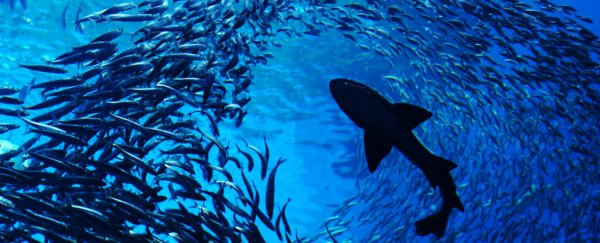
“Humans have impacted the ocean in a more dramatic fashion than merely capturing fish,” explained marine ecologist Ryan Heneghan from the Queensland University of Technology.

“It seems that we have broken the size spectrum – one of the largest power law distributions known in nature.”

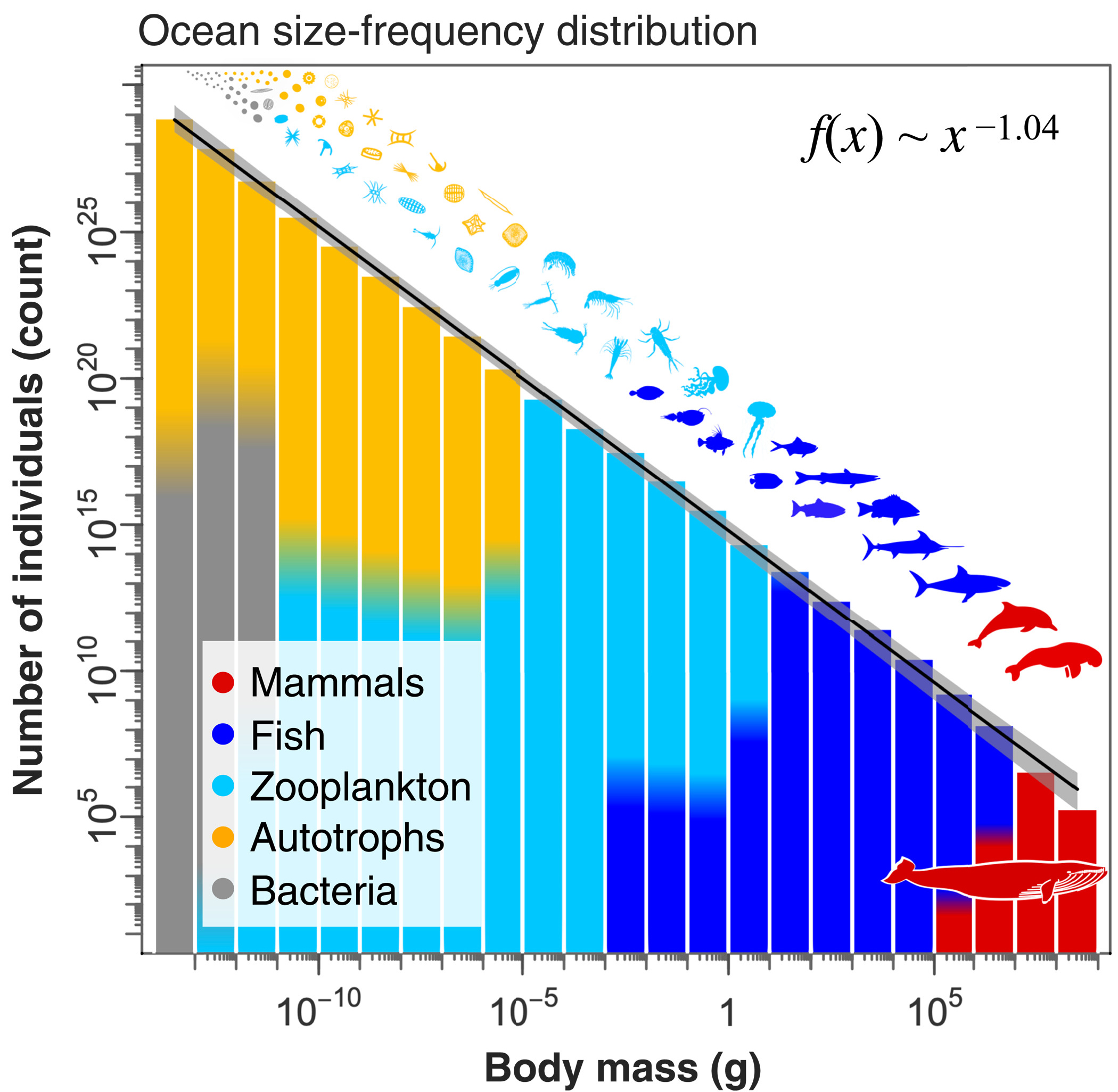
The power law can be used to describe many things in biology, from patterns of cascading neural activity to the foraging journeys of various species. It’s when two quantities, whatever their initial starting point be, change in proportion relative to each other.

In the case of a particular type of power law, first described in a paper led by Raymond W. Sheldon in 1972 and now known as the ‘Sheldon spectrum’, the two quantities are the body size of an organism, scaled in proportion to its abundance. So, the larger they get, there tend to be consistently fewer individuals within a set species size group.https://61938ebedd12f586120e3c9ad776f2eb.safeframe.googlesyndication.com/safeframe/1-0-38/html/container.html

For example, while krill are 12 orders of magnitudes (about a billion) times smaller than tuna, they’re also 12 orders of magnitudes more abundant than tuna. So hypothetically, all the tuna flesh in the world combined (tuna biomass) is roughly the same amount (to within the same order of magnitude at least) as all the krill biomass in the world.

Since it was first proposed in 1972, scientists had only tested for this natural scaling pattern within limited groups of species in aquatic environments, at relatively small scales. From marine plankton, to fish in freshwater this pattern held true – the biomass of larger less abundant species was roughly equivalent to the biomass of the smaller yet more abundant species. 

Now, Max Planck Institute ecologist Ian Hatton and colleagues have looked to see if this law also reflects what’s happening on a global scale. 

“One of the biggest challenges to comparing organisms spanning bacteria to whales is the enormous differences in scale,” says Hatton.

“The ratio of their masses is equivalent to that between a human being and the entire Earth. We estimated organisms at the small end of the scale from more than 200,000 water samples collected globally, but larger marine life required completely different methods.”https://61938ebedd12f586120e3c9ad776f2eb.safeframe.googlesyndication.com/safeframe/1-0-38/html/container.html

Using historical data, the team confirmed the Sheldon spectrum fit this relationship globally for pre-industrial oceanic conditions (before 1850). Across 12 groups of sea life, including bacteria, algae, zooplankton, fish and mammals, over 33,000 grid points of the global ocean, roughly equal amounts of biomass occurred in each size category of organism.

“We were amazed to see that each order of magnitude size class contains approximately 1 gigaton of biomass globally,” says McGill University geoscientist Eric Galbraith.

""(Ian Hatton et al, Science Advances, 2021)
Hatton and team discussed possible explanations for this, including limitations set by factors such as predator-prey interactions, metabolism, growth rates, reproduction and mortality. Many of these factors also scale with an organism’s size. But they’re all speculation at this point.

“The fact that marine life is evenly distributed across sizes is remarkable,” said Galbraith. “We don’t understand why it would need to be this way – why couldn’t there be much more small things than large things? Or an ideal size that lies in the middle? In that sense, the results highlight how much we don’t understand about the ecosystem.”https://61938ebedd12f586120e3c9ad776f2eb.safeframe.googlesyndication.com/safeframe/1-0-38/html/container.html

There were two exceptions to the rule however, at both extremes of the size scale examined. Bacteria were more abundant than the law predicted, and whales far less. Again, why is a complete mystery.

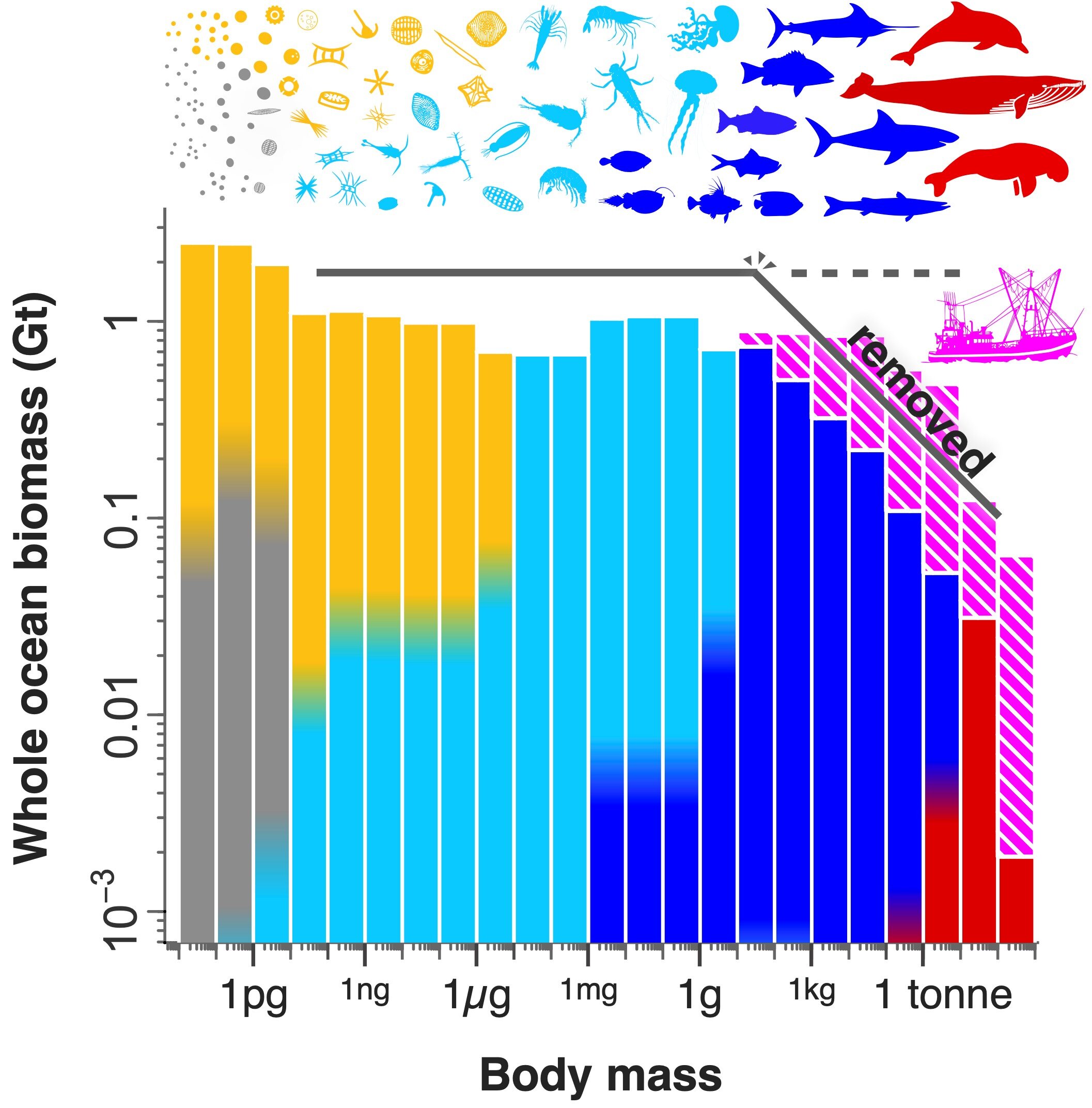
The researchers then compared these findings to the same analysis applied to present day samples and data. While the power law still mostly applied, there was a stark disruption to its pattern evident with larger organisms.

“Human impacts appear to have significantly truncated the upper one-third of the spectrum,” the team wrote in their paper. “Humans have not merely replaced the ocean’s top predators but have instead, through the cumulative impact of the past two centuries, fundamentally altered the flow of energy through the ecosystem.”

""(Ian Hatton et al, Science Advances, 2021)

While fishes compose less than 3 percent of annual human food consumption, the team found we’ve reduced fish and marine mammal biomass by 60 percent since the 1800s. It’s even worse for Earth’s most giant living animals – historical hunting has left us with a 90 percent reduction of whales.

This really highlights the inefficiency of industrial fishing, Galbraith notes. Our current strategies are wasting magnitudes more biomass and the energy it holds, than we actually consume. Nor have we replaced the role that biomass once played, despite now being one of the largest vertebrate species by biomass.

Around 2.7 gigatonnes have been lost from the largest species groups in the oceans, whereas humans make up around 0.4 gigatonnes. Further work is needed to understand how this massive loss in biomass affects the oceans, the team wrote.

“The good news is that we can reverse the imbalance we’ve created, by reducing the number of active fishing vessels around the world,” Galbraith says. “Reducing overfishing will also help make fisheries more profitable and sustainable – it’s a potential win-win, if we can get our act together.”

Their research was published in Science Advances.

On ‘personal choice’ and trying to be a ‘popular’ vegan

There's an Elephant in the Room's avatarThere's an Elephant in the Room blog

Image by Tras los Muros https://traslosmuros.com/en/

I’m sure we’ve all heard – or maybe even used at some time – the tired old assertion about ‘my personal choice’? My first hearing was when it was actually snarled at me through gritted teeth by a former work colleague on learning I had become vegan about a decade ago. It got old quickly after that, but it’s still doing the rounds and I’m sure some who use it, still imagine it’s original.

Yet every single one of us is very well aware that nothing is a ‘personal choice’ when a victim is involved – I’d be surprised if anyone says otherwise. However all our lives we’ve been surrounded by lies, deceptions, and media fabrications that leave us mostly oblivious to the reality that our eating, clothing, toiletry, entertainment and other ‘choices’ are annually creating trillions of innocent victims out of thinking, feeling…

View original post 651 more words

Dassel man seriously injured in hunting accident

Exposing the Big Game's avatarCommittee to Abolish Sport Hunting Blog

https://www.crowrivermedia.com/hutchinsonleader/news/public_safety/dassel-man-seriously-injured-in-hunting-accident/article_1df442f8-4485-11ec-85dd-3fac301afa9a.html

A 38-year-old rural Dassel man was airlifted to St. Cloud Hospital following a hunting accident Friday afternoon in Kingston Township.

At 2:40 p.m., the Meeker County Sheriff’s Office received a report of a person with a gunshot wound in the 72000 block of County State Aid Highway 27. Law enforcement found Michael Hendrickson with a gunshot wound to his leg, and a tourniquet had been applied to control the bleed.

According to the report, the Sheriff’s Office believes it was an accidental discharge by Hendrickson, who shot himself while climbing into his tree stand.

The Minnesota Department of Natural Resources, Dassel Rescue, Mayo Ambulance and Like Link III also responded to the scene, and Hendrickson was airlifted to St. Cloud Hospital with serious injuries.

Meeker County Sheriff Brian Cruze reminds all hunters to practice safe firearms handling, especially while climbing into and out of elevated deer stands.

View original post

Hunters beware? Deer added to growing list of animals that can carry, transmit COVID-19

Exposing the Big Game's avatarCommittee to Abolish Sport Hunting Blog

https://www.koco.com/article/amazons-2021-holiday-toy-book/38136669Share

KOCOUpdated: 7:00 PM CST Nov 12, 2021Infinite Scroll EnabledChristine StanwoodReporterPlay VideoSHOW TRANSCRIPT

GET LOCAL BREAKING NEWS ALERTS

The latest breaking updates, delivered straight to your email inbox.Your Email AddressSUBMITPrivacy NoticeOKLAHOMA CITY —

With rifle deer season just around the corner, wildlife experts want hunters to be aware that animals can carry COVID-19.

But there are ways hunters can protect themselves in the midst of the pandemic while in the great outdoors.Advertisement

“It’s turning out that a lot of wildlife and domestic animals are able to be a carrier for COVID-19,” said Dwayne Elmore, a wildlife extension specialist with Oklahoma State University.

>>Related:OKC Zoo administers animal-approved COVID-19 vaccine to select species

Elmore said recent research suggests deer can carry COVID-19 and transmit it to humans.

“That is not really that surprising because other coronaviruses have worked that way in the past,” he said. “People…

View original post 231 more words

Hunting – What Scripture Says

Exposing the Big Game's avatarCommittee to Abolish Sport Hunting Blog

September 6, 20212 Comments

Hunting – What Scripture Says

Photo bycmonphotographyfromPexels

As we approach the hunting season once again in Minnesota, USA, as well as in other parts of the USA and around the world, it is time to ask ourselves as Jesus followers if hunting is something we should be doing. What does the Bible say about hunting? Richard Dunkerly, evangelical Christian, teacher and writer, in a timeless letter to ACC (Animal Christian Concern), writes on the topic as follows. This letter can also be found inRoslyne Smith‘s book,Animal Welfare: Through The Cross.(For more information on the Bible and hunting, seethisvideo fromCreation Care Church)


The small sparrow clung with intractable grace to the TV antennae

Photo by Miriam Fischer from Pexels

wire just beneath the gable of our neighbour’s house. He seemed to be soaking…

View original post 1,463 more words

Bird Flu outbreak in Japan: Can it spread to humans? Know all about the signs, risk factors and more

Exposing the Big Game's avatarThe Extinction Chronicles

TIMESOFINDIA.COM | Last updated on -Nov 11, 2021, 16:00 ISTSharefbsharetwsharepinshareComments (0)

As per latest reports, Japan has identified its first bird flu outbreak for the season. The H5N1 infection case was first detected and confirmed at a poultry farm in the northeast of the country. About 143,000 birds are being exterminated so as to contain the spread of the virus.

While Japanese officials have claimed that there is no possibility of avian influenza being transmitted to humans through the consumption of chicken meat or eggs, the increase in the number of human bird flu cases in China this year has been concerning for many across the globe.

That said, let us find out what bird flu is and whether or not it can be transmitted to humans.

Read more: Flu season 2021: As flu cases surge, these…

View original post 374 more words

Fight over US wolf protections heads to federal courtroom

Exposing the Big Game's avatarCommittee to Abolish Sport Hunting Blog

  • MATTHEW BROWN Associated Press
  • 5 hrs ago

Gray Wolves-Protections
In this 2014 photo released by the Oregon Department of Fish and Wildlife, a wolf from the Snake River Pack passes by a remote camera in eastern Wallowa County, Ore.Oregon Department of Fish and Wildlife via AP

MATTHEW BROWN Associated Press

BILLINGS — A U.S. government attorney urged a federal judge Friday to uphold a decision from the waning days of the Trump administration that lifted protections for gray wolves across most of the country, as Republican-led states have sought to drive down wolf numbers through aggressive hunting and trapping.

Wildlife advocates argued that the state-sponsored hunts could quickly reverse the gray wolf’s recovery over the past several decades in large areas of the West and Midwest.

They want U.S. District Judge Jeffrey White in Oakland, California to put wolves back under the legal shield of the Endangered Species…

View original post 689 more words