Anonymous Animals is an intense look at a world reversed. Instead of humans having control over the lives of animals, its the animals who have control over humans. That means, humans are the pets, the thing being hunted, and the thing being treated beyond unfairly.
Director, Baptiste Rouveure’s film is a revelation in every sense. It really reaches into the core of a disturbing and heartbreaking world in which we have a mirror placed directly in humanity’s face.
The official synopsis for Anonymous Animals goes like this:
Maniac Cop 2 and 3 is Headed to 4K UHD
‘Chucky’
TMNT X Universal Monsters With Raphael As Frankenstein’s Monster
Powered by Playwire
The balance of power between man and animal has changed. In a remote countryside, any encounter with the dominant can become hostile.
The imagery in this film is extremely striking. The posters image of a deer holding a shotgun, in a field alone is somehow sobering. Over the course of the film Rouveure takes you through the humiliations, horrors and love that man and animal symbiotically share.
The entire thing is an outside the box horror experience that rivals some of the more intentionally disturbing films I have seen in 2021. It’s one of those films that changes the way you want to interact with the world. It almost demands to be seen.
Anonymous Animals arrives in select theaters and on demand beginning Nov. 5.
By Rose Scoggins on Wednesday, October 20, 2021Subhead
Victim, a pastor from Pickens County, died when muzzleloader rifle discharged during maintenance
The Elberton Star logo
Preliminary investigations of a death on Highway 172 West in Bowman on Sunday, Oct. 10 indicate a Jasper man may have died as the result of an accidental discharge of a muzzleloader, according to…
Watch now: First black bear hunted in Missouri during bear seasonPlay Video
spaceplay / pause
qunload | stop
ffullscreen
shift+←→slower / faster
↑↓volume
mmute
←→seek
.seek to previous
12…6seek to 10%, 20% … 60%
Lucas Bond, communications manager with the Missouri Department of Conservation, interviews a hunter who harvested the first black bear in southwestern Missouri on Monday, Oct. 18, 2021. Video provided by the Missouri Department of Conservation
The first black bear hunted in the state of Missouri was shot in the southwest part of the state on Monday.
The bear, a female weighing about 250 pounds, was hunted on private land, said Missouri Department of…
When it comes to first-timers hunting ducks and geese, there’s a lot to learn.
We’re talking waterfowling here folks, a passionate, historic pursuit that boasts a long and storied hunting heritage. From decoy carving to dog training to habitat conservation to strategies afield, aspects of this celebrated sport are multifaceted and intriguing. And for youngsters who might want to explore the many varied pieces of the waterfowling puzzle, a golden opportunity awaits. That’s because the folks at the Brandywine Red Clay Alliance (BRC) will be hosting their popular Young Waterfowlers Program over the next two Sundays, October 24 and 31.
The BRC recognizes that waterfowling is an American tradition that combines hunting with an appreciation of wetlands…
Trapping seasonhas started in Maine. If your dog isinadvertently caught in a trap, here’s what to do.
Thosewho spend time in the woods with their dog shouldknow how to free their animal from a trap. It’s not an uncommon occurrence in Maine, especially withbird hunters running dogs. The good news is most traps will not harm your dog. Most land traps are simply meant to hold an animal, not injure or kill it. While your dog may bark and yip,a correctly settrap is not going to cause permanent damage.
If your dog is caught, stay calm. Again, your dog may be barking or whining, but it’s likelyonly scared.A common practice is to cover the dog’s head with a coat…
The man, 69, was brought to Maine Medical Center in Portland on Saturday morning and was in fair condition Monday afternoon.
BY KATHLEEN O’BRIENTIMES RECORDShareA Phippsburg man was taken to Maine Medical Center in Portland after he accidentally shot himself in the foot at his home Saturday morning.
The 69-year-old was preparing to go bird hunting and “was going to clean the weapon and he thought both barrels were empty, but one wasn’t,” Sagadahoc County Sheriff Joel Merry said. There was no one else in the room when the single shot was fired.
Merry didn’t know the extent of the man’s injuries when he was brought to Maine Medical Center in Portland on Saturday. He was in “fair condition” on Monday afternoon, MaineHealth Spokesperson Caroline Cornish wrote in an email to The Times Record.
Public development banks are directly undermining UN and Paris climate goals by channeling billions of taxpayer dollars into multinational meat corporations
A cattle feedlot in Nebraska. Photograph: Aerial Archives/Alamy
As the climate crisis boils over, new research shows that reducing methane emissions is our best hope to rapidly stem the crisis. It’s time to turn up the heat on the industrial meat industry and dramatically curtail its climate harm, which includes 32% of global methane emissions. Yet instead development banks are using public funds to expand this sector that generates 16.5% of total greenhouse gas emissions (GHGs).
On 19 and 20 October, hundreds of public development banks (PDBs) will gather for the second Finance in Common Summit to make pledges to advance Paris climate and UN sustainable development goals (SDGs). The summit – which will also focus on agriculture and agribusiness transformation – presents a vital opportunity for these banks to put their money where their mouth is and align their agriculture investments to meet these goals.
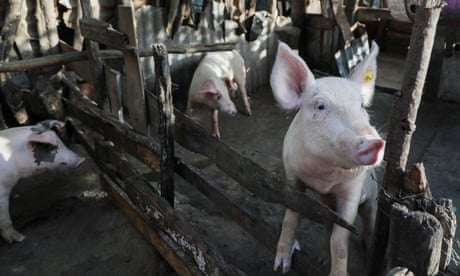
With vast documented evidence of factory farming’s destructive effects, a new global campaign, Divest Factory Farming, is calling on PDBs to immediately stop financing industrial livestock operations and shift their investments towards a more equitable and sustainable food system. A 2020 investigation by the Guardian and the Bureau of Investigative Journalism revealed that over the past decade, just two banks – the World Bank’s International Finance Corporation (IFC) and the European Bank for Reconstruction and Development (EBRD) – “have provided $2.6bn for pig, poultry and beef farming, as well as dairy and meat processing”. Additional research shows that the top five development banks have spent more than $4.6bn in this sector over the past 10 years.
Disturbingly, this trend continues unabated. In June, the IFC board approved a new $50m loan for Pronaca, Ecuador’s fourth largest corporation, to expand intensive pig and poultry production. This project is moving forward despite opposition from international and Ecuadorian groups, including indigenous communities who say that their water and lands have been polluted by the company’s operations.
In recent years, the Inter-American Development Bank’s private sector arm, IDB Invest (which also backs Pronaca), increased its investments in industrial livestock companies more than twentyfold in the Latin America and Caribbean region, from approximately $15m between 2011 and 2017 to around $500m from 2018 to present.Advertisementhttps://d99dc8087522bc1a2c0fe9758958c42f.safeframe.googlesyndication.com/safeframe/1-0-38/html/container.html
There has been global outcry against the Marfrig loan. A recent letter sent to the IDB directors and president argues that while the IDB Invest loan targets “deforestation-free production” by 2025 in the Amazon and by 2030 in the Cerrado, “this loan will prop up a company whose current practices will likely lead to further legal and illegal deforestation and human rights violations in these regions,” for years. The letter was sent by 200 environmental, human rights, and development organizations from around the world.
IDB Invest is considering the Marfrig loan at a time when deforestation rates have increased 34% under Brazil’s far-right Bolsonaro regime. This administration, backed by agribusiness, is rapidly gutting environmental protections and enforcement while pushing a disastrous legislative agenda that will destroy forest protections and the rights of Indigenous peoples. In this context, it is doubly urgent to halt financing for companies like Marfrig that could take advantage of these weakened protections.
As documented in a Greenpeace report, Marfrig still has no effective procedures in place to guarantee that cattle ranchers linked to illegal deforestation or human rights violations are excluded from its supply chain. Marfrig acknowledges that it cannot currently verify the source of 40% of its indirect production in Brazil. With land grabbing, indigenous land rights disputes and illegal deforestation in regions where Marfrig operates, the letter notes, “the company’s failure to establish a timely and effective system to prevent these impacts would likely violate multiple performance standards and should disqualify Marfrig from receiving public financing from IDB Invest.”
If cattle were a nation, they would be the third largest emitter of greenhouse gases in the world
While the banks argue that investments in giant livestock corporations create jobs, in reality these loans propel further consolidation and corporate power in a sector that harms workers, farmers and consumers. In recent years, Marfrig has spent $800m to acquire nearly a fourth of BRF, one of the world’s largest poultry producers, and another $969m to acquire almost 82% of shares in US-based National Beef Packing Co. With these latest purchases, Marfrig’s annual combined sales top $13bn. This is not a firm that needs or deserves public assistance.Advertisementhttps://d99dc8087522bc1a2c0fe9758958c42f.safeframe.googlesyndication.com/safeframe/1-0-38/html/container.html
Ultimately, these PDB investments entrench a destructive industrial food system that worsens our climate crisis. These investments mirror the misguided spending of governments worldwide. A recent UN report found that nearly 90% of the $540bn in global agricultural subsidies each year are “harmful”, with the largest subsidies going to industrial beef and milk production.
In Latin America, cattle production is responsible for 70% of deforestation across Amazon countries. According to the Inter-American Development Bank, more than 800,000 sq kmof Amazonian jungle – equivalent to 90% of Venezuela’s landmass – has been deforested to make way for industrial livestock and animal feed production.
Unless we dramatically scale back meat and dairy and move swiftly to sustainable methods, experts project that livestock production alone could account for a whopping 80% of the world’s budget for greenhouse gas emissions (in a 1.5C temperature increase scenario) by 2050. If cattle were a nation, they would be the third largest emitter of greenhouse gases in the world. With less than 10 years to prevent irreversible climate catastrophe, every investment and policy must help greatly reduce emissions while bolstering food security and resiliency to weather upheavals.
By ending investments in factory farms, public development bank leaders will send a clear signal to other public finance institutions, the private sector, markets and governments that it’s time for meaningful emissions reductions from livestock, and time to shift subsidies and investments toward highly productive, lower-carbon ecological farming. There is no time to waste.
Kari Hamerschlag is the deputy director of Friends of the Earth US’s food and agriculture program and Christopher D Cook is an award-winning journalist and author of Diet for a Dead Planet: Big Business and the Coming Food Crisis
IMAGE: THE RUDDY TURNSTONE (ARENARIA INTERPRES) IS A MARINE WADER BIRD, HERE PICTURED ON A SEASHORE OCCUPIED BY HUMAN SETTLEMENT AT WHITBY, UK.view more CREDIT: PETRI NIEMELÄ
Humans are shaping environments at an accelerating rate. Indeed, one of the most important current topics of research is the capacity of animals to adapt to human-induced environmental change and how that change affects the expression of animal traits.
With the help of data collected on a little over one hundred animal species, researchers from the University of Helsinki and Lancaster University studied which behavioural traits are the most sensitive to human-induced environmental change, and to which human-induced changes in the environment animals respond the most sensitively. From the largest to the smallest, the groups of organisms included in the study were fish, birds, crustaceans and mammals. In addition, insects, amphibians and lizards were represented.
All the behavioural traits included in the study – aggression, activity, boldness, sociability and exploration of their environment – changed markedly due to environmental change brought about by humans.
“The biggest change was seen in the animals’ activity in exploring their environment. Animals have a strong response to all forms of environmental change, but climate change engendered the greatest change in animal behaviour,” says Postdoctoral Researcher Petri Niemelä from the Faculty of Biological and Environmental Sciences, University of Helsinki.
In addition to climate change, the other forms of human-induced environmental change included in the modelling were changes in carbon dioxide concentration and nutrient levels, alien species and other biotic changes caused by humans, as well as direct human impact through, for example, urbanisation or other human disturbances.
Changes in activity or other behaviour can often be the initial change in animals instigated by climate change.
“Behavioural change can serve as a buffer with which animals avoid the immediate negative effects of environmental change. For instance, such change can compensate for low reproductive success or increased mortality caused by environmental change. By changing their behaviour, animals can also gain more information on the altered environment.”
The researchers of the University of Helsinki and Lancaster University based the study on a survey of over a thousand scholarly, peer-reviewed, publications, from which the data needed for the analysis were collected on a little over one hundred animal species. The study was published as an open-access publication in the international OIKOS journal series in September 2021.
A new report from the United Nations’ World Meteorological Organization (WMO) warns that Africa’s rare glaciers will disappear within two decades.
Thereport released Tuesdaywarned that the current retreat rates of Africa’s glaciers — Mount Kenya, the Rwenori Mountains and Mount Kilimanjaro— are higher than the global average. If it continues, the mountains would bedeglaciated by the 2040s.
The WMO made the findings in The State of the Climate in Africa 2020 report, which details how Africa is disproportionately vulnerable to the consequences of climate change.
The report was done in collaboration with the African Union Commission, the Economic Commission for Africa (ECA) through the Africa Climate Policy Centre (ACPC), and…
Written by Taylor BrockThursday, Oct 07 2021, 2:09 PM
A suspect is in court after aTuesday-night hunting incident.
RCMP Manitoba says two men were hunting separatelyin a wooded area off of Silver Bridge Road, south of Elma, a community roughly 70 kilometres east of Winnipeg, on Tuesday before they were called about a shooting.
Police say at around 7:55 p.m. they were called to the area. When they arrived, they found a 59-year-old man from Rosengart shot dead. They say the victim was shot by a 45-year-old German citizen man. The two did not know each other.
The suspect is being charged with Manslaughter, appearing in court Thursday.
Lac du Bonnet RCMP, Major Crime Services, RCMP Forensic Identification Services, and Manitoba Conservation Officer Service are investigating.


 The Elberton Star logo