‘Vested interest is slowly shifting towards the ever-larger renewable sector.’ Whitelee, the UK’s largest onshore wind farm, in east Ayrshire and south Lanarkshire.Composite: Guardian
So many things have broken the wrong way since the Paris climate accords were agreed in mid-December of 2015. Within eight weeks Donald Trump had won his first presidential primary, an insane comet streaking across the night sky, trailed by outliers like Brazil’s Jair Bolsonaro. The world has enduredopéra bouffedistractions like Brexit, and the true paralyzing emergency of the pandemic.https://www.theguardian.com/email/form/plaintone/green-lightSign up for our weekly environment newsletter, Green Light.
At Ontario’s fall fairs, animal farmers want fairgoers to see what animal agriculture is all about. They display cute animals with names, some nursing their young, and speak of their important roles as food producers. This is all to help consumers feel OK about the animal agriculture industry, which kills over 800 million of those animals each year. Agricultural fairs have long been used by the industry as a tool to perpetuate ideas of animal farming as wholesome, natural and necessary. But, what you see at the fair isn’t really what most animal farming is all about.
In recent years, demand for more transparency in meat, dairy and egg production has grown. More consumers want to believe their sausage and cheese come from humanely-treated animals. And the animal agriculture industry has been eager to sell that dream. One farmer at the Norfolk County Fair recently told a Torstar reporter that transparency “is key for farmers looking to correct the record about controversial topics like animal welfare.”
However, rather than actually making changes to increase transparency and improve animal welfare, the industry has instead worked hard to further conceal how the sausage is really made, and to sell false images of animal farming as honest and humane. This is done via well-known marketing imagery of happy animals in green pastures, of clean barns and caring farmers. This is also done through media sound bites that describe cruel farrowing crates that don’t allow nursing pig mothers to so much as turn around, as a “piglet protection program,” and that describe the process of shocking or gassing those pigs before stabbing them in the throat, as them simply “moving on.”
No, this is not “agriculture awareness,” as the industry calls it, this is marketing. Because when activists and undercover investigators enter the spaces where animals are farmed, those massive sheds far from public eye, they don’t find happy, clean animals with names. They find filth, suffering and death.
If activist or investigator footage makes it to the media, farm owners will almost always describe abuse caught on camera as a rare one-off. And when footage doesn’t make it to the news, it is often because what is captured, though shocking, isn’t illegal. How can it be, when there are no laws governing everyday treatment of farm animals, and most provincial animal care acts have blanket exemptions for “standard” practices? Such practices can and do include taking newborn calves away from their mothers, bashing the skulls of ill or injured piglets into concrete as a form of euthanasia, and killing “byproduct” male chicks by throwing them live into macerators. Why don’t farmers display those things at the fair?
Transparency is not the goal of the animal agriculture industry. If it was, it would not have lobbied for “ag-gag” legislation, which just passed in Ontario last year, to deter investigators, journalists and activists from further exposing it. (The author is currently part of a lawsuit challenging this law in Ontario.)
As meat prices continue to increase and efforts of activists to expose animal farming continue, the industry is upping its marketing game. Don’t be fooled. Farmers will often say that the majority of animal operations in Canada are family-owned, to evoke those lovely images of small, bucolic farmsteads. But with the average number of animals per-farm in Canada around 2000, it’s obvious that family-owned doesn’t mean what many consumers likely think it does. Inhumane factory farming is abundant in Canada. They just won’t tell you that at the fair.Jessica Scott-Reid is a writer and animal advocate, and a co-host of Canada’s animal law podcast, “Paw & Order.”
A Ludington man passed away Thursday night due to a hunting accident.
At 10:08 PM, emergency crews were called to the 4700 block of West Decker Road in Mason County’s Victory Township for a reported of a hunter who had passed away.
Deputies arrived to find a 48 year-old man deceased under his tree stand.
The stand was located approximately 20 feet in the tree with his hunting gear still in the stand.
His wife, who went to check on her husband after he failed to return for an evening of hunting, found him.
The case remains under investigation, but no foul play is suspected.Play Video
The CEO of a leading meat producer, Danish Crown, says beef will become a luxury item like champagne due to its negative effect on the planet. Further, the company admits that it underestimated the plant-based movement.
Danish Crown is Europe’s largest meat processing company, according to its website, with market access to more than 130 countries.
In the financial year 2019-2020, Danish Crown slaughtered 18 million pigs and 0.8 million cattle, its annual report says.
The future of meat
The company’s CEO, Jais Valeur, recently spoke with Denmark’s Berlingskenewspaper about the future of meat.
“It has become clear to me that the way one consumes and thinks about meat is going to change markedly in the coming years,” Valeur said.
He’s referring to the public’s increasing concern about the climate emergency. A growing body of research is shining light on the destructive nature of animal agriculture – including deforestation, emissions, biodiversity loss, and pollution.
Beef, in particular, is said to be one of the least sustainable meats.
“Beef is not going to be super climate friendly. It will be a bit like champagne, namely a luxury product,” Valeur explained, adding that it will be eaten ‘when we need to pamper ourselves’.
Michael Minter, Program Manager at think tank CONCITO, agreed with Valeur’s remarks.
“I agree that beef will very much be a luxury product. Beef and dairy products are some of the most climate-damaging foods,” Minter said to Berlingske. “But the alternatives are on the way. I think developing cell- or plant-based alternatives can go pretty fast. It will challenge cattle breeders and slaughterhouses.’
Underestimating the meat-free movement
According to its website, Danish Crown is aiming to halve its climate impact by 2030. Further, the company wants to achieve ‘carbon-neutral production’ by 2050.
This may be why the 130-year-old meat company has started producing plant-based food, a topic which Valeur himself admits he overlooked.
“When I took office five years ago, Danish Crown was challenged in several areas. At one point, we were asked about plant-based foods and climate by some consultants, but declined that it should be on the agenda,” Valeur said.
“I probably had my Beatles moment there. Because it was a bit like rejecting the Beatles when they came out. Here, five years later, I would like to admit that we were wrong.”
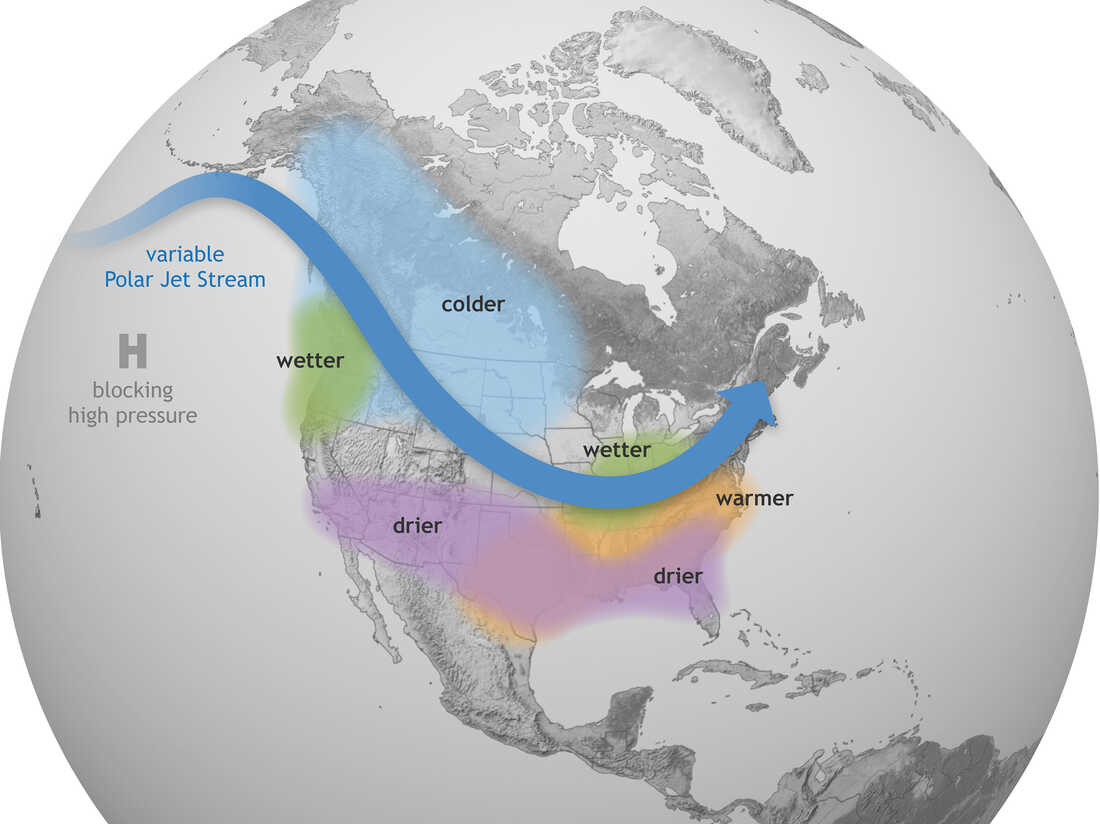
This Climate.gov graphic shows how La Niña generally affects weather conditions in the United States. Forecasters say there’s a nearly 90% chance that La Niña conditions will be in place from December 2021 to February 2022.National Oceanic and Atmospheric Administration
La Niña will most likely be joining us for the winter again, according to federal forecasters.
The National Oceanic and Atmospheric Administration’s (NOAA) Climate Prediction Center announced on Thursday that La Niña conditions have developed and are expected to continue, with an 87% chance that they will be in place from December to February.
La Niña (translated from Spanish as “little girl”) is not a storm, but a climate pattern that occurs in the Pacific Ocean every few years and can impact weather around the world.
The U.S. is expected to feel its effects on temperature and precipitation, which could in turn have consequences for things such as hurricanes, tornadoes and droughts.
Forecasters point out that this is actually the second La Niña winter in a row, a not-uncommon phenomenon that they call a “double-dip.” The most recent period lasted from August 2020 to April 2021. (More below on what has happened since.)
“Our scientists have been tracking the potential development of a La Niña since this summer, and it was a factor in the above-normal hurricane season forecast, which we have seen unfold,” Mike Halpert, deputy director of NOAA’s Climate Prediction Center, said in a news release. “La Niña also influences weather across the country during the winter, and it will influence our upcoming temperature and precipitation outlooks.”Article continues after sponsor message
NOAA will release its official winter outlook on Oct. 21. In the meantime, here’s a primer on how La Niña works and what it could mean for different parts of the country.
What exactly is La Niña?
Scientists stress that La Niña is not a storm that hits a specific area at a given time. Instead, it’s a change in global atmospheric circulation that affects weather around the world.
“Think of how a big construction project across town can change the flow of traffic near your house, with people being re-routed, side roads taking more traffic, and normal exits and on-ramps closed,” states a NOAA webpage. “Different neighborhoods will be affected most at different times of the day. You would feel the effects of the construction project through its changes to normal patterns, but you wouldn’t expect the construction project to ‘hit’ your house.”
We’ll start off with the technical explanation: It’s one part of the El Niño-Southern Oscillation (ENSO) cycle, a natural climate pattern defined by opposing warm and cool phases of oceanic and atmospheric conditions in the Pacific.
La Niña and its counterpart, El Niño, alternately cool and warm large areas of the tropical ocean about every two to seven years on average. (There’s also a “neutral” state, which is where we’ve been since the last La Niña ended.)
As the agency explains (with a helpful flowchart), forecasters can officially declare a La Niña eventwhen sea surface temperatures clock in below a certain level, are modeled to remain under that threshold and prompt a noticeable atmospheric response, like changes in winds.
Here’s how that works.
“During normal conditions in the Pacific ocean, trade winds blow west along the equator, taking warm water from South America towards Asia. To replace that warm water, cold water rises from the depths — a process called upwelling,” NOAA explains. “El Niño and La Niña are two opposing climate patterns that break these normal conditions.”
Trade winds are stronger than usual under La Niña conditions, so they push more warm water toward Asia. Meanwhile, off the west coast of the Americas, an increase in upwelling sends cold water toward the surface. (The nutrient-rich water also draws more cold-water species, like squid and salmon, to places such as the California coast.)
So what does that actually feel like on the ground?
The biggest impact of La Niña on North American rain, snow and temperatures tends to be felt during the winter, according to NOAA.
Generally speaking, La Niña winters tend to be drier and warmer than normal across the southern U.S. and cooler and wetter in the northern U.S. and Canada.
The Pacific Northwest, parts of the Midwest and the Tennessee and Ohio valleys can see more rain and snow than in a typical winter.
La Niña can also lead to a more severe Atlantic hurricane season, which we’re already seeing this year.
The main thing that forecasters stress is that while La Niña events are associated with certain climate patterns — namely, deviations in temperature and rainfall in different parts of the country — they’re a matter of “probability, not certainty.”
So if you’re wondering whether La Niña will affect your home this winter, NOAA scientists offer this answer:
“Maybe. Probably. Probably not. The answer depends on many factors, including where you live, how strong the event continues to be, and other climate patterns that develop and influence the seasonal outcome.”
What about weather events such as snow, flooding and tornadoes?
Snow is hard to predict, but experts say La Niña could bring increased snowfall over the Northwest, northern Rockies and Upper Midwest Great Lakes region. Parts of the Southwest, central-southern Plains and mid-Atlantic are likely to see less than usual.
La Niña generally contributes to more Atlantic hurricanes but fewer in the eastern and central Pacific (El Niño is the opposite). As NOAA explains, those Atlantic hurricanes form in the deep tropics from African easterly waves, so are more likely to become major hurricanes that could hit the Caribbean and United States.
The position of the jet stream also appears to have an impact on tornadoes and which parts of the country are more likely to experience them. During La Niña winters, the jet stream and severe weatherare likely to be farther north.
La Niña could also worsen California’s ongoing drought and make its wildfire season even more of a threat. As Bloomberg explains, the state usually gets most of its annual water from rain and snow between November and April — the same period when La Niña is predicted to shift storm tracks northand away from the region that needs it.
While the southern U.S. could see prolonged drought, the northern part of the country — especially the Pacific Northwest — is likely to experience heavy rains and flooding.
How long will it last, and how often does it happen?
The National Ocean Service says that episodes of El Niño and La Niña typically last nine to 12 months but can sometimes stretch for years.
They both tend to develop during the spring, reach peak intensity during the late fall or winter and then weaken during the spring or summer.
In other words, La Niña’s influence on the U.S. will be strongest between January and March but could linger into the early spring.
Why is it called that?
As the backstory goes, South American fishermen had long observed warmer-than-normal coastal Pacific Ocean waters and dramatic decreases in fish catch happening around Christmastime. They nicknamed that phenomenon El Niño — Spanish for “little boy” — after baby Jesus.
So when scientists discovered the opposite phase of El Niño in the 1980s, they decided to call it La Niña. (Of course, language about gender identity and expression is a lot more nuanced these days.)
How does this relate to climate change?
It’s too soon for scientists to say exactly how a warmer world would affect the ENSO cycle.
“But remember, just because we do not have high confidence on how ENSO might change in the future does not mean that it won’t,” NOAA stated in a 2016 blog post. “It just means scientists have more work to do.”
They are confident, however, that ENSO itself will continue into the future. And they say global warming will likely affect the impacts of La Niña, including extreme weather events.
The biggest threats to our natural worldIllustration: Charlotte Ager/The Guardian
From destructive land use to invasive species, scientists have identified the main drivers of biodiversity loss – so that countries can collectively act to tackle them
The world’s wildlife populations haveplummeted by more than two-thirds since 1970– and there are no signs that this downward trend is slowing. The first phase of Cop15 talks in Kunming this week will lay the groundwork for governments to draw up a global agreement next year to halt the loss of nature. If they are to succeed, they will need to tackle what the IPBES (Intergovernmental Science-Policy Platform on Biodiversity and…
Just one day after hurtling into space on the Blue Origin rocket, an emotional William Shatner appeared on Cuomo Prime Time to discuss the profound experience. The 90-year-old actor revealed that the once-in-a-lifetime trip was incredibly bittersweet.
“I wish I had better news and more entertainment and jokes to tell you, but I was moved to tears by what I saw,” Shanter said. “And I come back filled with… overwhelmed by sadness and empathy for this beautiful thing we call Earth.”
Shatner was visibly overcome with emotions while talking about how the trip affected his view on humanity. The usually jovial actor stressed the importance of implementing cleaner business practices to reduce the impact of climate change.
“We’re at the tipping point, we haven’t got time to wait 30 years and argue about a few billion dollars,” Shatner said. “Burying your head in the sand another instant about global warming and the destruction of the planet is suicide for all of us.”
Shatner appeared to reference the climate change agenda in President Biden’s embattled $3.5 trillion spending bill. He also warned that if we don’t do something about the industrial pollution, we will not only be stripping the planet of its natural resources, we will be stripping it of the future.
“What is tragic is if our children, especially our children’s children, don’t have a chance to be part of this beautiful thing we call Earth… and it’s just sad,” Shatner lamented.
A Canadian woman was woken up by a meteorite on October 3, which crashed through her roof.
Ruth Hamilton saw a smoking space rock inches away from her head, according to CBC News.
Experts at Western University in London, Ontario, confirmed that the rock was a meteorite.
Ruth Hamilton was woken up by a cosmic crash on October 3, when a meteorite blazed through her roof and landed on her pillow inches away from her face, according to CBC News.
The woman, who lives in Golden, British Columbia, Hamilton told CBC she was woken up by her dog barking.
“The next thing was just a huge explosion and debris all over my face,” Hamilton told CBC. “I jumped out of bed and turned on the lights. I didn’t know what else to do, so I called 911.”
According to the report, Hamilton was not sure if there was any rock blasting ongoing in the mountains nearby her, but authorities confirmed none occurred that night.
Hamilton then turned the rock over to a team of specialists at Western University in London, Ontario, who was able to confirm that it was in fact a meteorite. A similar incident occured last year in Indonesia, when a meteorite crashed through a local villager’s roof.
According to the report, Hamilton kept mum at first after the incident. She told CBC that she plans to keep the galactic gift after the researchers are done analyzing it, if possible.Read the original article on Insider
An Oklahoma City area doctor apparently died in a hunting accident Saturday on Poteau Mountain.
According to the statement from LeFlore County Sheriff’s Department Deputy Bradley Warren, the LC Sheriff’s Department received a call of a hunting accident on Poteau Mountain.
Warren’s report said when Sheriff’s Department deputies arrived, they found Mohammad Faisal Khanh on the ground close to his tree stand and was deceased.
According to Warren’s report, Khan was bowhunting and appeared to have a wound to one of his legs, which was apparently to have been caused by one of his arrows.
Warren’s report said the Oklahoma Department of Wildlife Conservation was called, and both the ODWC and the LeFlore County Sheriff’s Department are working the investigation — which was still ongoing as of press time. He also said it was Khan’s hunting partner who found him, but Warren did not…


 by


 © Marko Aliaksandr/Shutterstock An artist’s depiction of a meteorite falling to the ground. Marko Aliaksandr/Shutterstock

