Madison, WI. — Today Animal Wellness Action, the Center for a Humane Economy, Friends of the Wisconsin Wolf and Wildlife, and Project Coyote sued the state of Wisconsin over its reckless and politically motivated decision to authorize a quota of 300 wolves for the November wolf hunt, on top of the 218 known killed in a February hunt. The combination of two killing seasons in a single year, at these inordinately high levels and contrary to scientific data, may result in the destruction of half of the state wolf population in 2021, and puts the survival of the Wisconsin wolf population at risk.
The lawsuit alleges that the political appointees on the Wisconsin Natural Resources Board (Board) – including a hold-over member from the Scott Walker Administration who refuses to cede control of his seat – disregarded the recommendations from professional staff at the Wisconsin Department of Natural Resources (DNR) and chose to set an arbitrary and unsustainable kill level without regard for the health and well-being of the wolf population or sustainable ecosystems in which the wolves play an integral role.
The lawsuit also alleges that the 2011 law that requires Wisconsin to hold an annual wolf hunt is unconstitutional. It asks the Dane County Circuit Court to overturn the law, reverse the quota set by the Board, and enjoin DNR from issuing licenses for the November hunt.
“The Natural Resources Board should know its role– to oversee and ratify the decisions of the professional staff at the Wisconsin DNR,” stated Paul Collins, AWA’s Wisconsin State Director and resident of Stoughton, WI. “Instead, the Board has hijacked wolf management. The courts cannot allow this arbitrary and capricious decision-making to drive wildlife management decisions in Wisconsin.”
The last wolf trophy hunt in Wisconsin took place just 6 months ago, when hunters engaged in a 60-hour killing spree of at least 218 wolves, exceeding the quota set by the state by 83 percent. The injury to the wolf population was compounded as breeding females and dominant males were killed, thus impacting pup production and survival in the spring. Wildlife researchers have analyzed the February hunt and have conservatively estimated that hunters and poachers killed 27-33 percent of the wolves in the state, putting the current population as low as 695 animals.
“The combination of the February hunt and the planned fall hunt could result in a 60 percent decline in Wisconsin’s wolf population,” said Melissa Smith, founder of Friends of the Wisconsin Wolf and Wildlife. “That is extraordinarily reckless and cannot be allowed to happen. This is a species fresh off the federal endangered species list, with a current federal legal challenge arguing that the delisting itself was not warranted.”
Wolves number only slightly more than 5,000 across their range in the lower 48 states, and they face a panoply of threats. Without the shield of federal protection, the human persecution of wolves has ramped up in a way reminiscent of the 19th-century slaughter of the animals, with Wisconsin, Idaho, and Montana in particular unleashing ruthless wolf-killing plans for 2021.
“Of all the wolf-killing states, Wisconsin may be the worst because it is the only one to allow the barbarity of using hounds to chase, capture and kill wolves,” said Michelle L. Lute, PhD in wolf conservation science and National Carnivore Conservation Manager for Project Coyote. “These egregiously cruel methods and extreme kill quotas make clear the dire situation for not only wolves and dogs but for our ecosystems as well as science-based reason and democracy.”
The groups are represented by lawyers with Animal & Earth Advocates, Greenfire Law, and the Wisconsin-based Laffey, Leitner & Goode.
This EXPOSED Wildlife Conservancy campaign is a joint campaign in partnership with the Grizzly Bear Foundation working toward a continued ban on the provincial grizzly bear trophy hunt in Alberta, Canada. The campaign also includes a call to action for the Alberta government to fully implement and fund its own Grizzly Bear Recovery Plan. The end goal is to ensure that grizzly bear management in Alberta continues to work toward recovery and coexistence with this iconic Threatened species with input from all stakeholders, including First Nations.https://www.youtube.com/embed/7G61twkGsGI?rel=0&controls=1&autoplay=0&mute=0&start=0
In the Crosshairs
THE ROAD TO RECOVERY FOR ALBERTA’S THREATENED GRIZZLY BEARS
This 30-minute documentary brings together the most recent science-based research with stunning visual footage and photographs to tell the story of the past, present, and future of grizzly bear recovery in Alberta. The film explores hunting, habitat loss, and coexistence issues, delving into the latest population estimates and the very real…
By Sharon Levy29th August 2021From Knowable MagazineCommonly thought of as a human response to danger, injury and loss, there is growing evidence that many animals show lasting changes in their behaviour after traumatic events. Can they point to an evolutionary source for PTSD?E
Every few years, snowshoe hare numbers in the Canadian Yukon climb to a peak. As hare populations increase, so do those of their predators, lynx and coyotes. Then the hare population plummets and predators start to die off. The cycle is a famous phenomenon among ecologists and has been studied since the 1920s.
In recent years, though, researchers have come to a startling conclusion – hare numbers fall from their peak not just because predators eat too many of them. There’s another factor: chronic stress from living surrounded by killers causes mother hares to eat less food and bear fewer babies. The trauma of living through repeated predator chases triggers lasting changes in brain chemistry that parallel those seen in the brains of traumatised people. Those changes keep the hares from reproducing at normal levels, even after their predators have died off.
And it’s not just snowshoe hares, as behavioural ecologists Liana Zanette and Michael Clinchy have shown. Zanette and Clinchy, both at the University of Western Ontario, are a married couple who majored in psychology as undergraduates. Today, they study what they call the ecology of fear, which combines the psychology of trauma with the behavioural ecology of fear in wild animals. They’ve found that fear of predators can cause other wild mammals and songbirds to bear and raise fewer young. The offspring of frightened voles and song sparrows, like those of stressed snowshoe hares, are less likely to survive to adulthood and succeed in reproducing.
These findings add to a growing body of evidence showing that fearful experiences can have long-lasting effects on wildlife and suggesting that post-traumatic stress disorder, with its intrusive flashback memories, hypervigilance and anxiety, is part of an ancient, evolved response to danger. The work is part of a wider scientific debate over the nature of PTSD and whether it is an evolved response shared among mammals, birds and other creatures, or is unique to humans.
Fearful experiences such as being hunted by predators or humans may leave a long-lasting effects on animals (Credit: Arctic Images/Getty Images)
Studies of the ecology of fear started in the 1990s. Before then, scientists assumed that the impact of a predator on an individual prey animal was either deadly or fleeting. If a hare survived a coyote attack, or a zebra escaped the claws of a lion, it would move on and live its life as before.
But research shows that fear can alter the long-term behaviour and physiology of wild animals, from fish to elephants. “Fear is a response all animals mount to avoid being killed by predators,” says Zanette. “It’s enormously beneficial, because it keeps you alive to breed another day. But it does carry costs.”
Rudy Boonstra, a population ecologist at the University of Toronto, has studied the impacts of extreme stress on the snowshoe hares and other small mammals of the Canadian Yukon since the 1970s. He was inspired by his own family history: Boonstra was born in the Netherlands, where his mother — like many of the Dutch — experienced severe stress during World War Two. “That likely affected her children,” he says. “That sense of stress being a relevant factor in our biology was always in the back of my mind.”
Boonstra knew that during the decline phase of the snowshoe hare cycle, the great majority of hares are killed by predators. But there turned out to be more to the story. When Boonstra’s student, Michael Sheriff, tested faeces of live-caught hares during the rise and fall phases of the population cycle, he found that levels of the stress hormone cortisol in mother hares fluctuated with predator density, peaking when predators were most numerous.
Those highly-stressed mothers, the researchers found, bore fewer, smaller babies. And heightened stress hormone levels were also passed from mothers to daughters, slowing the rates of hare reproduction even after predators had died off and abundant vegetation was available for hares to eat. This explains why the hare population remains low for three to five years after predators have all but vanished from Boonstra’s study site.
Animals stressed by many predators spend more time hiding and less time feeding, so they produce fewer young — but that may allow more adult hares to survive to rebuild the population
Early pioneers of stress physiology focused on human problems and viewed such stress responses as pathological, but Boonstra has come to disagree. He sees the response of snowshoe hares as an adaptation that allows the animals to make the best of a bad situation. Animals stressed by many predators spend more time hiding and less time feeding, so they produce fewer young — but that may allow more adult hares to survive to rebuild the population when the cycle starts again.
Some of the most dramatic impacts of wildlife trauma have been observed in African elephants. Their populations have declined drastically due to poaching, legal culling and habitat loss. Undisturbed elephants live in extended family groups ruled by matriarchs, with males departing when they reach puberty. Today, many surviving elephants have witnessed their mothers and aunts slaughtered before their eyes. A combination of early trauma and the lack of stable families that would ordinarily be anchored by elder elephants has resulted in orphaned elephants running amok as they grow into adolescence.
“There are interesting parallels between what we see in humans and elephants,” says Graeme Shannon, a behavioural ecologist at Bangor University in Wales who studies the African elephant. Trauma in childhood and the lack of a stable family are major risk factors for PTSD in people. And among elephants who’ve experienced trauma, Shannon notes, “we’re seeing a radical change in their development and their behaviour as they mature”. Elephants can remain on high alert years after a terrifying experience, he says, and react with heightened aggression.
Shannon experienced this first-hand when he and his colleagues were following a herd of elephants in South Africa’s Pongola Game Reserve. The researchers kept their car at a respectful distance. But when they rounded a curve, Buga, the herd’s matriarch, stood blocking the road. The driver immediately turned off the engine, which generally causes elephants to move on peaceably. Instead, Buga charged the car. “Next thing we knew, the car was upside down and we were running,” remembers Shannon. Buga’s extreme reaction, he suspects, was linked to trauma she experienced when she was captured and relocated six years earlier.
Human responses to danger, injury and loss are likely part of this same evolved set of responses. A vast body of evidence shows that the brains of mice, men — in fact, all mammals and birds, fish, even some invertebrates — share a common basic structure, and common responses to terror or joy. The brain circuitry that signals fear and holds memories of terrifying events lies in the amygdala, a structure that evolved long before hominids with bulging forebrains came into being.
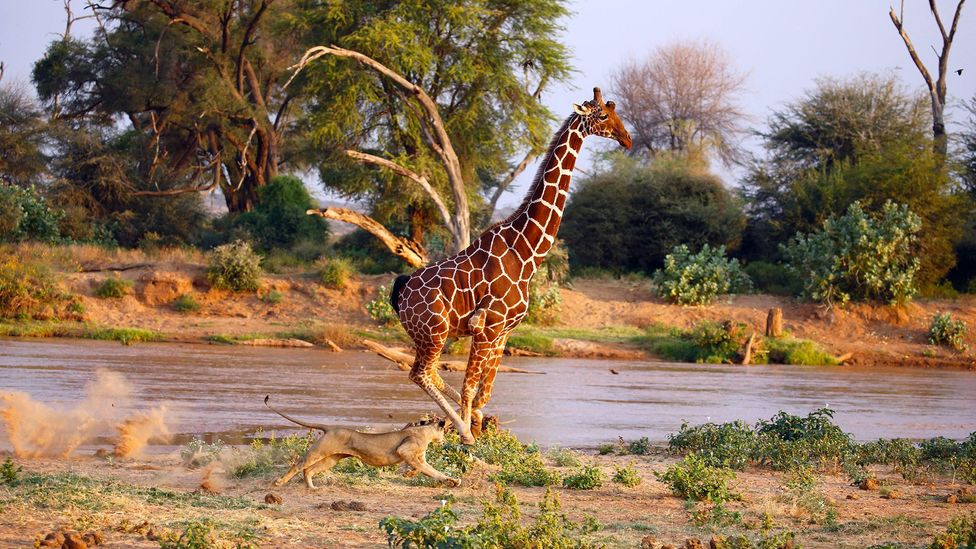
Many adult giraffes bear the scars from lions, but these encounters may leave non-physical marks too (Credit: BiosPhoto/Alamy)
Most modern people with PTSD have been traumatised in combat or during a criminal attack or a car crash. But the intrusive memories of trauma, the constant state of alarm that can wear down the body’s defences and lead to physical illness — these arise from the same ancient brain circuits that keep the snowshoe hare on the lookout for hungry lynx, or the giraffe alert for lions.
The amygdala creates emotional memories, and has an important connection to the hippocampus, which forms conscious memories of everyday events and stores them in different areas of the brain. People or other animals with damaged amygdalae can’t remember the feeling of fear, and so fail to avoid danger.
Brain imaging studies have shown that people with PTSD have less volume in their hippocampus, a sign that neurogenesis — the growth of new neurons — is impaired. Neurogenesis is essential to the process of forgetting, or putting memories into perspective. When this process is inhibited, the memory of trauma becomes engraved in the mind. This is why people with PTSD are haunted by vivid memories of an ordeal long after they’ve reached safety.
In a similar manner, fear of predators suppresses neurogenesis in lab rats. And Zanette and Clinchy are demonstrating that the same pattern holds in wild creatures living in their native habitats.
The scientists began by broadcasting the calls of hawks in a forest and found that nesting female song sparrows that heard the calls produced 40% fewer live offspring than those that did not. In later experiments, they showed that brown-headed cowbirds and black-capped chickadees that heard predator calls showed enduring neurochemical changes due to fear a full week later. The cowbirds had lowered levels of doublecortin, a marker for the birth of new neurons, in both the amygdala and hippocampus.
Repeated chases by predators can alter snowshoe hare behaviour and lead them to have fewer young (Credit: Tom Brakefield/Getty Images)
The same pattern has been shown in wild mice and in fish living with high levels of predator threat. These neurochemical signals parallel those seen in rodent models of PTSD that researchers have long used to understand the syndrome in humans.
Despite the mounting evidence that a wide range of animals experience long-term impacts of extreme stress, many psychologists still see PTSD as a uniquely human problem. “PTSD is defined in terms of human responses,” says David Diamond, a neurobiologist at the University of South Florida. “There is no biological measure — you can’t get a blood test that says someone has PTSD. This is a psychological disease, and that’s why I call it a human disorder. Because a rat can’t tell you how it feels.”
Some researchers now disagree with this human-centric view of PTSD, however. “A lot of things are shared between humans and other mammals,” says Sarah Mathew, an evolutionary anthropologist at Arizona State University. This includes learning about and responding to danger, and avoiding situations that present life-threatening risks. Mathew believes that PTSD has deep evolutionary roots, and that some of its symptoms arise from adaptations — like a heightened state of alert — that allow individuals of many species, including our own, to manage danger.
This evolutionary perspective is beginning to change minds. Clinchy and Zanette have organized conferences on the ecology of fear and PTSD that bring together ecologists, psychiatrists and psychologists. “The psychiatrists and psychologists were talking about PTSD as maladaptive,” recalls Clinchy. “We were arguing that this is an adaptive behaviour, to show these extreme reactions in this particular context, because that increases your survival.”
Diamond came to agree. The brain of someone with PTSD, he says, “is not a damaged or dysfunctional brain, but an overprotective brain”.
“You’re talking about someone that has survived an attack on his or her life,” he adds. “So the hypervigilance, the inability to sleep, the persistent nightmares that cause the person to relive the trauma — this is part of an adaptive response gone awry.”
“There’s a stigma involved in PTSD, frequently,” says Zanette, “so people don’t seek treatment. But if patients can understand that their symptoms are perfectly normal, that there is an evolutionary function for their symptoms, this might relieve some of the stigma around it so that people might go and seek treatment.”
* This article originally appeared in Knowable Magazine, and is republished under a Creative Commons licence.
By Bart PfankuchSouth Dakota News WatchAD0:23SKIPhttps://imasdk.googleapis.com/js/core/bridge3.478.1_en.html#goog_1748814541
Editor’s note: This is the first part of a South Dakota News Watch story on the state’s predator control bounty program. Two more partsof the story will be published in the days to come.
A state-sanctioned pheasant protection program that pays South Dakota youthand adults $10 for every raccoon, skunk and other predator they trap has led to the killing of more than 134,000 animals in the past three years with no scientific evidence the program is working.
Known as the Nest Predator Bounty Program, the effort to boost pheasant and duck populations by paying trappers to kill animals that eat the eggs and hatchlings of pheasants and ducks began in 2019 and recently completed its third year of operation. The program that takes place for a few months during the spring pheasant nesting season has been approved for another year in…
Photo by: Oregon Department of Fish and Wildlife via APThis Feb. 1, 2017 photo provided by the Oregon Department of Fish and Wildlife shows the Western gray wolf Snake River pack seen by a remote camera in the Hells Canyon National Recreation Area. (ODFW via AP)By:MTN NewsPosted at12:05 PM, Aug 30, 2021and last updated1:18 PM, Aug 30, 2021
After a public comment period that drew more than 26,000 comments, the Montana Fish & Wildlife Commission at its August 20 meeting adopted several changes to the 2021/2022 wolf hunting and trapping regulations.
Changes include eliminating quotas, increasing the number of wolf trapping and hunting licenses allowed for individual hunters, extending wolf trapping seasons, and the allowance of snares for trapping wolves.
“It’s really a success story when you look at enhancing our trapping traditions and outdoor heritage,” said Kevin Robling, GF&P secretary.Written By:Bart Pfankuch / South Dakota News Watch|2:00 pm, Aug. 30, 2021
Shown here is a trap used to catch nest predators that are included in the state’s Nest Predator Bounty Program, which was created to enhance pheasant nesting success. (Sam Fosness / Republic)
A state-sanctioned pheasant protection program that pays South Dakota youths and adults $10 for every raccoon, skunk and other predator they trap has led to the killing of more than 134,000 animals in the past three years with no scientific evidence the program is working.
Known as the Nest Predator Bounty Program, the effort to boost pheasant and duck populations by paying trappers to kill animals that eat the eggs and hatchlings of pheasants and ducks began in 2019 and recently completed its third year of…
See picturesque Lake Tahoe obscured by smoke from wildfire02:21
(CNN)The ragingCaldor Firein Northern Californiaprompted evacuation ordersand warnings in the Lake Tahoe Basin Sunday night after fire conditions resulted in rapid spread, causing at least one hospital to transfer all of its patients out amid the flames.All patients were being evacuated fromBarton Memorial Hospitalin South Lake Tahoe.”Patients will be transferred to regional partner facilities & patients’ families will be notified,” the hospital said in atweetSunday night. “Barton’s Emergency Department remains open for emergent health needs only.”
Five people have been injured in the fire that has destroyed more than 650 structures and damaged nearly 40 more since it began August 14, Cal Fire said.
Photos:Wildfires raging in the WestFirefighters try to reach a fire site in…
You’re seeing it everywhere: Impossible Whoppers, Beyond sausage at Pizza Hut, eventually plant-based chorizo at Chipotle, popping up on fast food and fast-casual menus all over the place. It’s a plant-based bonanza! That trend isn’t about to plateau, at least not anytime soon. Piplsay, a consumer opinion company, polled 30,700 people across the United States to see what they really thought of these products on fast food menus, and it’s interesting to see how many people are starting to embrace the movement.
Above all, it starts with faux-meat awareness. How many people actually know about the availability of plant-based options at their favorite fast food restaurants? The answer: 71%. That means 29% of the people polled weren’t even aware that this was an option yet at many places. (People, where have you been?)
Of those who were aware of the products, 54% said they’ve tried them. Of that group, 21% who identified as meat eaters said they’ve tasted those items once or twice, and 18% of meat eaters said they’d eaten fake meat offerings several times (aka more than twice). Meanwhile, of the respondents who are vegan or vegetarian, only 8% had plant-based meat on repeat visits and 7% of them gave it a shot only once or twice. Are you surprised by those findings? If these stats seem backward—as in, it would seem more likely that non-meat eaters would appreciate and order a meatless burger more often than carnivores—consider the fact that, as Vox explains here, plant-based meat is designed for “flexitarians” and meat eaters to replace the meat that’s already in their diet. Not as many vegetarians and vegans are actively craving products that mimic the taste and texture of meat.
The remaining 46% of respondents said they were aware of plant-based fast food options, but hadn’t tried any of them. Of that group, 22% were flat-out uninterested in giving the vegan meat substitutes a shot. I know some people who are vehemently against plant-based meat for whatever reason, but I mean…you can’t really have an opinion about something you refuse to try.
In terms of satisfaction, 70% of those who tried vegan meat substitutes reported that they enjoyed the experience, and 60% said they’d eat them again. The remainder said their experiences were not so good (18%) and not good at all (12%). A lot more people seem to like it than hate it, which must mean it’s doing a pretty good job imitating beef—or providing a similarly satisfying experience, at least. If you haven’t tried it yet, admit it: aren’t you a little curious?
Updated: 1:40 PM PDT Aug 30, 2021Infinite Scroll EnabledKCRA StaffPlay Video
GET LOCAL BREAKING NEWS ALERTS
The latest breaking updates, delivered straight to your email inbox.Your Email AddressSUBMITPrivacy Notice
Evacuation orders were issued Monday for all of South Lake Tahoe after expanded evacuations the night before as the massive Caldor Fire in El Dorado County experienced a “rapid spread,” Cal Fire said.
Watch continuous coverage live in the player above
Monday’s new evacuation orders are for the following areas:
Heavenly:East of Pioneer Trail between Larch and Al Tahoe, to include the area of Heavenly Ski Resort out to the Alpine County Line and the Nevada State line on the East.
Stateline:East of Ski run on the lake side of Pioneer Trail and also both sides of Pioneer Trail between Larch and the Nevada State line.
PUBLISHED MON, AUG 30 20217:43 AM EDTUPDATED 5 HOURS AGOCatherine Clifford@IN/CATCLIFFORD/@CATCLIFFORDSHAREShare Article via FacebookShare Article via TwitterShare Article via LinkedInShare Article via EmailKEY POINTS
Environmental studies professor Sarah Ray wrote “A Field Guide to Climate Anxiety: How to Keep Your Cool on a Warming Planet.”
Ray hopes it will better equip people with the morphing and sharpening fears her Humboldt State students brought to her classroom.
In this conversation with CNBC, Ray shares how she thinks climate communications and psychology need to change to help young people.
Her advice is useful for anyone struggling to find a way to productively move through climate change fears and paralysis.
Sarah Ray, a professor of environmental studies at Humboldt State University in Arcata, California, and author of “A Field Guide to Climate Anxiety: How to Keep Your Cool on a Warming Planet.”Photo courtesy Sarah Ray
Young people are not coping well with climate anxiety.
CNBC is publishing a series of accounts of how climate watchers, leaders and others are facing the emotional toll of climate change and finding a way through their anxiety, and this is a piece in that series.
The following are excerpts of Ray’s comments in a telephone interview with CNBC. They have been edited for brevity and clarity.
‘This new generation is radically different’
The existential weight that my students were bringing to me personally and into the classrooms to each other was something I had no tools to deal with.
I was seeing a great impatience with doing the work of classes: “Why am I wasting my time in college when this stuff is happening out there?” Very much like what we hear from Greta Thunberg and the youth climate movement. This sense of impatience with the types of activities we do in classes, a real desire for action, a real desire for getting out there, rolling your sleeves up and doing something and fixing these problems. The urgency has totally sunk in. There was a fetishizing of action over thinking or talking or reading.
Economics, politics, law, engineering, science used to be the places where students would go into if they wanted to get into environmental stuff. And they were predominantly white, and they often came in with a nostalgia about wanting to get things back to nature the way it was before “bad stuff happened to it.” And that was the modus operandi of the field.
This new generation is radically different.
Sarah Ray, a professor of environmental studies at Humboldt State University in Arcata, California, with her two kids, ages 10 and seven.Photo courtesy Sarah Ray
There is a real awareness of the social justice dimensions and the sort of systems change thinking around climate change. The new generation doesn’t think of this as just something that we need to go into science to fix or technology to fix or engineering to fix or even politics or law. There’s a sense of this being a systemic thing that we need all hands on deck to address. We need all the talents, we need all the skills we from the artists, to the creative types, to the imagination people, to the children’s book writers, to the teachers to the parents — in addition to all of the usual suspects that used to be in sort of thinking about the major leverage points of affecting climate change.
It used to be that climate change was sort of imperceptible, abstract, hard to get your head around hard to deal with. It was a communication conundrum. It evaded all of the risk perception, tick boxes that need to be checked to create a good villain, for people to perceive something as a problem — especially for young people for whom the future feels really far away.
No longer is it abstract, or in the future. It is now, and it’s perceivable. And that has been a huge achievement, because by definition, climate change is the least narratable villain in a story.
They won’t be flying as much. They will refuse things that my generation takes for granted, like plastic and single-use containers. They will slowly, hopefully, successfully change how infrastructure works, how their transportation works, how they build their families, how they build their homes, how they live on this planet and walk on this Earth. Their lifestyles won’t accept what my generation has accepted as normal.
There’s going to be a real reckoning around reproductive refusal. What’s fascinating about that is environmentalists have long chosen not to have children as a way to reduce their impact on the planet, but this generation is choosing not to have children because they don’t think their children will have a livable future. That’s a very, very, very different reason to do it.Environmentalists have long chosen not to have children as a way to reduce their impact on the planet, but this generation is choosing not to have children because they don’t think their children will have a livable future.Sarah RayPROFESSOR AND AUTHOR
The climate movement forever has thought, “We’re never going change capitalism, this is never going to happen.” This real sense of futility of the whole endeavor, and that futility is less, I feel like that is diminished.
The younger generations are saying, “No, actually Covid has shown us that we can change a lot of stuff.” They feel more politically powerful than previous any previous generation before them, except for maybe in the ’60s. In the last 50 years, this is the most powerful feeling generation, and they have good reason to feel that way.
Necessity is the mother invention. Desperation is the mother of action. These two things absolutely go together. You can’t have such a politically organized generation and group without such clear and present danger.
For a sustainable future: Focus on what’s working
The story is not already prewritten. The dominant narrative is about inevitability. And that is an excuse for inaction. And I am utterly early against that. My favorite book on this is the newest book by Elin Kelsey, “Hope Matters.”
The story that we can build the future we want has to be the central story with young people. I don’t care whether that’s rose tinted. I don’t care if that’s Pollyanna to some people. The science is out there on what happens with young people if they think that their future is already written for them, and that is not good. That is not an option for me.
The future of climate communication, the future of climate psychology has to simply be the “both-and” orientation. It’s just going to have to be, because we’re all going to learn at some point that living in doom and gloom narratives is very ineffective, and it makes us literally want to kill ourselves. This is very scary. We’ve gone from nobody caring enough about climate change to people caring so much that they’re nihilistic. We cranked up the urgency and then we’ve like overshot the mark.
It’s not that urgency is a bad thing. Urgency has a rhetorical situation and purpose and audience that is very effective and needs to happen. And we need to keep using urgency where appropriate. So I am not rejecting urgency outright. But for people who do really care a lot, it is not a productive thing.
We are going to be in this for a while. There is some urgency needed, but we need to focus on those fears that we do have control over, and slow down and do the work in a way that is sustainable for ourselves. And simply put that is the recipe for engaging in this work without burning out, without getting overwhelmed.
We need to be clear-eyed about it. I’m not suggesting that we block out everything that we can’t control. Taking in of all this information through the news, social media, all the ways that we have a 24-7 news stream, in general, that negativity bias of media and negativity bias in our psychologies and in our brains does not equate to reality. And it does equate to serious depression and anxiety.
We can be aware of how bad things are, and also how good things are. We can counterbalance the overwhelming negativity of news and our own biases around negativity by consuming and actively seeking out things that are positive. And that’s not about being in denial or naive. That is about making sure we are consuming, that we’re exposed to reality, which is not all bad.




 Top Videos


 Top Articles


 Updated: 1:40 PM PDT Aug 30, 2021Infinite Scroll Enabled


