AUGUSTA, Maine (AP) — Maine’s fall hunting seasons are set to begin in two weeks with the start of the bear hunt.
Maine’s “big four” fall game animals are black bears, moose, white-tailed deer and wild turkeys. The bear hunting season begins on Aug. 30 and runs to late November.
The deer hunt comes next, with the expanded archery season starting on Sept. 11. The firearms season for deer takes place in November.about:blankhttps://imasdk.googleapis.com/js/core/bridge3.475.0_en.html#goog_1151593143about:blankjavascript:void(0)
Read More
The moose season runs from late September to late November. It’s legal to hunt turkeys from Sept. 20 to Nov. 6.
Maine Gov. Janet Mills and other state officials have encouraged hunting during the coronavirus pandemic because it’s an outdoor activity that involves social distancing.
MARQUETTE — A group of deer hunters organized by Marquette outdoors writer Richard P. Smith has launched a legal challenge in Ingham County Circuit Court to several Upper Peninsula deer hunting decisions by the Natural Resources Commission.
At its February meeting, the NRC rejected three changes to U.P. deer hunting regulations recommended by the Michigan Department of Natural Resources. The DNR used the best available science in making those recommendations, Deer Hunters for Responsible UP Deer Management stated in its challenge.
Those proposed changes would have eliminated“Hunter’s Choice”regulations in the U.P., made does legal to bowhunters throughout the U.P. and made crossbows legal for deer hunting in the U.P. during the December archery deer season.
Proposal G, a law passed by 70% of Michigan voters in 1996, requires the NRC to use the best available science when making decisions…
For years, conservationists have successfully fought torestore the Midwest’s wolf population. A new state policy could imperil that progress: Wisconsin’s Natural Resources Board voted last week to allow hunters to kill up to 300 wolves during a fall killing period this year, ignoring recommendations from anadvisory panelof biologists.
The scientists from the state’s Department of Natural Resources said the board should impose a limit of hunting 130 wolves based on concerns about a state-sanctioned hunt in February. During that four-day hunting and trapping season, Wisconsin hunters killed 218 gray wolves despite officials capping the kill at119. The hunt, which came just a month after gray wolveslost protectionsunder the federal Endangered Species Act, killingan estimated 20% of…
Saturn’s rings aren’t just a beautiful adornment — scientists can use the feature to understand what’s happening deep inside the planet.
By using the famous rings like a seismograph, scientists studied processes in the planet’s interior and determined that its core must be “fuzzy.” Instead of a solid sphere like Earth’s, the core of Saturn appears to consist of a ‘soup’ of rocks, ice and metallic fluids that slosh around and affect the planet’s gravity.
The new study used data from NASA’s Cassini mission, which orbited Saturn and its moons for 13 years between 2004 and 2017. In 2013, data from the mission revealed for the first time that Saturn’s innermost ring, the D-ring, ripples and swirls in ways that cannot be entirely explained by the gravitational influences of the planet’s moons. The new study looked at these motions in Saturn’s rings in greater detail to gain insight into the processes in its interior.
“We used Saturn’s rings like a giant seismograph to measure oscillations inside the planet,” Jim Fuller, assistant professor of theoretical astrophysics at Caltech and one of the authors of the paper said in a statement. “This is the first time we’ve been able to seismically probe the structure of a gas giant planet, and the results were pretty surprising.”
Related: Cassini’s greatest hits: The spacecraft’s best images of SaturnCLOSEhttps://imasdk.googleapis.com/js/core/bridge3.475.0_en.html#goog_159719567https://imasdk.googleapis.com/js/core/bridge3.475.0_en.html#goog_2090026904Volume 0%This video will resume in 15 seconds PLAY SOUND
Not only does the planet’s core seem sludgy, it also appears to extend across 60% of the planet’s diameter, making it much larger than previously estimated.
The analysis showed that Saturn’s core might be about 55 times as massive as the entire planet Earth. Of the total mass of the core, 17 Earth masses are made of ice and rock, with the rest consisting of a hydrogen and helium-based fluid, the study suggests.
The lead author of the study, Christopher Mankovich, a postdoctoral scholar research associate in planetary science who works in Fuller’s group, explained that the motions in the core cause Saturn’s surface to constantly ripple. These surface waves create minuscule changes in the planet’s gravity that subsequently affect the rings.
Companies need tight control over their spend and immediate insight into their spend data. Read how best-in-class companies are using automation to stay flexible and resilient.SEE MORE
According to the scientists, the nature of those ring ripples suggests that the core, despite its sloshing, is composed of stable layers of various densities. Heavier materials sit around the center of the planet and don’t mix with the lighter materials closer to the surface.
“In order for the planet’s gravitational field to be oscillating with these particular frequencies, the interior must be stable, and that’s only possible if the fraction of ice and rock gradually increases as you go in toward the planet’s center,” Fuller said.
Mankovich compared the material in the core to sludge, adding that the layered but liquid nature of the core is akin to the salinity of Earth’s oceans, which increases with depth.
The findings might challenge some of the established models of the formation of gas giants, planets with no hard surface, which are composed mainly of hydrogen and helium, the study suggests. These models assume that the rocky cores of these planets formed first and then attracted large envelopes of gas. If the cores of the planets are, however, fuzzy as the study indicates, the planets might instead incorporate gas earlier in the process.
In fact, recent findings by NASA’s Juno mission suggest that another of the solar system’s gas giants, Jupiter, might also have a similarly fuzzy core.
“Christopher [Mankovich] and Jim [Fuller] were able to show that one particular ring feature provided strong evidence that Saturn’s core is extremely diffuse,” said Matt Hedman, a planetary scientist at the University of Idaho, who was part of the team that first discovered that the motions in Saturn’s rings can’t be fully explained by the gravity of its moons.Advertisement
“I am excited to think about what all the other ring features generated by Saturn might be able to tell us about that planet,” added Hedman, who did not collaborate on the new paper.
The research is described in a paper published Monday (Aug. 16) in the journal Nature.
A cat in the United Kingdom rescued his 83-year-old owner after she fell into a ravine by attracting the attention of bystanders with his meowing.
Police in Bodmin, located in Cornwall, England, shared on Facebook last week that officers were searching for the missing woman on Saturday. But she was located by a “member of the public” who spotted the woman’s cat “meowing in the corner of a large maize field near to her home address.”
“The elderly female had fallen approximately 70 ft down a very steep embankment, with incredibly difficult access and uneven terrain,” police shared on Facebook.
After the black cat, named Piran, drew attention to his lost owner, emergency officials pulled her up to a field before taking her to a hospital via air ambulance.
“Piran the cat saved the day!” police in Bodmin shared.
Tamar Longmuir, one of the woman’s neighbors, told Sky News that she and others searched fields in the area for the woman “but there was no sign of her.”
But the neighbors soon noticed that Piran continued to meow at a nearby gate.
“The cat is very attached to her, and he was going back and forth in the gateway and meowing, so I decided to go and search the maize field,” Longmuir said.
She called for the woman in the area but didn’t hear any response – at first.
“Just as I was going to go off the path and start going through the crop, I heard a very faint response to my calling. … I then quickly realized my neighbor was down the 70-foot ravine,” Longmuir told Sky News.
“She had gone through the barbed wire and was laying in the stream – we think she had been in there for hours,” she added.
Longmuir said her neighbors were thankful for Piran’s diligence.
“Without the cat waiting at the gate to that field, it could have been hours later that I or anyone else would have checked in there,” she said.
Peter Weber, Senior editorMon, August 16, 2021, 8:57 PM·2 min readIn this article:
Francis CollinsAmerican geneticist and director of the National Institutes of Health
A coronavirus vaccine vial.Sean Rayford/Getty Images
The Biden administration will announce as soon as Wednesday that most eligible Americans who received the COVID-19 vaccine will need a booster shot eight months after getting their second injection,The Associated PressandThe Washington PostreportedMonday night, citing at least four people familiar with the decision. U.S. health officials have for months said the approved vaccines remain effective at preventing serious illness, hospitalization, and death, but new data from Israel and elsewhere suggest the Delta variant and perhaps the passage of time have rendered the vaccines less effective.
“I think Delta changed everything,” one person familiar with the decisiontells thePost.
By Marie Jackson BBC NewsPublished5 hours agoShare
image captionPen Farthing has rented a cargo plane to get the rescue animals out of the city
A Royal Marine veteran, who founded an animal sanctuary in Kabul, has made an impassioned plea to the UK government to help his staff leave Afghanistan.
Paul “Pen” Farthing said he would not leave them behind to “suffer a fate” that the West has put upon them.
His charity, Nowzad, wants ministers to “do the right thing” by flying 71 people to the UK from Afghanistan after the Taliban seized the capital city.
The BBC has contacted the Foreign Office for a comment.
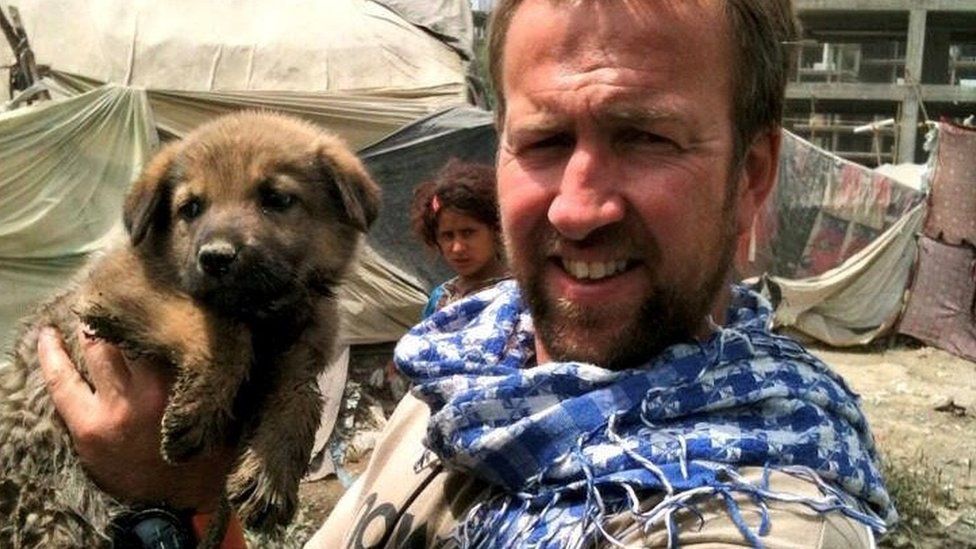
Mr Farthing set up the charity 15 years ago, helping to increase awareness of animal welfare in the country and to rescue stray dogs and abused donkeys.
“I don’t think there are words to describe what they are feeling right now,” he told the BBC News, from Kabul.
“What do you say to someone who is probably going to be told they will have to marry a Taliban fighter and end up living at home, never being allowed to leave and just raising children with someone they absolutely detest?”
Mr Farthing, who served with the Royal Marines as a commando in the Afghan province of Helmand in the mid-2000s, said the West “should hang our heads in shame for what we have just done to this country”.
“We gave people hope, aspirations, dreams for the future. In a matter of weeks, we have just ripped them from them.”
He said he was not hopeful the Taliban regime had changed for the better.
For now, the eyes of the world were watching the Taliban, he said.
But in two months’ time, the international community would be gone, the US would have left the airport and no-one would be watching – and if they did go back to their ways, no-one was coming to interfere in Afghanistan again, he added.
The British and US servicemen and women who died in Afghanistan – including two of his marines – had died “in vain”, he said.
“We have achieved nothing now – we have just thrown everything away.”
How one dog inspired a marine to found an animal sanctuary
image captionDogs are often made to fight one another in Afghanistan
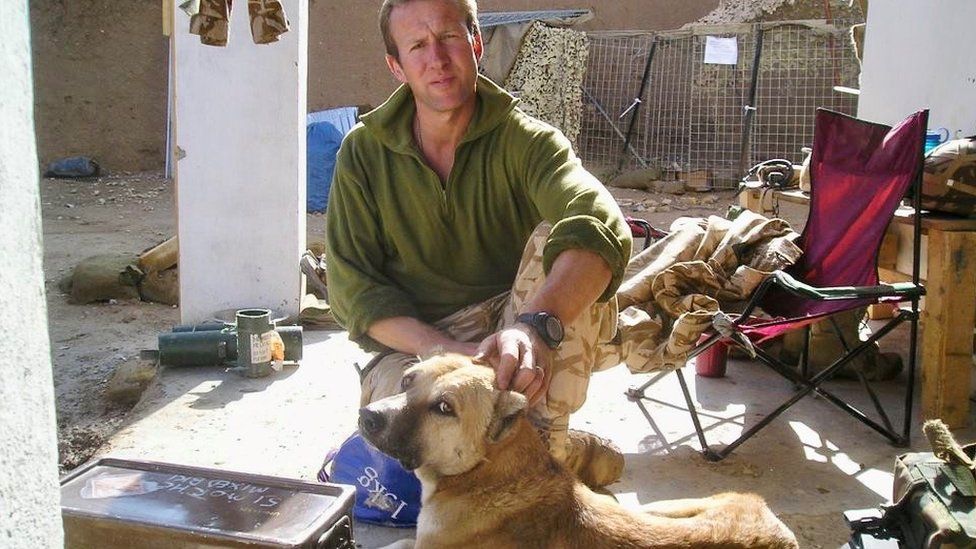
It was while on deployment in Afghanistan in 2006 that Pen Farthing and his troops broke up a fight between two dogs in the town of Nawzad – and one of them followed him back.
The pair spent the next six months together and he was given the name Nowzad after the town. At the end of his deployment he sought to bring him back to the UK.
It was a move that inspired him to reunite other servicemen and women with dogs and cats they had befriended while serving – and so the charity Nowzad was born.
The charity says it currently looks after more than 140 dogs and 40 cats, and has reunited 1,600 soldiers with the dogs and cats they rescued and bonded with while serving in Afghanistan.
Pen Farthing’s book, One Dog at a Time, helps promote and fund the sanctuary’s work.
In an emotional appeal, he pleaded for the government to make an exception for his Afghan staff, who will not fall under the two existing schemes for interpreters and British government workers.
A campaign is under way on social media but he said so far he has had no communication from the British government.
Vice Adm Sir Ben Key, who is running the UK’s evacuation programme in Afghanistan, said the UK hoped to help 6,000 to 7,000 British nationals and eligible Afghan staff to leave – but that figure was dependant on the security situation.
Afghans considered eligible to resettle in the UK include workers for the British government, interpreters, cultural advisers and embassy staff. Others eligible are those deemed to be at high and imminent risk.
Foreign Secretary Dominic Raab earlier said the UK was looking at a “bespoke arrangement” for Afghan refugees, with full details to be set out in due course.
A new resettlement scheme will be aimed at helping those most in need – including women and girls – to come to the UK, No 10 has said.
The city council’s unanimous vote made Ann Arbor not only the first city in the Midwest to prohibit the sale of fur, but the first in a fur-producing state to do so. Jillian Cooper/Stock Photography
With yesterday’s passage of an ordinance banning the sale of certain fur products, Ann Arbor, Michigan’s City Council scored a pair of firsts. The 10-member council’s unanimous vote made Ann Arbor not only the first city in the Midwest to prohibit the sale of fur, but the first in a fur-producing state to do so. The ordinance language included clear reasoning for the ban and provided limited exemptions and a year-long transition for liquidation of inventory and fulfillment of existing commitments. But, as lead sponsor Jeff Hayner declared, “This is yesterday’s business.”
The Ann Arbor ban passes less than a year after an outbreak of SARS-CoV-2 (the virus that causes COVID-19) in mink on a Michigan fur farm and the infection of a Michigan taxidermist with a COVID-19 variant found in mink. As it turns out, fur farming, so obviously unnecessary and so woefully cruel, plays a part in the global pandemic that threatens both humans and animals, with some 20 million mink killed in the aftermath of similar outbreaks on fur farms throughout the world.
We’re especially proud of the central role that HSUS Michigan state director Molly Tamulevich played in securing passage of the ordinance. Molly is one of our incredible team of HSUS state directors, living proof of our deep commitment to advancing animal protection issues in the states. Every state is different, with its own challenges and opportunities, and in Michigan, the fight for wildlife is an absolute priority. That’s why the result in Ann Arbor is significant, and not just because it adds momentum to the campaign to stop the killing of animals for fur. The vote is also important because it represents another milestone in our efforts to expose and confront the stranglehold that user-oriented interests, those who want to preserve animals only for the purpose of killing them or using them for fur or trophies, have on wildlife policy in Michigan. In the work of making this world a better one for animals, our movement to protect wildlife is one of the most important struggles of all.
In this regard, Michigan is one of our target states. Wildlife management in Michigan and other states has been corrupted and misshapen by the dominating influence of the hook-and-bullet lobby and the exclusion of citizens who want to see animals thrive in the wild as part of a broader, more ecologically balanced approach to managing their habitats and populations.
For some time now, we’ve been doing our best to demonstrate the strength of animal protection values in Michigan. In 2006, we led the successful campaign to stop the state from opening a hunting season on mourning doves, with voters rejecting the proposal in all 83 counties and casting more votes – some 2.5 million – against shooting doves than they did for any candidate in that election—including the governor.
And twice in the last decade, when the fate of wolves came to a public vote, we delivered two ballot initiative referendum victories in support of these persecuted carnivores, backed by a combined 3.5 million voters. Our campaign to protect wolves from trophy hunters in the state is not over, but we’ve shown that in a state where wildlife officials accept recognition awards from the likes of Safari Club International, we’re winning the battle for hearts and minds.
More recently, we’ve trained the spotlight on one of the worst of wildlife cruelties, the mass slaughter of animals for prizes and cash, and gained some traction. Just last month, we saw the first condemnation of wildlife killing contests in the state, and the second followed just two weeks later.
We’ve even seen two bills introduced in the Michigan House that seek to democratize and bring more representation of non-consumptive perspectives to the various committees and agencies managing the state’s wildlife.
No matter the state, we’ve got a long way to go when it comes to establishing democratic and science- and values-based governance in relation to wildlife policy. But the Ann Arbor vote, which involved 10 public officials charged with representing the views of their constituents, and the ballot referendums, which garnered millions of pro-animal votes to overturn special interest legislation favoring consumptive users, have much in common. Together, they demonstrate that whenever the public has a fair chance to express its views directly or make the case to a body that is not stacked with trapping, trophy hunting and other supporters of consumptive use, it’s almost always good for wildlife.
We’ll be working for the day when that is the norm, a day when the interests of animals are taken seriously in everybody that deliberates their fate, a day when the views of the vast wildlife-loving public are given the weight they deserve. As the results from Ann Arbor make clear, we’re on our way.
Wildlife killing contests are a low-profile form of animal exploitation rarely seen by the general public but quite pervasive across America. Countless events like the “Shoot for the Cash Predator Bash” and the “Grand Slam Coyote Series” take place in nearly all of the 42 states where they are legal. Competitors kill for the thrill, for bragging rights, and for cash and prizes, often invoking the interests of the ranching industry to defend their conduct.
Exposing killing contests
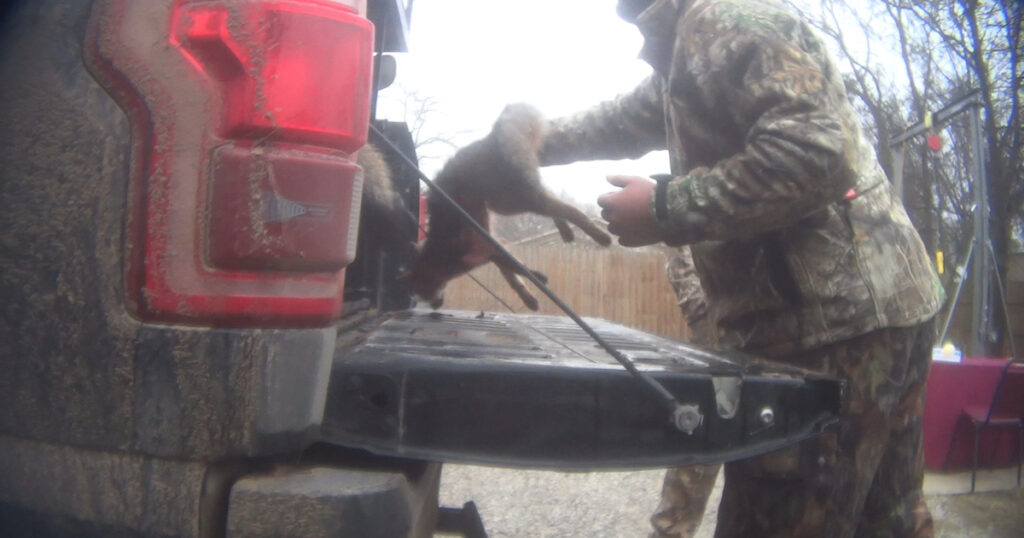
In January 2021, an undercover investigation by the Humane Society of the United States documented the aftermath of the Kanawha Valley Predator Calling Championship at a Virginia resort. Dead coyotes and foxes were piled into crates on trucks with bumper stickers reading “Yote H8R,” “Coyote Hearse,” and “Coyote Taxi.” Over the 45-hour span of the event, competitors gunned down approximately 315 animals for the chance at cash and prizes.
Participants dragged the bodies, torn apart by bullets, to a scale, where they were hung upside down for weighing as a crowd watched the distribution of prizes to the teams that had killed the most and the biggest animals. The winning two-man team killed 52 animals. A team wearing matching “Nightlife Assassins” sweatshirts congratulated each other.
A few weeks later in Texas, a contestant in the “De Leon Pharmacy and Sporting Goods’ Varmint Hunt” described the gun he used to kill the row of bloody bobcats, coyotes, foxes, and raccoons now laying at his feet. “They’re like a .22-250 on steroids,” he told an HSUS investigator, referring to his custom-built rifle. “I wouldn’t use something like that if you want to save the fur,” he said. “These [guns] are not very fur-friendly.” Nudging a dead coyote with his foot, he added, “I shot this one up here in the throat from high up and it blew out the whole bottom of his chest.” More than $3,000 in cash prizes were doled out.Play00:25-02:56MuteSettingsEnter fullscreenhttps://www.youtube-nocookie.com/embed/jumXRyrDayE?autoplay=0&controls=0&disablekb=1&playsinline=0&cc_load_policy=0&cc_lang_pref=auto&widget_referrer=https%3A%2F%2Fsentientmedia.org%2Fthe-pervasive-pastime-putting-americas-coyotes-at-risk%2F&noCookie=true&rel=0&showinfo=0&iv_load_policy=3&modestbranding=1&enablejsapi=1&origin=https%3A%2F%2Fsentientmedia.org&widgetid=1Play
There was similar carnage on display at a contest at the Williamsport Fire Department in Indiana in December 2020. The HSUS undercover footage shows firefighters helping to haul roughly 60 coyotes to the weigh station, where holes were punched in the animals’ legs to hang them from the scale. A participant told investigators that he uses AR-15 rifles with night vision to kill animals, adding, “I enjoy it.”
Such butchery can only be achieved with the use of high-tech equipment that runs into the thousands of dollars. Teams use electronic calling devices—which imitate the sounds of dependent young in distress—to lure animals into shooting range and then gun them down with AR-15 style weapons fitted with night vision and thermal imaging scopes. The animals don’t stand a chance.
Ranching interests as a ploy
Directly contradicting gold standard science in wildlife management, contestants at these events grasp at straws with their claim that killing contests provide a service to ranchers by eliminating carnivores who would otherwise prey on cattle. It’s their most common falsehood.
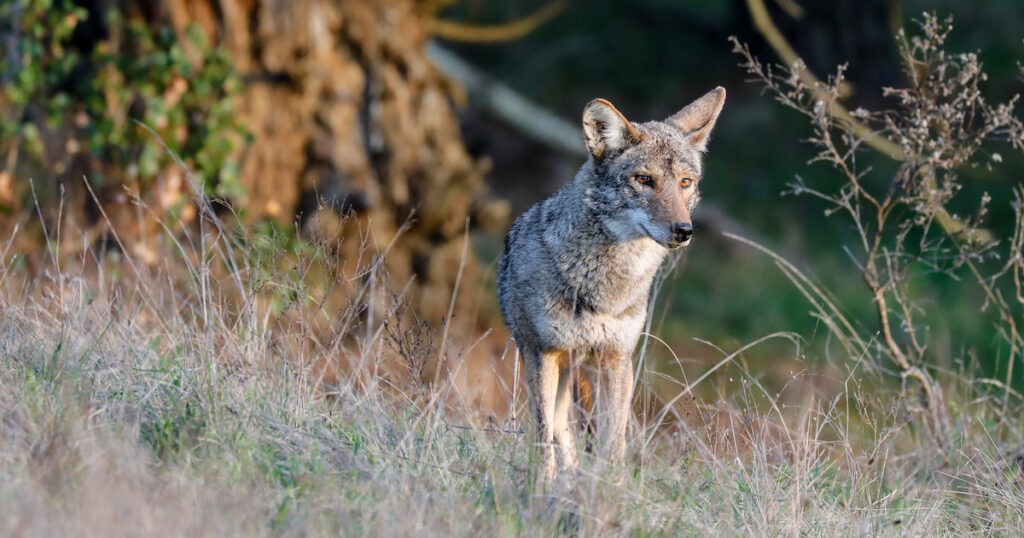
Randomly killing coyotes actually causes their numbers to rise. Coyotes are compensatory breeders—they reproduce more quickly due to a sudden drop in competition for resources. Indiscriminate killing disrupts their social structure, encouraging more breeding and migration, which ultimately results in more coyotes. In the face of relentless mass extermination attempts for over 150 years, coyotes have tripled their range in the United States.
Credit: The HSUS
Killing contests may even increase livestock losses. A recent review of studies using U.S. Department of Agriculture data found a “paradoxical relationship” between lethal control of carnivores and the number of livestock killed. To feed larger litters of pups who are born as a result of indiscriminate coyote killing, adults who normally prefer to prey on rodents are forced to switch to larger targets like sheep to survive. Killing off a non-offending coyote also allows more problematic coyotes—formerly excluded from a specific territory—to move in. Scientists have coined the term “guard coyote” to explain the phenomenon of using one coyote to stave off others.
No good reason to mass kill carnivores
According to USDA data, all carnivores combined—including coyotes, wolves, and cougars—are responsible for less than 0.5 percent of cattle and sheep losses in the U.S.
The predominant sources of mortality to livestock include disease, illness, birthing problems, and weather. Even free-roaming domestic dogs pose an equal or greater risk than wild carnivores. Wildlife agencies encourage the use of traditional animal husbandry practices and strategic nonlethal control methods to provide protection, with lethal control of specific, problem-causing coyotes as a last resort.
There is no good reason to mass kill carnivores. Why would you want to? Countless Americans delight in spotting the resilient, resourceful coyote in the wild—appreciating the species not only for its intrinsic value but for its ecological services. Coyotes and other top carnivores help control rodent and rabbit populations, scavenge on animal carcasses, and indirectly boost biodiversity.
When the Washington Fish and Wildlife Commission banned killing contests in the state in 2020, one commissioner called coyotes the “only free employees” on her cattle ranch and scorned contest participants who had trespassed on her property to kill them.
In recent years, a growing number of wildlife agency professionals, carnivore scientists, and hunters have condemned killing contests as unethical, counterproductive, and damaging to the reputation of hunters. The Virginia Department of Wildlife Resources stated that there is “no scientific evidence” to support claims that killing contests reduce coyote numbers or limit livestock damage. The chair of the Arizona Game and Fish Commission, also a hunter, said, “There has been a lot of social outcry against this, and you can kind of understand why. It’s difficult to stand up and defend a practice like this.”
Credit: Shelly Prevost / Flickr
Help shut down the slaughter
Since 2014, eight states have outlawed wildlife killing contests and similar efforts are underway in many others. We shouldn’t let a stubborn and indifferent faction treat animals as chips in a game for cash and prizes.






 Rudy Wilms / Flickr