For years, conservationists have successfully fought torestore the Midwest’s wolf population. A new state policy could imperil that progress: Wisconsin’s Natural Resources Board voted last week to allow hunters to kill up to 300 wolves during a fall killing period this year, ignoring recommendations from anadvisory panelof biologists.
The scientists from the state’s Department of Natural Resources said the board should impose a limit of hunting 130 wolves based on concerns about a state-sanctioned hunt in February. During that four-day hunting and trapping season, Wisconsin hunters killed 218 gray wolves despite officials capping the kill at119. The hunt, which came just a month after gray wolveslost protectionsunder the federal Endangered Species Act, decimated an estimated 20%…
Body-gripping traps arecruel and inhumane. While also being a danger to wildlife, humans, and pets. The only exception to this bill would apply to wildlife management, where nonlethal options are not effective.Advertisementhttps://player.hb.selectmedia.asia/prebid/iframe.html?adid=1215f7789169ba735&ref=https%3A%2F%2Fwww.onegreenplanet.org
Cathy Liss, AWI President,said, “We thank Chairman Nadler and Representative Blumenauer for their commitment to ending the use of cruel traps in our country’s refuges. Body-gripping traps, such as strangling snares, Conibear traps, and steel-jaw leghold traps. Are inhumane and indiscriminate. Public lands belong to all of us, not just the select few who wish to…
Remains of a male banteng were found after it had been trapped. It is the sixth banteng to have died since Mum Pram Bei was declared a community forest in Kampong Speu province.
Officials from the conservation team found the carcass several days after the banteng died.
Luy Sarom, a conservation officer for the Mum Pram Bei Try forestry community, said the male banteng died as a result of being trapped by a hunter. The animal tried to walk away but couldn’t escape from the snare.
Sarom said the same thing happened in May, when a banteng walked in view of…
Several years of ongoing drought conditions and the extreme drought this summer have decreased mule deer populations across the state. Here are a few things people hunting deer and elk this fall should know.
The animal kingdom boasts some incredibly long lifespans that far exceed the average human’s. While humans may have an “absolute limit” of 150 years, this is just a blink of an eye compared with the centuries and millennia that some animals live through; and some animals can even stop or reverse the aging process altogether.
Although there are very long-living land animals (the oldest tortoise, for example, is nearly 190 years old), none of them make this list — the true age champions all live in water. From old to oldest, here are 10 of the longest living animals in the world today.
Bowhead whales (Balaena mysticetus) are the longest living mammals. The Arctic and subarctic whales’ exact lifespan is unknown but stone harpoon tips found in some harvested individuals prove that they comfortably live over 100 years, and may live more than 200 years, according to the National Oceanic and Atmospheric Administration (NOAA).
The whales have mutations in a gene called ERCC1, which is involved with repairing damaged DNA, that may help protect the whales from cancer, a potential cause of death. Furthermore, another gene, called PCNA, has a section that has been duplicated. This gene is involved in cell growth and repair, and the duplication could slow aging, Live Science previously reported.
Rougheye rockfish (Sebastes aleutianus) are one of the longest living fish and have a maximum lifespan of at least 205 years, according to the Washington Department of Fish and Wildlife. These pink or brownish fish live in the Pacific Ocean from California to Japan. They grow up to 38 inches (97 centimeters) long and eat other animals such as shrimp and smaller fish, according to the Committee on the Status of Endangered Wildlife in Canada (COSEWIC), an independent advisory panel that assesses the status of species threatened with extinction in Canada.
Freshwater pearl mussels (Margaritifera margaritifera) are bivalves that filter particles of food from the water. They mainly live in rivers and streams and can be found in Europe and North America, including the U.S. and Canada. The oldest known freshwater pearl mussel was 280 years old, according to the World Wildlife Fund (WWF). These invertebrates have long lifespans thanks to their low metabolism.
New Important Warning from Former U.S. Presidential CandidateSEE MORE
Freshwater pearl mussels are an endangered species. Their population is declining due to a variety of human-related factors, including damage and changes to the river habitats they depend on, according to the International Union for Conservation of Nature (IUCN).
Greenland sharks (Somniosus microcephalus) live deep in the Arctic and North Atlantic oceans. They can grow to be 24 feet (7.3 meters) long and have a diet that includes a variety of other animals, including fish and marine mammals such as seals, according to the St. Lawrence Shark Observatory in Canada.Advertisement
A 2016 study of Greenland shark eye tissue, published in the journal Science, estimated that these sharks can have a maximum lifespan of at least 272 years. The biggest shark in that study was estimated to be about 392 years old, and the researchers suggested that the sharks could possibly have been as much as 512 years old, Live Science previously reported. The age estimates came with a degree of uncertainty, but even the lowest estimate of 272 years still makes these sharks the longest living vertebrates on Earth.
Tubeworms are invertebrates that have long lifespans in the cold, stable environment of the deep sea. A 2017 study published in the journal The Science of Nature found that Escarpia laminata, a species of tubeworm living on the ocean floor in the Gulf of Mexico, regularly lives up to 200 years, and some specimens survive for more than 300 years. Tubeworms have a low death rate with few natural threats, such as a lack of predators, which has helped them evolve to have such long lifespans.
Ocean quahog clams (Arctica islandica) inhabit the North Atlantic Ocean. This saltwater species can live even longer than the other bivalve in this list, the freshwater pearl mussels. One ocean quahog clam found off the coast of Iceland in 2006 was 507 years old, according to National Museum Wales in the U.K. The ancient clam was nicknamed Ming as it was born in 1499 when the Ming Dynasty ruled China (from 1368 to 1644).
Corals look like colorful, underwater rocks and plants, but they are actually made up of the exoskeletons of invertebrates called polyps. These polyps continually multiply and replace themselves by creating a genetically identical copy, which over time causes the coral exoskeleton structure to grow bigger and bigger. Corals are therefore made up of multiple identical organisms rather than being a single organism, like Greenland sharks or ocean quahog clams, so a coral’s lifespan is more of a team effort.
Corals can live for hundreds of years or more, but deep-water black corals (Leiopathes sp.) are among the longest-living corals. Black coral specimens found off the coast of Hawaii have been measured to be 4,265 years old, Live Science previously reported.
Sponges are made up of colonies of animals, similar to corals, and can also live for thousands of years. Glass sponges are among the longest living sponges on Earth. Members of this group are often found in the deep ocean and have skeletons that resemble glass, hence their name, according to NOAA. A 2012 study published in the journal Chemical Geology estimated that a glass sponge belonging to the species Monorhaphis chuni was about 11,000 years old. Other sponge species may be able to live even longer.
Turritopsis dohrnii are called immortal jellyfish because they can potentially live forever. Jellyfish start life as larvae, before establishing themselves on the seafloor and transforming into polyps. These polyps then produce free-swimming medusas, or jellyfish. Mature Turritopsis dohrnii are special in that they can turn back into polyps if they are physically damaged or starving, according to the American Museum of Natural History, and then later return to their jellyfish state.
The jellyfish, which are native to the Mediterranean Sea, can repeat this feat of reversing their life cycle multiple times and therefore may never die of old age under the right conditions, according to the Natural History Museum in London. Turritopsis dohrnii are tiny — less than 0.2 inches (4.5 millimeters) across — and are eaten by other animals such as fish or may die by other means, thus preventing them from actually achieving immortality.
Hydra is a group of small invertebrates with soft bodies that look a bit like jellyfish. Like Turritopsis dohrnii, Hydras also have the potential to live forever. Hydras don’t show signs of deteriorating with age, Live Science previously reported. These invertebrates are largely made up of stem cells, which continually regenerate through duplication or cloning. Hydras don’t live forever under natural conditions because of threats like predators and disease, but without these external threats, they could be immortal.
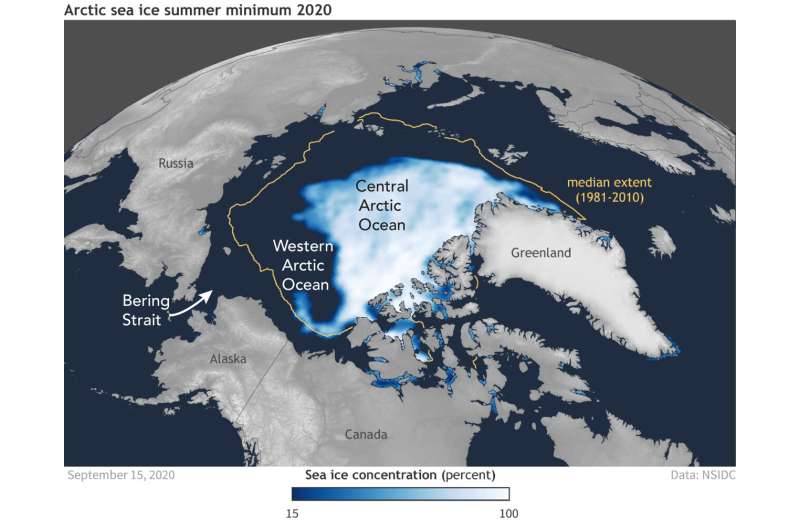
Global climate change is warming the Arctic Ocean and shrinking sea ice. Here, the blue-white ice cap shows the coverage of sea ice at its smallest extent in summer 2020, and the yellow line shows the typical Arctic sea ice minimum extent between 1981 and 2010. Some have proposed that the newly exposed sea surface will lead to a plankton population boom and a burgeoning ecosystem in the open Arctic Ocean, but a team of Princeton and Max Planck Institute for Chemistry scientists say that’s not likely. They have examined the history and supply rate of nitrogen, a key nutrient. Their recent work finds that stratification of the open Arctic waters, especially in the areas fed by the Pacific Ocean via the Bering Strait, will prevent surface plankton from receiving enough nitrogen to grow abundantly. Credit: Jesse Farmer, Princeton University; modified from Rebecca…
Aug. 12 (UPI) — The ongoing transformation of Earth’s atmosphere, fueled by runaway greenhouse gas emissions, will shrink the cooling effects of small- and medium-sized eruptions by as much as 75 percent, according to new research.
Conversely, the study — published Thursday in the journal Nature Communications — suggests the cooling effects of larger eruptions will be amplified by global warming.
In 1991, the massive plume from the eruption of the Philippines’ Mount Pinatubo, the second largest of the 20th century, reached 18 miles into the atmosphere and spread out in all directions, forming a thick layer of haze that caused global temperatures to drop by as much as 0.5 degrees Celsius.
By comparison, human-caused global warming has raised global temperatures by more than 1 degree Celsius since 1850.
But whereas the cooling effects of volcanic eruptions dissipate after a couple of years, greenhouse gases persist in the atmosphere for hundreds of years.
Climate change is likely to shrink the cooling effects of moderate volcanic eruptions, while amplifying the cooling effects of large eruptions. Photo by EPA-EFE/STRINGER
“Beyond the data we have from recent eruptions like Pinatubo, we can also see the cooling effect of volcanoes going back two thousand years from the information contained in tree rings,” first author Thomas Aubry said in a press release.
“However, we wanted to look at the question from the opposite angle: how could a warming climate affect the cooling from volcanic eruptions?,” said Aubrey, a geophysicist and research fellow at Cambridge University in Britain.
For the new study, scientists looked at how the atmosphere’s shifting composition and characteristics will influence the buoyancy of rising volcanic plumes.
For large eruptions, the models showed plumes are likely to rise faster and spread out more quickly, amplifying the haze’s cooling effects by 15 percent.
However, simulations suggest the cooling effects of more moderately sized eruptions — which happen more frequently than large eruptions — are likely to decline by as much as 75 percent under a high-end warming scenario.
That’s because the troposphere is expected to expand as the planet warms, pushing the troposphere-stratosphere boundary higher and higher.
When volcanic ash is unable to reach the stratosphere, plumes are more easily washed out by precipitation patter in just a few weeks, limiting an eruption’s ability to block out sunlight for long periods of time.
“Climate change isn’t something that’s coming – it’s already here, as clearly demonstrated by this week’s IPCC report,” co-author Anja Schmidt said in the release.
“The effects of climate change and some of the feedback loops it can cause are becoming more obvious now. But the climate system is complex: getting a grasp of all these feedback loops is critical to understanding our planet and making accurate climate projections,” said Schmidt, a geochemist and interdisciplinary lecturer in climate modeling at Cambridge.
Researchers suggest the feedback loops identified in their latest paper remain unaccounted for in the climate models used by the IPCC.
Scientists predict the structure and composition of the atmosphere will continue to change as wildfires burn with greater frequency and greenhouse gas emissions continue unabated.
As a result, scientists must continue to reassess and model the ways volcanic eruptions interact with the atmosphere.
Today I was motivated to write a short blog on passing a roadside advert that has stood for many years, directing shoppers to a butcher in a nearby village. Bragging about ‘100% Scottish beef’ and ‘award winning pies and sausages, it’s a true life counterpoint to the many ridiculous accusations levelled at vegans for ‘shoving your ideas down other people throats’, accusations by those who shove other individuals down their throats and don’t like it being pointed out that their brutalised victims were not in any way willing.
I’m sure it comes as no surprise to hear that blogging and writing about animal rights is not a cheerful occupation. For me, it requires objectivity, honesty, and continuous self-evaluation, seeking the most effective way to get the message across that there is nothing special about our species that entitles us to lay waste to our fellow creatures and the living world…