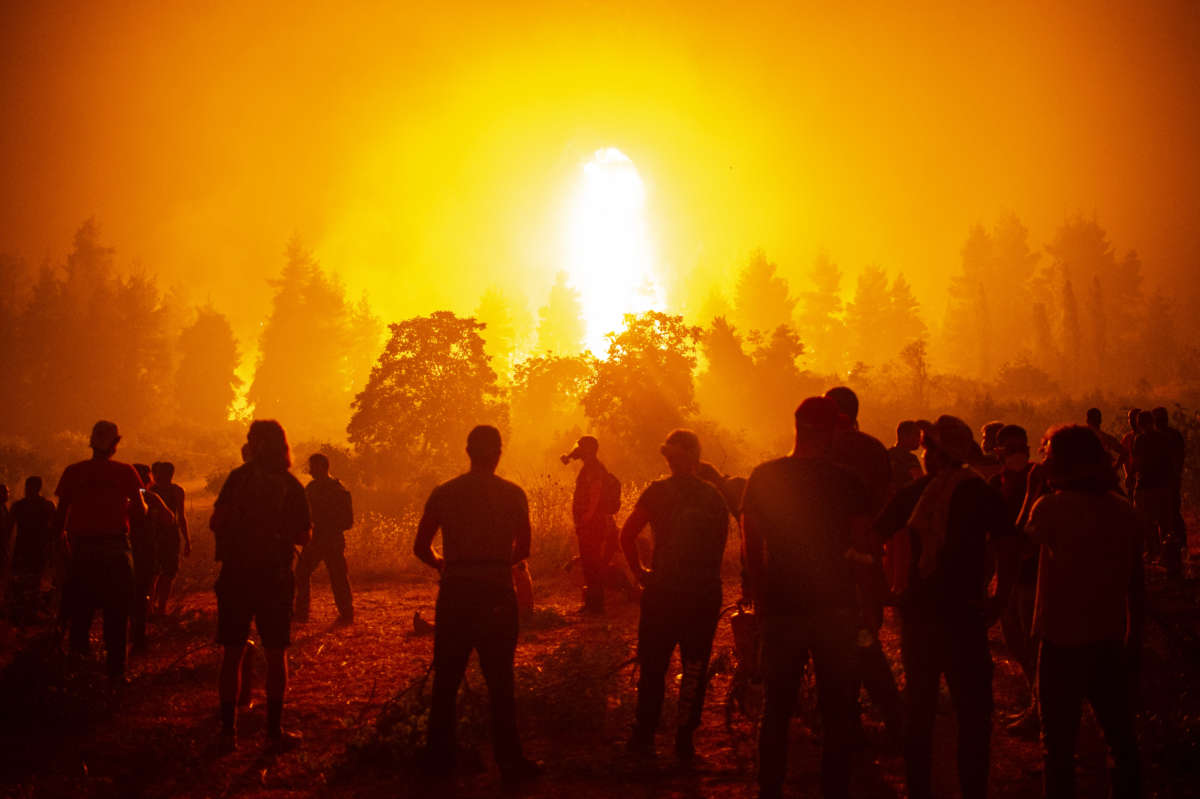
Local youth and volunteers gather in an open field and wait to support firefighters during a wildfire next to the Greek village of Kamatriades, near Istiaia, northern Evia (Euboea) island on August 9, 2021.
New logging cutblocks are imminent in a particularly inappropriate corner of West Fraser Hinton’s forestry tenure area in west central Alberta. Logging operations in fifty-four cutblocks, slated to start next month, will remove mature forests that are critical habitat for the threatened A La Peche southern mountain caribou population. This will eliminate the forests sheltering both sides of a key endangered Athabasca Rainbow trout stream, forests that stretch from Highway 40 right to the edge of the iconic Willmore Wilderness Area. The logging will undermine important caribou and native trout recovery options and will prolong Alberta’s current reliance on controversial annual wolf culls. All of the logging is scheduled to start just ahead of a crucial caribou sub-regional planning process for this area.
Alberta Wilderness Association (AWA) and Canadian Parks and Wilderness Society (CPAWS) learned of these plans from concerned trappers. The trappers have only seen logging plans for two forestry ‘compartments’ overlapping their Fur Management Area. The cutblocks will remove almost all the remaining mature forest in the Moon Creek area (Map 1). The imminent cutblocks appear to cover a greater portion of the Moon Creek area compared to what Alberta approved for that area for the entire decade of 2016-2026, as per the publicly available approved spatial harvest sequence in West Fraser Hinton’s approved 2017 forest management plan.
Only six percent of West Fraser Hinton’s total tenure area overlaps with ranges of A La Peche and adjacent Little Smoky caribou populations (Map 2). AWA and CPAWS request the Government of Alberta defer new cutblocks in the six percent of West Fraser Hinton’s tenure that overlaps caribou range. This will protect caribou survival options while Alberta continues to develop its promised upcoming caribou habitat plan for this area that complies with the federal Species at Risk Act.
“You’d be hard pressed to think of a worse place to clearcut in Alberta right now,” says Carolyn Campbell, AWA conservation director. “If Alberta can’t pause logging in the six percent of West Fraser Hinton’s tenure area that overlaps with caribou range until its promised sub-regional plan is finished, there is something deeply and drastically wrong with forestry management here.”
“Wolf culls are not an excuse to continue destroying caribou habitat—they are an emergency measure meant to stymie caribou declines while habitat is conserved and restored,” says Gillian Chow-Fraser with CPAWS Northern Alberta, referencing the predator management in A La Peche range ongoing since 2005. “With sub-regional planning just starting now, everything depends on having intact habitat left to manage.”
“The millions of dollars Alberta spent to reclaim the seismic lines, the millions spent to aerial gun the wolves and set poison bait sites…. then to have 54 cutblocks in the same caribou zone? It really seems to fly in the face of any logic…” says trapper Darcy Handy. “Is the government really concerned about saving the caribou?”
The upcoming logging overlaps with the winter range of A La Peche caribou, a range already heavily disturbed and fragmented from forestry and energy activities. By 2017, only 12% of the A La Peche winter range was undisturbed, far below the minimum 65% undisturbed threshold that is required for self-sustaining caribou. As well, Alberta is obliged to maintain enough biophysical habitat (habitat in current good condition) for the near-term survival of the caribou. The dire measure of wolf culls can only be justified as a temporary, last resort measure if it is combined with strong habitat protection and restoration.
Alberta committed in its October 2020 agreement with the federal government to start a planning task force for A La Peche and adjacent Little Smoky caribou in 2021 and to finish a plan that complies with caribou habitat requirements by 2023. These imminent clearcuts will further reduce available older forest critical habitat these caribou need to survive the next few decades. They also further reduce the available options for the upcoming range plans to achieve habitat for self-sustaining caribou.
If you can, AWA asks that you write Alberta Agriculture and Forestry Minister Devin Dreeshen (af.minister@gov.ab.ca) and Alberta Environment and Parks Minister Jason Nixon (aep.minister@gov.ab.ca) to request that:
Alberta halt imminent clearcuts by West Fraser Hinton that will remove almost all remaining mature forest for threatened caribou and endangered Athabasca rainbow trout in the Moon Creek area from Hwy 40 to the Willmore Wilderness Area;
Alberta defer other clearcuts in the six percent of West Fraser Hinton’s tenure that overlaps caribou range, to protect caribou survival options; and
Alberta finalizes an enforceable land use plan for A La Peche and adjacent Little Smoky caribou ranges that complies with the Species at Risk Act before resuming clearcuts in this part of West Fraser Hinton’s tenure.
For more information: Carolyn Campbell, Alberta Wilderness Association, 403-921-9519 Gillian Chow-Fraser, Canadian Parks and Wilderness Society, 289-775-3250 Darcy Handy, trapper, 780-933-1150 John E. Marriott, EXPOSED Wildlife Conservancy, 403-688-3851
MAP 1: IMMINENT PROPOSED CUTBLOCKS IN MOON CREEK AREA OF WEST FRASER HINTON FORESTRY TENURE. SOURCE: ALBERTA WILDERNESS ASSOCIATION.
MAP 2: A LA PECHE AND LITTLE SMOKY CARIBOU RANGES AND FORESTRY TENURES. ONLY 6% OF WEST FRASER HINTON’S FOREST MANAGEMENT AGREEMENT (FMA) AREA OVERLAPS WITH CARIBOU RANGE. THE YELLOW SHADED AREA OF A LA PECHE CARIBOU RANGE NEAR WILLMORE WILDERNESS PARK (SHADED IN GREEN) IS WHERE THE LOGGING IS IMMINENT. MAP SOURCE: HINTON WOOD PRODUCTS (DIVISION OF WEST FRASER MILLS LTD.), 2015 CARIBOU HABITAT CONSERVATION STRATEGY REPORT, ADAPTED FROM AN ALBERTA GOVERNMENT 2013 MAP.
UPIhttps://imasdk.googleapis.com/js/core/bridge3.474.0_en.html#goog_275967784Volume 0%Environmental impact to the emperor penguin
AccuWeather’s Melissa Constanzer spoke with research biologist Stephanie Jenouvrier about how impacts to the environment have affected emperor penguins and what the future has in store for them.
Aug. 3 (UPI) — Climate change is accelerating the extinction risk for emperor penguins, scientists said Tuesday.
The penguin species endemic to Antarctica forms colonies on sea ice, which are projected to significantly decline due to ongoing greenhouse gas emissions.
Researchers found that if sea ice declines at the rate currently projected by climate models, the species resiliency, redundancy and representation will be dramatically reduced and almost all colonies quasi-extinct by 2100, according to a new studypublished Tuesdayin Wiley Online Library.
The key findings support federal production of the species under the Endangered Species Act, and the U.S. Fish…
Daily coronavirus briefing: How wildfire smoke may be spreading cases
Experts say wildfire smoke could be “an additional vehicle for spreading the virus even faster.” Plus, a top doctor blasts his own country’s handling of the pandemic, as less than 3% of the population is vaccinated.
Updated Aug. 14, 2021 2:09 PM PDTCopied
53 Entrieshttps://imasdk.googleapis.com/js/core/bridge3.474.0_en.html#goog_1576036575Volume 0%Children hit hard by COVID-19 surge in U.S.
The latest surge of COVID-19 cases in the U.S. is mostly in the unvaccinated, especially children who aren’t eligible. With school about to begin, there is debate about how to protect them.1 HOUR AGO
Former FDA chief expects coronavirus to become an ‘endemic’ virus
Updated Aug. 11, 2021 4:22 PM PDTCopiedhttps://imasdk.googleapis.com/js/core/bridge3.474.0_en.html#goog_1147393691Volume 0%This video file cannot be played.(ErrorCode:232001)
The frozen ground in Siberia continues to burn, tearing through more than 3.7 million acres of forest.
Santa Claus isn’t supposed to see smoke. For the first time in recorded history, hazy smoke from raging wildfires in the Arctic has reached the North Pole, and NASA satellites have the images to prove it.
On Aug. 6, the space agency’s MODIS, an imaging sensor on the Aqua satellite, captured true-color images of what NASA called a “vast, thick, and acrid blanket of smoke” that clouded the North Pole. The smoke originated from enormous blazes in the Siberian region of northern Russia.
According to China’s Xinhua news agency, the Mongolian capital city of Ulaanbaatar was blanketed in “white smoke,” NPR reported. The republic of Yakutia – home to Oymyakon,the coldest inhabited…
With the population declining, First Nations, environmentalists, and others are working together to safeguard boreal caribou — and their habitat — before it’s too lateBy Amy van den Berg – Published on Aug 05, 2021
The boreal caribou is considered a threatened species in Ontario. (iStock/mirceax)
The forestry sector calls it the Abitibi River Forest: more than 3 million hectares of land near Cochrane that extend to just south of James Bay and hug the Ontario-Quebec border. It is dominated by towering stands of black and white spruce, scraggy jack pine, and tamarack that turn golden yellow in the fall. It is also home to the North French watershed, one of the last sources of clean drinking water left in this part of the province.
Nearly a decade ago, 492 boreal caribou roamed the area, which forms part of the Kesagami range. Even then, though, the population was classified as “not self-sustaining,” as its habitat — caribou need large and undisturbed swathes of old coniferous forest or peatland to survive — had been disturbed by both natural and human forces. While it’s unclear how many remain, experts believe their numbers continue to shrink, and the species is considered threatened in the province.
Enter the Made in the North Caribou Plan, also known as the Cochrane Plan. It was devised eight years ago by a group made up of environmentalists, forestry representatives, and First Nations. It brings together local communities and, more recently, the province’s forest-management planning team to protect the health of woodland caribou — and prevent further degradation of their habitat. If the collaboration succeeds, experts say, its cross-sector approach could act as a blueprint for similar efforts across the country. But, they warn, it won’t be easy: the project is unfolding against a backdrop of environmental deregulation that could hinder conservation efforts.
Our journalism depends on you.
You can count on TVO to cover the stories others don’t—to fill the gaps in the ever-changing media landscape. But we can’t do this without you.Donate
Caribou in North America have lost more than half of their historic range. (Ted Simonett, Wildlands League)
Caribou herds, which live in areas of the boreal forest stretching from Labrador to Yukon, are in peril across the country. “Basically, almost every boreal caribou population that lives in managed forests in Canada is in decline,” says Julee Boan, a Thunder Bay-based boreal-program manager at Ontario Nature, a registered charity dedicated to conservation. While human activity is the most significant cause of habitat loss, forest fires have also damaged caribou ranges across the province’s north. To date, caribou in North America have lost more than half of their historic range.
Joe Bennett, an associate professor at Carleton University who specializes in conservation and threatened species, says that “Canadians have often taken for granted that we have this supposed wilderness and that we’re a nation of forests. The reality is that we have disturbed our boreal forests quite a lot, especially in certain areas, and this has led to threats to species such as boreal caribou.”
Threats include industrial-resource-extraction activities — such as logging, mining, and those related to oil and gas — and hydroelectricity. These industries cut roads through the forest, opening the landscape to larger numbers of moose and deer and therefore also to more predators, such as wolves and bears. Climate change, too, plays a part. It’s causing white-tailed deer to move northward: they help boost the wolf population and can carry the brainworm parasite, which is lethal to caribou.
In 2008, Ontario developed a recovery strategy and habitat-guidance documents for caribou that include a range-management approach to evaluating disturbances: this involves working to support caribou habitat health — for example, by not harvesting in areas where a certain percentage of a range has already been affected. Provincial forestry guidelines are aimed at minimizing the harm to caribou and their habitat and include renaturalizing logging roads and avoiding calving areas.
The federal government in 2012 produced a recovery strategy that labelled 37 of 51 caribou populations in Canada not self-sustaining. There has not, though, been continuous monitoring since — which makes understanding Ontario’s situation difficult. “Caribou are very difficult and expensive to survey,” Ray says. “And in order to know how caribou are doing, you have to take good looks at their population on a regular basis.”
The Cochrane Plan was formed in 2013 to fill the void. It is co-led by Wildlands League, a non-profit environmental organization; Rayonier Advanced Materials Lumber, which operates a local sawmill; Taykwa Tagamou and Moose Cree First Nations; and Cochrane itself. Moose Cree is working with the federal government to establish an Indigenous protected area in the North French watershed, in part to conserve caribou habitat.
“When you come to the table and you’re collaborative, you can solve these things,” says Anna Baggio, director of conservation planning for Wildlands League. “It’s a good mindset.”
The partnership was the first of its kind in Ontario and one of only a handful of similar joint efforts across Canada.
Because caribou are found in the northern section of the Abitibi River Forest planning area, the members proposed a system of zoned logging that sets aside 800,000 hectares of caribou habitat and leaves 2.2 million hectares for varying levels of forestry. Put simply: harvest more trees along the area’s southern region, harvest moderately in the middle, and leave the northern edge of the forest alone.
“Part of our thinking is that we can’t restore the southern part of that range, because it’s so heavily developed, so let’s not make the range worse by moving development to the far northern part,” says Baggio.
Members of the Cochrane Plan work to raise awareness of the need to protect the region’s critical caribou habitat. (Courtesy of Wildlands League)
Last December, the province’s forest-management-planning team agreed, after consultation with the Cochrane Plan, not to place cut blocks — areas authorized for harvesting — in the northern section of the caribou range for at least the next 20 years. “It’s not perfect,” says Baggio. “But it buys us critical time to put in place a long-term plan.”
Ontario’s Endangered Species Act, passed in 2007, was once considered the strongest such legislation in Canada. Under the ESA, the habitat of any species classified as endangered or threatened would receive automatic legal protection. “It was a very strong act, but it’s been weakened over the years in various ways,” says Ray.
In an email to TVO.org, the Ministry of Natural Resources and Forestry says, “Forest management plans are developed using a planning manual regulated under the Crown Forest Sustainability Act (CFSA). The FMPM requires the application of MNRF’s approved forest management guides to provide for protection to values, including species at risk.”
But advocates say the guidelines under the Crown Forest Sustainability Act are not comparable to those in the Endangered Species Act. “The purpose of the two acts is distinctly different,” says Boan. While the CFSA’s rules for forestry attempt to minimize logging’s impact on the habitat of species at risk, the ESA aims to help populations recover. “Recovery is the key aspect.”
Advocates have also criticized the government’s changes to environmental-assessment and public-consultation processes. And, while the province indicated in its “Forest Sector Strategy,” launched in August 2020, that the current volume of timber harvested is less than 60 per cent of what it was in 2000, that same strategy suggests doubling the amount of logging on Crown land by 2030. “Combined, they’ve created an environment of deregulation,” says Boan. “And it’s going to put caribou at more risk.”
“We’re not going to be able to get a lot of this habitat back for caribou — this is just not possible,” says Baggio, from Wildlands League. The organization is calling for a halt on the expansion of the industrial footprint in caribou habitat that have already experienced 35 per cent disturbance.
The Cochrane Plan also wants the province to step in and permanently protect the caribou habitat within the Abitibi River Forest. “What’s been happening locally so far, I think that’s a good sign,” Baggio says. “What we’d like [Ontario] to do is go one step further and really try and figure out a way to come up with a long-term strategy so that the forest companies will know where to go to operate.”
In the meantime, the group is urging other companies to avoid the area: it’s still open to other activities, such as mineral and gas exploration. And many caribou populations move between ranges; although the federal Species at Risk Act encourages provinces and territories to implement range plans to ensure critical habitat remains 65 per cent undisturbed, Ontario has not yet done so.
Experts say, though, that such voluntary initiatives will not be enough for Ontario’s caribou. “It’s important to have [them], like what’s happening in the northeast,” says Boan. “But that’s not happening everywhere. And more deregulation isn’t going to help.”
Despite the roadblocks, Baggio is heartened by how many people are taking up the cause: “It just takes more political will, more ambition, and more leadership.”
Ontario Hubs are made possible by the Barry and Laurie Green Family Charitable Trust & Goldie Feldman.
Most experts agree it depends on the species, but much evidence shows large mammals suffer under even the best human care.
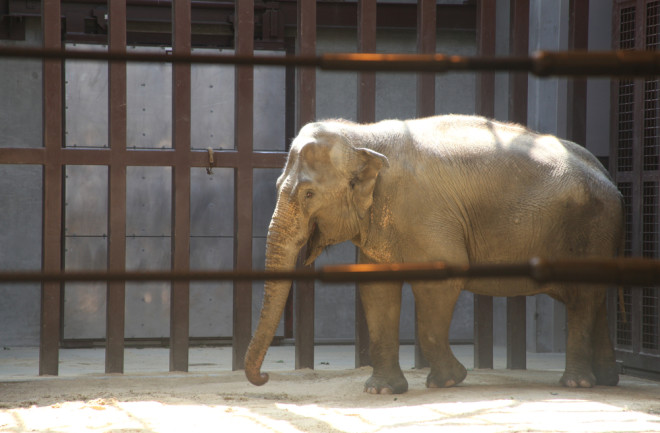
By Cody CottierAug 7, 2021 12:00 PM(Credit: DN Cherry/Shutterstock)
Newsletter
Sign up for our email newsletter for the latest science newsSIGN UP
For much of the past year and a half, many of us felt like captives. Confined mostly within monotonous walls, unable to act out our full range of natural behavior, we suffered from stress and anxiety on a massive scale. In other words, says Bob Jacobs, a neuroscientist at Colorado College, the pandemic gave us a brief taste of life as lived by many animals.
Though anthropomorphism is always suspect, Jacobs observes that “some humans were quite frustrated by all that.” This is no surprise — we understand the strain of captivity as we experience it. But how do animals fare under the same circumstances? Putting aside the billions of domesticated livestock around the world, some 800,000 wild or captive-born animals reside in accredited American zoos and aquariums alone. Many people cherish these institutions, many abhor them. All want to know: Are the creatures inside happy?
Signs of Stress
Happiness is hard to judge empirically, but scientists do attempt to quantify welfare by measuring chronic stress, which can arise as a result of restricted movement, contact with humans and many other factors. The condition reveals itself through high concentrations of stress hormones in an animal’s blood. These hormones, called glucocorticoids, have been correlated with everything from hair loss in polar bears to reproductive failure in black rhinos. about:blankabout:blank
That said, it’s difficult to say what a normal level of stress is for any given animal. An obvious baseline is the captive’s wild counterpart (which surely has its own troubles, from predation to starvation). But the problem, says Michael Romero, a biologist at Tufts University, “is that there’s just not enough data.” Given the challenge of measuring a wild animal’s stress — the requisite capture isn’t exactly calming — few such studies have been undertaken, especially on large animals.
Besides, hormones may be an imperfect gauge of how agitated an animal really feels. “Stress is so complicated,” Romero says. “It’s not as well characterized as people think.” So researchers can also look for its more visible side effects. Chronic stress weakens the immune system, for example, leading to higher disease rates in many animals. Opportunistic fungal infections are the leading cause of death in captive Humboldt penguins, and perhaps 40 percent of captive African elephants suffer from obesity, which in turn increases their risk of heart disease and arthritis.
Even when breeding does succeed, high infant mortality rates plague some species, and many animals that reach adulthood die far younger than they would in the wild. The trend is especially poignant in orcas — according to one study, they survive just 12 years on average in American zoos; males in the wild typically live 30 years, and females 50.
Big Brains, Big Needs
Our wild charges don’t all suffer so greatly. Even in the above species there seems to be some variability among individuals, and others seem quite comfortable in human custody. “Captive animals are often healthier, longer-lived and more fecund,” writes Georgia Mason, a behavioral biologist at the University of Ontario. “But for some species the opposite is true.” about:blankabout:blank
Romero emphasized the same point in a 2019 paper: the effect of captivity is, ultimately, “highly species-specific.” In many ways it depends on the complexity of each species’ brain and social structure. One decent rule of thumb is that the larger the animal, the worse it will adjust to captivity. Thus the elephant and the cetacean (whales, dolphins and porpoises) have become the poster children of the welfare movement for zoo animals.
Jacobs, who studies the brains of elephants, cetaceans and other large mammals, has described the caging of these creatures as a form of “neural cruelty.” He admits they are “not the easiest to study at the neural level” — you can’t cram a pachyderm into an MRI machine. But he isn’t bothered by this dearth of data. In its absence, he holds up evolutionary continuity: the idea that humans share certain basic features, to some degree, with all living organisms. “We accept that there’s a parallel between a dolphin’s flipper and the human hand, or the elephant’s foot and a primate’s foot,” Jacobs says.
Likewise, if the brain structures that control stress in humans bear a deep resemblance to the same structures in zoo chimps — or elephants, or dolphins — then it stands to reason that the neurological response to captivity in those animals will be somewhat the same as our own. That, Jacobs says, is borne out by a half century of research into how impoverished environments alter the brains of species as varied as rats and primates.
Abnormal Behavior
Not all forms of captivity are equally impoverished, of course. Zookeepers often talk about “enrichment.” Besides meeting an animal’s basic material needs, they strive to make its enclosure engaging, to give it the space it needs to carry out its natural routines. Today’s American zoos generally represent a vast improvement over those of yesteryear. But animal advocates contend they will always fall short of at least the large animals’ needs. “No matter what zoos do,” Jacobs says, “they can’t provide them with an adequate, stimulating natural environment.”
If there is any doubt as to a captive animal’s wellbeing, even the uninformed zoogoer can detect what are perhaps the best clues: stereotypies. These repetitive, purposeless movements and sounds are the hallmark of a stressed animal. Elephants sway from side to side, orcas grind their teeth to pulp against concrete walls. Big cats and bears pace back and forth along the boundaries of their enclosures. One survey found that 80 percent of giraffes and okapis exhibit at least one stereotypic behavior. “Stress might be hard to measure,” Jacobs says, “but stereotypies are not hard to measure.” about:blankabout:blank
Proponents are quick to point out that zoos convert people into conservationists, and occasionally reintroduce endangered species to the wild (though critics question how effective they truly are on these fronts). Considering their potential to bolster the broader conservation movement, Romero suggests an ethical calculation might be in order. “Maybe sacrificing a few animals’ health is worth it,” he says.
Wherever these moral arguments lead, Jacobs argues that “the evidence is becoming overwhelming” — large mammals, or at least many of them, cannot prosper in confinement. The environmental writer Emma Marris concludes the same in Wild Souls: Freedom and Flourishing in the Non-Human World.“In many modern zoos, animals are well cared for, healthy and probably, for many species, content,” she writes, adding that zookeepers are not “mustache-twirling villains.” Nevertheless, by endlessly rocking and bobbing, by gnawing on bars and pulling their hair, “many animals clearly show us that they do not enjoy captivity.”
Animals all across the world are undergoing a strange transformation. In Appalachia,salamander body sizeshave decreased by 8 percent since 1960,menhaden fishcaught in the Atlantic are 15 percent lighter than they were in 1987, andbird specimensat Chicago’s Field Museum have lost up to 4 percent of their body mass since collection began in the late 1970s.
Agrowing body of evidencesuggests these changes are the product of global warming: As average temperatures rise, smaller bodies make it easier for warm-blooded animals to stay cool; for cold-blooded animals, warming temperatures speed up metabolism and stunt their growth.
These changes might appear relatively small, but they can…
Minnesota’s bear population has been on the rise over the past few years.The DNR has indicated that the amount of those applicating for bear hunting is up to 24,600 people. Glen Schmitt fromOutdoor Newssays we haven’t seen that number in more than 2 decades according to theDNR. He says “Minnesota is a really good bear hunting state.”
The baiting season for bears begins Friday August 13 with the hunting season set to begin on September 1st. Glen Schmitt says bear hunting is a lot of work which includes maintaining a bait station, and dealing hot and try conditions. Glen says the heaviest bear population in the state is in northern Minnesota. He says we only have black bears in the state. Glen says jelly, jelly donuts, and gummy bears or gummy…
David BressanContributorScienceI deal with the rocky road to our modern understanding of earthFollow
A new visualization tool will make data on future sea level rise from the Intergovernmental Panel on… [+]NASA/JPL-CALTECH
NASA’s Sea Level Change Team has created asea level projection toolbased on the Intergovernmental Panel on Climate Change (IPCC) report that visualizes the impacts of future sea level rise on coastlines and communities.
More than 600 million people (around 10 percent of the world’s population) live in coastal areas that are less than 10 meters (32 feet) above sea level.





 (Credit: DN Cherry/Shutterstock)


