One of world’s two remaining live specimens — female Fatu who lives with her mother Najin on Kenya’s 90,000-acre Ol Pejeta wildlife conservancy — provided the eggs for the project, while the sperm used was from two different deceased males.https://www.dianomi.com/smartads.epl?id=3533
Scientific consortium Biorescue described in a press release late Thursday how the eggs were collected from Fatu in early July before being airlifted to a lab in Italy for fertilisation, development and preservation.
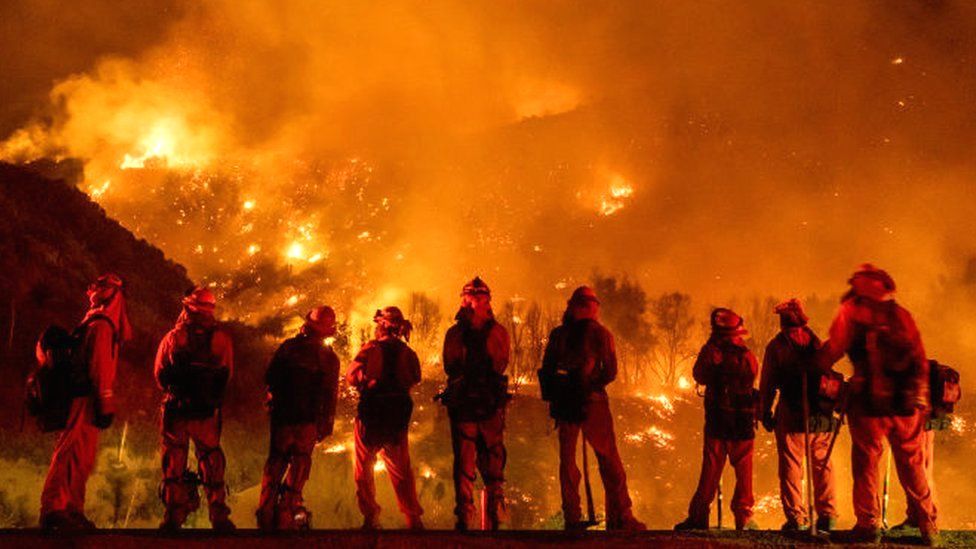
image captionThe El Dorado wildfire in southern California last year spread over more than 22,000 acres
A US couple whose gender reveal party last year was blamed for starting a deadly California wildfire face up to 20 years in prison, officials say.
Refugio Manuel Jimenez Jr and Angela Renee Jimenez have been charged with several offences, including involuntary manslaughter, over the El Dorado fire.
Officials say a smoke bomb used at the gender event last September sparked the blaze, in which one firefighter was killed and others were hurt.
The couple have pleaded not guilty.
The El Dorado fire lasted more than two months and covered over 22,000 acres of southern California, destroying homes and other properties.
The California Department of Forestry and Fire Protection, known as Cal Fire, alleged that a “smoke-generating pyrotechnic device” used during a gender reveal party near the city of Yucaipa on 5 September was the cause of the blaze.
The wildfire was eventually extinguished on 16 November.
Firefighter Charles Morton was killed tackling the blaze and several other firefighters were seriously injured.
On Tuesday, San Bernardino County officials said the couple who organised the gender reveal party had been charged with involuntary manslaughter and for recklessly causing a fire resulting in injury and damage to homes.
They face prison sentences “extending” up to 20 years if found guilty on all charges, prosecutors said.
The couple are due to appear in court on 15 September.
Gender reveal parties are celebrations announcing whether expecting parents are going to have a girl or a boy.
They can include prediction games, with the “big reveal” being made with fireworks and coloured smoke grenades.
In recent years, several large-scale parties have gone wrong.
By Lucy Sherriff13th July 2021One small, plucky animal has an outsized ability to transform its environment, helping to replenish river ecosystems even in the desert.S
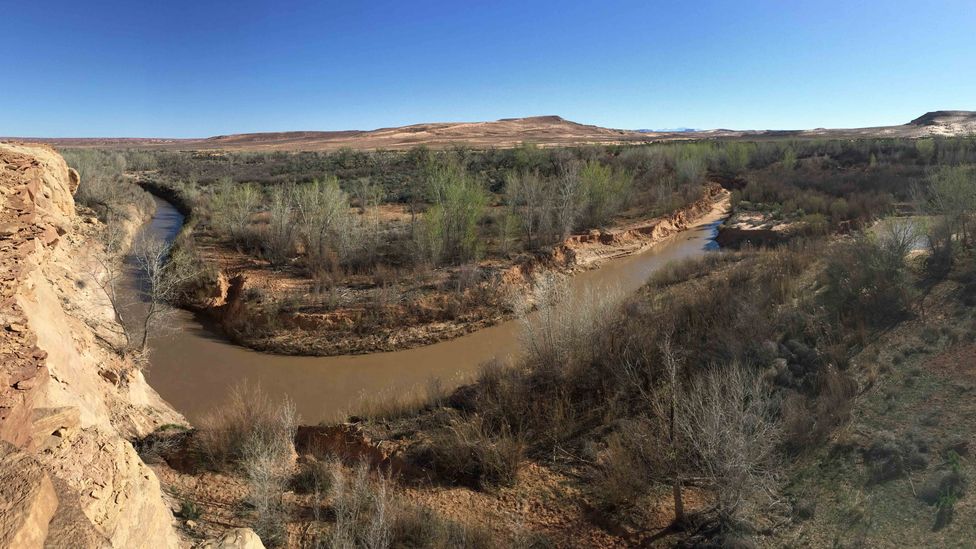
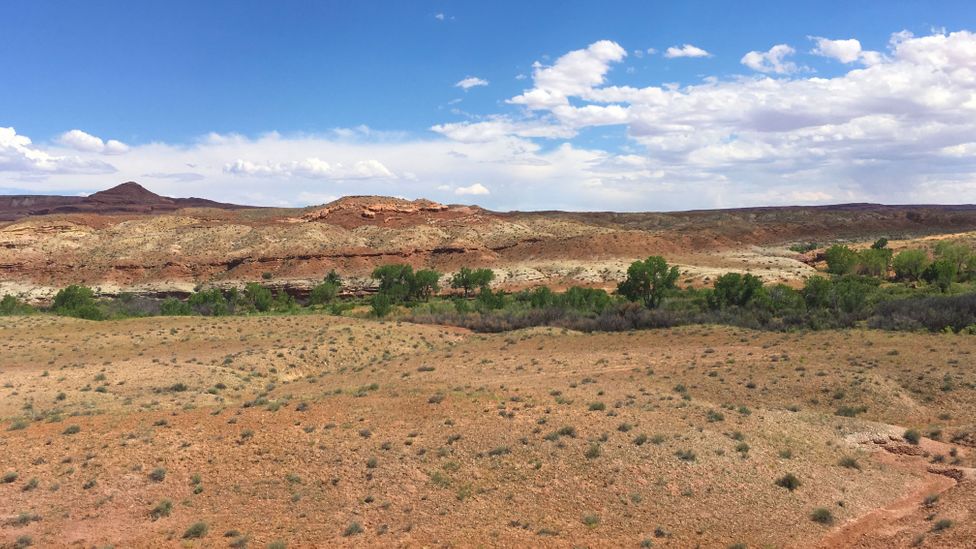
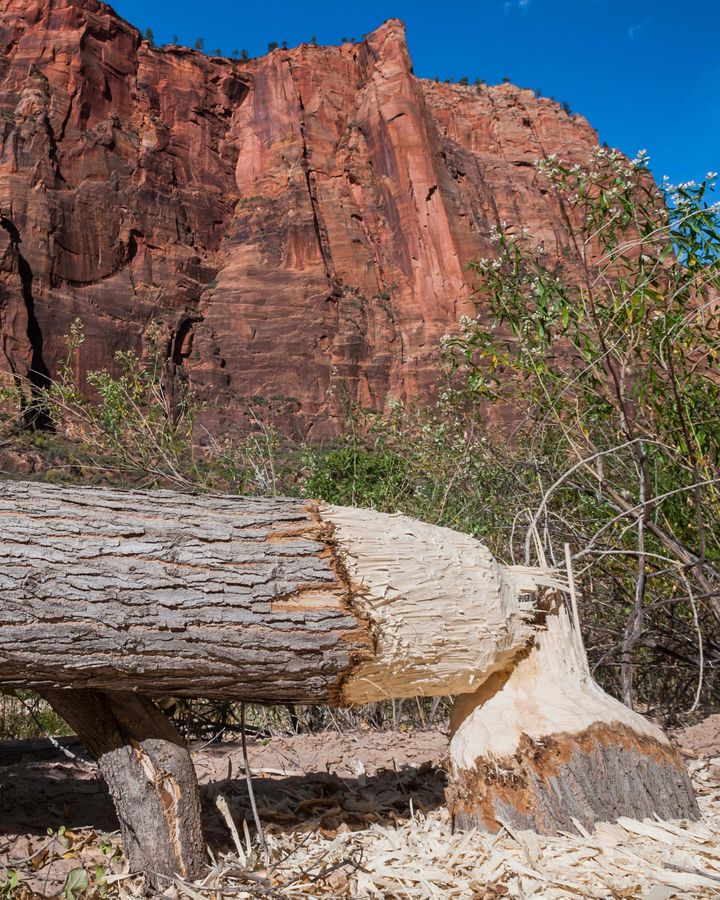
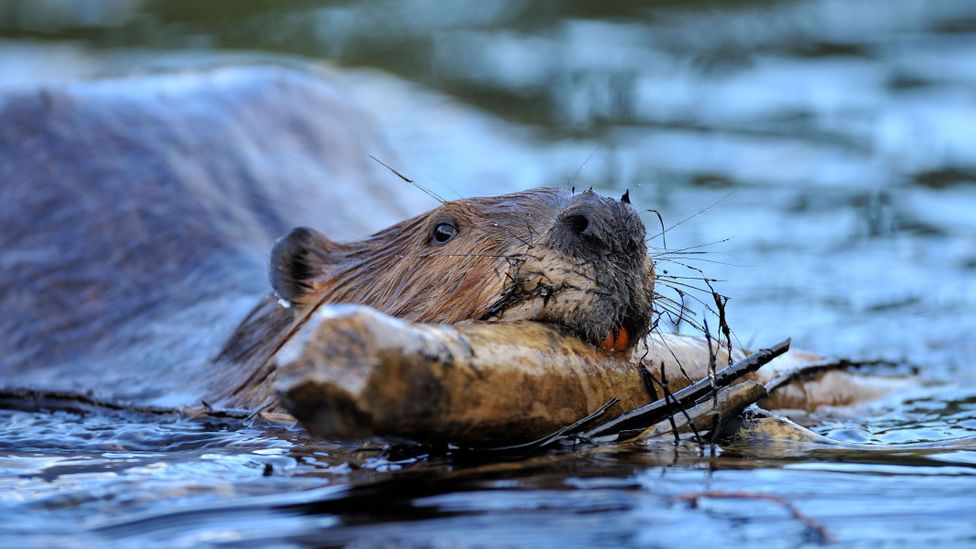
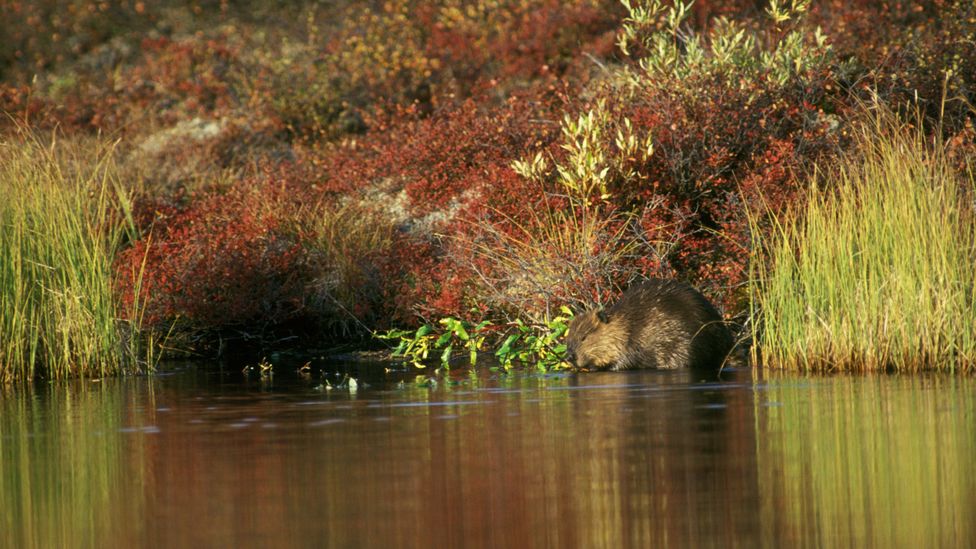
Standing at the edge of a precipice, under a scorching sun in eastern Utah, you can see nothing but the state’s infamous red rocks and towering buttes for miles. No trees to offer welcome shade, the only vegetation being dry scrub that clings to the flat, dusty plains, while the sheer cliffsides are barren of life. But if you happen to glance down at the dizzying depths of the canyon that lies at the bottom of the desert sandstone mountains, you’d see a lush oasis, blooming with green vegetation, the Price River snaking through the rock even on the hottest of summer days. And if you scrambled down, and watched patiently for long enough, you might even spot some beavers – the very architects of this thriving wetland landscape, smack bang in the middle of the desert.
Getting these beaver populations to thrive in Utah’s desert landscape has been a challenging task for Emma Doden, a masters student in translocated beaver ecology at Utah State University. Doden and several other researchers set out to reintroduce beavers to the drought and fire-stricken land. Water shortages are severe here, and much of the river ecosystem is degraded. Doden’s primary goal is to restore the quantity and quality of water in eastern Utah, whose waterways sustain an array of wildlife, riverbank vegetation and endangered fish species.
“In desert environments, water can be very limiting, but it serves as the lifeline to so many species that live out there, including livestock,” she says.
As the world heats up and extreme weather becomes more frequent, scientists have been rushing to reintegrate beavers into struggling ecosystems and dry landscapes
Water shortages in the region have been made worse by river degradation, caused by irrigation, pollution and mismanagement. Seeing the effects of this played a large part in Doden’s drive to bring beavers back to Utah.
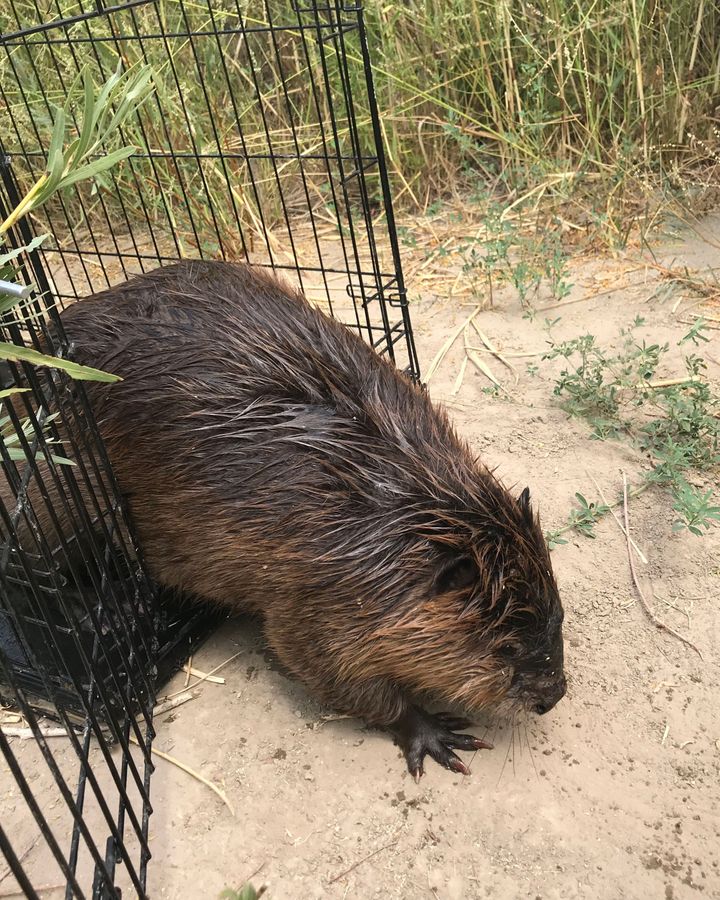
The beavers Doden released as part of her study were often rescued from conflict situations with humans, and would otherwise have been put down (Credit: Emma Doden)
As the world heats up and extreme weather becomes more frequent, scientists have been rushing to reintegrate beavers into struggling ecosystems and dry landscapes.
For Doden, relocating beavers into the desert posed some unique challenges. The availability of water being the obvious one. The drought was so bad last year that one of Doden’s study sites completely dried up.
“And the intense heat,” she adds. “In the summertime it can be above 100F (37.8C) for weeks or even months at a time. And so we initially tried to avoid relocating animals during the hottest months.”
In these desert systems, beavers hide out in their burrows all day, and come out at night.
The fur trade that thrived from the 16th to 19th Centuries decimated beaver populations, which never fully recovered after the decline of hunting (Credit: Getty Images)
Doden’s focus is on two rivers in Utah: the Price and San Rafael rivers, both of which flow through some of eastern Utah’s driest areas. She specialises in passive river restoration, meaning there is no manmade manipulation of the landscape. It’s also the most straightforward, as introducing artificial dams – known as “dam analogues” – requires a permit from Utah’s environmental agency. “What’s interesting is I have this original study of what happens when you put in beavers without any additional structural support.”
The river system already had some beavers, though their populations had been badly reduced by the North American fur trade. “We believed the system could support a lot more beavers,” Doden says, “and we wanted to supplement it with translocated beavers.”
When I say I work with beavers in the desert, it definitely raises eyebrows. They forget there are waterways here – Emma Doden
The area where Doden and her colleagues are carrying out their work has been relatively understudied when it comes to beavers, she noted. Research has been carried out into areas that flood and forested or marshy regions, but little has been done in terms of desert landscapes. Another unique aspect of Doden’s work is she has used existing resident beavers as a baseline to compare behaviour, movements, space use, survival, and dam building capabilities with the new translocated beavers, to see how they can settle in and adapt.
“We wanted to see if these translocated beavers would ultimately be contributing towards restoration efforts,” says Doden.
Many of the beavers came from the university’s beaver rehabilitation and relocation centre, which captures nuisance animals across the state. They go through a three-day quarantine before they are released, to prevent the spread of invasive diseases, and are tagged with a microchip, as well as a radio transmitter, so Doden can track their movements.
“The ultimate goal is to get them to build dams,” she says. “The dams are what are going to increase habitat complexity and restore water.”
Rivers through the Utah desert provide a narrow strip of lush vegetation, a promising habitat for beaver translocation (Credit: Emma Doden)
Doden’s first trial was in May 2019, followed by a second in 2020. In total she translocated 47 animals, all from “conflict situations”, to live near nine already-existing individuals. “We’re taking those animals that would have otherwise been euthanised, and hopefully using them to do some good.”
But not all of the newly introduced beavers settled into their new homes. “We did see some mortality,” she remembers. Some beavers were unable to adapt to the heat, experienced stress related to relocation, and some were killed by natural predators. “And quite a few moved from the targeted restoration area. They didn’t all settle down to build the dams. But that’s to be expected, you’re not going to have 100% success.”
What Doden and her team did see, however, was dams being built in areas they had never been before.
“A few of these beavers stuck where we put them. And even the ones that didn’t – we had some move 20km [12 miles] downstream, which is pretty far for a small little animal – they are probably still helping the system, as the river is so degraded.”
The desert conditions are “a little harsher” for translocated beavers. “There’s more limited resources, the vegetation is patchy, so it makes sense that we’re seeing individuals move long distances,” she says.
The following season, Doden released more, after feeling confident that the newcomers were not negatively impacting the small existing population. “By putting more of these neighbours into the system it’s hopefully helping to reach restoration goals more quickly and on a wider scale.”
In building dams for themselves, beavers change the local environment for many animals that share their habitat (Credit: Alamy)
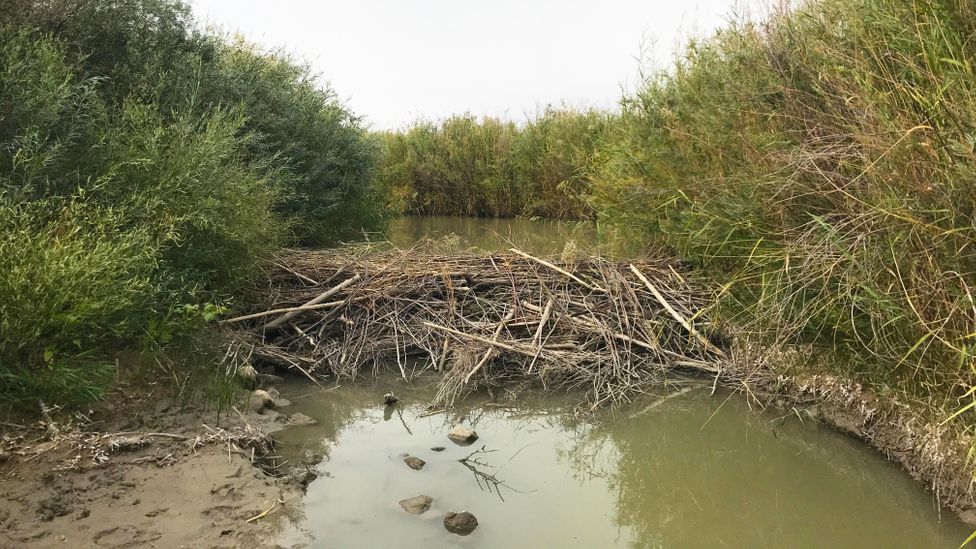
As Doden is finishing up her masters, she’s handing the reins over to another student, who will continue to do translocations in the same area for the next two years. Now permits to build dam analogues have been obtained too, they’ll start to add those into the landscape too, in the hopes of a higher success rate. The artificial structures help attract beavers as a lot of the work has been done for the creatures already. The beavers can then build on top of these manmade dams, rather than having to construct their own from scratch.
Just one beaver dam can improve water quality, as well as acting as a firebreaker for the surrounding land
“I guess the everyday person would be surprised to know there are beavers in the desert,” Doden acknowledges. “When I say I work with beavers in the desert, it definitely raises eyebrows. They forget there are waterways here.”
Whatever the success rate, Doden is keen to point out that these animals would have otherwise been killed. “So we’re giving them a second chance.”
North America is facing an intense battle against wildfires, which raged across the American West in 2020 – including in Utah – burning 8.8 million acres (3.6 million hectares) of land, and could be even worse this year.
Beavers, some scientists believe, could provide the key to reviving watersheds and mitigating wildfire risks. In a paper published last year, Emily Fairfax found that areas where beaver dams were present were better at surviving wildfires than regions without beavers.
“I thought that beaver dams would work sometimes,” Fairfax says of the creatures’ impact on wildfire-ravaged regions. “But in every one of the sites I studied, if there was a dam, the land was protected from fire.”
Beavers are versatile, historically widespread animals that can survive in a number of different climates (Credit: Alamy)
Beavers are in high demand too in Northern California, along the Klamath River, where the Yurok Tribe has been working on intense river restoration. Sarah Beesley is a biologist for the tribe, and has been working on building beaver dam analogues to attract beavers back onto the land. But it has been a long road to bring the river back to a point where it would be viable for beavers to survive.
“We have a lot of work to do to get these streams back into shape, and enough for the beaver to actually move in and start dam building and recolonising,” she says. “A lot of the streams have been straightened and channelised and are just too swift and not very conducive for dam building.”
Our very existence depends on this healthy river – Barry McCovey
The Yurok Tribe, whose land is in the Lower Klamath Basin, is actually moving the riverto “put more wiggles into it”, Beesley explains, in order to slow the water down. The eventual goal is both to attract beavers and restore the river to its natural flow. (Read more about the benefits of “slow water”)
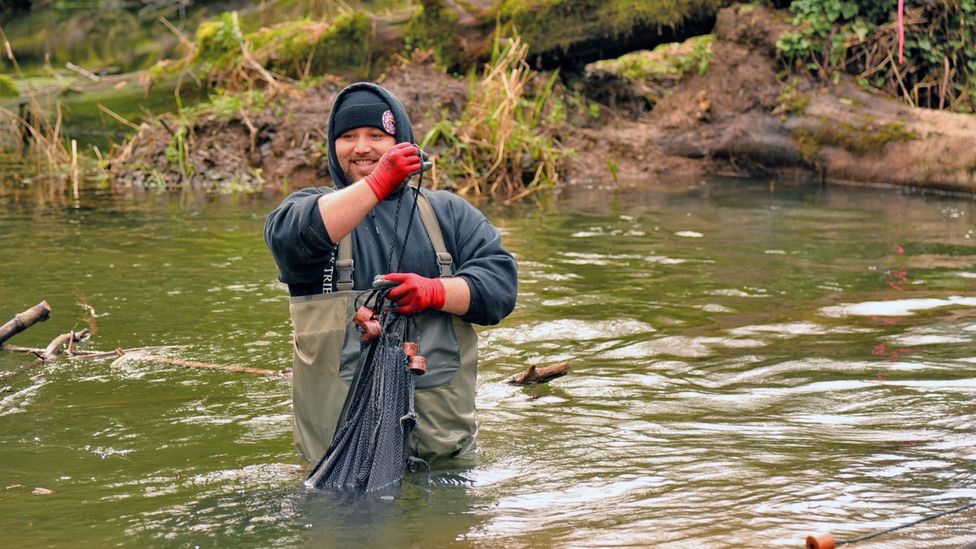
Beesley’s team has been building dam analogues along small coastal watersheds, which the biologist says are “critically important right now”. Last summer, their efforts enhanced the amount of surface flows for small juvenile salmon that were being reared in the West Fork Creek tributaries of the Klamath River, as well as rescuing fish out of drying regions and transporting them up to the healthier habitats. “By enhancing surface flows, we’re able to provide better survival conditions for those juvenile fish,” says Beesley.
Members of the Yurok Tribe depend closely on the salmon of the Lower Klamath Basin, and monitor the river to track fish populations (Credit: Matt Mais)
Salmon are an integral part of Yurok life. The tribe, which is also known as the Yurok People, depend on salmon as both a source of food and income, and the fish is a key part of their heritage and cultural traditions. This year, due to drought and water shortages in the Upper Klamath Basin, millions of juvenile salmon died, meaning the tribe has been left without a viable food source for the year.
Since May of this year 70% of the juvenile salmon measured in the river were dead. “It’s traumatic and devastating,” says Barry McCovey, a Yurok Tribe member and director of its fisheries department. “Our very existence depends on this healthy river.”
So Beesley and her team’s work to restore the river, and the role beavers play in restoration, has become even more vital. Following the building of dam analogues, the Yurok’s scientists have been monitoring the fish with electronic tags to track their survival and movements, and have seen “really positive results”.
“When we put those analogues in there, we are creating more water for the fish to survive,” Beesley adds. This summer, Beesley is focusing on Upper McGarvey Creek, and will be building more analogues to hopefully save more juvenile salmon.
After the release of beavers, Emma Doden began to see dams built where they had never been built before (Credit: Emma Doden)
It’s still a learning process, she says, and the jury is still out on whether dam analogues will help beavers in the Klamath River. The team puts cameras on the dams to monitor how the beavers react to them. “One of the big questions still is: if a human builds a dam will a beaver adopt it? Manmade dams are very different from how a beaver would build it, so it can be very hit or miss.”
Dams on the Danube
While the dam analogues are being constructed in Utah and Northern California, in the Danube Delta in Central Europe, another kind of dam is being removed to clear the way for beavers.
In late 2019, 10 dams and other manmade structures were removed on the Kogilnik, Kagach and Sarata Rivers, in the upper part of the Sasyk lagoon on the territory of the Danube Biosphere Reserve in Ukraine, to restore rivers to their free-flowing state. The effort appears to have worked. In March this year, a reserve employee found a large number of felled willow trees – one of the species beavers love to gnaw on – he followed their trail to discover a beaver’s dam.
Max Yakovlev, a researcher for the reserve, believes the beaver came over from neighbouring Romania. “Whether beavers settle down in the Ukrainian Danube Delta, only time will tell,” he says. “But it’s incredibly nice to witness such beautiful and cute animals returning to their home after such a long absence.
“The presence of beavers is positively reflected in the lives of many residents, especially mink and otters. Furthermore, their activities increase the productivity of reservoirs, the waters are clearer and fish supplies are increasing.”
The beavers along the Danube may have returned of their own accord, but in other areas of Europe people have taken a more active approach to reintroduce them to the landscape.
Beaver numbers are being boosted in Europe as well as North America through reintroduction schemes (Credit: Getty Images)
Around 200 wild beavers were discovered on the River Tay in Scotland back in 2001, and since then, scientists have been scrambling to conduct controlled releases throughout the UK to study their impact on the environment.
“No one officially knows how the beavers got to Scotland – or England,” explains Richard Brazier, director of the Centre for Resilience in Environment, Water and Waste at the University of Exeter, who has been working on beaver monitoring since 2013.
Reintroducing a species is naturally a delicate balancing act, particularly when they can cause damage to property by damming culverts, flooding roads and blocking irrigation, leading to flooded fields and infrastructure. They’re so unpopular among farmers, in fact, that there’s a whole YouTube community dedicated to filming themselves dynamiting beaver dams with explosives.
“We do have farmers – and fishermen – who are very keen to see beavers coming back, who recognise they are great for fish and the livestock and irrigation,” Brazier says. “But there is a group who doesn’t want to see beavers back in the landscape, and one of the key things has been knowing where farmers are coming from, knowing what their concerns are, and engaging with them. It’s an ongoing process and we’re working with them to manage any negative impacts.
“It’s about learning to live with these animals again in a renewed co-existence.”
Beavers might well incur costs to landowners, but Brazier believes they can be addressed by providing adequate compensation for any flooded fields higher in the watershed. He believes it’s a small cost in comparison to that of other flooding prevention, or the value of the other benefits that beavers bring such as water quality improvement, carbon storage and enhanced biodiversity.
In the UK, have been shown to reduce the severity of flooding – though there have also been concerns raised about their impact on farmland (Credit: Getty Images)
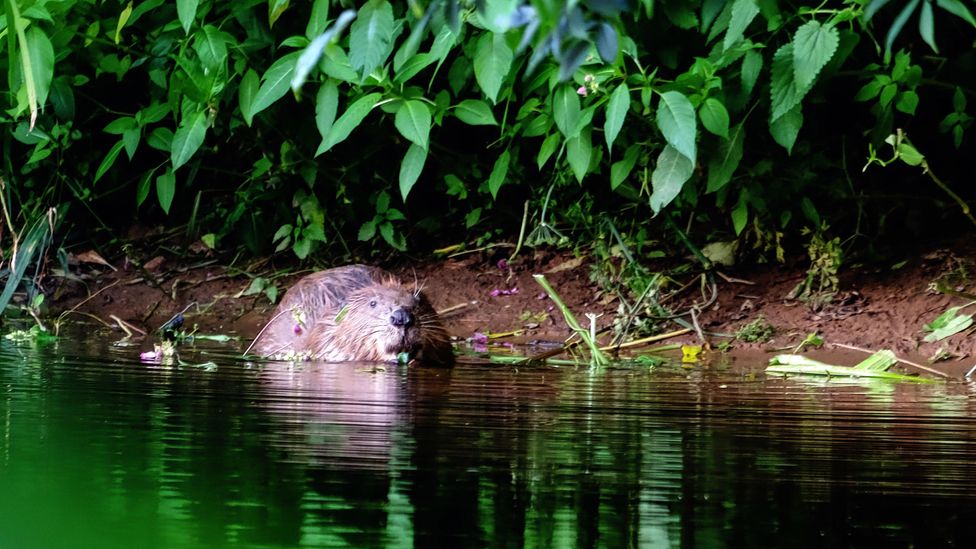
In 2008, a family of beavers were found on the River Otter in East Devon – the first time in 400 years beavers had been spotted in England. When they gave birth to kits in 2014, the government initially planned to remove them from the river, considering them an invasive species. However pressure from conservation groups persuaded the government to allow scientists – led by Brazier – to turn the site into a five-year trial to monitor the beavers’ effects on the landscape.
The results showed the beavers created 13 ponds along a 183m (600ft) stretch of stream, storing well over 1,000 tonnes of water. The ponds trapped 15 tonnes of carbon and one tonne of nitrogen – a fertiliser that in excess is detrimental to water quality. The water entering the site was thick with runoff, washed into the stream from farm fields during heavy rains, but the network of dams acted as a filter, cleaning the water of fertiliser.
At the end of the trial, scientists found fish populations were 37% higher in beaver ponds than elsewhere along the river. During flooding events, peak water flows were lower along dammed areas. And other wildlife, including teals and water voles, were also doing better than before the trial.
“The real surprise for me was the effect they had on flooding,” Brazier explains. “The dams slowed the flow of water and really reduced the impact of flooding downstream. And then, of course, in drought periods the ponds still held water, and so the stream kept flowing even though it hadn’t rained for weeks.”
And, he adds, because there is water all year round, the aquatic life is better able to survive. “That’s been a massive bonus for biodiversity.”
With beaver releases happening in South Downs, Wales, Cornwall and Cheshire, across the pond in Utah, Idaho and on Indian Reservations in California, Washington and Oregon, and even more on the horizon, many more of us could soon be feeling the effects of beavers flourishing in the wild.
Activists from the climate change protest group Extinction Rebellion take part in a protest march in St. Ives, Cornwall, on June 11, 2021, on the first day of the three-day G7 summit being held from June 11-13.
Global warming is accelerating, bringing the world close to the edge of the precipice. Heat waves, floods and deaths are major news, and as Truthout has reported, “this summer’s record-breaking temperatures caused by a climate catastrophe that, until recently, even the most pessimistic climatologists thought was still two or three decades out.” Yet, as Noam Chomsky points out in the interview below, corporate media devoted almost as much coverage in one day to a space cowboy than it did the entire year of 2020 to the biggest crisis facing humanity.
Is the world losing the war against climate change? Why is there still climate crisis denial and inactivism? The choice is clear: We need global action to tame global warming or face apocalyptic consequences, says Chomsky, a globally renowned public intellectual who is Laureate Professor of Linguistics at the University of Arizona and Institute Professor Emeritus at the Massachusetts Institute of Technology (MIT), and is the author of more than 150 books on topics such as linguistics, international affairs, U.S. foreign policy, political economy and mass media.
C.J. Polychroniou: Climate emergency facts are piling up almost on a daily basis — extreme heat waves in various parts of the U.S. and Canada, with temperatures rising even above 49 degrees Celsius (over 120 degrees Fahrenheit); deadly floods in western Europe, with close to 200 dead and hundreds remaining unaccounted for in the flooding; and Moscow experienced its second-hottest June. In fact, the extreme weather conditions even have climate scientists surprised, and they are now wondering about the accuracy of prediction models. What are your thoughts on these matters? It appears that the world is losing the war against global warming.
Noam Chomsky: You probably remember that three years ago, Oxford physicist Raymond Pierrehumbert, a lead author of the just-released Intergovernmental Panel on Climate Change (IPCC) report, wrote that “it’s time to panic…. We are in deep trouble.”
What has been learned since only intensifies that warning. An IPCC draft report leaked to Agence France-Presse in June 2021 listed irreversible tipping points that are ominously close, warning of “progressively serious, centuries-long and, in some cases, irreversible consequences.”
Last November 3 was a narrow escape from what might well have been indescribable disaster. Another four years of Trump’s passionate racing to the abyss might have reached those tipping points. And if the denialist party returns to power, it may be too late to panic. We are indeed in deep trouble.
The leaked IPCC draft was from before the extreme weather events of summer 2021, which shocked climate scientists. Heating of the planet “is pretty much in line with climate model predictions from decades ago,” climate scientist Michael Mann observed, but “the rise in extreme weather is exceeding the predictions.” The reason seems to be an effect of heating of the atmosphere that had not been considered in climate studies: wobbling of the jet stream, which is causing the extreme events that have plagued much of the world in the past few weeks.
The frightening news has a good side. It may awaken global leaders to recognition of the horrors that they are creating. It’s conceivable that seeing what’s happening before their eyes might induce even the GOP and its Fox News echo chamber to indulge in a glimpse of reality.
We have seen signs of that in the COVID crisis. After years of immersion in their world of “alternative facts,” some Republican governors who have been mocking precautions are taking notice, now that the plague is striking their own states because of lack of preventive measures and vaccine refusal. As Florida took the lead nationwide in cases and deaths, Gov. Ron DeSantis backed way (only partially) from his ridicule — eliciting charges of selling out to the enemy from party stalwarts and perhaps endangering his presidential aspirations. A shift which might, however, be too late to influence the loyal party base that has been subjected to a stream of disinformation.
Possibly the sight of cities drowning and burning up may also dent GOP-Fox loyalty to the slogan “Death to intelligence, Viva death,” borrowed from the annals of fascism.
The denialism of environmental destruction naturally has an impact on public opinion. According to the most recent polls, for 58 percent of Republicans, climate change is “not an important concern.” A little over 40 percent deny that humans make a significant contribution to this impending catastrophe. And 44 percent think that “climate scientists have too much influence on climate policy debates.”
If there ever is a historical reckoning of this critical moment in history — possibly by some alien intelligence after humans have wrecked this planet — and if a Museum of Evil is established in memory of the crime, the GOP-Fox dyad will have a special room in their honor.
Responsibility is far broader, however. There is no space to review the dismal record, but one small item gives the general picture. The indispensable media analysis organization FAIRreports a study comparing coverage on morning TV of the climate crisis with Jeff Bezos’s space launch: 267 minutes in all of 2020 on the most important issue in human history, 212 minutes on a single day for Bezos’s silly PR exercise.
Returning to your question, humanity is quite clearly losing the war, but it is far from over. A better world is possible, we know how to achieve it, and many good people are actively engaged in the struggle. The crucial message is to panic now, but not to despair.
One of the most worrisome developments regarding the climate crisis is that while virtually all of the published climate science shows the impacts of global warming are increasingly irreversible, climate skepticism and inactivism remain quite widespread. In your view, is climate crisis denial motivated by cultural and economic factors alone, or is there possibly something else also at work? Specifically, I am wondering if there is a connection between postmodern attacks on science and objectivity and climate science denial and inactivism.
There was a skeptical crisis in the 17th century. It was real, a significant moment in intellectual history. It led to a much better understanding of the nature of empirical inquiry. I’m not convinced that the postmodern critique has improved on this.
With regard to your question, I doubt that the postmodern critique has had much of an impact, if any, outside of rather narrow educated circles. The major sources of climate science denial — in fact much broader rejection of science — seem to me to lie elsewhere, deep in the culture.
I was a student 75 years ago. If evolution was brought up in class, it was preceded by what’s now called a trigger warning: “You don’t have to believe this, but you should know what some people believe.” This was in an Ivy League college.
Today, for large parts of the population, deeply held religious commitments conflict with the results of scientific inquiry. Therefore, science must be wrong, a cult of liberal intellectuals in urban dens of iniquity infected by people who are not “true Americans” (no need to spell out who they are). All of this has been inflamed by the very effective use of irrationality in the Trump era, including his skillful resort to constant fabrication, eroding the distinction between truth and falsehood. For a showman with deeply authoritarian instincts, and few principles beyond self-glorification and abject service to the welfare of the ultrarich, there’s no better slogan than: “Believe me, not your lying eyes.”
The organization that Trump now owns, which years ago was an authentic political party, had already moved on a path that provided a generous welcome to such a figure. We’ve discussed previously how the brief Republican flirtation with reality on environmental destruction during the McCain campaign was quickly terminated by the Koch brothers’ campaign of intimidation. The last time Republican leaders spoke freely without obeisance to Trump, in the 2016 primaries, all were loyal climate denialists, or worse.
Scientists are human. They’re not above criticism, nor their institutions. One can find error, dishonesty, childish feuds, all of the normal human flaws. But to be critical of science as such is to condemn the human quest to understand the world in which we live. And truly to abandon hope.
Many discussions on the climate crisis revolve around “equity” and “justice.” Leaving aside the question of “climate equity vs. climate justice,” especially in the context of the Paris Agreement, how much importance should we assign to these debates in the context of the overall goal of decarbonizing the global economy, which is obviously the only way to tackle the existential crisis of global warming?
It shouldn’t be overlooked that it is the small, very affluent minority, most of them in the rich countries, who have overwhelming responsibility for the environmental crisis, in the past and right now. Decarbonizing and concern for equity and justice, therefore, considerably overlap. Beyond that, even on narrow pragmatic grounds, putting aside moral responsibility, the major socioeconomic changes required for the necessary scale of decarbonization must enlist committed mass popular support, and that will not be achieved without a substantial measure of justice.
Robert Pollin has been making the case for a Global Green New Deal as the only effective way to tackle global warming, and the two of you are co-authors of the recently published work, Climate Crisis and the Global Green New Deal: The Political Economy of Saving the Planet. No doubt, we need internationalism in the fight against climate breakdown because, as you have so aptly put it yourself, it is either “extinction or internationalism.” My question to you is twofold: Firstly, how do you understand “internationalism” in the current historical juncture where, in spite of all of the globalizing processes under way in the course of the past 40 or 50 years, the nation-state remains the central agency? And, secondly, what system changes are required to give “internationalism” a real fighting chance in the war against the apocalyptic consequences of global warming which are already knocking at humanity’s door?
There are many forms of internationalism. It’s worthwhile to think about them. They carry lessons.
One form of internationalism is the specific kind of “globalization” that has been imposed during the neoliberal years through a series of investor-rights agreements masquerading as free trade. It constitutes a form of class war.
Another form of internationalism is the Axis alliance that brought us World War II. A pale reflection is Trump’s sole geostrategic program: construction of an alliance of reactionary states run from Washington, including as one core component the Middle East Abraham Accords and its side agreements with the Egyptian and Saudi dictatorships, taken over by Biden.
Still another form of internationalism has been championed on occasion by workers’ movements, in the U.S. by the “Wobblies,” the Industrial Workers of the World (IWW). Other unions, too, have the term “international” in their names, a relic of commitment to true internationalism.
In Europe, the most eloquent spokesperson for this form of internationalism was Rosa Luxemburg. The conflict between internationalism and chauvinism came to a head with the outbreak of World War I. Chauvinism conquered. The Socialist International collapsed. In Luxemburg’s acidic words, the slogan, “Proletarians of all countries united” was abandoned in favor of “Proletarians of all countries cut each other’s throat.”
Luxemburg held true to the internationalist vision, a rare stance. In all countries, intellectuals across the political spectrum rallied enthusiastically to the chauvinist cause. Those who did not were likely to find their way to prison, like Luxemburg: Karl Liebknecht, Bertrand Russell, Eugene Debs. The IWW was crushed by state-capital violence.
Turning to the present, we find other manifestations of internationalism. When the COVID pandemic broke out in early 2020, the rich countries of central Europe at first managed to get it more or less under control, a success that collapsed when Europeans chose not to forego their summer vacations.
While Germany and Austria were still in fairly good shape in early 2020, there was, however, a severe pandemic in northern Italy a few miles to their south, within the Europe Union. Italy did benefit from true internationalism — not on the part of its rich neighbors. Rather, from the world’s one country with internationalist commitments: Cuba, which sent doctors to help, as it did elsewhere, extending a record that goes far back. Among others, Panama received assistance from Cuba, but the U.S. took care of that. In its final 2020 report, Trump’s Department of Health and Human Services proudly announced that it had successfully pressured Panama to expel Cuban doctors to protect the hemisphere from Cuba’s “malign” influence.
The malign influence, spelled out in the early days of Cuban independence in 1959, was that Cuba might infect Latin America with its “successful defiance” of U.S. policies since the Monroe Doctrine of 1823. To prevent this threat, the U.S. launched a major campaign of terror and economic strangulation, following the logic spelled out at the State Department in 1960 by Lester Mallory. He recognized, as U.S. intelligence knew, that the “majority of Cubans support Castro,” and that the “only foreseeable means of alienating internal support is through disenchantment and disaffection based on economic dissatisfaction and hardship.” Therefore, “it follows that every possible means should be undertaken promptly to weaken the economic life of Cuba … to bring about hunger, desperation and overthrow of government.”
The policy has been rigorously followed with bipartisan fervor in the face of unanimous world opposition (Israel excepted). The days of “decent respect for the opinions of mankind” have long faded to oblivion, along with such frivolities as the UN Charter and the rule of law. It is astonishing that Cuba has survived the relentless assault.
The successes of the policy of strangulation and torture are reported with no little exuberance, an unusual exhibition of sadistic cowardice. Among the many popular protests underway in Latin America, one is front page news: in Cuba, giving Biden an opportunity to slap even more sanctions on the “villain” for its resort to abusive measures to suppress the demonstrations, which appear to be mostly about “economic dissatisfaction and hardship,” and failures of the authoritarian government to respond in timely and effective fashion.
Cuba’s unique internationalism is also undermined, freeing the world from any departure from the norm of self-interest, rarely breached in more than the most limited ways.
That must change. It is by now broadly understood that hoarding of vaccines by the rich countries is not only morally obscene but also self-destructive. The virus will mutate in countries with nondominant economies, and among those refusing vaccination in the rich countries, posing severe dangers to everyone on Earth, the rich included. Much more seriously, heating of the planet also knows no borders. There will be nowhere to hide for long. The same is true of the growing threat of nuclear war among major powers: the end.
Rosa Luxemburg and the Wobblies sketched the kinds of “system changes” toward which humanity should strive, in one or another way. Short of the goals they envisioned, steps must be taken toward engaging an informed and concerned public in international institutions of solidarity and mutual aid, eroding borders, recognizing our shared fate, committing ourselves to working together for the common good instead of “cutting each other’s throats.”
This interview has been lightly edited for clarity.
Wisconsin, increasingly divided between rural and urban views, faces hard, contentious questions of how big its remaining wolf population should be
Listen to article8 min
Adrian Wydeven checks his compass after distant wolves responded to his howls in the Chequamegon-Nicolet National Forest in northern Wisconsin in early July. (Peter Kendall)
ByPeter KendallYesterday at7:00 a.m. EDT727
CHEQUAMEGON-NICOLET NATIONAL FOREST, Wis. — The howl that Adrian Wydeven sent into the moonless summer night sounded like what a wolf might make, a descending run of low tones, impressively loud and sustained.
The answer that came back from the dark forest was far more authentic, however. It started as a single note, deep and mournful, that rose in volume and complexity as at least one other wolf joined in, their melody lines crossing, inadvertently forming ominous chords as they passed.
“It feels like you are having a conversation with them,” Wydeven whispered as…
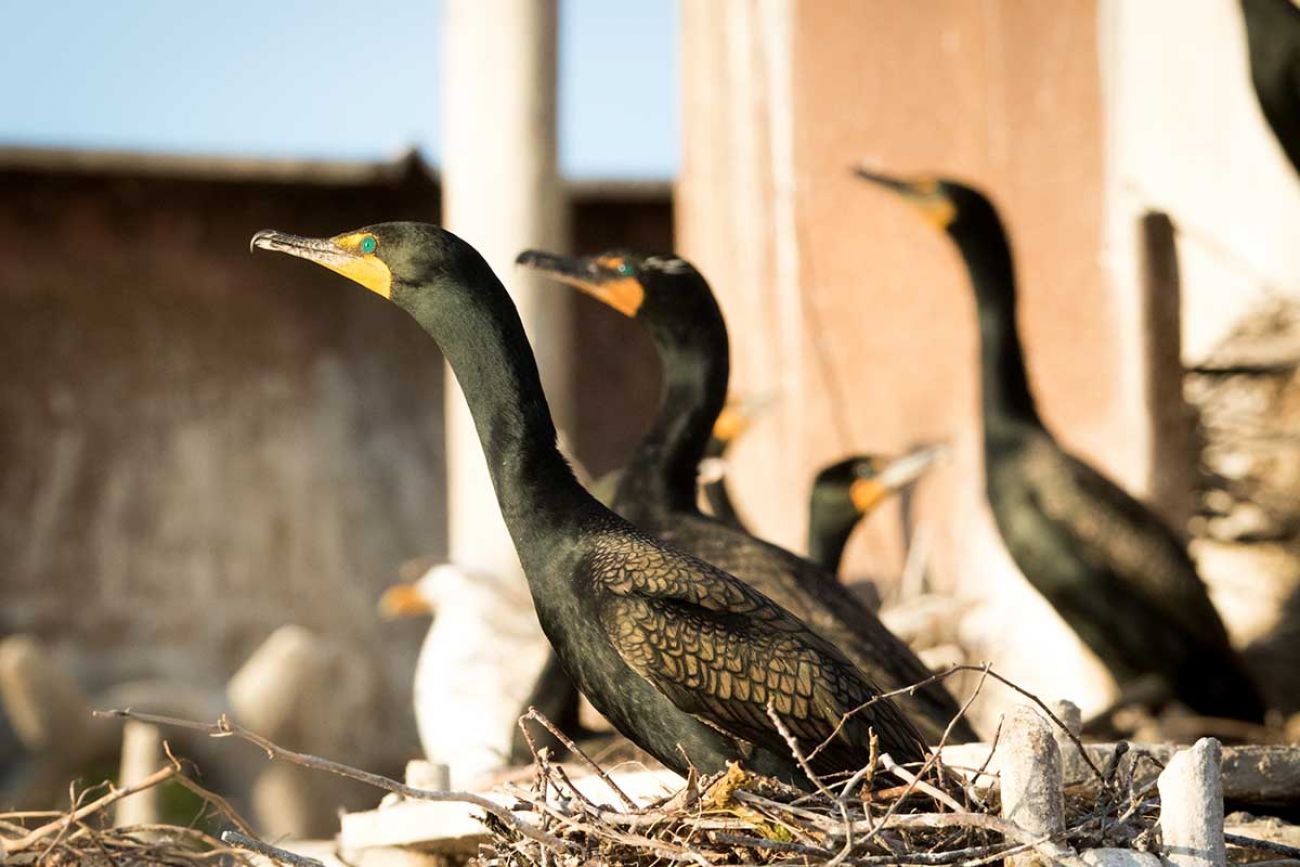
Under a new federal permit program that took effect this year, Michigan officials can kill up to 9,650 cormorants and destroy up to 1,400 nests in hopes of keeping fish out of cormorants’ bellies and on Michigan anglers’ fishing hooks. (Bridge file photo)July 28, 2021Kelly House, Makayla CoffeeMichigan Environment WatchGreat Lakes, Upper Peninsula, Rural Michigan
After years of urging federal regulators to let them protect fish by killing double-crested cormorants — a slender, black seabird that nests in colonies throughout the Great Lakes region — Michigan anglers and wildlife managers have gotten their wish.
Under a new federal permit program that took effect this year, Michigan officials can kill up to 9,650 adult birds and destroy up to 1,400 nests in hopes of keeping fish out of cormorants’ bellies and on Michigan anglers’ fishing hooks.
Claramunt said Michigan will likely only kill about a third as many cormorants as its permit allows.
The new lethal control program is welcome news to Tom Frontjes, a resort owner and charter boat captain on the Les Cheneaux Islands in northern Lake Huron, which is home to a cormorant colony that numbered 1,500 nesting pairs in 2018.
The islands’ once-abundant sportfish stocks have dwindled from their heyday, and the local tourism industry has suffered as a result. Frontjes attributes those declines in large part to the cormorants.
Each adult bird can eat about a pound of fish per day. Every year that the local colony went unchecked, Frontjes said, was “another nail in the coffin” for fishing tourism.
But while anglers rejoice over the ability to combat a bird they view as competition, some scientists and bird advocates argue the government is wasting resources on a killing program that won’t revive fish populations.
The birds, they argue, are being scapegoated for broader ecosystem changes that have upended the Great Lakes food web.
“People see them eating fish and think they have to be controlled,” said Jim Ludwig, an Ontario-based scientist who studies cormorants. “That’s the mindset, but I don’t think the data supports control on the Great Lakes at all.”
‘Stop the growth’
Cormorants are protected under the Migratory Bird Treaty Act. But the U.S. Fish and Wildlife Service can and does grant exceptions to the act’s ban on killing migratory birds.
A hearty thanks to all 97 new sustaining members who joined us in June 2021. Our team is supported in part by readers who trust our nonpartisan, nonprofit storytelling. Please join.DONATE HEREI’m already a member!
In the years since, state fish managers and fishing advocates have pushed to regain the ability, said the DNR’s Claramunt.
They won a victory this year, when the federal government launched a new permit program that allows state and tribal wildlife managers to take as many as 121,500 double-crested cormorants nationwide. That’s as much as one-seventh of the U.S. population.
“We needed a new permit system to move forward with a long-term solution, and I’m happy with this approach and this system so far,” Claramunt said.
States must clear several hurdles to get a permit, including showing that they’ve already tried non-lethal control methods such as chasing birds in boats or using loud pyrotechnics to scare them away. They must apply for a new permit each year.
State fishery managers and their designees have long harassed cormorants at big colonies throughout the state. But, Claramunt said, “when you harass them long enough, they get conditioned and they pretty much know you’re not a threat.”
State fishery managers are focused on 13 sites this year, including large Great Lakes colonies on Beaver Island in Lake Michigan and the Les Cheneaux Islands in Lake Huron, along with inland sites such as Brevort Lake near St. Ignace and Indian Lake near Manistique.
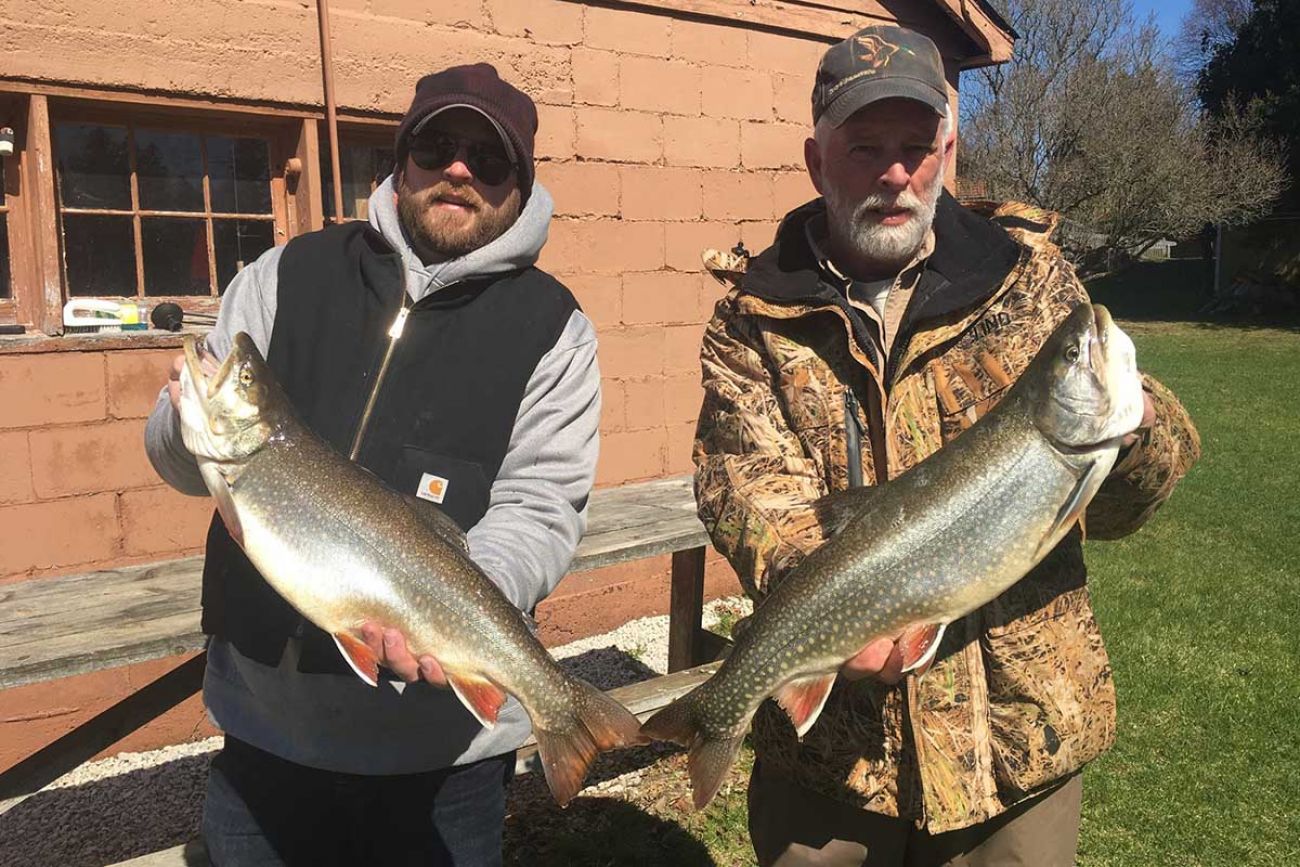
Derrek Stuk and Rick Frontjes pose with their catch. Tom Frontjes, a boat captain and resort owner in the Les Cheneaux Islands, said cormorants congregate in shallow bays while fish are spawning, enabling the birds to “do a ton of damage in a very short amount of time.” (Courtesy photo)
So far, workers have killed cormorants at five of the 13 sites, while resorting to harassing the birds at the rest.
On the Les Cheneaux Islands, workers have visited the local cormorant colony multiple times this year on lethal control missions, Frontjes said.
It will take time to shrink a colony that has rebounded since the former federal control program ended, he said, but “I’m thankful that we’re able to stop the growth.”
Does killing birds save fish?
Not everyone agrees.
In a position statement opposing the order, the Michigan Audubon Society noted that other pressures on the Great Lakes, from invasive mussels to habitat loss and pollution, pose far bigger threats to Great Lakes fish.
By killing cormorants, the group said, government officials are “encouraging the persecution of a visually-obvious target, when the reasons for dwindling sportfish populations are complex and lack a silver bullet.”
Other seabirds also eat fish, noted Ludwig, the Ontario-based scientist. But cormorants, with their black plumage and prehistoric appearance, bear the brunt of anglers’ ire.
He chalks it up to a sharply disputed theory of “cultural bias against any animal that’s black,” combined with the cormorant’s communal nesting habits: Their densely-packed colonies make them a highly-visible target.
Ludwig believes the killing program will needlessly harm a native bird species that may already be in decline. A federal program that once kept close track of cormorant nesting sites ended in 2008, he said. As a result, species managers lack a clear picture of how Great Lakes cormorant populations are faring today.
The fish and wildlife service has vowed to develop a protocol to resume monitoring within a year.
Ludwig said his surveys of selected cormorant colonies in the Great Lakes indicates the birds are struggling to find food and protect their nests from eagles that have started eating cormorant chicks as a replacement for the disappearing fish.
“The entire structure of the ecosystem shifted,” Ludwig said, and the culprit is invasive mussels, not hungry cormorants.
Scientific studies have drawn mixed conclusions about whether the birds can drive down sportfish numbers in the Great Lakes, though there is clearer evidence of their impact in smaller inland lakes.
On the big lakes, fish and wildlife managers say the birds’ nesting behavior makes them a localized threat.
Cormorant colonies can number as large as thousands of nesting pairs. One study found that as cormorant numbers rose on the Les Cheneaux Islands, the local perch fishery collapsed.
With all those birds confined in a small area, Frontjes said, “they can do a ton of damage in a very short amount of time,” picking off perch by the thousands as the fish gather in the islands’ shallow bays to spawn.
Nobody is proposing eliminating the birds entirely, Frontjes said, “but you can’t have them totally decimating other species, either.”
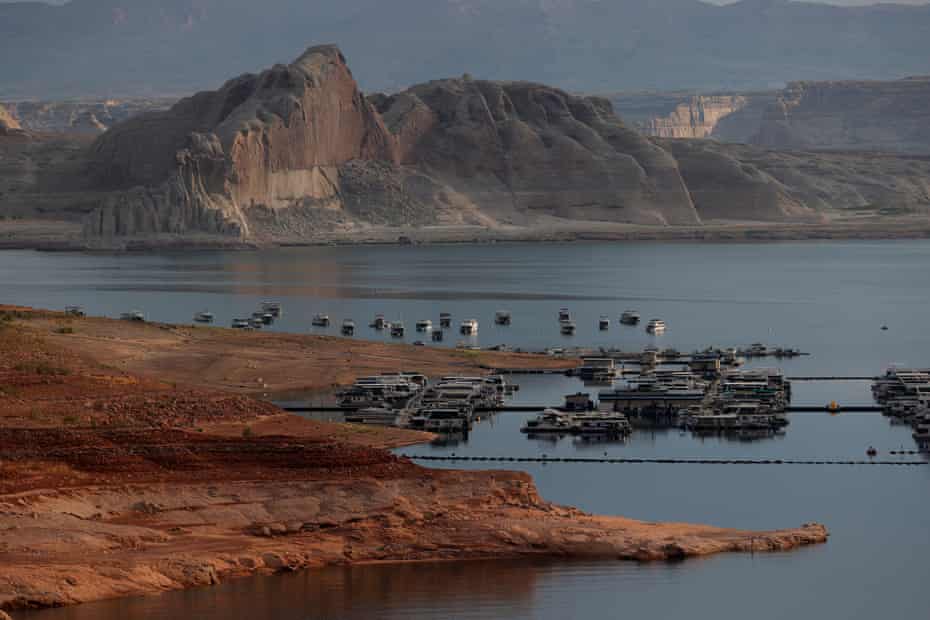
The giant reservoir is currently three-quarters empty and will keep dropping at least through next spring due to record low snowpack levels in the Colorado River basin.Photograph: Justin Sullivan/Getty Images
At Lake Powell on the Arizona-Utah border, the water line has dropped to a historic low, taking a heavy toll on the local industrySupported by
Chaos erupted at Bill West’s business in Page,Arizona, last week when he was forced to tell dozens of paid clients their summer vacations were either canceled or on hold – effective immediately.
West, the owner of a houseboat timeshare company, was scrambling after record-low water levels at Lake Powell – one of the most popular motorized boating destinations in the US – disrupted recreational and tourism activities throughout the region.
The National Park Service abruptly announced earlier this month that houseboats could…
The lifestyles of around three average Americans will create enough planet-heating emissions to kill one person, and the emissions from a single coal-fired power plant are likely to result in more than 900 deaths, according to the first analysis to calculate the mortal cost of carbon emissions.
The new research builds upon what is known as the “social cost of carbon”, a monetary figure placed upon the damage caused by each ton of carbon dioxide emissions, by assigning an expected death toll from the emissions that cause the climate crisis.
The analysis draws upon several public health studies to conclude that for every 4,434 metric tons of CO2 pumped into the atmosphere beyond the 2020 rate of emissions, one person globally will die prematurely from the increased temperature. This additional CO2 is equivalent to the current lifetime emissions of 3.5 Americans.
Adding a further 4m metric tons above last year’s level, produced by the average US coal plant, will cost 904 lives worldwide by the end of the century, the research found. On a grander scale, eliminating planet-heating emissions by 2050 would save an expected 74 million lives around the world this century.
Air pollution caused by the burning of fossil fuels is also directly killing people, with a landmark Harvard University study published in February finding that more than 8 million globally are dying each year from the health effects of toxic air.
“There are a significant number of lives that can be saved if you pursue climate policies that are more aggressive than the business as usual scenario,” Bressler said. “I was surprised at how large the number of deaths are. There is some uncertainty over this, the number could be lower but it could also be a lot higher.”
The research, published in Nature Communications, illustrates the vast disparities in the emissions generated by people’s consumption in different countries around the world. While it takes just 3.5 Americans to create enough emissions in a lifetime to kill one person, it would take 25 Brazilians or 146 Nigerians to do the same, the paper found.
The social, or financial, cost of carbon has become a widely-used metric after its creation by economist William Nordhaus, who subsequently won a Nobel prize, in the 1990s. The measurement calculates the damage caused by a ton of emissions, factored with the ability to adapt to the changing climate.
Under Nordhaus’ DICE model the 2020 social cost of carbon is $37 a metric ton but Bressler’s addition of the mortality cost brings this figure up to $258 a ton. This change to the model would imply that an economically optimal policy would be to radically reduce emissions to reach full decarbonization by 2050, a scenario that has also been backed by climate scientists as one that would avoid the worst ravages of global heating.
“Nordhaus came up with a fantastic model but he didn’t take in the latest literature on climate change’s damage upon mortality, there’s been an explosion of research on that topic in recent years,” said Bressler.
Gernot Wagner, a climate economist at New York University who was not involved in the research, said that the social cost of carbon is a “crucial policy tool” but is also “very abstract”.
“That makes attempts to translate our climate impact into more relatable terms so important,” he said, adding that the new research on the mortality cost shows the “results are certainly dramatic”.
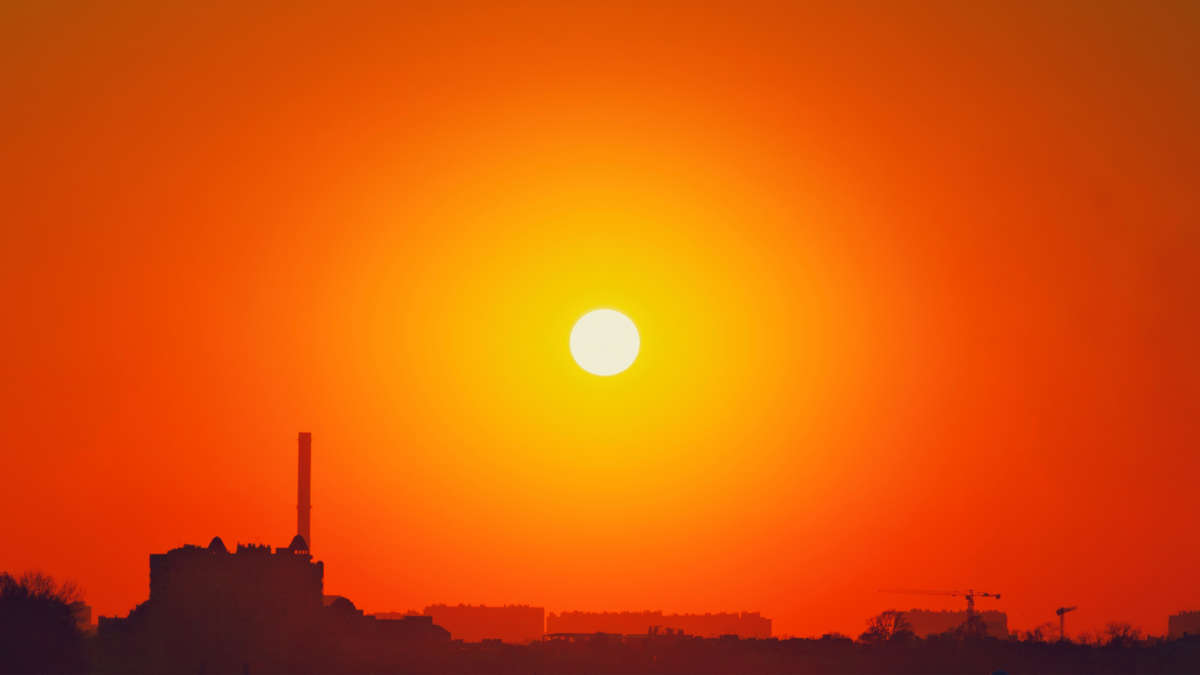
A series of heatwaves has swept the globe over the past month, including the dramatic heat and wildfires in the US Pacific north-west, where temperature records in Seattle and Portland were shattered and caused hundreds of people to die from heat stroke and other related conditions. Scientists say the climate crisis, driven by carbon emissions, is making heatwaves far more frequent and severe.
Bressler said that while his paper looked at the emissions caused by individual activity, the focus should instead be on policies that impact businesses and governments that influence carbon pollution on a societal scale.
“My view is that people shouldn’t take their per-person mortality emissions too personally,” he said. “Our emissions are very much a function of the technology and culture of the place that we live.”