I’m a big fan of the Endangered Species Act (ESA). In fact I wrote my PhD on an ESA issue — wolves at Isle Royale National Park — back in 1997. The Endangered Species Act has helped keep some species from being wiped out across the U.S.
In that vein, it was good to hear about the proposed “Extinction Prevention Act” recently introduced in Congress by U.S. Rep. Grijalva and U.S. Senator Blumenthal. The Extinction Prevention Act proposes to give more funding to species protection programs. This is good news because the ESA has been fiscally starved by past congresses and presidential administrations.
But the Extinction Prevention Act is not enough. Biodiversity is under assault across the U.S. as growth and development — mostly driven by human population growth — ravages and devours natural landscapes.
Scientists have been paying attention to this. As one example, the authors in the scientific journal, Issues In Ecology, (Winter 2016) stated:
“The ESA has not kept pace with rapid socioeconomic changes in the United States and advances in conservation science. Since 1973, the US population has grown by more than 50%, and gross domestic product has expanded from approximately $1.4 trillion to more than $16 trillion, resulting in multiple stressors to vulnerable species….the greatest threats to listed species are habitat loss and degradation…. Human population growth, economic activity, and intensive land uses have rapidly increased. Threats to listed species such as habitat loss and degradation and invasive exotic species have increased in severity. Climates have undergone fundamental change. These trends will likely continue.”
Whether it’s puma in southern California, or grizzly bear in the Northern Rockies, human population growth is squeezing out the non-human world, invading its habitat, pushing it to the edge of extinction. In my local watersheds in northern Colorado, population growth is devouring landscapes, rivers, and wildlife habitats.
In 2019, the Center for American Progress reported: “The United States is quietly losing its remaining forests, grasslands, deserts, and natural places at a blistering pace. Every 30 seconds, a football field worth of America’s natural areas disappears to roads, houses, pipelines, and other development.”
The U.S. House and President Biden have taken positive steps recently around protecting wildlife habitat with the 30×30 campaign that proposes to protect 30 percent of the U.S. landscape by the year 2030. At the very same time though, around 2 million more people are added to the U.S. population each year which creates a Los Angeles County-sized blob of urban sprawl — another 10 million people — on the U.S. landscape every 5 years.
It feels like one-step-forward, two-steps-back to me. We can spend more money trying to save species, and launch new programs to protect more critical wildlife habitat, but if we keep adding 2 million people to the U.S. every year, we’re going backwards in our conservation goals.
We need to stabilize the U.S. population if we are to have any chance of saving endangered species as well as the majority of the extraordinary, but extremely threatened, natural world around us.
To help inform proposals for the Aug. 20 Fish and Wildlife Commission meeting, Montana Fish, Wildlife & Parks is soliciting public comments on two topics: Elk shoulder seasons and trapping setbacks.
The comments will be incorporated into FWP staff’s presentation to the Commission at its meeting Aug. 20. The Commission will allow further public comment on these subjects during the meeting.
Elk Shoulder Seasons
At its June meeting, the Fish and Wildlife Commission approved a proposal to go out for public comment to extend Elk Shoulder Seasons to Feb. 15 on private land in 18 hunting districts. These are hunting districts where shoulder seasons currently exist, but end prior to Feb. 15.
The department would now like the public to provide input on expanding…
SPRINGFIELD, Ill. (AP) — Four hunters from Indiana have pleaded guilty and paid fines in a southern Illinois poaching case.
The Illinois Department of Natural Resources says in a recent news release that the four hunters pleaded guilty to unlawful use of a rifle.
Jon Reynolds, Tim Allen, James Hall, and Cade Cruse are accused of deer hunting with rifles without required permits or hunting licenses and had two untagged, harvested deer with them.
Illinois Conservation Police seized four rifles and donated the untagged deer to a local animal rehabilitator to help feed injured wildlife.
The four hunters were sentenced to 1 year of supervision and paid $5,000 in fines.
Abortion rights activists gather outside the U.S. Supreme Court to protest against recently passed anti-abortion laws across the country, on May 21, 2019, in Washington, D.C.
In June of 2022, upwards of35 percentof the U.S. could instantly lose access to legal abortion. The Supreme Court’s decision onDobbs v. Jackson Women’s Health Organizationcould effectively overturnRoe v. Wade, a landmark case in 1973 which held that a person’s right to choose an abortion was integral to their right to privacy and therefore should not be dictated by the government. Through decades of carefully orchestrated, conservative state-level action,24 statesare poised to overturnRoeprotections, including 10 with immediate “trigger bans” in place…
Brazil’s rainforest stores a huge amount of CO2. As it’s released at record rates, we may have passed a tipping point
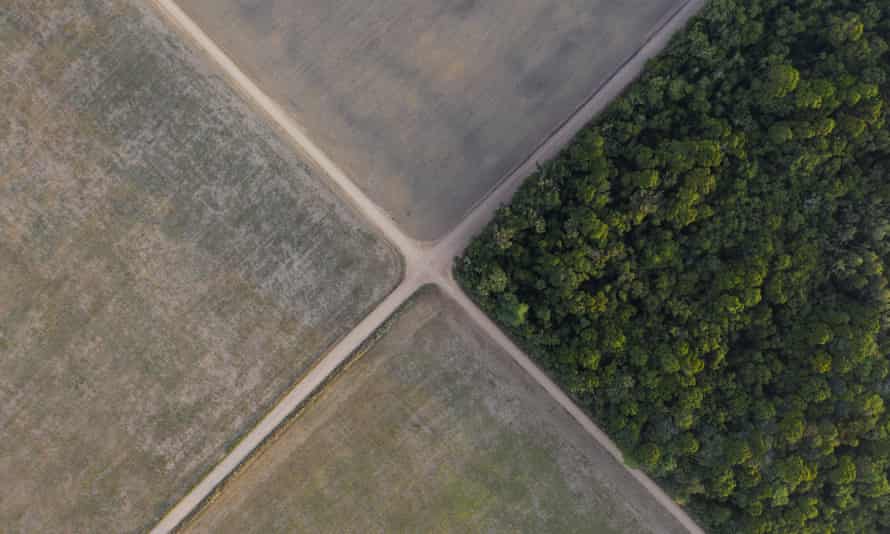
‘We are witnessing the destruction of great swathes of the Amazon, into islands of trees within a sea of soy bean plantations and cattle ranches.’ Soy fields in Belterra, Pará state, Brazil. Photograph: Léo Corrêa/AP
Mon 19 Jul 2021 07.28 EDT
The Amazon acts as a vital organ for our entire planet. The largest rainforest in the world, it provides an important function to both the Earth’s water and carbon cycles. The region, home to abundant and highly diverse species and ecosystems, houses more than 390bn trees. These have an exceptional capacity to recycle water by pumping it from the soil back up into the atmosphere, but also play a crucial role in storing carbon: the Amazon forest stores an amount of carbon equivalent to two to three times all the CO2 emitted by the UK since 1750. When trees die, either by natural causes or deforestation, this carbon can return to the atmosphere.
Climate change, and at least four decades of deforestation and degradation of the Amazon following the installation of main roads that have expanded from south to north and east to west through the basin, have created a situation in which the Amazon is more open than ever to human destruction. The declining capacity of the forest, notably in its south-east, to uptake one of the main greenhouse gases, has a knock-on effect: reducing the rainforest’s own resilience to climate change and exponentially increasing the possibility of the climate reaching a theorised “tipping point”.
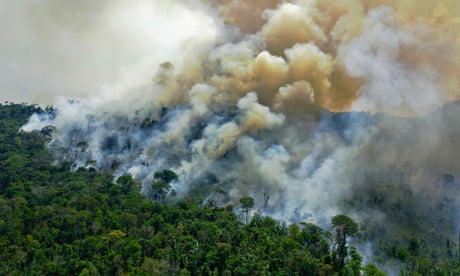
The synergic effects between a highly fragmented and degraded forest caused by decades of deforestation, logging and fire, and more frequent and intense drought events caused by climate change, generates the perfect condition for recurrent forest fires. The study shows that large pools of carbon are being emitted through such fires, especially in the north-east. This is clearly shocking and extremely worrying, but also surprising is the volume of carbon emitted by the remaining forest in the south-east. There, several years after the conversion to pasture, the remaining forest is acting differently to the other regions: the new landscape and climate mean the forest is changing its behaviour, with even standing forests inexplicably emitting carbon. The impacts of returning fires in the rainforest, which is a fire-sensitive ecosystem, include change in forest structure, reduction in carbon stocks, biodiversity and nutrient availability.
To restore the net carbon emissions of the Amazon forest to its balance and avoid other portions of the region’s forest reaching a tipping point where massive mortality further affects resilience, we must reduce forest loss by deforestation and fires, and invest in massive landscape restoration. Unfortunately, Brazil is taking a different route in relation to these major sources of carbon emissions. The country, which is the sixth largest greenhouse gas emitter in the world, has 44% of its emissions directly associated with land use change, mainly the conversion of forests to agriculture and pasture fields.
For decades, the so-called Amazon tipping point hypothesis has been predicting that once we reach 20% deforestation of the basin, the system would shift from a carbon sink to a carbon source. Now, the longstanding hypothesis has started to be confirmed, as we witness the destruction of great swathes of one of the most magnificent forests on Earth, into islands of trees within a sea of soy bean plantations and cattle ranches. Yet this Nature paper indicates that Brazil may be emitting much more than previously reported.https://36d0eb969e924a3a01b91d8a6a52bd8c.safeframe.googlesyndication.com/safeframe/1-0-38/html/container.html
The chances of reversing this situation are becoming more distant by the day. There has been no investment in restoration by the federal government – and the rates of deforestation and fires have been reaching new heights month after month. This situation has been aggravated since Jair Bolsonaro took over the presidency. Enforcement agencies have been weakened and deauthorised, a problem compounded by a lack of direction and resources. Stakeholders including illegal loggers and miners have had their voices heard by the government over indigenous peoples and local communities. Ongoing changes in environmental policies, such as allowing mining in indigenous lands, formalising land titles on public lands occupied illegally, and loosening the environmental licensing process, continue to incentivise illegal activities, generating more deforestation and fire.
To change this situation, we must better implement enforcement to fight and inhibit illegal activities that cause deforestation and environmental crimes in the Amazon; provide positive incentives for sustainable use and good practices in forestry and agriculture; support indigenous peoples and local communities’ economies; increase transparency and traceability of Amazon products; and engage the private sector and international community in green financing and other environmental solutions.
From individuals to large organisations, we must boycott the products and initiatives that drive deforestation, and instead consume products and fund initiatives that keep the forest standing. If both the Brazilian and global societies don’t wake up to the importance of a healthy Amazon to the fight against the pervasive effects of climate change in the region, we will all lose out.
Ane Alencar is the science director of the Amazon Environmental Research Institute (IPAM), Brazil. Dr Adriane Esquivel Muelbert is a lecturer in global forest ecology at the University of Birmingham and Birmingham Institute of Forest Research (BIFoR)
Imagine a universe where you could point a spaceship in one direction and eventually return to where you started. If our universe were a finite donut, then such movements would be possible and physicists could potentially measure its size.
“We could say: Now we know the size of the universe,” astrophysicist Thomas Buchert, of the University of Lyon, Astrophysical Research Center in France, told Live Science in an email.
Examining light from the very early universe, Buchert and a team of astrophysicists have deduced that our cosmos may be multiply connected, meaning that space is closed in on itself in all three dimensions like a three-dimensional donut. Such a universe would be finite, and according to their results, our entire cosmos might only be about three to four times larger than the limits of the observable universe, about 45 billion light-years away.CLOSEhttps://imasdk.googleapis.com/js/core/bridge3.472.0_en.html#goog_1604299803Volume 0% PLAY SOUND
A tasty problem
Physicists use the language of Einstein’s general relativity to explain the universe. That language connects the contents of spacetime to the bending and warping of spacetime, which then tells those contents how to interact. This is how we experience the force of gravity. In a cosmological context, that language connects the contents of the entire universe — dark matter, dark energy, regular matter, radiation and all the rest — to its overall geometric shape. For decades, astronomers had debated the nature of that shape: whether our universe is “flat” (meaning that imaginary parallel lines would stay parallel forever), “closed” (parallel lines would eventually intersect) or “open” (those lines would diverge).
That geometry of the universe dictates its fate. Flat and open universes would continue to expand forever, while a closed universe would eventually collapse in on itself.
Multiple observations, especially from the cosmic microwave background (the flash of light released when our universe was only 380,000 years old), have firmly established that we live in a flat universe. Parallel lines stay parallel and our universe will just keep on expanding.
But there’s more to shape than geometry. There’s also topology, which is how shapes can change while maintaining the same geometric rules.
For example, take a flat piece of paper. It’s obviously flat — parallel lines stay parallel. Now, take two edges of that paper and roll it up into a cylinder. Those parallel lines are still parallel: Cylinders are geometrically flat. Now, take the opposite ends of the cylindrical paper and connect those. That makes the shape of a donut, which is also geometrically flat.
While our measurements of the contents and shape of the universe tell us its geometry — it’s flat — they don’t tell us about the topology. They don’t tell us if our universe is multiply-connected, which means that one or more of the dimensions of our cosmos connect back with each other.
Look to the light
While a perfectly flat universe would extend out to infinity, a flat universe with a multiply-connected topology would have finite size. If we could somehow determine whether one or more dimensions are wrapped in on themselves, then we would know that the universe is finite in that dimension. We could then use those observations to measure the total volume of the universe.
But how would a multiply-connected universe reveal itself?
A team of astrophysicists from Ulm University in Germany and the University of Lyon in France looked to the cosmic microwave background (CMB). When the CMB was released, our universe was a million times smaller than it is today, and so if our universe is indeed multiply connected, then it was much more likely to wrap in on itself within the observable limits of the cosmos back then. Today, due to the expansion of the universe, it’s much more likely that the wrapping occurs at a scale beyond the observable limits, and so the wrapping would be much harder to detect. Observations of the CMB give us our best chance to see the imprints of a multiply connected universe.
The team specifically looked at the perturbations — the fancy physics term for bumps and wiggles — in the temperature of the CMB. If one or more dimensions in our universe were to connect back with themselves, the perturbations couldn’t be larger than the distance around those loops. They simply wouldn’t fit.
As Buchert explained to Live Science in an email, “In an infinite space, the perturbations in the temperature of the CMB radiation exist on all scales. If, however, space is finite, then there are those wavelengths missing that are larger than the size of the space.”
In other words: There would be a maximum size to the perturbations, which could reveal the topology of the universe.
Maps of the CMB made with satellites like NASA’s WMAP and and the ESA’s Planck have already seen an intriguing amount of missing perturbations at large scales. Buchert and his collaborators examined whether those missing perturbations could be due to a multiply-connected universe. To do that, the team performed many computer simulations of what the CMB would look like if the universe were a three-torus, which is the mathematical name for a giant three-dimensional donut, where our cosmos is connected to itself in all three dimensions.Advertisement
“We therefore have to do simulations in a given topology and compare with what is observed,” explained Buchert. “The properties of the observed fluctuations of the CMB then show a ‘missing power’ on scales beyond the size of the universe.” A missing power means that the fluctuations in the CMB are not present at those scales. That would imply that our universe is multiply-connected, and finite, at that size scale.RELATED CONTENT
“We find a much better match to the observed fluctuations, compared with the standard cosmological model which is thought to be infinite,” he added.
“We can vary the size of the space and repeat this analysis. The outcome is an optimal size of the universe that best matches the CMB observations. The answer of our paper is clearly that the finite universe matches the observations better than the infinite model. We could say: Now we know the size of the universe.”
The team found that a multiply-connected universe about three to four times larger than our observable bubble best matched the CMB data. While this result technically means that you could travel in one direction and end up back where you started, you wouldn’t be able to actually accomplish that in reality. We live in an expanding universe, and at large scales the universe is expanding at a rate that is faster than the speed of light, so you could never catch up and complete the loop.
Buchert emphasized that the results are still preliminary. Instrument effects could also explain the missing fluctuations on large scales.
Still, it’s fun to imagine living on the surface of a giant donut.
New Data Leads To Rethinking (Once More) Where The Pandemic Actually Began
Audio will be available later today.
Back in May, a group of scientists — many at the top of the virology field — shifted the debate about the origins of COVID-19. They published a letter in the journalSciencesaying the lab-leak theory needs to be taken more seriously by the scientific community.
Given the current evidence available, the scientists wrote, the outbreak is just as likely to have originated from a laboratory — specifically the Wuhan Institute of Virology, which studies coronaviruses — as from an infected animal. “We must take hypotheses about both natural and laboratory spillovers seriously until we have sufficient data,” they concluded.
Now one of the scientists who signed that letter says new data has come…
The rapid succession of precedent-shattering extreme weather events in North America and Europe this summer is prompting some scientists to question whether climate extremes are worsening faster than expected.
Why it matters:Extreme weather events are the deadliest, most expensive and immediate manifestations of climate change. Any miscalculations in how severe these events may become, from wildfires to heat waves and heavy rainfall, could make communities more vulnerable.
Comet C/2014 UN271 (Bernardinelli-Bernstein), as seen in a synthetic color composite image made with the Las Cumbres Observatory 1-meter telescope at Sutherland, South Africa, on 22 June 2021. The diffuse cloud is the comet’s coma. Credit: LOOK/LCO
A newly discovered visitor to the outer edges of our Solar System has been shown to be the largest known comet ever, thanks to the rapid response telescopes of Las Cumbres Observatory. The object, which is named Comet C/2014 UN271 Bernardinelli-Bernstein after its two discoverers, was first announced on Saturday, June 19th, 2021. C/2014 UN271 was found by reprocessing four years of data from the Dark Energy Survey, which was carried out using the 4-m Blanco telescope at Cerro Tololo Inter-American Observatory in Chile between 2013 and 2019.
At the time of the announcement, there was no indication that this was an active world. Anticipation was immediately high among astronomers. C/2014 UN271 was inbound from the cold outer reaches of the Solar System, so rapid imaging was needed to find out: when would the big new-found world start to show a comet’s tail?
Las Cumbres Observatory was quickly able to determine whether the object had become an active comet in the three years since it was first seen by the Dark Energy Survey. “Since the new object was far in the south and quite faint, we knew there wouldn’t be many other telescopes that could observe it,” says Dr. Tim Lister, Staff Scientist at Las Cumbres Observatory (LCO). “Fortunately LCO has a network of robotic telescopes across the world, particularly in the Southern Hemisphere, and we were able to quickly get images from the LCO telescopes in South Africa,” explained Tim Lister.
An orbital diagram showing the path of Comet C/2014 UN271 (Bernardinelli-Bernstein) through the Solar System. The comets’ path is shown in gray when it is below the plane of the planets and in bold white when it is above the plane. Credit: NASA
The images from one of LCO’s 1-meter telescopes hosted at the South African Astronomical Observatory, came in around 9pm PDT on Monday night June 22. Astronomers in New Zealand who are members of the LCO Outbursting Objects Key (LOOK) Project were the first to notice the new comet.
“Since we’re a team based all around the world, it just happened that it was my afternoon, while the other folks were asleep. The first image had the comet obscured by a satellite streak and my heart sank. But then the others were clear enough and gosh: there it was, definitely a beautiful little fuzzy dot, not at all crisp like its neighboring stars!” said Dr. Michele Bannister at New Zealand’s University of Canterbury. Analysis of the LCO images showed a fuzzy coma around the object, indicating that it was active and was indeed a comet, even though it is still out at a remarkable distance of more than 1,800,000,000 miles, more than double Saturn’s distance from the Sun.
The comet is estimated to be over 100km in diameter, which is more than three times the size of the next biggest comet nucleus we know, Comet Hale-Bopp, which was discovered in 1995. This comet is not expected to become naked-eye bright: it will remain a telescopic object because its closest distance to the Sun will still be beyond Saturn. Since Comet C/2014 UN271 was discovered so far out, astronomers will have over a decade to study it. It will reach its closest approach to the Sun in January of 2031. A recent article in the New York Times about the comet details its predicted travel.
Thus Tim Lister and the other astronomers of the LOOK Project will have plenty of time to use the telescopes of Las Cumbres Observatory to study C/2014 UN271. The LOOK Project is continuing to observe the behavior of a large number of comets and how their activity evolves as they come closer towards the Sun. The scientists are also using the rapid response capability of LCO to get observations very quickly when a comet goes into an outburst.
“There are now a large number of surveys, such as the Zwicky Transient Facility and the upcoming Vera C. Rubin Observatory, that are monitoring parts of the sky every night. These surveys can provide alerts if one of the comets changes brightness suddenly and then we can trigger the robotic telescopes of LCO to get us more detailed data and a longer look at the changing comet while the survey moves onto other areas of the sky,” explains Tim Lister. “The robotic telescopes and sophisticated software of LCO allow us to get images of a new event within 15 minutes of an alert. This lets us really study these outbursts as they evolve.”