Emergency Management B.C. warns that available accommodation for thousands of wildfire evacuees strained to the limit in Thompson and Cariboo regions, with some evacuees being sheltered as far south as ChilliwackAuthor of the article:
Amy Smart, The Canadian PressPublishing date:Jul 19, 2021 • 1 day ago • 4 minute read • Join the conversation
This handout photo courtesy of B.C. Wildfire Service shows a wildfire southwest of Deka Lake (C41102), which is estimated to be 200 hectares, British Columbia, on July 2, 2021.PHOTO BY -/AFP
Article content
MERRITT — A regional politician in British Columbia’s Interior is calling for more support amid a “dire” wildfire situation that he said has filled every available hotel with fleeing evacuees and stretched local security resources beyond their capacity.
Advertisement
STORY CONTINUES BELOW
Article content
Ken Gillis, who chairs the Thompson-Nicola Regional District, signed an evacuation order Monday for 28 properties near the community of Westwold, the latest in…
Erick LundgrenPhD Student, Centre for Compassionate Conservation, University of Technology Sydney
Arian WallachLecturer, Centre for Compassionate Conservation, University of Technology Sydney
Daniel RampAssociate Professor and Director, Centre for Compassionate Conservation, University of Technology Sydney
Disclosure statement
Arian Wallach receives funding from the Australian Research Council.
Daniel Ramp receives funding from the Australian Research Council.
Erick Lundgren does not work for, consult, own shares in or receive funding from any company or organization that would benefit from this article, and has disclosed no relevant affiliations beyond their academic appointment.
In the heart of the world’s deserts – some of the most expansive wild places left on Earth – roam herds of feral donkeys and horses. These are the descendants of a once-essential but now-obsolete labour force.
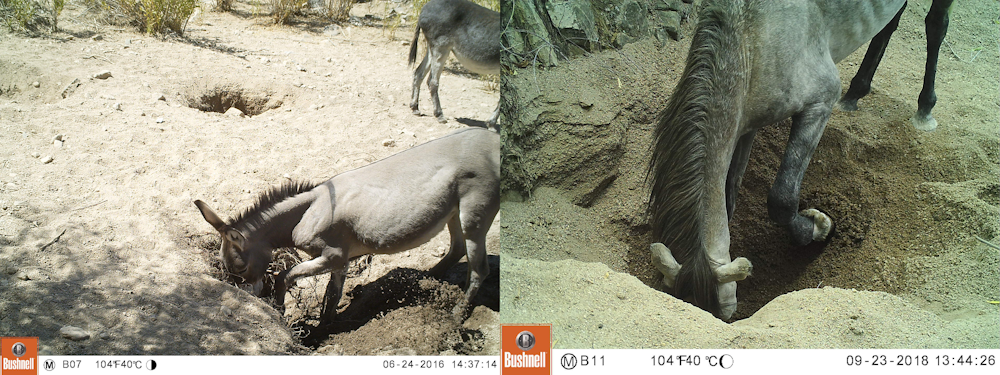
These wild animals are generally considered a threat to the natural environment, and have been the target of mass eradication and lethal control programs in Australia. However, as we show in a new research paper in Science, these animals do something amazing that has long been overlooked: they dig wells — or “ass holes”.
In fact, we found that ass holes in North America — where feral donkeys and horses are widespread — dramatically increased water availability in desert streams, particularly during the height of summer when temperatures reached near 50℃. At some sites, the wells were the only sources of water.
Feral donkeys and horses dig wells to desert groundwater. Erick Lundgren
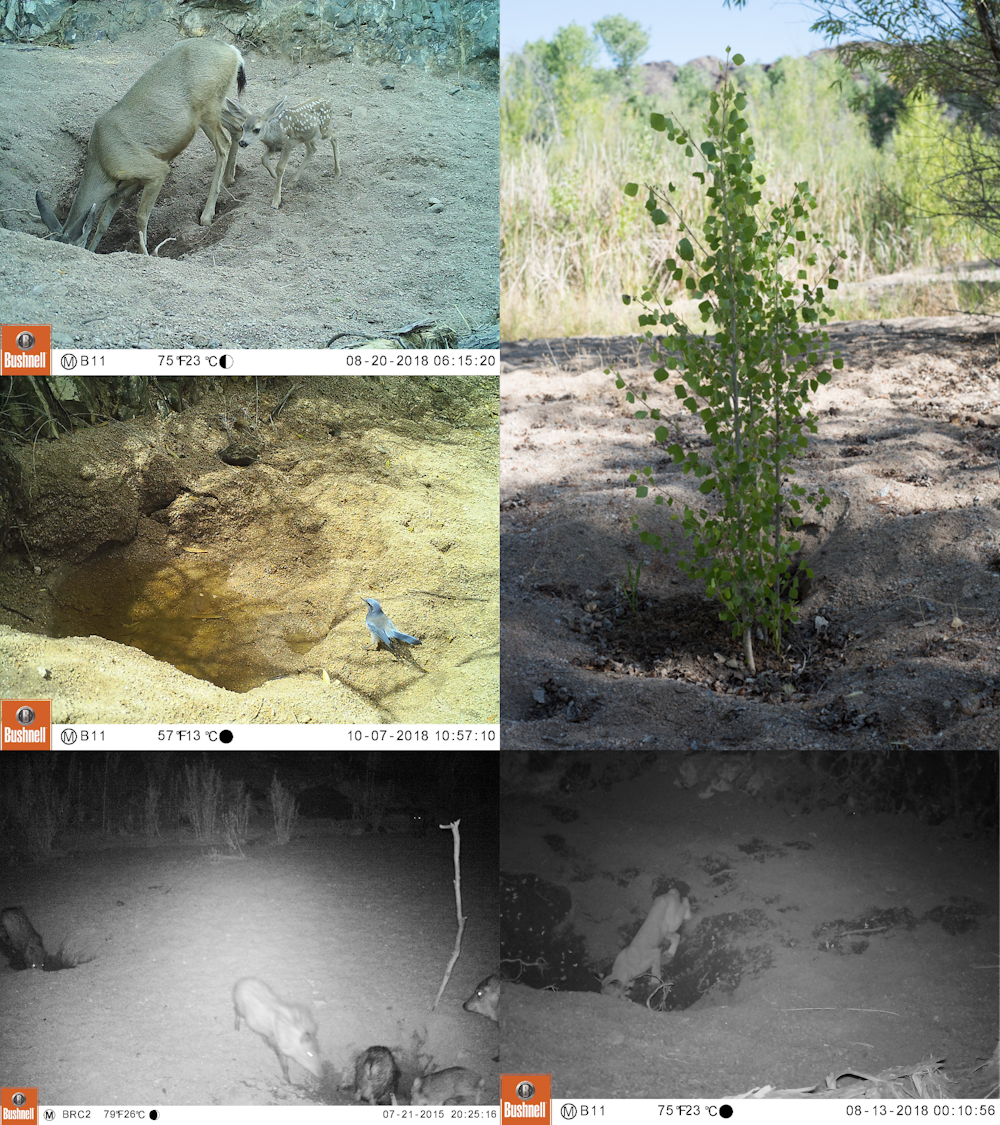
The wells didn’t just provide water for the donkeys and horses, but were also used by more than 57 other species, including numerous birds, other herbivores such as mule deer, and even mountain lions. (The lions are also predators of feral donkeys and horses.)
How The Conversation is different: All our authors are experts.
Learn more
Incredibly, once the wells dried up some became nurseries for the germination and establishment of wetland trees.
Numerous species use equid wells. This includes mule deer (top left), scrub jays (middle left), javelina (bottom left), cottonwood trees (top right), and bobcats (bottom right). Erick Lundgren
Ass holes in Australia
Our research didn’t evaluate the impact of donkey-dug wells in arid Australia. But Australia is home to most of the world’s feral donkeys, and it’s likely their wells support wildlife in similar ways.
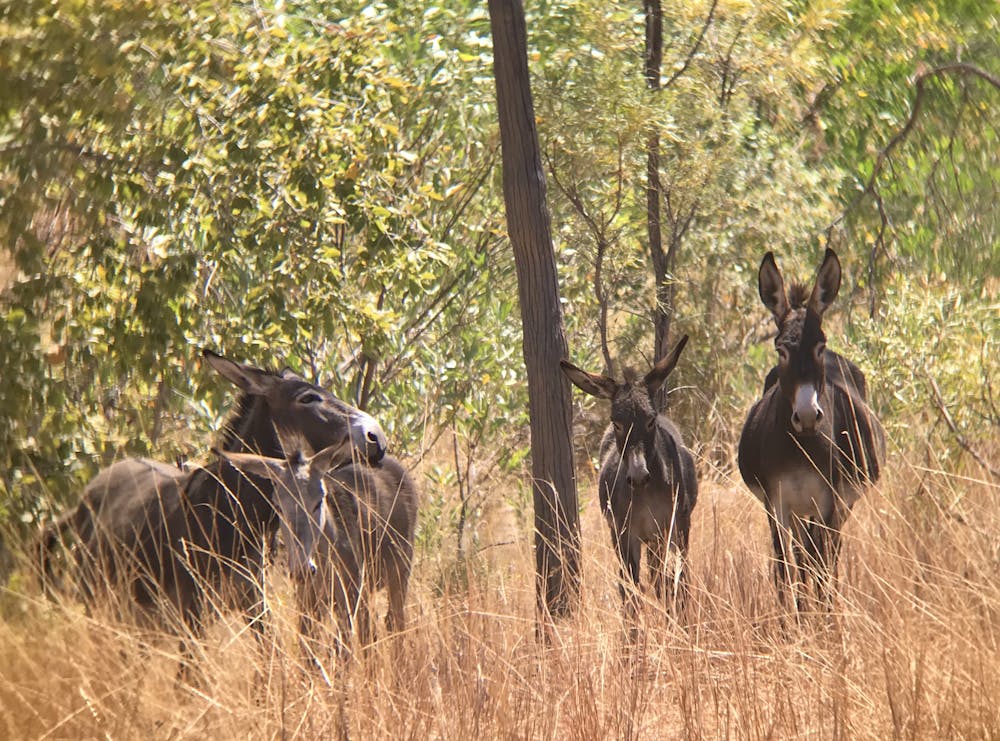
Across the Kimberley in Western Australia, helicopter pilots regularly saw strings of wells in dry streambeds. However, these all but disappeared as mass shootings since the late 1970s have driven donkeys near local extinction. Only on Kachana Station, where the last of the Kimberley’s feral donkeys are protected, are these wells still to be found.
In Queensland, brumbies (feral horses) have been observed digging wells deeper than their own height to reach groundwater.
Some of the last feral donkeys of the Kimberley. Arian Wallach
Feral horses and donkeys are not alone in this ability to maintain water availability through well digging.
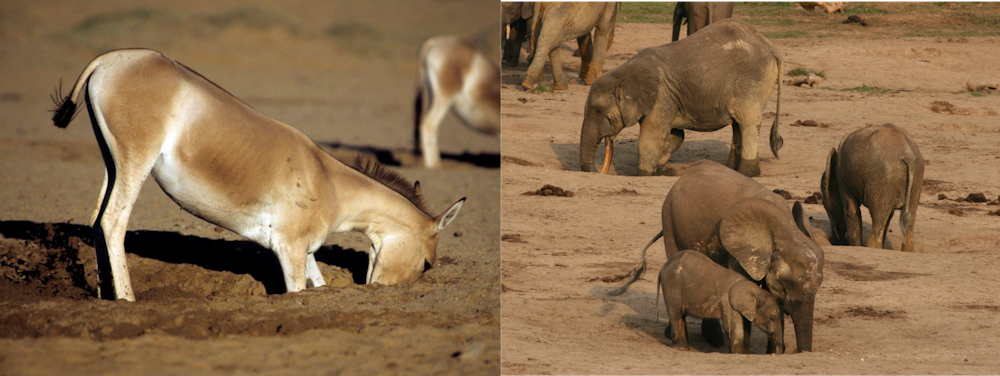
Other equids — including mountain zebras, Grevy’s zebras and the kulan — dig wells. African and Asian elephants dig wells, too. These wells provide resources for other animal species, including the near-threatened argali and the mysterious Gobi desert grizzly bear in Mongolia.
These animals, like most of the world’s remaining megafauna, are threatened by human hunting and habitat loss.
Other megafauna dig wells, too, including kulans in central Asia, and African elephants. Petra Kaczensky, Richard Ruggiero
Digging wells has ancient origins
These declines are the modern continuation of an ancient pattern visible since humans left Africa during the late Pleistocene, beginning around 100,000 years ago. As our ancestors stepped foot on new lands, the largest animals disappeared, most likely from human hunting, with contributions from climate change.
If their modern relatives dig wells, we presume many of these extinct megafauna may have also dug wells. In Australia, for example, a pair of common wombats were recently documented digging a 4m-deep well, which was used by numerous species, such as wallabies, emus, goannas and various birds, during a severe drought. This means ancient giant wombats (Phascolonus gigas) may have dug wells across the arid interior, too.
Likewise, a diversity of equids and elephant-like proboscideans that once roamed other parts of world, may have dug wells like their surviving relatives.
Indeed, these animals have left riddles in the soils of the Earth, such as the preserved remnants of a 13,500-year-old, 2m-deep well in western North America, perhaps dug by a mammoth during an ancient drought, as a 2012 research paper proposes.
Feral equids are resurrecting this ancient way of life. While donkeys and horses were introduced to places like Australia, it’s clear they hold some curious resemblances to some of its great lost beasts.
Our previous research published in PNAS showed introduced megafauna actually make Australia overall more functionally similar to the ancient past, prior to widespread human-caused extinctions.
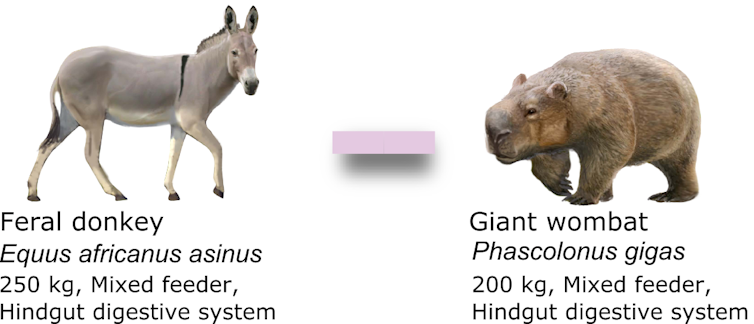
Donkeys share many similar traits with extinct giant wombats, who once may have dug wells in Australian drylands. Illustration by Oscar Sanisidro
For example, donkeys and feral horses have trait combinations (including diet, body mass, and digestive systems) that mirror those of the giant wombat. This suggests — in addition to potentially restoring well-digging capacities to arid Australia — they may also influence vegetation in similar ways.
Water is a limited resource, made even scarcer by farming, mining, climate change, and other human activities. With deserts predicted to spread, feral animals may provide unexpected gifts of life in drying lands.
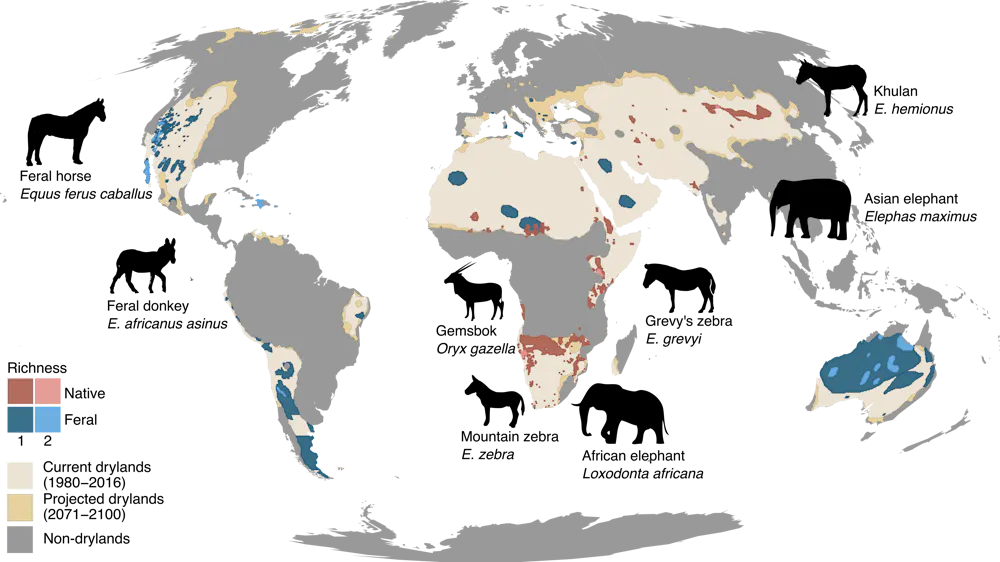
Feral donkeys, horses (mapped in blue), and other existing megafauna (mapped in red) may restore digging capacities to many drylands. Non-dryland areas are mapped in grey, and the projected expansion of drylands from climate change in yellow. Erick Lundgren/Science, Author provided
Despite these ecological benefits in desert environments, feral animals have long been denied the care, curiosity and respect native species deservedly receive. Instead, these animals are targeted by culling programs for conservation and the meat industry.
Several groups signaled intent to file a lawsuit over the expanded wolf-killing law they say will result in the deaths of other federally protected animals.
BOISE, Idaho — Note: The video above is from a May story about the impacts of the expanded wolf-killing law.
Environmental groups have notified Idaho Gov. Brad Little and other state officials of their intent to file a lawsuit over an expanded wolf-killing law they believe will result in the illegal killing of federally protected grizzly bear and lynx.
The Center for Biological Diversity, Western Watersheds Project and others on Monday gave a required 60-day notice of their intent to sue if Idaho officials don’t prohibit all hunting, trapping and snaring in grizzly bear and lynx habitat.
For lynx, the conditions could cover most of Idaho except for the southwestern portion of the state. For grizzly bears, the areas would include portions of northern, central and eastern Idaho. Wolves are found in roughly the northern two-thirds of the state.
In May, the Republican governor signed into law a measure lawmakers said could lead to killing 90% of the state’s 1,500 wolves through expanded trapping and hunting. It took effect July 1.
Lawmakers who sponsored the measure, backed by hunters and the state’s powerful ranching sector but heavily criticized by environmental advocates, said numerous times that the state is allowed to cut the number of wolves down to 150 before federal authorities would take over management of the species. They said reducing the wolf population would reduce attacks on livestock and boost deer and elk herds.
“Lynx, grizzly bears, and gray wolves all inhabit similar habitat types and geographic ranges in Idaho, and wolf hunting and trapping therefore frequently occur in areas in which lynx and grizzlies are also present,” the groups said in their letter. “Moreover, because snare and other authorized means of hunting and trapping are imprecise tools, they pose a substantial risk to non-target species, including lynx and grizzly bears.”
Besides Little, the letter was also sent to the members of the Idaho Fish and Game Commission and the directors of the Idaho Department of Fish and Game and Idaho State Department of Agriculture.
Roger Phillips, spokesman for the state Department of Fish and Game, said the agency doesn’t comment on pending litigation.ADVERTISEMENT
Little’s office didn’t immediately respond to a request for comment from The Associated Press.
Environmental groups filed a similar notice of intent to sue in Montana last month that also involves the potential killing of grizzly bears and lynx by wolf hunters and trappers.
A primary change in the new law allows the state to hire private contractors to kill wolves and provides more money for state officials to hire the contractors.
The law also expands the way wolves can be hunted and killed. Those methods include trapping and snaring an unlimited number of wolves on a single hunting tag, using night-vision equipment, chasing down wolves on snowmobiles and ATVs and shooting them from helicopters. It also authorizes year-round wolf trapping on private property.
It’s not clear if the expanded methods and seasons to kill wolves would reduce the wolf population to 150. Republican state Rep. Fred Wood, a former member of the Idaho Fish and Game Commission, said the only way to do that would be to use poison, which is not in the new law.
However, hunters have said night-vision scopes, now allowed, could significantly increase the number of wolves killed. But the threatened lawsuit cites possible deaths of grizzly bears and lynx from expanded trapping and snaring of wolves.
“Idaho’s outdated plans for wolf killing will inevitably harm other native wildlife species,” said Patrick Kelly, Idaho director of Western Watersheds Project. “It’s unacceptable to allow imperiled species to be ‘collateral damage’ in Idaho’s war on wolves.”
The state Department of Fish and Game reported in February that the wolf population has held at about 1,500 the past two years. The numbers were derived by using remote cameras and other methods.
About 500 wolves have been killed in the state in each of the last two years by hunters, trappers and wolf control measures carried out by state and federal authorities.
The entire staff at AIIMS, Delhi, has been placed in isolation as a preventative measure after a 12-year-old boy undergoing treatment for H5N1 Avian influenza died
All India Institute of Medical Sciences (AIIMS), New Delhi today recorded the first bird flu death in the country for this year after a 12-year-old boy undergoing treatment for H5N1 Avian influenza died at its pediatric department.
The entire staff at AIIMS, New Delhi, has been placed in isolation as a preventative measure.
Lawsuit Launched Over Idaho’s Harmful Wolf-Hunting Laws
New Laws Pose Substantial Risks to Federally Protected Lynxes, Grizzly Bears
BOISE,Idaho— Ten groups filed anotice of intenttoday to sue the state of Idaho to challenge the state’s new wolf-hunting laws, which also pose a serious risk to federally protected species like lynxes and grizzly bears.
The laws, which call for the killing of up to 90% of the current gray wolf population, allow for year-round hunting, trapping and snaring, with hunters and trappers allowed to kill an unlimited number of wolves on a single tag. The state’s authorization of an unlimited season and expanded methods of killing wolves is likely to result in incidental trapping and snaring of federally protected lynxes and grizzly bears, violating the Endangered Species Act.
Earthjustice sent the notice on behalf of the Center for Biological Diversity, Footloose Montana, Friends of the Clearwater, International…
by:Brittany FlowersPosted:Jul 20, 2021 / 08:48 AM EDT/Updated:Jul 20, 2021 / 08:48 AM EDTjavascript:false
LILLEY TOWNSHIP, Mich. (WOOD) — Some people are born with a disability and for others, it comes unexpectedly. In either case, loss of direction or purpose, decrease in self-esteem and the challenges of everyday life can put people with disabilities at a higher risk for depression.
Carson Nyenhuis of Grandville found himself in this unexpected situation after a motorcycle crash five years ago.
“I’m paralyzed from the chest down from the accident,” Nyenhuis said. “During my recovery and stuff, I went through some bad depression and had some buddies take me back out in the woods and it really revitalized my spirit and my everything.”
That’s when he realized he loved to help people and wanted to find a way to give others the same opportunity and experience that he had.While there…
The Chicago Roo Crew is seeing more people than usual getting rid of their birds — a difficulty on top of trying to pay off vet bills for the birds they already care for.
Chicago Roo Crew takes in birds like Fuego, who’ve been dumped or are ex-fighters in cockfighting rings.
Credibility:
Original Reporting
On the Ground
Sources Cited
BRONZEVILLE — Julia Magnus has always lived around birds.
Her family raised parrots when she was growing up. Nowadays, her Bronzeville yard is home to birds like Fuego, a fiery game rooster, and Ember Miji Pop Claw, a chicken with spurs. She’s become an animal rights lawyer and a volunteer at Chicago Roo Crew, a female-led group that advocates for the care of roosters in the city.
It’s a life where her birds’ clucking never gets old. But now her organization and volunteers need help.
Julia Magnus, an animal rights lawyer and volunteer for Chicago Roo Crew as seen on July 1, 2021.
During the pandemic, Chicago Roo Crew has been inundated with birds who were often given up by people who said the animals were more work than they’d anticipated. At one point, the group received six requests in two weeks to foster roosters and birds. They’ve had to stop taking in birds, and medical expenses are ballooning for the ones they are caring for.
Now the group has started a GoFundMe to help pay outstanding veterinary bills. As of Friday, they’ve raised just over $3,100, which Magnus said is less than half of what they owe to care for the birds.
“The more people who contribute to the vet bills, and the more people, equally as importantly, offer to foster or adopt, the more we can take and the more we can do,” she said.
Facing Increased Challenges
Over the past several years, the Chicago Roo Crew has worked throughout the city to provide resources, guidance and other services to people raising hens and roosters, less common but increasingly sought-after animal companions. Volunteers often go on chicken runs, which are rescue trips to save lost or dumped chickens who the group then fosters.
“They’re very special, intelligent animals,” Magnus said.
Other work includes collaborating with groups like the Chicago Chicken Rescue, a local animal sanctuary, to organize rescues and care for birds, many of which have disabilities or are ex-fighters. Magnus and other volunteers also work with groups like Bronzeville-Kenwood Mutual Aid to share organically grown produce via a Facebook page.
Chicago Roo Crew’s raised beds grow produce the community is free to have through a mutual aid group.
With their group at capacity, Magnus has had to start saying “no” to people asking for help, instead detailing other resources to care for chickens. This is necessary because it would irresponsible to take in more birds than they can handle, Magnus said.
“Right now, currently, we’re closed for intake,” Magnus said. “Because we have too many [birds] and our vet bills are tremendous.”
Christina Zelano, founder of Chicago Chicken Rescue, also has to make tough decisions about which animals she’s able to take in.
“We also get an overwhelming number of requests just from people who live in the city and around the city to take in unwanted animals and pets,” Zelano said. “That’s a challenge. You know, we don’t have unlimited space, and so we really have to prioritize animals that are in dire need of help.”
The volunteers’ work often is exacerbated by school hatchery projects and illegal cockfighting rings, which leave swaths of birds in need of homes.
Many of the birds Chicago Roo Crew fosters require medical care. Some suffer from upper respiratory or parasitic infections. Others are injured and missing eyes, limbs or combs. Frostbite is common during the winter.
This Serama hen missing its feet is one of Zelano’s longterm residents at Chicago Chicken Rescue in Woodlawn.
Donations to the group’s fundraiser go directly toward veterinary bills at Niles Animal Hospital and Bird Medical Center.
“Obviously, we have other needs,” Magnus said. “But our volunteers pay those needs out of pocket, whether it’s infrastructure like runs or whether it’s crates or it’s gas money for transport. Everyone just pitches in for that at this point.
“But we do, ultimately, really need a lot of financial support to keep doing what we do. And it’s very frustrating.”
While fundraising can be a challenge for many nonprofits, chicken advocacy groups have an especially difficult time, said Sandi Swiss, vice president of Tiny Hooves Sanctuary and another Chicago Roo Crew volunteer.
“Fundraising, unfortunately, for roosters and chickens, can be a little bit harder than for a cow or a pig because, for whatever reason, so many people don’t even think they could have a connection with them,” Swiss said. “They’re not always seen as cute or cuddly animals.”
Sandi Swiss is a Chicago Roo Crew volunteer vice president of Tiny Hooves Sanctuary and organizer.
Working with other rescue groups is critical, Magnus said.
“Anytime we get calls for dumped birds, we always coordinate who’s going to go, who’s gonna do what,” she said.
Those collaborations also have led to busts and rescue missions. Chicago Roo Crew worked with Chicago Chicken Rescue, Chicago Animal Care and Control and police on a cockfighting bust in Englewood that saved 114 birds in 2019. Magnus said volunteers were able to treat and foster many of the birds, preventing them from being euthanized.
Magus became even more determined to advocate for responsible chicken care after that.
The experience also helped with the group’s most recent rescue operation in June, which involved a cockfighting ring based in Texas. Magnus and Swiss drove to downstate Mount Vernon to meet a team from Animal Investigation and Response, and they took in 10 roosters and four Cornish Cross chickens.
Galileo the rooster is another of the Chicago Roo Crew’s intakes.
Some of those birds are being treated at Chicago Chicken Rescue. Others have been adopted, something the volunteers encourage.
“It’s a way to, hopefully, start solving the bigger problem,“ Swiss said. “Encouraging people to take one or two birds and provide a home for them, recognize them as individuals and spend time with them. That also helps provide homes for all these animals that don’t have homes and are going to end up having a much worse fate if we can’t find a loving home for them.”
”We can not have everybody doing what Christina does, what Tiny Hooves does, what Farm Bird Sanctuary does,” Magnus said. “We need people to do it on a smaller, micro-sanctuary level. It’s just so critical right now that we do it, especially in a city where we have the ability to do it because it’s entirely legal. And you have the support from us. You have the support from other groups. That’s what we need most.”
Fuego, a game rooster as seen on July 1, 2021, is just one of the birds currently homed at Chicago Roo Crew.
POCATELLO, Idaho (KIFI) – This week, Idaho Fish and Game is offering its Ladies and Girls Hunter Education Class at the regional Fish and Game office in Pocatello.
This is a fun and educational setting for female students who would like to earn their hunter education certification. The course will be taught by female instructors who are eager to share their knowledge and passion about hunting, safety, and ethics in the field.
This course is for girls and women of nearly all ages nine and older.
The Ladies and Girls Hunter Education Class provides an opportunity for moms, daughters, grandmothers, aunts, and friends to get together and learn more about an activity that is not only fun, but a great way to enjoy the outdoors and…
One, as an outdoorsman and deer hunter, I am in favor of keeping the wolf population in check. Yes, they are beautiful, magnificent beasts but so are deer and the hunting dogs frequently deprecated by the wolves.
Two, Hunter Nation, which I have joined and support, is a grass roots organization that stands up for the heritage of hunting. This is a good and wholesome activity that teaches humility and character. I’m proud to be a hunter and conservationist.
Three, Ted Nugent is an outdoor icon. I never really loved his music but I certainly love his enthusiasm for the great outdoors and the people who enjoy hunting and fishing in…



 We believe in the free flow of information