Northwest Heat Wave Would’ve Been “Virtually Impossible” Without Climate Crisis

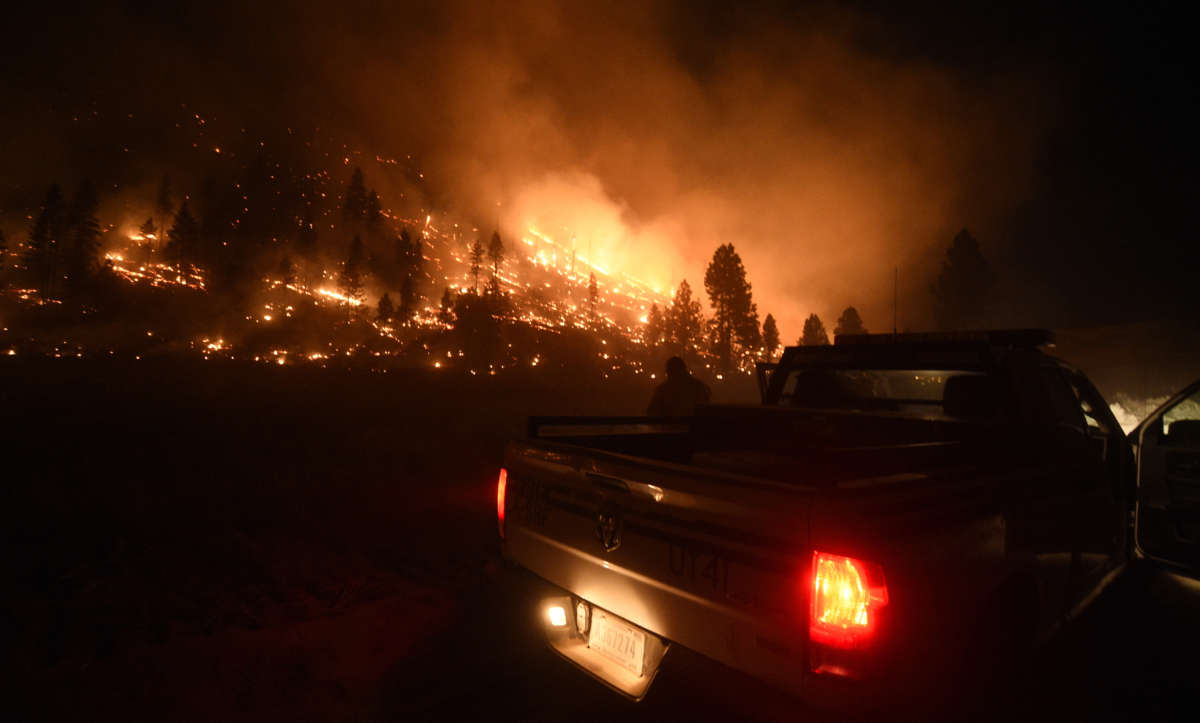
A U.S. Forest Service Public Information Officer surveys the effects of the southeastern flank of the Tennant Fire in California on July 4, 2021.

BYJake Johnson, Common DreamsPUBLISHEDJuly 8, 2021SHAREShare via FacebookShare via TwitterShare via Email

A white lower-case t on a black background

READING LISTENVIRONMENT & HEALTHIn Win for Overdose Prevention, Rhode Island Approves Harm Reduction CentersHUMAN RIGHTSThe US Government Wants Palestine to Fade From View. Don’t Let It.POLITICS & ELECTIONSForeign Governments and NGOs Will Try to Exploit Moïse’s AssassinationPOLITICS & ELECTIONSNoam Chomsky: To Retain Power, Democrats Must Stop Abandoning the Working ClassPOLITICS & ELECTIONSMitch McConnell Says Bipartisanship Is “Over.” Believe Him.POLITICS & ELECTIONSCould Other Condos Collapse Like Surfside? Ron DeSantis Doesn’t Care to Know.

Arapid-response scientific analysis of the Pacific Northwest heatwave that has killed hundreds of people — and more than a billion intertidal animals — indicates that the extreme temperature event “would have been virtually impossible” in the absence of the human-caused climate crisis.

“Our results provide a strong warning: our rapidly warming climate is bringing us into uncharted territory that has significant consequences for health, well-being, and livelihoods,” reads the analysis, which was conducted by a team of more than two dozen scientists as part of the World Weather Attribution initiative.

The group’s aim is to examine and quickly publicize connections between extreme weather events and the climate crisis to undercut denialists’ claims that the two are unrelated.

Get our free emails

  • Email

While the latest study has not yet been peer-reviewed, the researchers utilized peer-reviewed methods that have helped produce a growing body of research in a relatively new scientific field known as “extreme event attribution.”

The new analysis estimates that the heatwave that ravaged southwest Canada and the northwestern U.S. — particularly Oregon and Washington state — was “about a 1 in 1000 year event in today’s climate” and would “have been at least 150 times rarer without human-induced climate change.”

“An event such as the Pacific Northwest 2021 heatwave is still rare or extremely rare in today’s climate, yet would be virtually impossible without human-caused climate change. As warming continues, it will become a lot less rare,” the scientists wrote Wednesday. “The future will be characterized by more frequent, more severe, and longer heatwaves, highlighting the importance of significantly reducing our greenhouse gas emissions to reduce the amount of additional warming.”

“The latest heat-related death numbers are alarming,” the researchers added, “yet they are likely a severe undercount and the real toll will only become clear after mortality statistics are reviewed for the role of heat in exacerbating underlying conditions.”

Since its start in late last month — which has been deemed North America’s hottest June on record — has been linked to more than 100 deaths in Oregon, around 30 in Washington state, and nearly 500 in western Canada.

Kristie Ebi, a professor at the Center for Health and the Global Environment at the University of Washington and a co-author of the new analysis, told the Associated Press that “this study is telling us climate change is killing people.”

“Heat is the No. 1 weather-related killer of Americans,” said Ebi.

The Pacific Northwest is still experiencing intense heat, and — as the Washington Post reported Wednesday — is “bracing for another bout of exceptional heat amid a pattern that could once again place records in jeopardy.”

“Temperatures up to 25 degrees above average could dominate most of the West this weekend into next week, with little relief in sight for quite some time,” the Post noted. “Odds favor anomalously hot and dry conditions to prevail into the fall.”

_______________________________________________________________________

Northwest Heat Wave Is a Symptom of Terrifying Runaway Climate Feedback Loops
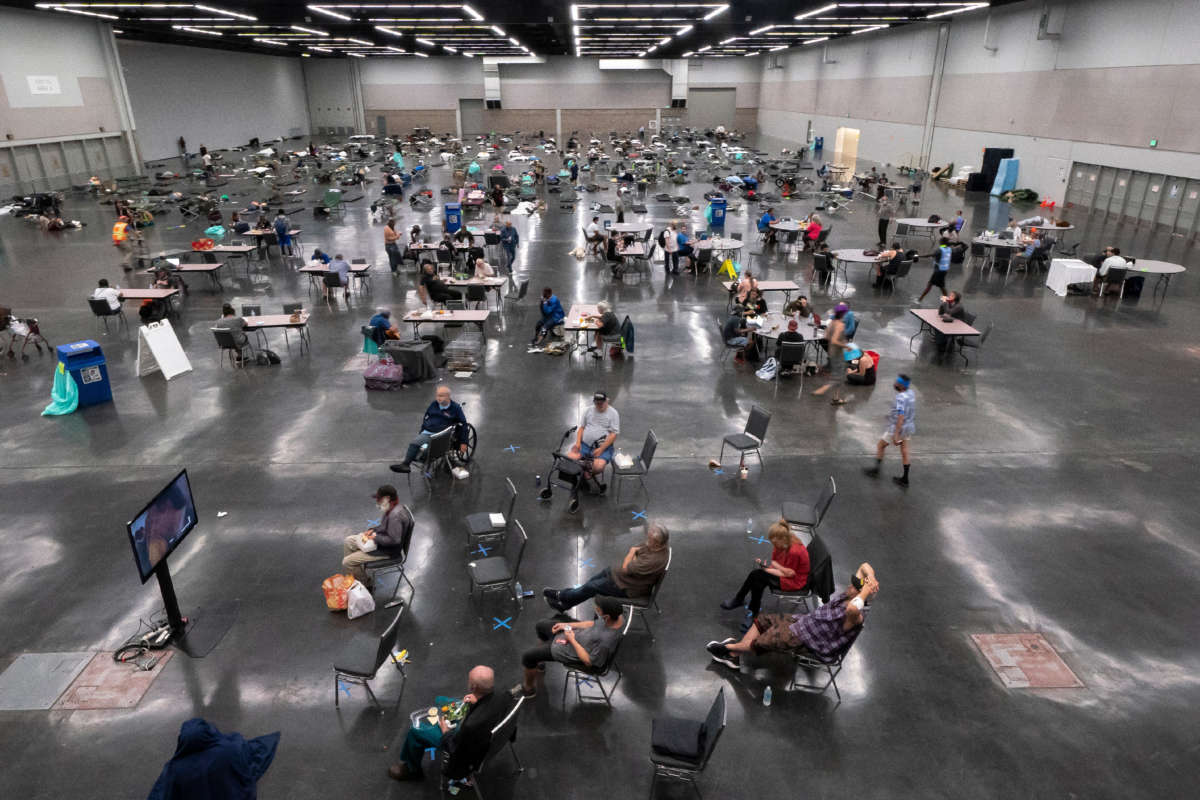
Portland residents fill a cooling center with a capacity of about 300 people at the Oregon Convention Center June 27, 2021, in Portland, Oregon.

BYWilliam Rivers Pitt, TruthoutPUBLISHEDJune 29, 2021SHAREShare via FacebookShare via TwitterShare via Email

A white lower-case t on a black background

READING LISTENVIRONMENT & HEALTHIn Win for Overdose Prevention, Rhode Island Approves Harm Reduction CentersHUMAN RIGHTSThe US Government Wants Palestine to Fade From View. Don’t Let It.POLITICS & ELECTIONSForeign Governments and NGOs Will Try to Exploit Moïse’s AssassinationPOLITICS & ELECTIONSNoam Chomsky: To Retain Power, Democrats Must Stop Abandoning the Working ClassPOLITICS & ELECTIONSMitch McConnell Says Bipartisanship Is “Over.” Believe Him.POLITICS & ELECTIONSCould Other Condos Collapse Like Surfside? Ron DeSantis Doesn’t Care to Know.

The village of Lytton, British Columbia, just northeast of Vancouver, saw temperatures on Sunday top 116 degrees. The roads are buckling in Portland, Oregon, under the onslaught of the heat, and the power cables on their streetcars are melting. The historic temperature spike is being caused by a “heat dome” above the affected region, meteorologists say, a confluence of events so rare they only come together every 1,000 years or so. Thanks to anthropogenic climate disruption — a fancy way of saying “humans did this” — these thousand-year events are becoming annual calamities.

“One of the primary reasons I moved to the Pacific Northwest was because of what I knew was coming in the climate crisis,” Dahr Jamail, who reported on climate for many years for Truthout, told me on Tuesday. Jamail lives in a small town in Washington State. “I’d done my research. I knew the projections for potable water availability, temperature spikes, arable land availability and where the climate impacts would be the mildest. For all of those, and more, the Pacific Northwest was one of the best places to live in the contiguous 48 states.”

However, Jamail noted, even since moving to Washington several years ago, he’s seen marked climate shifts.

Uncompromised, uncompromising news

Get reliable, independent news and commentary delivered to your inbox every day.

  • Email

“Where I live on the north coast of the Olympic Peninsula, it was 97 yesterday,” continued Jamail. “The day before it was almost as hot. The concrete slab upon which my home stands was the only cool spot. By the early afternoon, I was lying on it face down for respite. Across the water in Seattle, the Emerald City had never seen 100 degrees. Yesterday was the third time in the last three days it saw triple digits, and it was still 90 degrees at 8pm. All this, when less than a year ago, this region had the worst air quality in the world for days on end as we were engulfed in wildfire smoke blowing in from California.”

This is it. This is here. This is now. Even the safest places provide no safety. The theoretical has become actual; we have crossed the threshold into the unmistakable consequences of our horrid stewardship of this ridiculously precious planet and its ecosystems.

The western U.S. appears to be caught in a positive climate feedback loop, though there is little objectively positive about it. A “feedback loop” from the perspective of climate change “is the equivalent of a vicious or virtuous circle — something that accelerates or decelerates a warming trend,” according to a BBC climate report from earlier this year. “A positive feedback accelerates a temperature rise, whereas a negative feedback decelerates it.”

One example of a current and ongoing positive feedback loop is taking place in the Siberian tundra. Human-caused warming has led to the melting of the Siberian permafrost, which in turn has led to the release of billions of tons of methane out of the ground and into the atmosphere. Methane is a warming accelerant, one of the most dangerous kinds we are dealing with. When it gets dumped into the air in such quantities, warming is accelerated, more permafrost melts, more methane is released, warming is further accelerated, etc.

The feedback loop out west — human-caused warming leading to a massive drought which exacerbates warming, etc. — has come to include the current heat dome phenomenon. Put bluntly, the dome is making every other climate-related impact worse, and the potential consequences go far beyond the dangers posed by high heat to human health.

People out west are sitting in deep dread of the looming fire season, which could be worse than any we have seen. The drought has worsened, and the snow pack in the mountains — a vital feeder to the water table — is all but gone. With the arrival of the heat dome, much of the region is a bomb waiting to go off.

If the fire season this year is as bad or worse than expected, the next domino to fall in the effects of climate disruption will be potable water, which makes all this nothing less than an existential national emergency. From The New York Times:

When wildfires blaze across the West, as they have with increasing ferocity as the region has warmed, the focus is often on the immediate devastation — forests destroyed, infrastructure damaged, homes burned, lives lost. But about two-thirds of drinking water in the United States originates in forests. And when wildfires affect watersheds, cities can face a different kind of impact, long after the flames are out.

In Colorado’s Front Range, erosion from fire-damaged slopes during the summer rains could turn the flow of the Poudre and its tributaries dark with sediment, dissolved nutrients and heavy metals, as well as debris. This could clog intake pipes, reduce the capacity of reservoirs, cause algal blooms and cloud and contaminate the water, sharply raising maintenance and treatment costs. In the worst case, the water would be untreatable, forcing the cities to use alternate supplies for a time.

As climate change helps make wildfires burn hotter and longer, the risks to water supplies grow. But most people don’t think about the risks, said Kevin Bladon, a hydrologist at Oregon State University, even after a damaging fire. “Here we are in 2021,” he said. “We’re really removed from the 2020 wildfire season. Most people are thinking the problems are over.”

(Emphasis added.)

“The runaway feedback loops of the climate crisis are in full swing,” notes Jamail. “Most of the unraveling is occurring at a pace far more accelerated than the worst-case projections of our climate models. That wildfires are scorching millions of acres every year at a record pace should not come as a surprise. Nor should the impact of this on human water supplies. But what will likely come as a surprise to most will be the abrupt panic when the prices of food and potable water spike, or when the place where they live finally becomes unlivable for lack of water.”

The future is hot. The future is dry. The future is on fire. The future is now.

Victims in the shadows: octopuses, squids and cuttlefishes

There's an Elephant in the Room's avatarThere's an Elephant in the Room blog

Best of Show in the 9th Annual Ocean Art Underwater Photo Contest https://www.uwphotographyguide.com/ocean-art-contest-winners-2020

Octopus are soft-bodied, eight-limbed molluscs of the order Octopoda. The order consists of some 300 species and is grouped within the class Cephalopoda with squids, cuttlefish, and nautiloids. 

This blog was originally inspired by the many excellent articles I’ve read which provide insight to these fascinating creatures. These articles are always popular on social media, even amongst those who would think nothing of devouring these same individuals as a dietary indulgence.

As an animal rights blogger, however fascinating they are, I’m only too aware that alongside approximately 3 trillion of their fellow water-dwellers every year, cephalopods are considered – like every other species on the planet – to exist solely for the use and exploitation of the most brutal and oppressive species that has ever existed. Humans.

So I’d like to stress something really important. There is no…

View original post 2,154 more words

THE HISTORY OF BEEF CONSUMPTION IN THE U.S. AND HOW IT IS CHANGING

 By: Hemi Kim  |   Reading time: 7 minutes
The average American eats about 55 pounds of beef per year, based on 2019 U.S. Department of Agriculture (USDA) Food Availability data, a proxy for food consumption. Since the USDA began keeping statistics, the average amount of beef consumed per capita rose from 32 pounds per person in 1932 to 88.8 pounds in 1976 and has since steadily fallen. 

The vast majority of cows in the United States—about 41 million cows were being raised for beef and dairy in 2019—live to be about 14 to 16 months old, less than a tenth of the expected lifespan of a cow living in an animal sanctuary. 

The history of eating meat in America begins with hunted meat. This predates the arrival of the settler colonialists who created a system of white supremacy, within which the story of meat-eating became primarily one of stealing American Indian land, raising cows on that land, and the consumption of domesticated meat. 

In the 20th century, meat consumption has also been heavily tied to farming innovations. For example, after World War II, farmers began using antibiotics to prevent the spread of disease among animals living too close together. 

The resulting efficiency of the meat production system also came with a price of hazardous conditions for low-wage workers. Slaughterhouses tend to hire Black, Latino, Asian, and both undocumented and documented immigrant workers for dangerous, trauma-inducing, non-unionized work.

But how did cattle farming become like this, and what might the future hold for beef consumption in the U.S.?
 Read more

Also read: http://www.worldpeacediet.com/

Minnesota DNR calls off wolf hunt this year despite support from farmers, hunters

Exposing the Big Game's avatarCommittee to Abolish Sport Hunting Blog

https://www.parkrapidsenterprise.com/northland-outdoors/7104250-Minnesota-DNR-calls-off-wolf-hunt-this-year-despite-support-from-farmers-hunters

Agency officials made the annoucement during a video meeting of the state wolf advisory committee.Written By:John Myers|3:27 pm, Jul. 7, 2021

    The Minnesota Department of Natural Resources said Wednesday that there will be no wolf hunting or trapping season in Minnesota in 2021. Agency officials said they will wait until a new state wolf management plan is in place early in 2022 before deciding on any wolf harvest options. (Photo by iStock/AB Photography courtesy of the Wisconsin DNR)

    The Minnesota Department of Natural Resources said Wednesday that there will be no wolf hunting or trapping season in Minnesota in 2021. Agency officials said they will wait until a new state wolf management plan is in place early in 2022 before deciding on any wolf harvest options. (Photo by iStock/AB Photography courtesy of the Wisconsin DNR)

    ST. PAUL — The Minnesota Department of Natural Resources on Wednesday, July 7, said there will be no wolf hunting and trapping season in Minnesota in 2021 as the agency continues to develop a new long-term wolf management plan.

    DNR officials made the announcement during a video meeting of the agency’s wolf plan advisory committee that is helping plot the future of wolf management in the state.

    Agency biologists…

    View original post 493 more words

    New law creates review process for serial hunting violators

    Exposing the Big Game's avatarCommittee to Abolish Sport Hunting Blog

    https://www.newscentermaine.com/article/sports/outdoors/new-law-creates-review-process-for-serial-hunting-violators/97-d6ce8bbb-ed3e-479b-a4ed-0e70c5db342f

    The law will establish an administrative process for suspending a hunters’ license for up to three years associated with civil trespassing while hunting.

    A new law will create a review process for hunting violationsVolume 90%Author:Sam Rogers (NEWS CENTER Maine)Published:6:10 PM EDT July 7, 2021Updated:6:10 PM EDT July 7, 2021

    Facebook

    Twitter

    AUGUSTA, Maine — Before Mainers pick their favorite shade of orange and once again take to the woods, hunters and landowners alike will have a new law to follow.

    Governor Janet Mills signed ‘An Act To Create an Administrative Review Process for Hunting Violations’ into law Tuesday. The bill sponsored by Representative Kathleen Dillingham, R-Oxford, received bipartisan support as it made its way through the legislative process.https://imasdk.googleapis.com/js/core/bridge3.470.1_en.html#goog_1196826761Everything Sony announced at its CES 2021 press conferenceFEATURED BY

    Although South Paris resident Troy Ripley does not serve in the Maine Legislature, he played a big role in this years-long process, Dillingham…

    View original post 373 more words

    Everything I Know About Hope I Learned From My Dog

    Opinion


    Guest Essay

    July 5, 2021

    Credit…Ryan Christopher Jones for The New York Times

    ·  ·  ·  ·  

    By Margaret Renkl

    Ms. Renkl is a contributing Opinion writer who covers flora, fauna, politics and culture in the American South.

    NASHVILLE — The bad-luck streak started when I got Covid-19 and then it escalated: health troubles, deaths in the extended family, frantic worry about loved ones, too many of whom were struggling in the pandemic. All of it backgrounded by dire news about the natural world and my own beloved country. There have been times during the last 16 months when I wondered whether grief and fear were all I would ever feel again.

    “When sorrows come, they come not single spies, but in battalions,” Hamlet’s perfidious stepfather observes, failing to note that his own crimes are to blame for the rotten state of Denmark. I can’t discover any way in which I am the source of my own pandemic sorrows, but I don’t need to search far to find others whose struggles are far worse. So with every new setback and every new worry, I remind myself to be grateful for what is going right, to stop enumerating all the things that are going wrong.

    That coping strategy worked pretty well until my dog died.

    As a writer, I try to call attention to the goodness people are capable of. I comb the headlines for promising news about social justice, the environment, the body politic. But in real life, I expect trouble to lurk beyond every corner, to emerge from every shadowed doorway. I have always felt a closer kinship with darkness than with light.

    “Fantastic!” my father would say whenever anyone asked how he was doing during the two and a half years it took him to die of a cancer. Even when the pain and nausea were at their worst, Dad was certain that being alive, no matter how much misery might be involved, was incomparably better than the alternative.

    My husband, too, is the kind of person who trusts that good will prevail after every anguish, who believes so thoroughly in the happy ending that he later forgets the anguish itself. Recently I mentioned a scare we’d had this year, and he didn’t even remember it. “You must not have been as traumatized by that as I was,” I said. “I’m not as traumatized by anything as you are,” he said.

    I grew up with an optimist, and I married an optimist, but even the sunniest human being is barely more than a neophyte where hope is concerned. In any household, the true master of hope is the family dog.

    Dogs regard any delicious smell emanating from the kitchen as a meal they can reasonably expect to share. An elderly dog may have been fed only kibble in all the years of his long life, but he will nevertheless haul his arthritic self to his feet and wander into the kitchen, confident that this time the lasagna sitting on the counter will be his.

    Our Lab mix, Scout, taught me that a dog who has never caught a squirrel will keep chasing squirrels the same way a dog who is not allowed on the bed will climb under the covers the second a bed is left unattended. Betty, a feist who had never been taken to school even once, would wait hopefully beside the back door every morning, just in case it was Take Your Dog to School Day at last. A UPS delivery driver once tossed a dog biscuit to Clark, our rangy old hound, as she turned the corner, and every day for years, that dog would wait in the yard for his biscuit, no matter how many delivery trucks rounded the corner without a pause.

    In my own life, the apotheosis of canine hope was Emma, the miniature dachshund we inherited after my mother’s death. Emma believed she could climb the bookcase where dog treats are kept, never mind that her legs were all of two inches high. She believed she could open the closet door where the dog food is kept, despite her lack of opposable thumbs. And damn if she didn’t manage both feats. For a dog, hope is self-reinforcing.

    Our last dog, Millie, taught me that dogs carry trauma with them, just as we do. Millie, a terrier mix, didn’t know why she feared what she feared, but she knew that my response to her fears would be kindness, patience and, often, a delicious chicken treat. Whenever we passed a big, scary dog on our walks or a giant, rumbling truck, she would look up hopefully, almost skipping when she saw my hand reaching for my pocket.

    The triumph of hope over irrevocable trauma — is it any wonder that Millie’s unexpected death was what finally broke my conviction that better times would soon be on the way?

    As much as I hate living in a house without a dog, it was months before I felt ready for a new one, and by the time I finally started looking, it had become much harder to adopt. Everyone, it seems, wants a pandemic companion. There are six new puppies on our street alone, with two more due from breeders this summer.

    I understand why rescue organizations are so careful about pet placements. Many year-old dogs available for adoption today are pandemic puppies who turned out to be more work, or more costly, than their adopters bargained for. Every day volunteers look into the desolate faces of pets left at the shelter by the only families they have ever known — or, worse, abandoned on the streets — and that’s why these organizations work so hard to avoid approving a home that isn’t an ideal match for that particular pet.

    It is also why so many dogs I applied for went to younger people or runners or families with children and other dogs or homes with a large yard or some other requirement my household didn’t meet.

    Then Rascal appeared. A pandemic-born mixed breed with a ruinous case of fleas, he was exactly the size and age we were looking for: small enough to travel with us, young enough to be part of our family for years. There were more than 40 applications for him. By some miracle, our home was the best match.

    Two hours after he arrived, Rascal was curled up in my lap. A day later, he knew his new name, a name he lives up to in ways that make me laugh out loud: stealing shoes from the shoe basket and hiding them around the house, grabbing the book I’m reading and running away with it, sneaking a sip of iced tea when my back is turned. Every morning, he likes to perch on the top of a chair in our family room, watching birds through the window. He cannot possibly catch a bird through that glass, and I think he surely knows it. He keeps hoping anyway.

    Margaret Renkl, a contributing Opinion writer, is the author of the books “Late Migrations: A Natural History of Love and Loss” and the forthcoming “Graceland, at Last: Notes on Hope and Heartache From the American South.”

    The Times is committed to publishing a diversity of letters to the editor. We’d like to hear what you think about this or any of our articles. Here are some tips. And here’s our email: letters@nytimes.com.

    Otsego approves youth hunting after debate

    Exposing the Big Game's avatarCommittee to Abolish Sport Hunting Blog

    https://www.thedailystar.com/news/local_news/otsego-approves-youth-hunting-after-debate/article_db9dd3ce-1f96-59ce-ae7e-f556a462e9ff.html

    • By Vicky Klukkert Staff Writer
    • Jul 7, 2021Updated5 hrs ago
    Otsego approves youth hunting after debate
    McCarthy

    The Otsego County Board of Representatives approved a resolutionallowing youths as young as 12 to hunt big game with adult supervision after much discussion and a public hearing.

    The state Department of Environmental Conservation proposed and the state Legislature approved a two-year pilot program to allow 12- and 13-year-old children to hunt deer using rifles, shotguns or muzzleloading firearmsnext to an adult licensed hunter, provided that it was approved by the local county governments.

    According to a map on the DEC website, Otsego was one of14 counties left to vote on the program. Other counties that haven’t voted on the resolution are Oneida, Montgomery, Onondaga, Schenectady, Albany, Ulster, Dutchess, Rockland, Putnam, Erie, Monroe, Seneca and Tompkins.

    “Every other countyhas voted to allowthis,”Rick Brockway, R-Laurens and Otego, said. “Ihope Otsego Countyisn’t the only one to oppose this resolution. Every…

    View original post 1,335 more words

    Bucks County hunter, who first thought he shot a groundhog at Nockamixon State Park, will spend 7-20 years in prison for fatally shooting teenager

    Exposing the Big Game's avatarCommittee to Abolish Sport Hunting Blog

    https://www.mcall.com/news/breaking/mc-nws-kenneth-heller-sentencing-20210707-vb7ynagi5vejdf2odjrthgwiw4-story.html

    ByLEIF GREISSTHE MORNING CALL|JUL 07, 2021AT6:47 PM

    Jason Kutt was watching the sunset with his girlfriend at Nockamixon State Park in October. More than 500 feet away, Kenneth Troy Heller raised his rifle and fired.

    The .17-caliber bullet hit Kutt in the neck. He died two days later. On Wednesday in a Bucks County courtroom, Heller learned his punishment for the fatal shot: seven to 20 years in state prison.Advertisement

    Kutt’s parents, Ronald and Dana Kutt, spoke before the sentencing. Ronald Kutt’s voice wavered with emotion and his eyes teared up as he described how his heart will never heal.

    “The biggest thing I’d do would be to hug him and tell him I love him one more time,” he said. “This was something that didn’t ever need to happen.”

    Authorities said Heller, 52, of Warminster Township,did not know Kutt and the shooting was an accident. District…

    View original post 890 more words

    13 Elephants from U.K. Zoo to Be Moved to Kenya in World’s ‘First’ Attempt of ‘Rewilding’ Herd

    Exposing the Big Game's avatarThe Extinction Chronicles

    https://www.msn.com/en-us/news/world/13-elephants-from-u-k-zoo-to-be-moved-to-kenya-in-world-s-first-attempt-of-rewilding-herd/ar-AALTviH?ocid=msedgntp

    Gabrielle Chung19 hrs agoLike1 Comment|27


    Trump once told a caller that Rudy Giuliani drank too much, was a loose cannon…NRA appeals Florida judge’s ruling on gun sales to people younger than 21

    More than a dozen elephants living in the United Kingdom are heading back to their “ancestral homelands” in what wildlife conservationists are calling the world’s first attempt at “rewilding” an entire herd.a elephant that is standing on a lush green field: Aspinall Foundation© Provided by PeopleAspinall Foundation

    Thirteen African elephants from the Howletts Wild Animal Park in Kent, England, will be flown more than 7,000 kilometers (approximately 4,349 miles) and released into the wild in Kenya,The Aspinall Foundation, an animal charity that runs the zoo, announced on their website.a elephant that is standing on a lush green field: "No elephant rewilding project of this scale has ever been attempted before," The Aspinall Foundation, a wildlife conservation charity, announced© Aspinall Foundation”No elephant rewilding project of this scale has ever been attempted before,” The Aspinall Foundation, a wildlife conservation charity, announced

    “This is thefirst time that a herd of elephants…

    View original post 278 more words

    California braces for dangerously high temperatures in new heatwave

    Exposing the Big Game's avatarThe Extinction Chronicles

    https://www.theguardian.com/us-news/2021/jul/07/california-heatwave-high-temperatures-inland-central-valley

    Temperatures could reach 115F in the Central Valleyand 120F in desert areas like Palm Springs

    People sit inside a cooling booth at the Shasta district fair during a heatwave in Anderson, California, on 26 June 2021.
    People sit inside a cooling booth at the Shasta district fair during a heatwave in Anderson, California, on 26 June 2021.Photograph: Bloomberg/Getty Images

    Erin McCormickin San FranciscoWed 7 Jul 2021 15.59 EDT

    A new heatwave is predicted to bring dangerously hot weather to California’s inland regions this week, as relentlessly high temperatures continue to torment the west coast.

    Meteorologists are warning residents to prepare for “potentially record-breaking” temperatures as high as 115F (46C) in the Central Valleyand 120F (49C) in desert areas like Palm Springs, with temperatures in Death Valleysetto approach an all-time high. The heat is predicted to start to build on Wednesday and increase through the weekend.

    “Temperatures are going to be about 10 degrees above normal for this time of year,” said Diana Crofts-Pelayo a spokesperson…

    View original post 388 more words