THEY WALKED IN on their own: the first wolves in more than 100 years known to call Washington state home, after this native species was nearly wiped out by hunting, trapping and government extermination campaigns.
Today, the Washington Department of Fish and Wildlife kills wolves only when they have repeatedly killed cattle, a relatively rare event, with about 80% of Washington wolf packs typically staying out of trouble with people.
Which brings us to the wolf that Ben Maletzke, statewide wolf specialist in the wildlife program for WDFW, likes to call The Old Guy.
WOLF 32M LIVED some 12 years as the patriarch of the Teanaway pack, kicking off the recovery of wolves in Washington despite living in cattle country, amid ranchettes, in a region that sees heavy recreational use year-round. He lost a mate to poachers, and the pack’s territory was roasted by wildfire in 2014. But still, wolf 32M and his family persisted, bringing the call of the wild back to the Central Cascades for the first time in a century, just two hours from Seattle.
Maletzke glided through powder on his snowmobile, a fresh snowfall providing perfect conditions for tracking work. Here, the winter ecology of the pack’s core territory was written in tracks. The soft sweep of grouse wings, the trot of a turkey, the hooves of mule deer and elk: all on the menu for a hungry wolf. But there was no sign of wolves that day. Maletzke was not surprised: “There are a lot of zeros when you are a wildlife biologist,” he said, changing out a data card in a motion-triggered wildlife camera.
Farther on the trail, he unpacked a chain saw to cut a tree fallen across the path, all in a day’s work for a backcountry biologist. “My mother says I got a Ph.D. in recess,” he said, gunning the snowmobile up into the mountains, into the core of the Teanaway pack’s home ground.
These wolves are what he calls steppingstones in recovery, the animals that could help lead the way to new territory, such as the vast sweep of country south of I-90 not yet recolonized by wolves. Recovery is still in early stages in Washington, with fewer than 200 wolves documented, and no statewide presence yet established.
Wolves disperse to new territory to find mates and begin packs of their own. Packs won’t overlap; the map Maletzke shows of known packs, with their movements tracked by radio collar, presents territories so strictly observed you would think they were fenced.
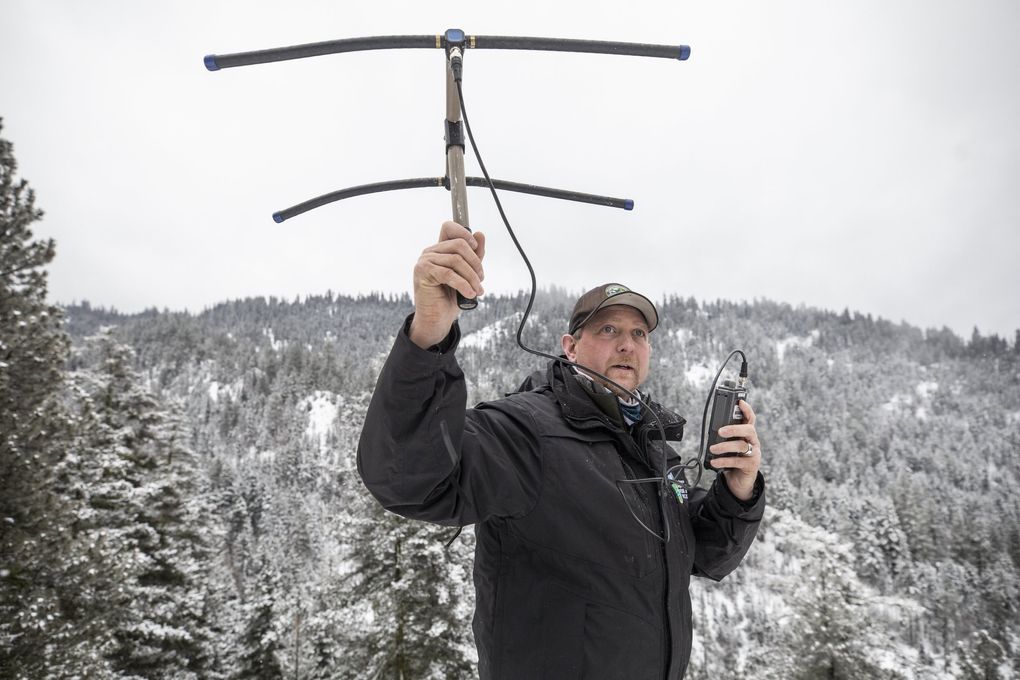
1 of 2 | Department of Fish and Wildlife biologist Ben Maletzke listens for the beeps from radio collars attached to wolves in the Teanaway pack. (Steve Ringman / The Seattle Times)
Wolves have few predators, but they can be killed by other wolves defending a territory or a kill. It is this pack dynamic that wildlife biologists are counting on, in time, to urge wolves into areas where they do not presently live. “We just need a couple to pick up and go,” Maletzke says. “It will happen.” For there are few animals more resilient or wily than the wolf.
WOLVES ARE THE most widely distributed of all land mammals, and one of the most adaptable.
The Bureau of Land Management (BLM) has reached a new cruel low with its Adoption Incentive Program (AIP), paying unscrupulous people to “adopt” wild horses and burros who then sell them to kill buyers all while telling the public they don’t send them to slaughter. Our tax dollars have been misused to remove the horses/burros off our public lands to be replaced with millions of cattle and sheep for far too long.
The BLM is preparing more roundups, leaving very few behind, and wants to use all kinds of birth control, some untested, as reported by the American Wild Horse Campaign. That is a recipe for extinction. A 2017 Public Policy Polling national survey found that 80% of Americans want Congress to keep anti-slaughter protections in place. Our voices are ignored in favor of the ranching industry that thinks it owns our public lands.
If taxpayers want this cruelty to stop, I urge them to contact their senators, representatives and the Department of Interior and tell them to rescind the AIP immediately, stop the roundups and reduce the ranchers’ grazing allotments. The millions of livestock are the ones degrading the landscape, not the thousands of horses/burros.
The successful rescue of two black bear cubs made for a wonderful story. But how many cubs orphaned by hunters during the ongoing spring black bear special permit hunting season will share the same reprieve?
Every spring, black bears emerge from their dens looking for food to nourish themselves and their newborn cubs. If a mother bear is killed during this hunt, her cubs are orphaned and do not survive. Why does Washington Department of Fish and Wildlife allow a hunt during such a vulnerable time?
Wildlife officials claim it is to manage timber damage. In truth the spring hunts solely provide more opportunity for hunters to kill bears at a time when…
(CNN)Travel is up, Covid-19 cases are down, and vaccines have been put in many arms.Thecoronavirus pandemicisn’t over, but Memorial Day weekend is set to look more like it did before the virusupended life more than a year ago.Americans Saturday were experiencing their first holiday weekend since the CDC changed itsmasking guidanceon May 13 — that fully vaccinated people don’t need to wear masks indoors, and they don’t have to keep their distance from others.
Mask mandates melted away. As of Friday, California, Hawaii, New Mexico were the only states with mask mandates for everyone.
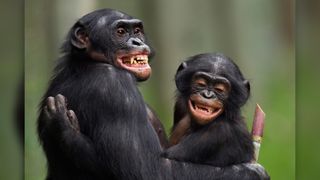
The 17-year-old male bonobo ‘Manono’ and 4-year-old male ‘Pole’ hug each other at Lola ya Bonobo Sanctuary in the Democratic Republic of Congo in 2010. (Image credit: Anup Shah via Getty Images)
COVID-19 interrupted one of life’s most familiar acts: the warm, enveloping comfort of a hug. The pandemic taught us many things, some more important than others — but one of those is just how much many of us rely on these embraces for a sense of reassurance, consolation and calm.
We’ve become profoundly aware of the significance of this simple act in our human lives — but does hugging exist in the rest of the animal kingdom? Are there any other species that embrace in the way humans do?
To answer that, first we have to define exactly what we mean by “hug.” From a subjective human standpoint, of course, a hug happens when someone wraps their arms around someone else. Naturally, this restricts hugging to animals with arms — and those are mainly primates, like us. This quickly reveals that, while we might see hugs as a uniquely human trait, hugging is actually just as prominent in the lives of nonhuman primates.
Take, for example, bonobos (Pan paniscus), which are often described as the peace-loving hippies of the primate world. These primates have been a lifelong subject of study for Zanna Clay, a comparative and developmental psychologist and primatologist at Durham University in the United Kingdom. Clay studies social interactions among bonobos, and much of her observational work takes place at a sanctuary in the Democratic Republic of the Congo for bonobos whose lives have been disrupted by hunting. At this sanctuary, it’s common to see troops of infants obsessively clinging to one another as they walk around in tandem.
“You have quite a lot of young orphans who need quite a lot of reassurance, and they do what we call the ‘hug walk’: They hug together and walk along in a little train,” Clay told Live Science.
Clay says that this behavior is more common in the sanctuary than it would be in the wild — possibly because bonobos are also exposed to embraces from their human caregivers — but it still does occur in bonobos’ natural lives. In fact, this behavior probably has roots in the maternal behavior of female bonobos, which cradle their infants when they are small. Researchers have observed that this hugging behavior is most common in young bonobos and typically occurs after a bonobo has experienced conflict or stress. Often, in these cases, a distressed bonobo will stretch out its arms in a beseeching gesture, and another bonobo will dramatically rush toward the squealing infant and encircle it in a tight embrace.
“A bonobo might request [a hug], so they will seek someone out and sort of ask for help, or somebody might offer them one,” Clay said.
Two bonobo juveniles hug each other at Lola ya Bonobo Sanctuary. (Image credit: Anup Shah via Getty Images)
It’s difficult to judge animal emotions, but the evidence points to the likelihood that hugging reassures these primates, just as it does humans, Clay said. Intriguingly, in some of her previous research, Clay and her colleagues discovered that orphaned bonobos were less likely to offer sympathetic hugs to distressed peers, compared with young bonobos that had been reared by their mothers. This might indicate the importance of parental care in laying the foundation for this social gesture in primates, Clay said.
Bonobos may be particularly fond of a good cuddle, but the maternal roots of this embrace make this behavior common across many other primate species. In many of these species, mothers hold their infants closely for extended periods of their infancy.
For instance, chimpanzees (Pan troglodytes) — bonobos’ close relatives — are also known to embrace. This is especially notable in tense situations such as “border patrols,” when chimps rove around to assert their presence and protect their territories, Clay said.
“If they hear a predator, or another chimpanzee group, or something scary, that’s when you’ll see them touching each other and holding on to each other,” Clay said. The hug seems to function as reassurance in the face of danger, Clay added — another relatable feature for humans, who typically reach for one another when afraid.
In the case of crested black macaques (Macaca nigra), which live in Indonesia, hugging comes with an added flourish: These monkeys request hugs by audibly smacking their lips — an invitation that’s not reserved for family but extended generously to other members of the troop.
In addition, young orangutans have been observed rushing to hug each other when confronted with the threat of a snake, thus emphasizing the hug’s apparently reassuring role in times of stress or fear. And in another macaque species, the Tonkean macaque (Macaca tonkeana), researchers have discovered that consoling hugs are plentiful after a fight — and may even be accompanied by a kiss.
Proactive peacekeeping
Most research on hugging in primates focuses on its assumed role in reassuring and consoling others — which makes sense, because this mirrors what hugs mean to humans. But research on the lives of spider monkeys reveals a different reason primates engage in these seemingly affectionate displays.
Filippo Aureli is an ethologist — someone who studies animal behavior — and is affiliated with both the Universidad Veracruzana in Mexico and Liverpool John Moores University in the United Kingdom; he studies how spider monkeys use hugging not to recover from conflict but rather to prevent it. In research based on weeks of observing spider monkeys in the tropical forests of Mexico’s Yucatán Peninsula, he discovered that these primates approach each other and embrace more in scenarios in which tensions threaten to boil over into conflict — for instance, when two unfamiliar monkey subgroups meet after a long time apart and fuse to form a larger troop. Advertisement
“The embrace is done by individuals that have a problematic relationship,” said Aureli, who is an editor on a book about conflict resolution in animals. “They may need to be together, and they may need to cooperate — but they are not best friends. And so, the embrace is a way to send a signal and really manage that conflicted relationship.” He explained that because an embrace involves a high degree of vulnerability — after all, one animal is fully exposing its body to another — this “helps to clarify, ‘Hey, I come with good intentions.'”
It’s possible that hugging as a means of proactive damage control occurs in other primates, as well. But currently, spider monkeys are the best-studied example of this aspect of the behavior, Aureli said. He described their embraces as “preemptive peacemaking,” and his study even suggests that humans could learn a thing or two from these careful creatures about how to manage conflict. “It’s much better to prevent than to repair,” Aureli said.
Spider monkeys, including one cradling a baby, sit on a log. (Image credit: Michael Nunez / 500px)
Speaking of humans, how do our own hugs compare to those of other primates? “At the end of the day, we are primates, and affiliative contact is a superimportant component of our social life,” Clay said. “So, to me, there’s obvious continuity in some of the functions of embracing and hugging with humans.”
As in nonhuman primates, being held and embraced by our parents in our infancy sets us up for the reassuring, consoling function that hugs play in our lives. According to Clay, the one notable difference between our hugs and those of our primate kin is that humans seem to have layered more social symbolism onto the embrace. “I think the difference is that with humans, it’s become a kind of conventionalized greeting or parting gesture,” Clay said. “Apes don’t tend to do that.”
Beyond primates
Of course, we have to be careful not to assume that hugging looks the same in other species as it does in humans. Hugs in primates are easy to identify because they look like ours, but other species may have hugs that appear different. Advertisementhttps://fcdf7a1a82e9344887b1a88ed294e24b.safeframe.googlesyndication.com/safeframe/1-0-38/html/container.html
“If we identify the function of a hugging embrace, then really, the form could be completely different — maybe less fascinating for us as humans, because we don’t recognize it,” Aureli said. “But it could basically fulfill the same role.”
Primate studies indicate that embraces function to bond, reassure, console and make peace, but hugs could have myriad analogues in other animals. For example, horses groom one another, and studies reveal that this activity decreases their heart rates — a hallmark of comfort and calm. Researchers have observed that if the prairie vole (Microtus ochrogaster) detects signs of distress in its mate, it will rush over and rapidly start grooming the mate’s fur; researchers have interpreted this behavior as a possible act of consolation. In birds, preening between pairs is thought to increase social bonds. RELATED MYSTERIES
Lions (Panthera leo) rub heads and nuzzle, which is believed to boost their social connections. Hundreds of other mammal species lean against, nestle and huddle with one another to provide comfort and warmth, or to form a united front against danger — which might play a similar role to the steadying hug we see in primates. Meanwhile, dolphins seem to display a kind of consoling peacemaking behavior: Studies show that these cetaceans are more likely to engage in reconciliatory activities after a conflict — for instance, giving each other a flipper rub, or gently towing each other through the water, like an apologetic piggyback.
So, after the separation and stress brought on by the COVID-19 pandemic, we might take heart in knowing that what humans know as a hug could have many equivalents in our fellow animals. All around the world, there are animals carrying out small acts of comfort and consolation, and making difficult situations a bit easier for one another. That thought is almost as comforting as a big, cozy hug itself.
LITTLE ROCK – The application period for Arkansas’s special urban bowhunts for the 2021-22 deer hunting season is now open.
The hunts, which begin Sept. 1, offer Arkansas bowhunters an early opportunity to get into the woods. It’s also the most effective method available for wildlife managers to assist cities in maintaining white-tailed deer populations at levels which reduce conflicts with homeowners and drivers.
The following areas will have urban hunts for the 2020-21 season:
– Bull Shoals
– Cherokee Village
– Fairfield Bay
– Heber Springs
– Helena/West Helena
– Horseshoe Bend
– Hot Springs Village
– Lakeview
– Russellville
The Arkansas Game and Fish Commission coordinates with the Arkansas Bowhunters Association and the Bull Shoals and Lakeview Urban Bowhunters Association to administer the nine urban bowhunting opportunities in The Natural State.
The S.C. Department of Natural Resources is asking deer hunters to help save the state’s deer population by helping to control a growing coyote population. According to DNR, coyotes first appeared in SC about 30 years ago and continue to expand greatly in numbers. Coyotes are negatively impacting our official State Animal, the White-tailed deer, by preying heavily on deer fawns. Since 2002, DNR officials report that South Carolina’s deer population has declined by more than 30 percent. “While our deer population is still healthy, we do not want to see it decline further,” according to information provided by SCDNR. To help with this problem, deer hunters are asked to trap coyotes. The S.C. Department of Natural Resources has a Coyote Harvest Incentive Program. This was created in 2016 and is meant to be a coyote tagging and reward program. Here’s how…
Fargo, ND, USA / The Mighty 790 KFGO | KFGOThomson ReutersMay 28, 2021 | 8:29 AM
MADRID (Reuters) – The Iberian lynx population in Portugal and Spain rose above 1,000 last year after 414 cubs were born under a joint breeding programme, in a major leap towards conserving the endangered species, Spain’s Environment Ministry said on Friday.
The initiative was launched in 2002 when the number of Iberian lynx, a wild cat native to the Iberian Peninsula, plunged to just 94 in Spain and none in Portugal, due to farming, poaching and road accidents.
By the end of last year there were 1,111 Iberian lynx living in the wild in the region, including 239 breeding females, the ministry said in a statement. The number was a record high since monitoring of the species began, it said.





 CLICK HERE TO PRINT!May 29, 2021 6:22 am,


