When confronted with an article or post about a poorly individual who has been rescued from being used as a human resource, it is not unusual to read furious criticisms:
1) about the farmer / breeder, 2) about the absence of veterinary care, or 3) about the apparent apathy of the XYZPCA organisations that are fancifully imagined to care about such matters and implement ‘laws’ to prevent them.
I don’t know if those who still cling to the notion that consumers can duck responsibility for the consequences of their demands are vegan or not, but based on my own memories, I’d guess possibly not. I suspect in my nonvegan past it might have eased whatever conscience I might have had to think that someone, somewhere was caring for my victims when I clearly wasn’t. Like…
Interstellar plasma is vibrating out there past the edges of the solar system.
An illustration of the Voyager 1 spacecraft, which is traveling through interstellar space.(Image credit: NASA/JPL)
Forty-four years after it rocketed off from Earth, the Voyager 1 spacecraft is detecting the background “hum” of interstellar space for the first time.
Voyager 1, launched in 1977, left the bounds of thesolar system— known as the heliosphere — in 2012. The heliosphere is the bubble of space influenced by solar wind, the stream of charged particles that emanates from the sun. Since popping out of this bubble, Voyager 1 has been periodically sending back measurements of the interstellar medium. Occasionally, the sun sends off a burst of energy known as a coronal mass ejection that disturbs this medium, causing the plasma, or ionized gas, of interstellar space to…
Police in southwestTaiwanare investigating an illegal trapping incident after a protected monkey lost three of its toes in a snare inside a national park.
A hiker in Gushan District in the port city of Kaohsiung encountered the injured Formosan rock macaque on Saturday and reported the sighting to a local monkey welfare advocacy group.
The Association for Coexistence with Macaca cyclopis shared images of the male macaque withNewsweek. The injured animal was seen sprawled on a wooden footpath at one of the entrances to Shoushan National Nature Park, said the non-governmental organization.
The picture shows the monkey appearing unable to walk while dragging a steel spring…
Updated 1:52 PM ET, Wed May 12, 2021HMAS Sydney off the coast of New South Wales, Australia, last year.
(CNN)Two dead endangered whales were dislodged from the hull of an Australian destroyer after the warship docked in San Diego last weekend, according to the Royal Australian Navy.The whales were found near HMAS Sydney, which berthed in Naval Base San Diego, the principal home port of the US Navy’s Pacific Fleet.”The Navy takes marine mammal safety seriously and is disheartened this incident occurred,” a statement from the Australian navy said.
The Australian and US navies — along with the US NOAA Fisheries, which oversees marine resources — were investigating, the statement said.
CNN affiliate 10News in San Diego reported the dead mammals were fin whales, the world’s second-largest whale species, behind only blue whales. One was 65 feet (about 20 meters) long and the other about 25 feet (7.6 meters), the report said.
A NOAA Fisheries fact sheet on fin whales lists them as endangered under the Endangered Species Act, with a population of about 3,200 off the US West Coast. The whales were once hunted extensively, but today their biggest threat is being struck by a ship, the fact sheet says.HMAS Sydney is a 481-foot (146.7-meter) guided-missile destroyer with a 7,000-ton displacement, according to the Australian navy. The ship’s hull extends 23.6 feet (7.2 meters) below the waterline.
It’s one of the newest ships in the Australian fleet, commissioned just a year ago.The ship steamed into San Diego on Saturday after testing its combat systems in an exercise off the California coast, according to a tweet from the Australian navy.Whale strikes by naval vessels are rare, said Carl Schuster, a former US Navy captain.”Whales can hear ships from miles away and generally avoid ships using mid-frequency and high-powered low frequency sonars because it bothers their hearing,” Schuster said.
Low-frequency sonar can confuse whales in shallower waters, Schuster said — but the Australian ship is equipped with a high-frequency sonar. However, a NOAA Fisheries report on whale strikes says they can occur as the whales feed and migrate in coastal waters, especially in heavy shipping lanes like those off Southern California.
Survey of 800 cities around world finds almost 43% do not even have plan to adapt to impacts of global heating
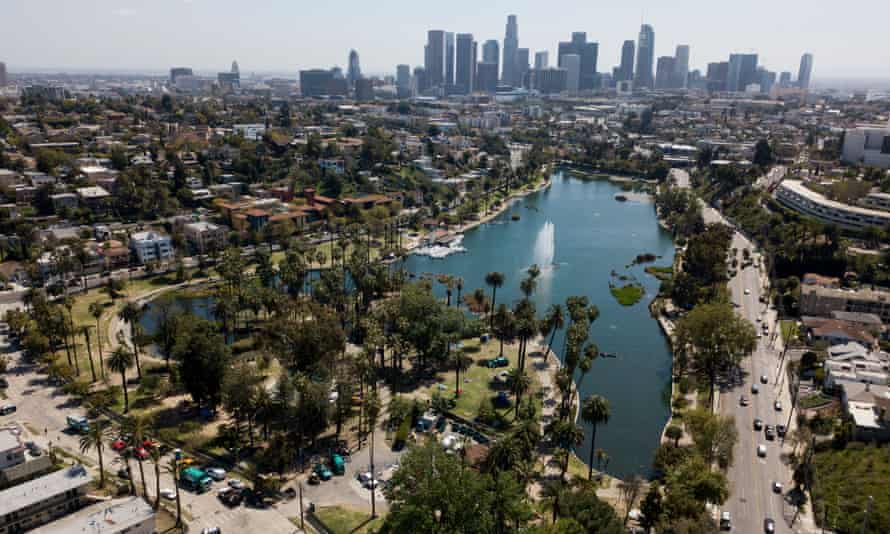
Los Angeles is one of the cities thought to be adapting well to the climate crisis. But hundreds of other cities around the world are not.Photograph: Ringo Chiu/Zuma Wire/Rex/Shutterstock
Fiona HarveyEnvironment correspondentWed 12 May 2021 00.01 EDT
268
One in four cities around the world lack the money to protect themselves against the ravages of climate breakdown, even though more than 90% are facingserious risks, according to research.
Cities are facing problems with flooding, overheating, water shortages, and damage to their infrastructure from extreme weather, which is growing more frequent as the climate changes. Asurvey of 800 cities, carried out by the Carbon Disclosure Project,found that last year about 43% of them, representing a combined population of 400 million people, did not have…
Survey of 800 cities around world finds almost 43% do not even have plan to adapt to impacts of global heating
Los Angeles is one of the cities thought to be adapting well to the climate crisis. But hundreds of other cities around the world are not. Photograph: Ringo Chiu/Zuma Wire/Rex/Shutterstock
Fiona Harvey Environment correspondentWed 12 May 2021 00.01 EDT
268
One in four cities around the world lack the money to protect themselves against the ravages of climate breakdown, even though more than 90% are facing serious risks, according to research.
Cities are facing problems with flooding, overheating, water shortages, and damage to their infrastructure from extreme weather, which is growing more frequent as the climate changes. A survey of 800 cities, carried out by the Carbon Disclosure Project, found that last year about 43% of them, representing a combined population of 400 million people, did not have a plan to adapt to the climate crisis.
Budgetary restraints were cited as the key reason by about 25% of cities. Many are reliant on national governments for the funding needed to protect their infrastructure and vulnerable populations from these threats.
The survey found that last year 422 cities had 1,142 projects to adapt to the climate crisis yet to be financed, requiring about $72bn (£51bn) in investment. The cost of water management projects alone that were yet to be financed was estimated at $22.6bn.
Installing renewable energy generation, such as solar panels, can generate a financial return, and energy efficiency projects begin to save money quite quickly, but the benefits of adapting to the impacts of extreme weather are less obvious and often more diffuse.
As well as reducing the risk of disaster and damage from extreme weather events such as flooding or droughts, adapting and increasing resilience to climate breakdown carries many benefits for the public, including cleaner air and water. For instance, increasing or enhancing green spaces, such as parks and other public amenities, is one of the key ways for cities to adapt, and can also vastly improve public health and mental wellbeing.
Places citing budgetary constraints as a barrier to adapting to the climate emergency included Southend in England, Rio de Janeiro in Brazil and Columbus in the US. Appleby said: “It’s a really varied mix of cities across the world that are experiencing this as a problem.”
She said the experience of the Covid-19 pandemic, when cities were deserted during lockdowns, has made people more aware of their vulnerability to shocks. “It has opened many people’s eyes to the issue of resilience and the huge interconnectedness of the planet,” she said. “But this needs the support of national government, and cities need funding to become more resilient places in the long term.”
Businesses may provide another source of funding for some adaptation projects. Three-quarters of cities surveyed by CDP were already working with businesses on sustainability issues, or had plans to do so within the next two years.
Appleby said some cities were adapting well to the climate crisis, including London, Bristol, Los Angeles and Athens. The Greek capital is turning roofs green and planting trees to cool the overheated streets, while Bristol is constructing more than 10 miles (17km) of flood defences.
A curious pig looks at visitors to a Silky Pork farms barn in Duplin County, North Carolina. Air pollution from Duplin County farms is linked to roughly 98 premature deaths per year, according to a new study published in the Proceedings of the National Academy of Sciences.
Anew study from a group of agricultural researchers found that nearly 18,000 deaths occur annually in the United States due to air pollution coming from farms.
The study, which was published in the journal Proceedings of the National Academy of Sciences, noted that gases associated with manure and animal feed are producing particles that are able to drift hundreds of miles away from their source. Most of the deaths attributable to farm pollution, however, come from animal-based agriculture, accounting for 80 percent of the deaths the study uncovered.
Chronic exposure to increased levels of fine particulate matter (sometimes shortened to PM2.5) that is released from farms “increases the risk of heart disease, cancer, and stroke,” an analysis of the study noted.
Never miss another story
Get the news you want, delivered to your inbox every day.
Email
Notably, deaths associated with farm pollution are more localized than deaths that occur with greenhouse gas pollution. Communities upwind from farms discharging the pollutants are at greatest risk, said Jason Hill, University of Minnesota professor and a lead author of the study. In other words, the health effects from agriculture-based air pollution tend to be more localized, dependent upon local weather patterns and other factors.
While that reduces the risk from these pollutants at the national and global levels (areas most affected by this type of pollution are in eastern North Carolina, California’s Central Valley and the Upper Midwest), the annual number of deaths caused by farm pollution now exceed deaths caused by pollution from coal power plants in the U.S.
The biggest culprit behind the deaths from farm pollution, in the study’s estimation, is ammonia, a chemical that’s released by manure and fertilizer, and which often combines with other pollutants found on farms, including nitrogen and sulfur. Hill, speaking with The Washington Post about the study, pointed out that animal waste is often stored in “lagoons” on farms, where huge amounts of ammonia are generated by the breakdown of animal feces. Ammonia is also created when farmers apply too much fertilizer on crops.
According to the study, livestock waste and fertilizer overuse likely accounted for about 12,400 deaths per year. While particulate matter emanating from “dust from tillage, livestock dust, field burning, and fuel combustion in agricultural equipment use” accounted for around 4,800 more deaths annually.
Agriculture industry leaders were quick to push back against the study’s findings. “U.S. pork producers have a strong track record of environmental stewardship,” claimed Jim Monroe, a spokesperson for the National Pork Producers Council.
A spokesperson for Smithfield Foods, which runs industrial hog operations in North Carolina, agreed with Monroe’s contentions, citing a study from the North Carolina Department of Environmental Quality, which said it didn’t find air quality problems in the areas where they had farms. But that study has some noteworthy flaws, including the fact that monitors used to detect ammonia levels were set up far away from the farms themselves.
Ammonia is a reactive chemical, and is difficult to detect unless a significant amount is released at one time.
“Air quality–related health benefits … can be achieved through the actions of food producers and consumers,” the study’s authors said. Reducing particulate-related emissions, promoting dietary shifts in animals, reducing food loss and waste, and other methods are cited in the study as helpful to reducing the number of deaths from agricultural air pollution.
“The greatest benefits are from changes in livestock waste management and fertilizer application practices,” the study said. “Producer-side interventions in the 10 percent of counties with the highest mitigation potential alone could prevent 3,600 deaths per year.”
Methods based out of regenerative agriculture — described as “a system of farming principles and practices that seeks to rehabilitate and enhance the entire ecosystem of the farm” by the Climate Reality Project — could also be beneficial for scaling back farm-based air pollution, particularly in California, where such efforts could potentially reduce the impact of wildfires in the state. Such methods (including encouraging animals to graze natural plants, shrubs, or grass on the land, rather than animal feed, and engaging in no-till farming strategies to increase moisture levels in the soil) have been cited by farmer Alexis Koefoed as helping her family’s farm survive a wildfire last year.
“I think what the fire reinforced for me is that regenerative agriculture, managing the soil, using animals as grazers to build healthy soil is absolutely the direction to go in,” Koefoed said.


 HMAS Sydney off the coast of New South Wales, Australia, last year.