Distressing footage reportedly captured recently at a residence in Austin, Texas, appears to show an evidently elderly and disabled dog being viciously attacked by a woman. In three videos captured on two days, the abuser can be seen violently yanking the leash; lifting the dog by her tail repeatedly while shouting, “Stay up!”; striking her with full-force downward slaps; and punching the animal as she yelps in obvious distress—all in apparent “retaliation” for this poor old dog simply being unable to hold herself up in the backyard.
PETA and our complainant have alerted Austin and Travis County authorities to this situation—providing the sickening visual evidence and the suspect’s address and imploring them to rescue the victim before more abuse transpires.
Unfortunately, authorities have apparently decided that no crime was committed—although Texas’s anti-cruelty statute reads, “A person commits an offense if the person intentionally, knowingly, or recklessly … tortures an animal,” and defines “torture” as “any act that causes unjustifiable pain or suffering.”
Most importantly—where is the dog? Despite vague assurances that she isn’t in danger, officials aren’t saying whether she was removed from the home.
Please politely urge the following officials to provide assurances that the victimized dog has been removed from her abuser:
Nepal’s decision to allow people to continue to climb its Himalayan peaks asa vicious Covid-19 wave sweeps the countrywas dealt a further blow after 19 more climbers tested positive for the virus.
Close-up shot of the Impossible Foods Company’s product Impossible Burger in Walnut Creek, California, January 11, 2021.
A San Francisco federal appeals court upheld a decision by the Food and Drug Administration to allow Impossible Foods to use “heme,” the additive the company says makes its products “taste like meat.”
Had Impossible Foods lost this legal battle, it could have dealt a heavy blow to the company. Genetically engineered heme is what sets its products apart from other competitors like Beyond Meat that don’t use the ingredient.HEME IS WHAT SETS ITS PRODUCTS APART FROM OTHER COMPETITORS
The FDA used a weaker legal standard than it should have to approve the use of heme, the nonprofit Center for Food Safety argued in a lawsuit it filed last year. It said the FDA made its decision based on safety standards for food additives rather than on standards for color additives, which stipulate that there needs to be “convincing evidence” that the color additive causes no harm. Heme is a red ingredient that makes Impossible Foods’ products appear to “bleed.”
The appeals court ruling said that the FDA had “substantial evidence” to deem heme in Impossible Foods safe to eat, Bloomberg reported today. It also allowed the FDA to rely on research commissioned by Impossible Foods in its decision-making.
Impossible Foods shared its own data with a food safety panel of experts from several universities for review and then conducted rat feeding studies to address questions from the FDA. “We have no questions at this time regarding Impossible Foods’ conclusion that soy leghemoglobin preparation is [generally recognized as safe] under its intended conditions of use to optimize flavor in ground beef analogue products intended to be cooked,” the FDA concluded in 2018.
The Center for Food Safety, on the other hand, said there needs to be more analysis. “FDA should have required additional independent testing to make sure that this new substance does not cause allergic reactions or other health problems in people,” Jaydee Hanson, policy director for the Center for Food Safety, said in a statement last year.
Wind-blown soil fills a ditch between a road and the fields of Gunsmoke Farms, a large organic farm northwest of Pierre, S.D., in early March.Stringer
Hardly a week goes by, it seems, without a big food company making promises to deliver products from green, sustainable farms. Turning those promises into reality, though, can be complicated.
Take Gunsmoke Farms, a vast property that covers 53 square miles just northwest of Pierre, S.D. The food company General Mills, maker of Cheerios, announced in 2018 that it would convert the farm to organic production. The company planned to turn it into an educational hub to teach other farmers “how to implement organic and regenerative agriculture practices.”
Now, some of Gunsmoke Farms’ neighbors say that the farm is doing more environmental harm than good.
Among the critics is Dwayne Beck, a soil scientist who manages South Dakota State University’s Dakota Lakes Research Station, 40 miles east of Gunsmoke Farms. Beck was skeptical about the project from the beginning. “It scared me, because normally organic [farming] entails lots of tillage, and those soils are very fragile,” he said.
Farmers often till the soil — breaking it up with tools such as chisel plows or disks — to uproot weeds and get land ready for planting. But tillage also tears soil loose from the plant roots that help hold it together and also breaks down parts of the soil that are most rich in carbon and nutrients.Article continues after sponsor messagehttps://4df503c1e72eef0faa09f6db82733d6a.safeframe.googlesyndication.com/safeframe/1-0-38/html/container.html
This is especially true of soils where Gunsmoke Farms is located, Beck said. The area developed from an ancient ocean floor, and the soil is full of clay. “Once you disturb it, nothing holds that soil together. It just turns into powder,” he said, vulnerable to rain or wind that can carry it away.
This used to happen regularly in western South Dakota. Beck recalls dust storms so thick, cars crashed because drivers couldn’t see vehicles just in front of them.
South Dakota was one of the places that saw severe soil erosion from wind during the Dust Bowl of the 1930s.Universal History Archive/Universal Images Group via Getty Images
Those dust storms happen less often now because over the past two decades, many farmers in the region abandoned regular tillage. They now use planting equipment that slices into undisturbed soil and places seed in the ground.
To control weeds, these farmers use herbicides. But chemical weed control isn’t an option for an organic business such as Gunsmoke Farms.
During the farm’s three-year transition to organic status, its managers grew primarily alfalfa, which doesn’t require annual planting. In 2020, though, they planted their first crops of wheat and peas, which involved tilling the enormous fields.
Months later, Beck said his fears were realized. He collected photographs of the damage: small drifts of wind-blown soil in a roadside ditch, and a country road that disappears into a brown cloud of blowing dust. “The soil that blew out of there, it will never be the same as it was before it blew,” he said. It won’t have the stability and structure of healthy soil, held in place by the roots of plants.
Beck and others who live near Gunsmoke Farms said that nonorganic farmers also struggled to control soil erosion in 2020 because of drought and high winds. But the problems at Gunsmoke, they said, were worse. A planting of winter wheat, which was supposed to protect the soil on those fields, failed to grow well.
When the Gunsmoke project was just getting off the ground, in 2018, an expert from the U.S. Department of Agriculture’s Natural Resources Conservation Service drew up a soil conservation plan for the farm. That plan called for wide strips of native grasses across the farm to help prevent soil from blowing, and for the steepest slopes to stay covered, most years, with crops such as alfalfa that don’t require annual planting.
Gary Zimmer, an expert on organic farming who collaborated with General Mills in launching the Gunsmoke project, said that he drew up a plan that incorporated many of these measures. But he said much of his plan was never implemented.
“It’s in a deep hole,” Zimmer said, referring to the farm. “I don’t know how you get it back out organically. It’s hard to farm organically if you do it really well, and have your intensive management. But 30,000 acres, poorly managed, is a really good sign for failure.”
General Mills doesn’t own Gunsmoke Farms or control it directly. It signed a “strategic sourcing agreement” with an investment firm called TPG Sixth Street Partners, an affiliate of the firm TPG, which acquired the land in order to supply General Mills with organic wheat, peas and other crops. Sixth Street later became an independent operation, and it currently owns Gunsmoke. The investors have hired a series of managers to run the farm.
General Mills said in a statement to NPR that turning Gunsmoke Farms into a thriving ecosystem “is a journey” and promised continued efforts to minimize erosion and improve soil health there.
Sixth Street Partners said in its statement that the farm is “early in the process of regenerating land” and that its mission — organic farming — also provides additional environmental benefits, such as lower use of pesticides and synthetic fertilizer.
Ruth Beck, who’s married to Dwayne Beck, spent many years as an extension agronomist with South Dakota State University, advising farmers in the area around Gunsmoke Farms. She said it’s simply difficult to grow crops organically, on a large scale, in this semi-arid part of the country. “You know, we’ve got to figure out ways to do that, if that’s what people want,” she said. “But we aren’t there yet.”
At Gunsmoke, she said, environmental marketing got ahead of what farmers can actually do
World faces ‘abrupt jump’ in pace of ice loss around 2060 unless emissions reduced to meet Paris agreement goals, study warns
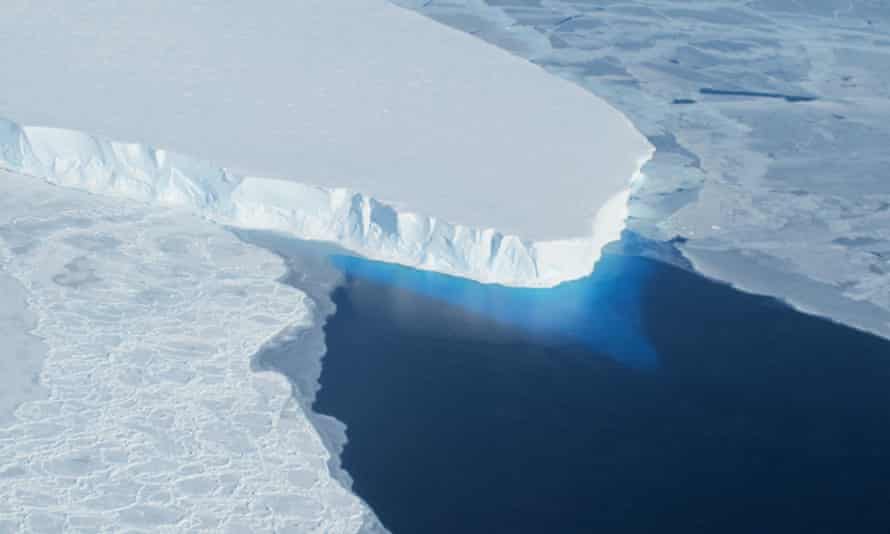
An undated photo courtesy of Nasa showing the Thwaites glacier in western Antarctica. This tipping point for Antarctica could be triggered by a global temperature rise of 3C above the preindustrial era. Photograph: AFP/Getty Images
The current pace of global heating risks unleashing “rapid and unstoppable” sea level rise from the melting of Antarctica’s vast ice sheet, a new research paper has warned.
Unless planet-heating emissions are swiftly reduced to meet the goals of the Paris climate agreement, the world faces a situation where there is an “abrupt jump” in the pace of Antarctic ice loss around 2060, the study states, fueling sea level rise and placing coastal cities in greater peril.
DeConto added: “The oceans would have to cool back down before the ice sheet could heal, which would take a very long time. On a societal timescale it would essentially be a permanent change.”
This tipping point for Antarctica could be triggered by a global temperature rise of 3C (5.4F) above the preindustrial era, which many researchers say is feasible by 2100 under governments’ current policies. The new research, published in Nature, finds that ice loss from Antarctica would be “irreversible on multi-century timescales” should this happen, helping raise the world’s oceans by 17cm to 21cm (6.69in to 8.27in) by the end of the century.
If the world was able to meet commitments made in the Paris deal, however, the research found Antarctica would contribute 6cm to 11cm of sea level rise by the end of the century, on a par with the current rate of ice loss. Under the Paris agreement, governments have vowed to limit dangerous global heating below 2C hotter than preindustrial times, with efforts to keep the increase to 1.5C.
“It’s really the next few decades that will determine the sea level rise from Antarctica,” De Conto said. “These ice shelves won’t be able to just grow back.”
Scientists have increasingly issued warnings over the fate of the huge amount of ice stored in Antarctica which, if it all melted, would raise global sea levels by 57 metres, completely submerging the world’s coasts.
While this won’t happen in any sort of foreseeable timescale, even a small increase in ice loss would be felt in global sea levels. Of particular concern is the western section of the Antarctic ice sheet, with scientists currently exploring the rate of decline experienced by the Thwaites glacier, also known as the doomsday glacier. In a worst-case scenario, the loss of the glacier, which is about the size of Britain and 1km deep, would raise sea levels by 65cm.
Antarctica is being winnowed away by a warming atmosphere as well as the heating oceans, with warming seawater entering crevasses and gnawing away at “pinning points” that hold enormous bodies of ice to submerged bedrock. A rapid acceleration of melting could cause a cascading effect where huge amounts of ice and water flow uninterrupted into the Southern Ocean.
Once in motion, the impacts from such dramatic ice loss would unfurl over centuries. “In the century after 2100 it’s potentially catastrophic,” said DeConto. “If we did nothing at all to reduce emissions we could get 5 metres of sea level rise just from Antarctica by 2200, at which point you’d have to remap the world from space. It would be unimaginable.”
DeConto’s paper uses a mode that incorporates temperature increase and ice loss, as well as the dynamic processes at play in Antarctica that present challenges in predicting exactly what will happen as the world continues to heat up.
Another study published in Nature on Wednesday, by scientists at King’s College in London, finds the sea level will rise by 0.5cm every year by 2100 if the global temperature rise hits 3C. DeConto said the other paper is an “impressive piece of work” but differed from his paper, which factored in compounding impacts from the loss of ice shelves.
“Neither of these papers are the last word, this is ongoing work,” he said. “Basically we are going to have to cope with continued sea level rise. The real question is whether it will be at a manageable or unmanageable rate for us.”
Orrin Pilkey, a sea level rise expert at Duke University who was not involved in the research, said the paper is an “important attempt to relate the Paris agreement to reality”.
He added: “I would consider this a thoughtful and even frightening but credible contribution which should provide a very strong basis to get on with implementation of the Paris agreement.”
Andrea Dutton, an expert in sea level rise at University of Wisconsin–Madison, who was a co-author, said the paper “addresses an important and pressing question” of what the Paris climate targets will mean for future sea level rise.
“We are already struggling with the amount of sea level rise that has occurred over the past century,” said Dutton, who added that a major acceleration in Antarctic melting will “bring about coastal retreat and migration on a scale that we have never before witnessed”.
“We will not be able to just adapt because it is impossible to just engineer our way out of this,” she said. “The conclusion is a stark reminder of the urgency in making deep and sustained cuts in our greenhouse gas emissions.”
Idaho Risks Losing $18 Million in Annual Federal Funds
BOISE,Idaho— In response to legislation recently approved by Idaho lawmakers that could lead to the slaughter of up to 90% of the state’s wolves, the Center for Biological Diversity todayaskedthe U.S. Department of the Interior and U.S. Fish and Wildlife Service to disqualify Idaho from receiving federal funding under the Pittman-Robertson Act.
“We won’t stand idly by while federal taxpayers are forced to fund Idaho’s wolf-slaughter program,” said Andrea Zaccardi, a senior attorney at the Center. “Idaho is entrusted with protecting its wildlife for all Americans, and its failure to do so should be met with serious repercussions, including the loss of federal funding.”
Under the Pittman-Robertson Act, a state may receive federal funding to support critical conservation and outdoor recreation projects but may be deemed ineligible if it passes legislation contrary to the Act…
At the end of the session, the Legislature passed a bill that had language inserted at the last minute that basically guarantees hunting outfitters more nonresident hunting clients. Other bills carrying the same language died in committee.
On Thursday, House Bill 637 was on its way to the governor’s desk after the House and Senate voted to pass subsequent amendments on mostly party-line votes on the last day of the session.
Sportsmen’s groups including the Backcountry Hunters and Anglers and the Montana Wildlife Federation are telling their members to ask Gov. Greg Gianforte to veto the bill, partly due language added Tuesday that is a handout to hunting outfitters.
It would give thousands of big game licenses – elk and deer – to nonresidents who agree to hunt with an outfitter, thus exceeding the limit of 17,000 nonresidents allowed to hunt in Montana. It also gives extra preference points for future license drawings to any nonresident who hunts with an outfitter.
Both actions encourage nonresidents to hunt preferentially with outfitters.
These are similar to changes that sportsmen opposed in Senate Bill 143 and House Bill 505. Dozens of sportsmen spoke in opposition to both bills and both were eventually tabled in committee.
On Wednesday, the Montana Wildlife Federation issued a statement saying, “Public hunters made it clear this session that everybody should have an equal opportunity to hunt in Montana, and this provision is just another attempt to put outfitted clients at the front of the line.”
In mid-march, HB 637, sponsored by Seth Berlee, R-Joliet, started as a “clean-up” bill clarifying several definitions and requirements of Fish, Wildlife & Parks regulations, such as who needed nonresident bear and mountain lion licenses, when boats could be used in hunting and reclassifying wolves as furbearers.
Many sportsmen had issues with the bill to begin with, because it did little to preserve Montana’s wildlife resources. For instance, it increased the number of nonresident mountain lion licenses while allowing nonresident large landowners or their guests to hunt lions without a license to use dogs.
Still, the bill flew through the House even though a fiscal note estimated FWP would lose a half-million dollars a year due to fewer nonresidents being required to buy licenses.
The bill was amended in the Senate, adding a section that would increase payments to landowners participating in FWP’s Block Management program.
By the time the Senate sent the amended bill back to the House on April 26, it was getting late in the game. Legislators were already talking about making “Sine die” motions to end the session as the budget got closer to being finished.
After the House voted against the bill as amended, House Speaker Rep. Wylie Galt, R-Martinsdale, sent the bill into a special conference on Monday. When the conference committee returned the bill to the House on Tuesday, the outfitter big game licenses were suddenly part of the bill.
Sen. Pat Flowers, D-Bozeman, tried to call attention to the change.
“This is being introduced on maybe the 2nd to last day of the legislature… Senate Bill 143 got tremendous interest,” Flowers said Tuesday on the Senate Floor. “To add this on as a simple amendment to what was a quote ‘agency clean up bill’ is disingenuous and does a disservice to sportsmen and women who don’t know this is happening.”
The Backcountry Hunters and Anglers had already opposed HB 637 because it allowed hunters to pursue black bears and mountain lions on the same day they purchase their tags, setting up an opportunity for less reputable hunters to shoot first and tag later.
Because wildlife is part of the public trust that FWP should manage for future generations, BHA opposed allowing nonresident landowners to hunt lions and bears on their property without a license.
But the outfitter license giveaway was the last straw for sportsmen, according to a BHA website post.
“Both chambers, in record time, passed 2nd and 3rd readings last night- all within the same day as the bill taking an entirely new form, and all without public comment or a public hearing with public testimony. The NO votes deserve our thanks; the YES votes have some explaining to do,” the post said.
Russia is mass producing the world’s first coronavirus vaccines for animals. /VETANDLIFE.RU/Reuters
Russia has started mass producing the world’s first COVID-19 vaccines for animals, with its first batch of 17,000 doses soon set for local distribution.
The country’s agricultural watchdog, Rosselkhoznadzor, announced the achievement on Friday, saying that while the jabs would initially be used at home, foreign firms had also shown interest in them.
According to the regulator: “About 20 organizations are ready to negotiate registration and supply of the vaccine to their countries. The file for registration abroad, in particular in the European Union, is under preparation.”
Russia, the first country to come up with the animal jab, registered the Carnivac-Cov vaccine in March 2021, after tests showed it generated antibodies against the coronavirus in dogs, cats, foxes and mink.
The county’s regulator said the inoculation would protect vulnerable species and thwart viral mutations.
It added that companies from Germany, Greece, Poland, Austria, Kazakhstan, Tajikistan, Malaysia, Thailand, South Korea, Lebanon, Iran and Argentina had inquired about purchasing the vaccine.
According to local media, production capacity is at around 3 million doses per month and is expected to increase to 5 million.
The race to find such a jab became urgent following multiple reports of animals contracting the virus early on in the pandemic, with the World Health Organization expressing serious concern over the risk of transmission with other species.
Companion animals such as cats and dogs have tested positive for COVID-19, but there have also been cases in big cats in sanctuaries, gorillas in zoos, and several other mammals.
Last November, Denmark was forced to cull its population of up to 17 million mink after a mutated strain was discovered in sick animals in the country’s fur farms.
With other countries reporting similar infection spikes among the species, concerns over the virus’s impact on the livestock industry have grown.
However, the impact of the novel coronavirus has not been as deadly for animals as diseases such as Highly Pathogenic Avian Influenza (HPAI), better known as bird flu, or African Swine Fever (ASF), the latter of which led to the deaths of around 8 million pigs. Source(s): Reuters18
Learn more about bear hunting in Missouri with MDC’s new online Black Bear Hunting Digest at huntfish.mdc.mo.gov/hunting-trapping/regulations/black-bear-hunting-digest.
JEFFERSON CITY, Mo. –The Missouri Department of Conservation (MDC) reminds Missourians interested in hunting black bears in the state to apply during May for one of 400 permits being offered by MDC for the state’s first black-bear hunting season this coming fall, Oct. 18–27. The maximum total harvest for the season will be 40 bears.Advertisement
Bear hunting in Missouri is limited to Missouri residents and restricts bear hunting to three designated areas of southern Missouri called Bear Management Zones (BMZ). Hunters must apply for a specific Black Bear Management Zone. Permit and harvest quotas for the upcoming Oct. 18-27 bear season…




 18


