Idaho Legislature Sets Sights on Wolf Extermination

https://www.sierraclub.org/sierra/idaho-legislature-sets-sights-wolf-extermination

New bill would allow for 90 percent of wolves in the state to be killed

PHOTO BY JACOB W. FRANK/NATIONAL PARK SERVICE VIA APBY LINDSEY BOTTS | MAY 3 2021

For the Idaho legislature, it seems, the only good wolf is a dead wolf. 

In late April, the Idaho legislature passed a bill that would allow hunters to kill up to 90 percent of Idaho’s wolf population. The legislation is now awaiting Governor Brad Little’s signature. If it’s signed into law, hunters and trappers will be able to kill as many wolves as they’d like, without restrictions.

The Idaho legislature’s savagery does not stop at doing away with hunting limits. The law would permit hunters to run down wolves with motorized vehicles and hunt in the dark using night-vision equipment (nearly all states restrict hunting to daylight hours). It would also extend the trapping season on private property to year-round, even during the breeding season, and allow hunters to trap or shoot as many animals as they want on a single tag. The law would also allow the state’s Wolf Predation Control Board to hire private contract killers to take out wolves, and it would increase the board’s annual budget from $110,000 to $300,000.

The proposal, which was fast-tracked through the state legislature in less than a week, represents the latest development in a chilling trend of Republican state lawmakers trying to eradicate wolves. From Wisconsin, where hunters pushed the state into allowing the slaughter of 20 percent of the population, to Montana, where trapping associations successfully lobbied lawmakers to bring back bounties, wolves face a level of persecution not seen since the turn of the 20th century.  

Suzanne Stone, director at the International Wildlife Coexistence Network, says passage of Idaho’s SB 1211 could “absolutely” warrant federal officials reviewing whether it’s time to return wolves in the Rockies to the endangered species list. As a part of the federal rule that removed wolves in the northern Rocky Mountains from the endangered species list over a decade ago, Idaho agreed to maintain a population of at least 15 breeding pairs and 150 wolves. But this is a floor, not a ceiling. Idaho Fish and Games estimates there are currently about 1,500 wolves in the state. The race to kill most of those animals could and should trigger federal oversight, says Stone, who has worked in wolf conservation for over 30 years.

“It’s like [lawmakers] don’t have any fear that the federal government is going to step back in and take over management if they betray their agreement,” Stone says. “There will definitely be people who pursue this not only from litigation but from new legislation as well.” 

According to the delisting agreement, there are four scenarios that could warrant wolves being returned to Endangered Species Act protection: if wolf populations drop below 10 breeding pairs or 100 individuals; if the population falls below 15 breeding pairs and 150 individuals for three consecutive years; if increased human pressures “significantly threaten” the wolf population; and last (specific to Wyoming wolf management), if the wolf population outside Yellowstone National Park falls below seven breeding pairs for three consecutive years. Stone says the new law would make it easy for Idaho to meet the first three of those criteria.

Violating the agreement with the federal government isn’t the only thing that could jeopardize the current state management of wolves. If the bill becomes law, Idaho could be in danger of violating its commitment to manage wolves as a game species, said Jonathan Oppenheimer, external relations director at the Idaho Conservation League, when he testified against the bill. 

LIKE WHAT YOU READ? SIGN UP FOR DAILY UPDATES FROM SIERRA MAGAZINE.SIGN UP

As a source population for wolves in other western states, Idaho’s wolves are vital to the success of overall wolf recovery in the West. In fact, the most recent federal delisting for wolves outside of the northern Rocky Mountains relies on thriving populations there to justify removing federal protections in other regions such as the Great Lakes. If wolves in the Northern Rockies become scarce, that could undermine the argument for further delisting, Stone says.  

“The federal delisting is already being litigated. So it’s very possible that Idaho and Montana will now fall under that review because of major changes in the regulatory mechanisms that were in place to help guarantee that the wolf populations here would be stable,” Stone told Sierra.  

Even though the wolf-killing bill passed the legislature in a lopsided 58–11 vote, opposition to the proposal has come from many directions—including some surprising ones. Conservation groups including the Idaho Conservation League and the Idaho Sportsmen issued statements rebuking SB 1211 for its disregard of ethical hunting principles. Last week, almost 30 former state, federal, and tribal wildlife biologists sent a letter to the governor urging him to veto the bill over similar concerns. And during the Senate committee hearing, Senator Michelle Stennett, a Democrat from Ketchum, raised concerns over the law’s risk to state management and called out the lack of federal inclusion.  

“I’m a little disturbed,” said Senator Stennett in her closing remarks. “US Fish and Wildlife wasn’t consulted. . . . I understand those that are interested parties putting this together, but in the end, we do still have to work with the Feds in order to keep this agreement together.”

For his part, bill sponsor Senator Van Burtenshaw, a Republican from eastern Idaho, has been clear about the groups he’s hoping to please. “We had the sheep men, the cattlemen . . . we had [the] Farm Bureau, we had outfitters and guides, as well as trappers at the table,” said Burtenshaw. “They put together a piece of legislation that was sponsored by the industry and agreed upon by the industry. And that’s how this came about.” 

Not coincidentally, these interest groups are extensions of the same constituencies that exterminated wolves in the United States a century ago. The rush to oblige them now means lawmakers prioritize killing and eradication over non-lethal measures.  

Yet research tells us that not only are lethal measures ineffective but also that the fears they’re based on are overblown. A 2019 report from the US Humane Society found that wolves account for less than 1 percent of cattle and sheep deaths in Idaho. “They have demonized the wolf to the point where they’re trying to legislate controlling the demon that is simply in their imagination,” Stone told Sierra.

Meanwhile, hunters argue that wolves are gorging on elk and deer, leaving them with fewer opportunities to hunt. Idaho Fish and Game employees, however, have referred to the recent spate of successful elk harvests as the “golden age of elk hunting.” Elk reports show that the state is meeting its harvest quotas in 16 of the 22 hunting zones, and the current population stands at approximately 120,000—just 5,000 animals below the all-time highest count.  

For Andrea Zaccardi, senior attorney for the Center for Biological Diversity in Idaho, the Idaho legislation is a prime example of what happens to wolves when they lose federal protections. The state already has a very permissive hunting season that allows the killing of wolf puppies, allows year-round hunting in some areas, and permits a single person to kill up to 15 wolves, including via the use of chokehold snares. 

“I think Idaho is setting the exact bad example that everyone has been afraid of in terms of what state management of wolves may look like,” Zaccadi told Sierra. “This is the first step in terms of Idaho just usurping authority from state management, making political decisions that are not scientifically based, and just goes to show the state is not responsible enough to manage wolves.” 

Who Decides How Your State’s Wildlife is Treated?

Exposing the Big Game's avatarCommittee to Abolish Sport Hunting Blog

1 day ago

By Wendy Keefover, Senior Strategist, Native Carnivore Protection for The Humane Society of the United States

bear

Lead Image Source :Martin Mecnarowski/Shutterstock

Support OneGreenPlanet

Being publicly-funded gives us a greater chance to continue providing you with high quality content. Please support us!Support Us

https://36089e9cac652e945ae3d1891e77e707.safeframe.googlesyndication.com/safeframe/1-0-38/html/container.html

While millions of Americans are spending more time outside enjoying nature and wildlife, most don’t know that the fate of thenation’s wildlifeis largely controlled by small unelected groups of people more invested in protecting the interests oftrophy huntersthan in protecting animals.

In every U.S. state, regulations governing how wildlife should be treated and managed—for example, how manytrophy huntingortrapping licensesshould be sold forwolves,bears,cougars, orbobcats, or what methods can be used to kill them—are created and administered by two entities.Advertisementhttps://player.hb.selectmedia.asia/prebid/iframe.html?adid=2699fc7c0d17a6433&ref=https%3A%2F%2Fwww.onegreenplanet.org

Life…

View original post 996 more words

CDC reviews death of Michigan woman who got Johnson & Johnson vaccine — everything you should know

Exposing the Big Game's avatarThe Extinction Chronicles

https://www.clickondetroit.com/health/good-health/2021/05/04/cdc-reviews-death-of-michigan-woman-who-got-johnson-johnson-vaccine-everything-you-should-know/

No evidence of rare blood clot after woman’s death, officials say

Annie VanGeest
Annie VanGeest(WDIV)

The Centers For Disease Control and Prevention is currentlyreviewing the death of a Michigan womanwho received theJohnson & Johnsonvaccine, though there is currently no evidence that her death and the vaccine are linked, officials said.

J&J vaccine pause

The Food and Drug Administrationrecommended pausing the use of the Johnson and & Johnson vaccinefor a short time earlier this month as officials investigated a rare instance of blood clots forming in a few women who received the shot.https://3fc302212af67a4d5d29d8d930fffaa4.safeframe.googlesyndication.com/safeframe/1-0-38/html/container.html

On April 12, 6.8 million doses of the Johnson & Johnson vaccine had been administered across the country, and six cases of the blood clot had been identified.

In other words, only 0.00008% of Johnson & Johnson recipients were affected, according to experts.

Officials said a type of blood clot called cerebral venous…

View original post 761 more words

Group asks US to cut funding to Idaho over wolf-killing bill

Group asks US to cut funding to Idaho over wolf-killing bill – The Washington Post

By Keith Ridler | APMay 4, 2021 at 12:13 p.m. PDT

BOISE, Idaho — A conservation group is asking the U.S. government to cut off millions of dollars to Idaho that is used to improve wildlife habitat and outdoor recreation opportunities because of legislation that could lead to 90% of the state’s wolves being killed.

The Center for Biological Diversity sent a letter Monday to Interior Secretary Deb Haaland, saying states may be deemed ineligible to receive federal wildlife restoration money if states approve legislation contrary to that goal.

Idaho received about $18 million last year in that funding, which comes from a tax on sporting firearms and ammunition. States can use it to pay 75% of the cost for projects including acquiring habitat, wildlife research and hunter education programs.

The conservation group’s request is a reflection of the long-simmering tension between ranchers and those seeking to protect wolves in the American West. About 1,500 wolves are in Idaho, with disagreement over whether that is too many or not enough because the predators are known to attack cattle, sheep and wildlife. Ranchers say they lose hundreds of thousands of dollars a year to those attacks.

The Idaho legislation, backed by the agriculture industry, allows the state to hire private contractors to kill wolves and opens up ways the predators can be hunted.

Those methods include hunting, trapping and snaring an unlimited number of wolves on a single hunting tag and allowing hunters to chase down wolves on snowmobiles and ATVs. The measure also allows the killing of newborn pups and nursing mothers on private land.

“We won’t stand idly by while federal taxpayers are forced to fund Idaho’s wolf-slaughter program,” said Andrea Zaccardi, a senior attorney at the Center for Biological Diversity. “Idaho is entrusted with protecting its wildlife for all Americans, and its failure to do so should be met with serious repercussions, including the loss of federal funding.”

Idaho lawmakers have approved the legislation. Republican Gov. Brad Little, whose family has a long history with sheep ranching in Idaho, hasn’t said whether he’ll sign the measure.

Last week, nearly 30 former state, federal and tribal wildlife managers sent a letter to Little asking him to veto it, saying the methods for killing wolves would violate longstanding wildlife management practices and sportsmen ethics.

The Idaho Fish and Game Commission also opposes the bill because it removes wildlife management decisions from the commission and its experts and gives them to politicians.

Supporters say the changes could help reduce the wolf population from about 1,500 to 150, alleviating attacks on cattle and sheep. The Idaho Cattle Association said it supports the measure because it allows the free-market system to play a role in killing wolves.

The Idaho Department of Fish and Game, using remote cameras and other methods, reported in February that the wolf population has been holding at about 1,500 the past two years.

About 500 wolves have been killed in the state in each of the last two years by hunters, trappers and wolf-control measures carried out by state and federal authorities.

Idaho’s wolf conservation and management plan calls for at least 150 wolves and 15 packs. Supporters of the measure say the state can increase the killing of wolves to reach that level.

According to the plan, if Idaho’s wolf population fell to 100, there is a possibility the U.S. Fish and Wildlife Service could resume management of the predators in the state.

US is becoming warmer with each decade, new numbers reveal

Exposing the Big Game's avatarThe Extinction Chronicles

https://www.accuweather.com/en/weather-news/new-noaa-1991-to-2020-climate-weather-normals/941550

ByLauren Fox,AccuWeather staff writer

Published May. 4, 2021 9:20 AM PDT|Updated May. 4, 2021 11:43 AM PDTCopiedhttps://imasdk.googleapis.com/js/core/bridge3.453.0_en.html#goog_1278558154Volume 0%New climate data resets average daily temperatures

A new report from NOAA updates what’s considered the daily “average” or normal temperatures.

New data on the “normal” temperature and climate variables in the United States has revealed that much of the country is getting warmer and wetter each decade — and some experts say the warming trends are on par with what would be expected from greenhouse gas-induced climate change.

“Normals,” as they referred to by meteorologists, are determined based on weather factors such as temperature and precipitation that have been tabulated by researchers over the past 30 years. Those numbers are then calculated into averages for the 30-year period.

Every 10 years, the U.S. normals are reviewed and updated by scientists from The National Oceanic and Atmospheric Administration’s (NOAA) National…

View original post 1,168 more words

12 crows shot, killed in suspected animal cruelty cases in Mountlake Terrace

https://komonews.com/news/local/im-just-horrified-dozen-disturbing-animal-cruelty-cases-reported-in-mountlake-terrace


by Michelle Esteban, KOMO News ReporterMonday, May 3rd 2021AAPolice believe one person has shot and killed at least a dozen crows in the city. (KOMO)https://imasdk.googleapis.com/js/core/bridge3.453.0_en.html#goog_1072611284Volume 90% Police believe one person has shot and killed at least a dozen crows in the city. (KOMO)

Facebook Share Icon
Twitter Share Icon
Email Share Icon

MOUNTLAKE TERRACE, Wash. — A disturbing rash of suspected animal cruelty cases in Mountlake Terrace.

Police believe one person has shot and killed at least a dozen crows in the city. Authorities said they are very close to recommending charges.

That’s a big relief to the community, because the worry is for the bird’s safety and more.

“I’m scared this guy is going to miss some day and hurt somebody,” said Eileen Wood-Lim outside her Mountlake Terrace home today.

Since February, Mountlake Terrace Police said at least 12 crows have been shot and killed in the city limits – all in the middle of the day.

Two home security videos shared by police and captured by worried residents show the same red truck multiple residents have reported seeing in the areas of multiple shootings. Police identified that same truck and its driver as their suspect.

“You can’t see person very well who’s shooting but you see crow fall out of the sky,” said Commander Pat Lowe referring to one of the videos.https://imasdk.googleapis.com/js/core/bridge3.453.0_en.html#goog_1072611282Volume 90% Authorities are searching for a suspected crow killer in Mountlake Terrace. (KOMO)

He said they believe there could be as many as 20 cases of crow shootings in Mountlake Terrace alone. Twelve are active and there are dozens of other unconfirmed reports on social media in the surrounding areas, from Brier to unincorporated Snohomish said Commander Lowe.

“I’m just horrified,” said Wood-Lim, standing in her driveway. She was home Monday during her lunch break from work.

One of those crows fell to its death March 4 in her driveway. She was home working, heard two shots, a thump and then the loud shriek from a cluster of crows.

“I love crows and to have somebody shooting them and have it happen right in my driveway made me upset,” Wood-Lim said.

Her worry is exactly why Mountlake Terrace Police have worked nonstop to track the crow killer

“If you take someone who will be so brazen do out in broad daylight and shoot out in public that’s pretty scary cause those bullets have to go somewhere,” Lowe said.

Lowe said the same red truck seen outside Eileen’s house on her doorbell camera is the same truck captured in multiple videos by others residents and turned over to police as evidence.

You can’t make out the driver in Eileen’s video but you can see what looks like a long gun. Police think it might be a high caliber pellet gun or even a 22. caliber rifle, but that’s still under investigation.

“It’s not out of the realm of possibilities that if someone is doing that with a crow, and then they’re upset with a pet dog, or pet cat or a child,” Lowe said.

Through an anonymous tip, police tracked down the truck’s owner.

Police said the Mountlake Terrace man agreed to let them see his truck to rule him out as a suspect, but kept rescheduling.

Eventually, Lowe said they found the truck at a nearby dealership and that the man sold it and didn’t tell them. Inside police found possible evidence.

We asked police since they made contact with the man who they consider a suspect, what’s happened with the shootings.

“It’s stopped,” Lowe said. “It’s the main thing we wanted to stop the shootings.”

Police said they are confident the truck’s owner is behind all the crowing killings and they will recommend charges be filed very soon.

Possible charges, may include shooting a firearm in the city and animal cruelty-related charges but police are still determining charges and are working with the state Fish and wildlife agency.

More to the Wolf Issue Than Meats the Eye

Exposing the Big Game's avatarCommittee to Abolish Sport Hunting Blog

©Jim Robertson

“Our task must be to free ourselves from this prison by widening our circle of compassion to embrace all living creatures and the whole of nature in its beauty.”

Albert Einstein

One doesn’t have to be a genius like Einstein to figure out that the ultimate moral goal of our species should be to move forward in regards to our kind treatment of others. Yet, when it comes to our behavior toward animals—especially wildlife—the human species seems to be backsliding a bit these days. Examples of it are many, while advancements are few and far between.

To counter this disparity, perhaps it’s time we stop using the term “human rights” in reference to things that should be considered basic rights for all species. Surely, the human race doesn’t need anything else singling it out to stroke its over-inflated, collective ego. Differentiating between human and non-human rights just encourages…

View original post 1,748 more words

Activists Stage “Eating Animals Causes Pandemics” Rally in NYC

MAY 2, 2021 BY DONNY MOSS — LEAVE A COMMENThttps://www.facebook.com/plugins/share_button.php?href=https%3A%2F%2Ftheirturn.net%2F2021%2F05%2F02%2Factivists-stage-eating-animals-causes-pandemics-rally-in-nyc%2F&layout=button&size=small&appId=560935960731324&width=67&height=21https://platform.twitter.com/widgets/tweet_button.06c6ee58c3810956b7509218508c7b56.en.html#dnt=false&id=twitter-widget-0&lang=en&original_referer=https%3A%2F%2Ftheirturn.net%2F2021%2F05%2F02%2Factivists-stage-eating-animals-causes-pandemics-rally-in-nyc%2F&size=m&text=Activists%20Stage%20%22Eating%20Animals%20Causes%20Pandemics%22%20Rally%20in%20NYC%20-%20Their%20Turn&time=1620069625899&type=share&url=https%3A%2F%2Ftheirturn.net%2F2021%2F05%2F02%2Factivists-stage-eating-animals-causes-pandemics-rally-in-nyc%2FShare on TumblrSave

The News

On May 1st, dozens of conservationists and animal rights activists staged a rally in Times Square to help members of the public connect the dots between eating animals and pandemics. Their message was simple: “Eating Animals Causes Pandemics.” The New York City rally was one of approximately 60 that took place in 20 countries around the world in support of International Pandemic Outreach Day.https://www.youtube.com/embed/M_AfsUPXW1k?feature=oembed

The Eating Animals Causes Pandemics campaign is a collaboration among animal rights, environmental, conservation and religious organizations. It emerged as a result of the outbreak of COVID-19, which is believed to have jumped to humans in a live animal market in China. Like many of the pandemics that preceded it, including the catastrophic Spanish Flu of 1918, COVID-19 is a zoonotic disease — one that is transmitted to humans from a non-human animal.

On International Pandemic Outreach Day, advocates in New York City spoke to hundreds of pedestrians whose attention they captured with their hazmat suits and posters. Most were not aware that outbreaks of avian flu, swine flu and a human version of mad cow disease are caused by our consumption of chickens, pigs and cows.

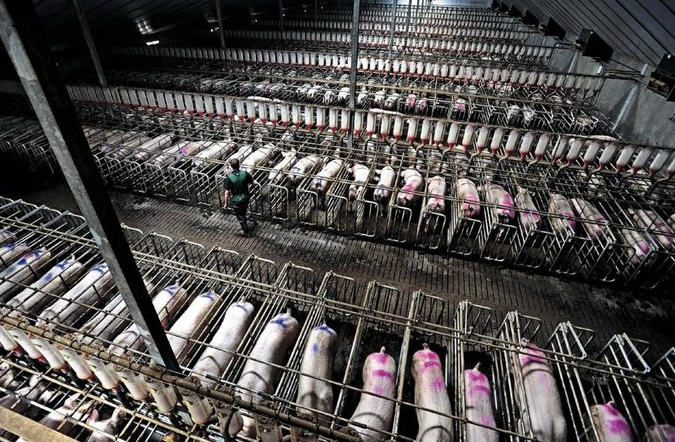
Factory farms are a breeding ground for infectious diseases, which could easily spread among the animals and, if zoonotic, to humans

The COVID-19 pandemic shined a global spotlight on the infectious disease risks associated with live animal markets, but zoonotic diseases can – and do – emerge in factory farms, slaughterhouses and any other setting where animals are intensively confined and/or slaughtered for human consumption. Dr. Michael Gregor, the author of Bird Flu: A Virus of Our Own Hatching (2016) has said, “If you actually want to create pandemics, then build factory farms.”

Conservationists and animal rights activists staged a rally in Times Square to raise awareness about the connection between eating animals and pandemics

Fact-Checking Idaho’s Wolf Eradication Law

What Biden’s Done for the Climate in His First 100 Days

The state is about to pass a law calling for 90 percent of its wolf population to be killed. It’s based on fear and lies.

A wolf pack in Yellowstone National Park.

Wes SilerWes Siler


Apr 29, 2021

This week, Idaho governor Brad Little is expected to sign into law a bill that calls for the extermination of 90 percent of the state’s 1,500-strong wolf population. Proponents say wolves are ruining the livelihoods of ranchers and hunters. Opponents say the wolves are necessary to a healthy ecosystem.

“They’re destroying ranchers,” said Republican senator Mark Harris, one of the bill’s sponsors, during a debate in the Idaho statehouse. “They’re destroying wildlife. This is a needed bill.”

“The politicians behind this bill lack science, ethics, and fact,” Amaroq Weiss, senior West Coast wolf advocate for the Center for Biological Diversity, told Outside. 

After being eradicated earlier in the 20th century, wolves were reintroduced to Idaho in 1995. Initially protected by the federal government under the Endangered Species Act, the state legislature worked to establish political control over management of the species. The Idaho Wolf Conservation and Management Plan was passed in 2002, creating a blueprint for the state’s Fish and Game department to take over management of the species upon delisting from the ESA, which took place across the northern Rocky Mountains in 2011. 

That original plan, written by the legislature, not Fish and Game, called for a minimum population level of 15 packs. Given that wolf packs in this part of the world average about ten members, that roughs out to a population of about 150 wolves. That number was determined by the legislature to be the population size that would allow the species to remain sustainable in the state—without creating conflict with ranchers and hunters. Wildlife biologists, in contrast, argue that wolves must return to the entire portion of their historic range that’s currently able to support the species before their population can be considered sustainable. 

This new bill, SB 1211, calls for Idaho’s wolf population to be reduced from its current estimated size of 1,556 back to that politically determined level of 150 wolves. To achieve that, it devotes $590,000 to hire contractors to exterminate the animals and removes any limits on the number of wolves hunters may harvest, while freeing them to use any method currently legal in the state, including trapping, the use of night vision equipment, shooting from vehicles, and baiting. 

The Idaho Fish and Game Commission opposes the legislation, arguing the bill would remove decisions about how to manage wildlife from the department’s professionals and place that decision making in the hands of politicians. Idaho’s approach is also in conflict with that of the U.S. Fish and Wildlife Service. 

Here are the reasons the bill’s proponents argue such extraordinary action is necessary—and how they compare to science. 

The Claim: Wolves Kill Livestock

“A cow taken by a wolf is similar to a thief stealing an item from a production line in a factory,” Cameron Mulrony, executive vice president of the Idaho Cattle Association, told The Guardian. 

And in the debate at the statehouse, Idaho’s Senator Harris called wolf livestock depredation a “disaster.”

The Reality: The Number of Kills by Wolves Is Exceptionally Small

In 2018 there were 113 confirmed wolf kills of cows and sheep. In 2019 that number was 156, and in 2020 it was 84. That gives us a three-year average of 113 wolf kills per year in the state. There are currently 2.73 million head of cows and sheep in Idaho. That means confirmed wolf-caused losses amount to 0.00428 percent of the state’s livestock. 

According to a study published in 2003 and widely cited by the agriculture industry, variables like terrain can sometimes make it hard to find dead livestock, so the true number of wolf-related losses may be up to eight times greater than the official tally. Assuming that worst-case scenario applies universally, wolf kills may account for as much as 0.02 percent of the state’s livestock. 

Idaho loses about 40,000 cattle each year to non-predator causes like disease, birthing complications, and inclement weather. 

U.S. Fish and Wildlife provides the state of Idaho with funding to compensate ranchers for confirmed cases of livestock lost to wolf depredation. Currently that amount covers 50 percent of the rancher’s total cost.

The Claim: Killing Wolves Reduces Depredation

“We need proper management to keep Idaho ranchers in business,” wrote Cameron Mulroney, vice president of the Idaho Cattle Association, in an opinion piece published by the Idaho Statesman. He goes on to call for taxpayer-funded wolf culling and increased wolf hunting opportunities for members of the public. 

The Reality: Healthy Packs Prefer Natural Prey

“Multiple state-sponsored studies have concluded that large-scale wolf removal through public hunting or significant lethal control does not substantially reduce livestock losses to wolves in areas of recurring conflict,” Zoë Hanley, a representative of Defenders of Wildlife, wrote in a letter to Idaho lawmakers. 

Many biologists believe that, because wolves function in packs, destabilizing and weakening those packs by killing members of them forces the wolfs to seek easier prey. “The odds of livestock depredations increased four percent for sheep and five to six percent for cattle with increased wolf control,” said a study that tracked livestock depredations across Idaho, Montana, and Wyoming between 1987 and 2012. 

The study does confirm that culling wolves to the point of removing them from an ecosystem can be demonstrated to reduce depredation. 

The Claim: Wolves Decrease Hunting Opportunities

Wolves are “destroying wildlife,” said Senator Harris in the debate. Hunters complain that they must compete with wolves for their natural prey, elk and deer, and that wolves push those animals out of traditional hunting areas, while reducing their outright numbers. 

“The old place where you took your Dad or your dad takes your son, you can’t go there anymore because the elk are gone,” wrote Benn Brocksome, executive director of the Idaho Sportsman’s Alliance, in an opinion piece. “There’s one or two deer where there used to be hundreds, they’ve really pushed the elk and deer populations around, and really diminished the populations in different areas.”

The Reality: Wolves Create Healthy Ecosystems

Despite all those pesky wolves, elk populations in Idaho are actually at or above management objectives. The outright number of elk in the state currently stands at 120,000, just 5,000 fewer than the all-time high of 125,000. That’s also 8,000 more elk than were counted in 1995, the year wolves were reintroduced to Idaho. 

As of 2019, the population of bulls (male elk) was above management objectives in 41 of Idaho’s 78 elk-hunting zones. According to Idaho Fish and Game, 2019 saw the 14th-highest elk harvest of all time in the state. In fact, the biggest problem elk populations in Idaho face is a lack of hunters prepared to hunt tough terrain. “One of the challenges we face in managing elk populations is getting enough hunters to hunt hard for and harvest antlerless elk in areas where we are working to bring elk herds back to the population objectives in the statewide elk plan,” Rick Ward, the department’s deer and elk program coordinator, said in a statement.

Mule deer aren’t fairing quite as well. “The three-year stretch of winters spanning from 2016 to 2019 was tough on many of Idaho’s mule deer herds, largely due to poor-to-average fawn survival,” according to Idaho Fish and Game. Still, 24,809 mule deer were harvested during the 2020 hunting season, with 28 percent of hunters finding success.Below average, but far from the lowest. 

It doesn’t appear that wolves decreased populations of ungulates, and the predators may even play an important role in protecting them: chronic wasting disease (CWD) is a contagious neurological disease that degrades brain tissue in deer and elk over time, leading to emaciation and eventually death. CWD has not yet reached Idaho, but it has been found just over the border in southwest Montana and in Wyoming. There is currently no known cure and no effective tool for preventing its spread.

At least that’s what researchers thought until they began a research project into CWD’s spread in Yellowstone National Park. There, preliminary results suggested that wolves may be effective at slowing its spread by killing infected animals. Wolves cannot be infected by the disease.

“Wolves wouldn’t be a magic cure everywhere,” Ellen Brandell, the Penn State University researcher leading the project, told The New York Times. “But in places where it was just starting and you have an active predator guild, they could keep it at bay and it might never get a foothold.” 

Gary J. Wolfe, a wildlife biologist and the former president and CEO of hunting advocacy group the Rocky Mountain Elk Foundation, agrees. “While I don’t think any of us large carnivore proponents are saying that wolf predation will prevent CWD, or totally eliminate it from infected herds, it is ecologically irresponsible to not consider the very real possibility that wolves can slow the spread of CWD and reduce its prevalence in infected herds,” he said in a statement released by the Sierra Club. “We should consider wolves to be ‘CWD border guards,’ adjust wolf hunting seasons accordingly, and let wolves do their job of helping to cull infirm animals from the herds.”


SB 1211 isn’t going to save livestock and won’t help hunters, but ultimately it may pose one major problem for anti-wolf Idahoans: if it causes the state’s wolf population to fall below ten packs, the bill could eventually lead to the state losing the ability to manage wolves within its borders. The 2002 Wolf Conservation and Management Plan, written by Idaho’s own legislature, calls for wolf management to revert to U.S. Fish and Wildlife control if the state’s population falls below ten packs. 

“In the unlikely event the population falls below ten packs … wolf management will revert to the same provisions that were in effect to recover the wolf population prior to delisting,” according to Idaho’s management plan. That’s the Endangered Species Act. 

Poland records largest-ever bird flu outbreak

https://www.thepoultrysite.com/news/2021/05/poland-records-largest-ever-bird-flu-outbreak

Over six million birds have been culled in the EU’s largest poultry producer as bird flu cases top 260.MARKETS AND ECONOMICSMARKET TRENDSBIOSECURITYAVIAN INFLUENZADISEASESHEALTH & DISEASEby The Poultry Site3 May 2021, at 8:33am

Poland is currently contending with 262 outbreaks of bird flu, the country’s highest recorded number of infections. Reporting from Notes from Poland explains that over six million birds have been culled to stem the spread of the disease. Though poultry farmers can claim compensation for their losses, the hit to the country’s poultry industry, which produces 20% of the EU’s poultry meat, has been immense.

Animal health authorities believe that the outbreaks are due to the high concentration of poultry farms in certain locations. Poland’s chief veterinarian is calling on the government to update regulations to ensure greater biosecurity measures and that there is sufficient space between poultry farms.

“This is the first time we are facing such a great crisis,” Andrzej Danielak, from the Polish Association of Poultry Breeders and Producers said. “Until now, 65 outbreaks was the largest [annual] number, and here we have already exceeded 200.”

Prices for eggs and poultry meat in Poland have already increased 65% since November, and many economists expect the price hikes to continue. However, there could be some relief as the weather becomes warmer.

Read more about this story in Notes from Poland.