A new study in the journal Nature Climate Change analyzed the Brazilian Amazon’s carbon emission.
The Brazilian Amazon released 16.6 billion tonnes of carbon dioxide from 2010 through 2019.
The study also found that deforestation increased almost fourfold in 2019 from the previous two years.
A new report on Thursday found that over the last decade theBrazilian Amazon released approximately 20 percent more carbon dioxide than it absorbed.
According to the journalNature Climate Change, the Brazilian Amazon released 16.6 billion tonnes of carbon dioxide and only absorbed 13.9 billion tonnes from 2010 through 2019.
America is changing faster than ever! Add Changing America to yourFacebookorTwitterfeed to stay on top of the news.
(CNN)America’s emerging limbo between a full-blown pandemic and a return to normal is throwing up new public health dilemmas that spark instant political fires — like afresh round of grandstanding over mask wearing.Top White House adviser Anita Dunn SundaydefendedPresident Joe Biden over his continueduse of a mask outdoors– even though the practice appears to conflict with new and relaxed administration guidelines for fully vaccinated citizens.In comments that didn’t necessarily clarify the situation, Dunn told CNN’s Jake Tapper on “State of the Union” that “extra precautions” were being taken for the President and that mask wearing was “a matter of habit.”
Republicans, seeking to dentstrong public approval ratingsfor Biden’s handling of the pandemic, have already accused him of whipping up stigma against people who refuse to wear masks…
Tyson debuts its first vegan burger, as the industry tries to make up for slow start inbooming plant-based meat market.ByMichael Hirtzer,Deena Shanker, andFabiana BatistaMay 3, 2021, 5:50 AM PDTUpdated on
There’s no other way to put it: Tyson Foods Inc.’sfirst attempt at an alt-meat burger was aflop.
Two years ago, the biggest U.S. meat company marketed a mix of real beef and pea protein to consumers with a “flexible diet.” But the half-vegan, half-not patty proved a tough sell. Tyson eventually discontinued it, saying only that it “constantly evaluates products.”
Now it’s back and trying again. On Monday, the maker of Jimmy Dean sausages unveiled a lineup of 100% vegan meat products…
The funeral was a suitably solemn affair. The small casket was placed on a table covered in a black drape, a maudlin yet defiant speech quoted a Dylan Thomas poem, a moment’s silence was held.
Inside the casket, however, was not a body, but a vial of meltwater from Clark glacier in Oregon, once an imposing body of ice but now a shrivelled remnant.
The funeral, a stunt held by worried glacier researchers on the steps of the state capitol in Salem, illustrated how the climate crisis is rapidly gnawing away at the majestic icepacks that used to throng the mountains of the northwestern US, potentially posing a threat to the region’s water supplies.
“There is just this immense sadness because we all knew it was going to be bad, but didn’t think it would be this bad,” said Anders Carlson, president of the Oregon Glacier Institute, who read the eulogy for Clark glacier at the “funeral” in October.
Clark glacier is, or was, found if you took a moderately strenuous hike amid the Cascade mountains, a range that stretches from British Columbia in Canada down to the northern reaches of California.
Once spanning about 46 football pitches in size, the Clark glacier is now about three football pitches in area, or what Carlson calls a “stagnant scrap of ice”.
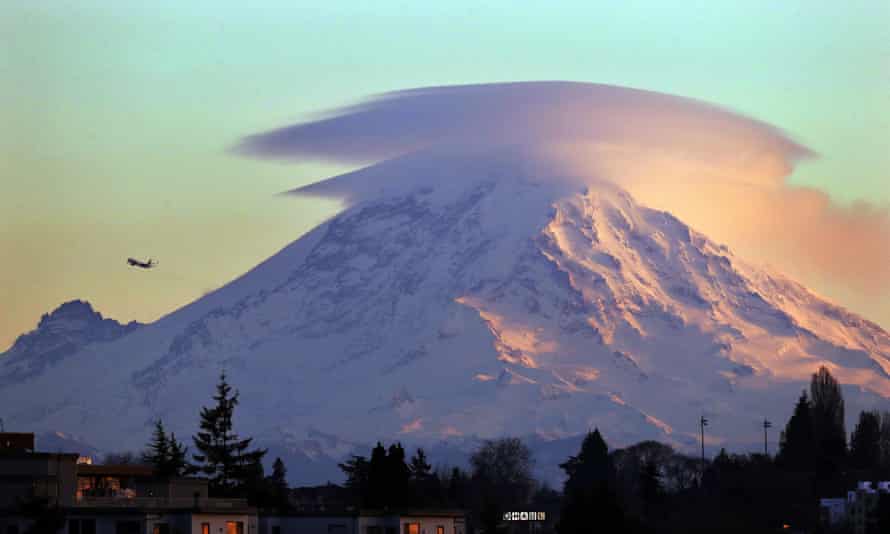
Mount Rainier Photograph: Elaine Thompson/AP
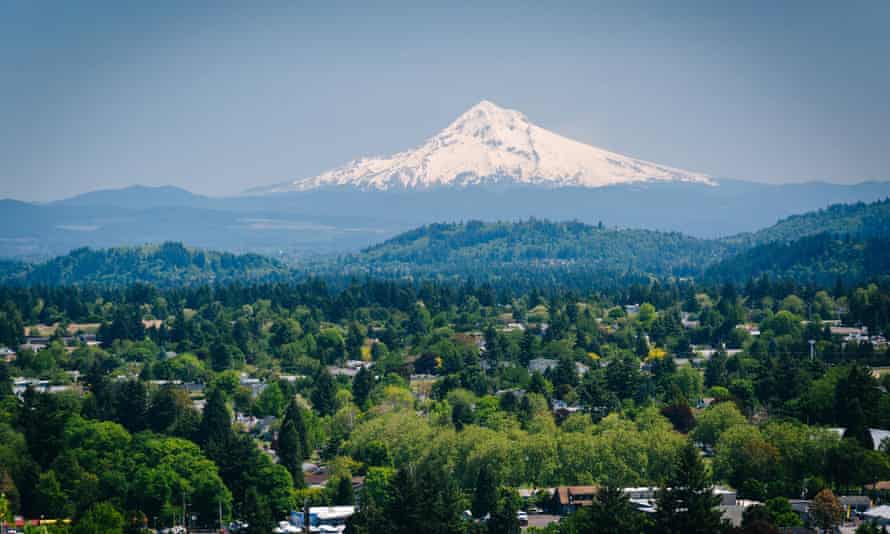
“It’s like a rotting carcass of its former self,” said Carlson. Glaciers move via gravity under their own vast weight, but once they have lost a certain amount of volume, they become dormant patches of ice. Other nearby glaciers found on the three sisters, a chain of volcanic peaks, and Mount Hood have similarly “died” in this way.Advertisementhttps://2d5c5e053b62f319ca53502bafa5e824.safeframe.googlesyndication.com/safeframe/1-0-38/html/container.html
“You go back through old photographs and glaciers have disappeared just in the last 20 years – it’s really dramatic,” said Carlson, who has calculated that at least a third of the state’s glaciers named by the US government in the 1950s are now gone.
Among their other benefits, the meltwater from glaciers each spring feeds streams and rivers that supply a water source for apple and pear orchards, vineyards and even some drinking water for towns situated in the shadows of the mountains.
Researchers have estimated that river volumes in the late summer could drop by 80% by the end of the century due to decreases in glacier and snow melt. These huge losses raise tough questions over how to replace the water.
“These glaciers are not just nice to look at – they are our water towers, where we store our water,” said Carlson.
“Places like Hood River and Eugene are drinking and growing crops with water from glaciers. If you like Oregon wine, the chances are it was grown with glacier water. If you lose that, it’s not going to be a pretty picture. You either try to get groundwater or build new dams, which is not popular with anyone.”
The decline of glaciers is part of a broader trend that has seen vast bodies of ice wither away from the Himalayas to Switzerland as global temperatures climb. The glaciers of America’s Pacific north-west aren’t as well known as those overseas, but they play an important role in the local environment and are suffering stunning losses.
Since the mock funeral, researchers have found that the Cascades are particularly vulnerable to the melting of glaciers, which can cause maladies ranging from increased wildfire risk to the loss of species such as steelhead trout that rely on the frigid cold of glacier-fed streams. In the longer term, the glaciers of the American west face almost complete obliteration.
“The glaciers in the western US continue to shrink and will largely disappear by the end of the century,” said Andrew Fountain, a geologist at Portland State University who has submitted new research that found the glaciers of the Olympic Mountains, in the state of Washington, will probably vanish by 2070.
“You might get icy remnants on the peaks of tall mountains like Mount Rainier or Mount Baker, but they will be pretty small. Rising temperatures are doing this, without a doubt.”
Beyond drastically cutting planet-warming emissions, there is little that can be done to salvage the glaciers, a sobering reality for those who have long hiked and climbed the peaks of the US north-west.
“It’s really hard to stop the decline,” said Carlson. “People don’t realise we are a glacierised country – we rely upon them, like the Swiss and Norwegians do. They are important and we need them.”
Yet neurons don’t work for free, a fact that constrains how nervous systems might evolve in size and complexity in the first place. Just because skulls expand, doesn’t mean nature will automatically fill them with grey matter.
Strange as it seems, we know very little about the evolutionary forces responsible for diversifying brain size across the backboned part of the animal kingdom.
So an international team of researchers undertook a huge study on the largest fossil and extant dataset yet assembled, measuring the spaces once occupying the skulls of more than 1,400 species, living and extinct.
Comparing information on body sizes with endocranial data, the…
The Green New Deal, formerly seen as radical, is now in mainstream debate. And renewable energy becomes more efficient every day
Power-generating windmill turbines at sunset near Larnaca, Cyprus.Photograph: Yiannis Kourtoglou/Reuters
Sat 1 May 2021 08.12 EDT
918
That we are living in science fiction was brought home to me last week when I put down Kim Stanley Robinson’s superb climate-futures novel The Ministry for the Future and picked up Bill McKibben’sNew Yorker letteron climate, warning of the melting of the Thwaites Glacier, “alreadyknownas the ‘doomsday glacier’ because its collapse could raise global sea levels by as much as three feet”. Where we are now would have seemed like science fiction itself 20 years ago; where we need to be will take us deeper into that territory.
Three things matter for climate chaos and our response to it – the science reporting on…
ByHyung-Jin Kim Associated PressSunday, May 2, 2021 6:39AMabout:blankEMBED <>MORE VIDEOS
President Joe Biden detailed topics including the COVID-19 pandemic, foreign policy, the American Rescue Plan and more in his first address to a joint session of Congress.SEOUL, South Korea — North Korea on Sunday warned the United States will face “a very grave situation” because President Joe Biden “made a big blunder” in his recent speech by calling the North a security threat and revealing his intent to maintain a hostile policy against it.
Stories of clever animals abound, from pigs playing video games to monkeys trading mobile phones – now tests reveal that they don’t merely act on instinct but can think flexibly, like usLIFE 7 April 2021
Superficially, these behaviours certainly seem smart. But what do they really reveal about animal intelligence? The human mind is remarkable for its innovation and problem-solving across many different domains. Do other animals have the same sort of brains, or are their headline-grabbing antics no more than party tricks that require little complex reasoning?
Scientists have begun devising elaborate tests to tackle this question. Like our own IQ tests, they allow researchers to assess the capacity of an animal’s mind, compare the mental abilities of different individuals and identify factors that lead to superior performance. The findings have been a revelation. They provide some fascinating insights into the anatomy of intelligence. And they may even shed light on the evolutionary origins of our own minds.





 Top Articles


