Salmon Have Shrunk So Much That Whole Foods Redid Its Guidelines

https://www.bloomberg.com/news/articles/2021-04-27/salmon-have-shrunk-so-much-that-whole-foods-redid-its-guidelines?fbclid=IwAR0M_Vsl3auoFdrIBFyc4v6QDbBgTWiAgGG9skFS3giheS34NC953fybT40

By Kim ChipmanApril 27, 2021, 4:00 AM PDT

  •  Climate change seen as threat to Pacific Rim’s ‘keystone’ fish
  •  Wild salmon woes pose threats to Alaska’s $2 billion industry
A fisherman washes freshly caught salmon in Newtok, Alaska.
A fisherman washes freshly caught salmon in Newtok, Alaska. Photographer: Andrew Burton/Getty Images

LISTEN TO ARTICLE

5:57

SHARE THIS ARTICLE

ShareTweetPostEmail

In this article

0597575DUNIVERSITY OF ALASKA FAIRBANPrivate Company0179553DUNIVERSITY OF CALIFORNIA SANPrivate Company

At OBI Seafoods, a sprawling operation with outposts throughout Alaska, there’s all sorts of extra machinery for workers to master. At Whole Foods Market, there are new guidelines for purchasing salmon from wholesalers. And at Ivar’s, a fixture on Seattle’s waterfront for eight decades, the chef is sending back more and more salmon delivered to his kitchen.

Behind all these changes is an alarming trend that’s been building for years: The giant schools of wild Pacific salmon that can turn southeast Alaska’s ice-cold waters into a brilliant orange blur are thinning out, and those that do survive are shrinking in size.

It’s the shrinking part that’s causing the biggest logistical snarl right now. Many salmon are so small they’ve thrown off OBI’s fish-sorting process and no longer meet the purchasing specifications at Whole Foods and culinary demands at Ivar’s. There, head chef Craig Breeden snaps photos of the fish next to his knife to illustrate their diminutive size before shipping them back.

“It’s very irritating when the supplier sends it to me and I see the size of these fillets,” he said. “In the last eight to 10 years, the salmon sizes have started to get smaller and smaller.”

‘Critical Moment’

More fromDeep-Sea Mining Robot Lost on Cobalt-Rich Floor of PacificCalifornia’s $4 Gasoline May Mean a Price Shock Across U.S.Glaciers Are Melting More Rapidly, Risking Floods and DroughtsChina Wants More Steel at Home as Industry Faces Overhaul

These disruptions are, for now, more a nuisance than serious problem. But they almost certainly presage more costly changes to come and, much more importantly, raise alarm bells about the growing crisis in some key salmon populations that is being driven, according to many scientists, by climate change and more competition for food. Decades after the Atlantic cod fisheries collapsed, concern is now mounting among experts that wild Pacific salmon could face a similar fate.

“The whole thing is out of whack,” said Laurie Weitkamp, a U.S. fisheries biologist at the National Oceanic and Atmospheric Administration. “Salmon managers are realizing that climate change is impacting their stocks and it is generally not favorable and it’s only going to get worse.”

Salmon are so vital that scientists call them a “keystone” species, since animals such as bears and eagles depend on them, and the fish indirectly spread nutrients into ecosystems including forests. A salmon’s life journey from freshwater streams to the ocean and back again to reproduce and die makes them especially vulnerable to warming temperatures and a shifting environment.
PA Salmon
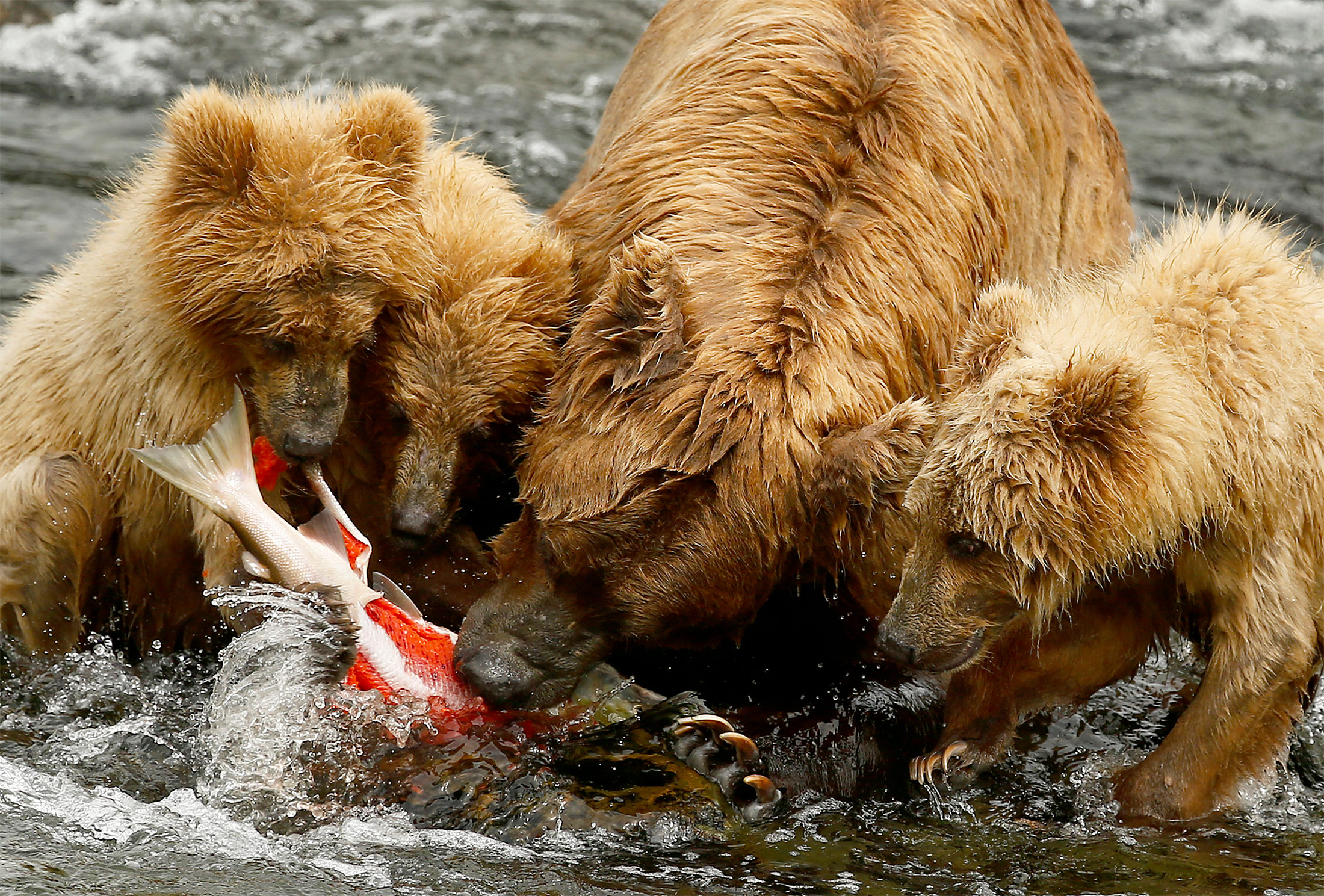
A bear and her cubs eat a sockeye salmon in Alaska’s Katmai National Park.Photographer: Luis Sinco/Los Angeles Times/Getty Images

Alaskan salmon are getting smaller partly because they’re returning from the ocean at a younger age, though scientists don’t really know why. The trend is also playing out across the Pacific Rim, from the U.S. mainland and Canada to Russia and Japan.

“When the size and the numbers go down that’s a harbinger of change that is taken as a red flag among many scientists,” said Peter Westley of the University of Alaska Fairbanks, co-author of a study on salmon size published last year with the University of California Santa Cruz.

The scientists examined four of the five Pacific salmon species in Alaska. Chinook — pursued by anglers and valued by restaurants — had the biggest average decline, at 8%, compared with pre-1990 fish. All other species shrunk, with sockeye showing the smallest decline at 2.1%. The most rapid changes were in the past decade.

Dwindling sizes in other species signaled a fishery’s collapse, including Canada’s Atlantic cod three decades ago.

In Europe and New England, the memory of rivers teeming with wild Atlantic salmon is all but forgotten due to overfishing, habitat loss and dam construction that blocked spawning grounds, said David Montgomery, whose 2003 book “King of Fish: The Thousand Year Run of Salmon” warns that the Pacific species could face the same fate. “Sadly, the book is still current.”

Agriculture, mining and other man-made interactions have sent Pacific salmon numbers plummeting in places including the Pacific Northwest’s Columbia-Snake River Basin. In some parts of Canada and the U.S., they’re endangered. Key runs in Alaska and Canada’s British Columbia province are seeing some of the worst years.

B.C.’s Fraser River had record low sockeye run sizes in three of the last five years, with last season setting a new low, said the Pacific Salmon Commission, which oversees management of the fish in the U.S. and Canada.

Collapsing Fisheries

“We are seeing a march north on the declines and collapses of salmon fisheries,” said Guido Rahr, head of Portland, Oregon-based Wild Salmon Center. “Japan has almost no wild fish left. In parts of Russia, once massive salmon runs are collapsing due to overfishing.”

Russia and the U.S. make up 85% of the world’s remaining Pacific salmon.
PA Salmon
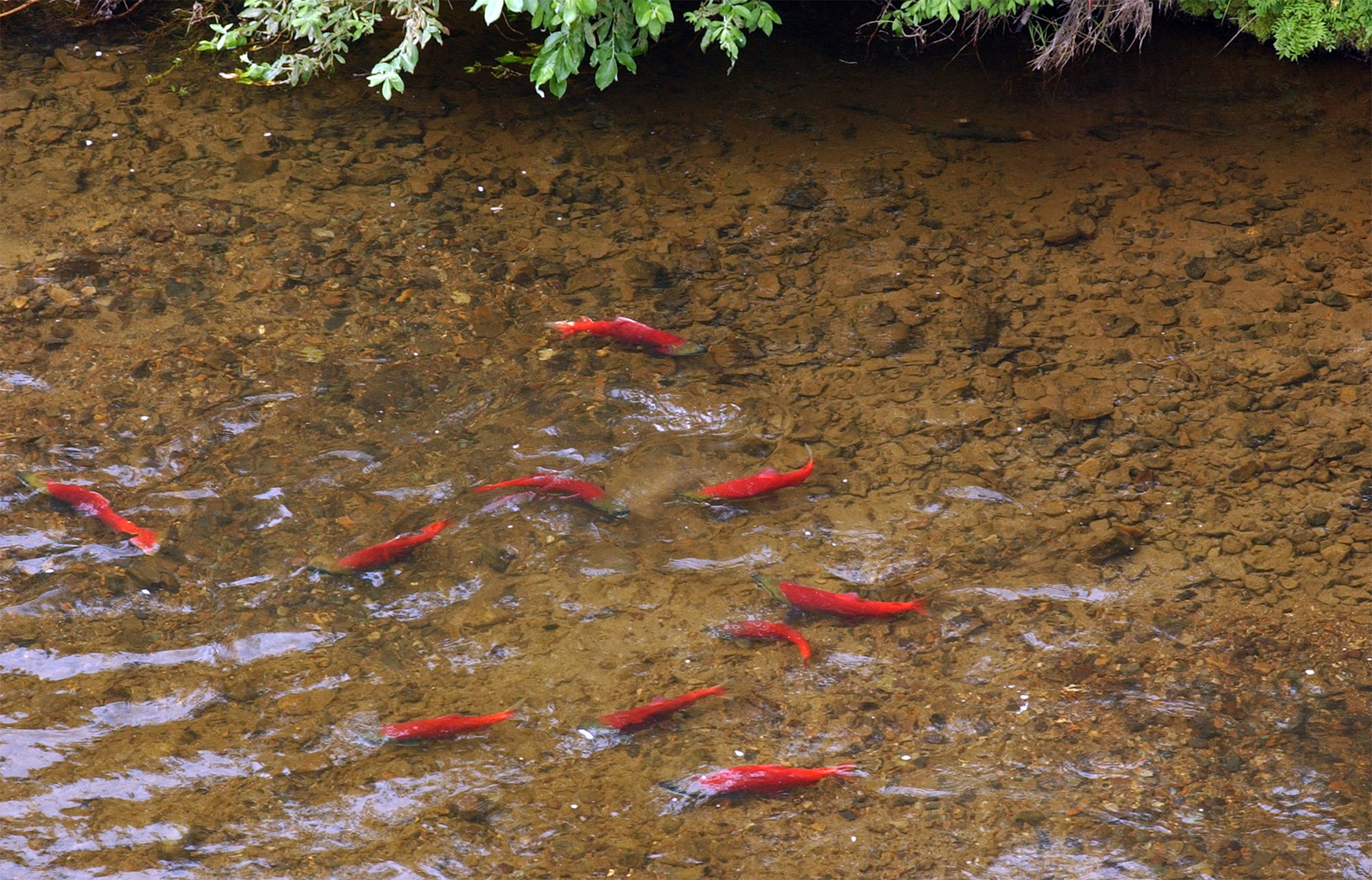
Sockeye salmon school up in the Upper Talarik River in the Alaska Peninsula.Photographer: Bob Hallinen/Anchorage Daily News/Tribune News Service/Getty Images

Less weighty catches mean fewer dollars for the $2 billion industry. Last year’s haul garnered $295.2 million, down 56% from 2019, Alaska estimates show.

“Salmon is such a nuanced and interconnected species — one little tweak when they are young can make a big change,” said Arron Kallenberg, founder and chief executive officer of seafood retailer Wild Alaskan Co. “From an industry standpoint it certainty makes an impact.”

While salmon runs in some areas saw steep population declines, Bristol Bay — supplier of about half the world’s sockeye — has had booming harvests. Even so, signs of smaller fish abound, OBI Seafoods CEO Mark Palmer said.What on Earth?The Bloomberg Green newsletter is your guide to the latest in climate news, zero-emission tech and green finance.EmailSign UpBy submitting my information, I agree to the Privacy Policy and Terms of Service and to receive offers and promotions from Bloomberg.

Historically, 4-pound sockeye and larger — key for commercial fisheries — comprise as much as 70% of each season’s Bristol Bay catch, Palmer said. Today, those larger salmon are no more than half the catch.

“Your yields go down a little bit with smaller fish,” he said.

At southeast Alaska’s Klukwan village, 115 miles north of Juneau, fishing nets have told the tale of shrinking salmon for years.

“Something is out of whack in the ocean and we wish we knew a way to fix it,” said Jones Hotch Jr., a tribal council member of this community of 40 families along a river whose indigenous name means “winter container for salmon.”

They depend on annual salmon return, which is why Hotch Jr. is pushing for stronger environmental protections against mining and other threats to the Chilkat River.

“My drive for saving our river for salmon runs to the very marrow of my being,” the 70-year-old said. “I believe that when we save our salmon, we save and preserve our culture.”

Grizzly bear illegally shot and killed in Idaho, Fish and Game says. Her cub died, too

Exposing the Big Game's avatarCommittee to Abolish Sport Hunting Blog

Female grizzly, cub die in Idaho poaching incident | Idaho Statesman

BY NICOLE BLANCHARDAPRIL 26, 2021 05:23 PM,UPDATED APRIL 27, 2021 01:24 PM

Play VideoDuration1:07Watch mama grizzly bear and cubs captured on trail cameraAn Idaho Fish and Game trail camera captured a grizzly bear sow and her two cubs as they sniffed a sapling baited with a scent lure. The bears were seen in the Upper Snake Region near Island Park on April 20, 2019.BYIDAHO DEPARTMENT OF FISH AND GAME

A female grizzly bear was shot and killed in a poaching incident in East Idaho last month,according to a news release from the Idaho Department of Fish and Game.

Fish and Game officials found the bear’s carcass lying partially submerged in Little Warm River near Island Park after they received a signal from the bear’s radio tracking collar indicating that it had died. It’s the third grizzly…

View original post 291 more words

Illegal hunting leads to charges in several West Virginia counties

Exposing the Big Game's avatarCommittee to Abolish Sport Hunting Blog

https://wchstv.com/news/local/illegal-hunting-leads-to-charges-in-several-west-virginia-counties


byJEFF MORRISTuesday, April 27th 2021AA

West Virginia Natural Police say they found blinds and multiple baited areas leading up to the opening of turkey season. (West Virginia Natural Resources Police)

West Virginia Natural Police say they found blinds and multiple baited areas leading up to the opening of turkey season. (West Virginia Natural Resources Police)

Facebook Share Icon

Twitter Share Icon

Email Share Icon

CHARLESTON, W.Va. (WCHS) —West Virginia Natural Resources Police said multiple people in several counties face charges for illegal hunting.

Natural Resources Police said in a Facebook post Tuesday that officers in Braxton, Clay and Nicholas counties conducted investigations leading up to the opening of turkey season and found multiple baited areas and blinds and saw hunters in the areas.https://www.facebook.com/plugins/post.php?href=https%3A%2F%2Fwww.facebook.com%2FDNRpolice%2Fposts%2F5442235452485246&width=500&show_text=true&height=809&appId

Police said the illegal hunting was taking place during the youth season and the first week of regular season.

The news release did not give a total of number of hunters who face charges.

Charges range from hunting turkey closed season, hunting turkey with the use of bait and illegal killing/possession of wildlife. All charges are pending in magistrate court.

View original post 15 more words

Anchorage dog dies in trap near Glenn Highway, reigniting debate about regulations

Exposing the Big Game's avatarCommittee to Abolish Sport Hunting Blog

April 26, 2021byLex Treinen, Alaska Public Media

Robert Ahmasuk (right) and Joni Spiess hold up a phone with a photo of Lola, Ahmasuk’s 4-year-old Husky-Lab-Beagle mix (Lex Treinen/Alaska Public Media)

In mid-February, 13-year-old Robert Ahmasuk was returning from a hunting trip on skis with his dog Lola near Gunsight Mountain, off the Glenn Highway. Just 50 yards from the parking lot, Lola, a 4-year-old husky mix, started acting anxious and darted off the trail.

That’s when Ahmasuk and his mom heard a yelp.

“I went over there first and I was like, ‘Oh, crap. Lola’s in a trap. Mom, get over here. Help me!’” said Ahmasuk, who lives in Anchorage most of the year.

They attempted to free Lola but knew their time was limited. Despite years of experience with trapping and hunting themselves, they weren’t able…

View original post 1,043 more words

No, Biden’s Not Banning Burgers — But Meat Is a Real Climate Problem

A meatless hamburger is seen on display at the Vegan Food Festival in Warsaw, Poland on October 6, 2019.
A meatless hamburger is seen on display at the Vegan Food Festival in Warsaw, Poland, on October 6, 2019.

BYMike Ludwig, TruthoutPUBLISHEDApril 27, 2021SHAREShare via FacebookShare via TwitterShare via Email

A white lower-case t on a black background

READING LISTPOLITICS & ELECTIONSTrump-Disrupted Census Hurts Marginalized Communities and Hands New Power to GOPENVIRONMENT & HEALTHNo, Biden’s Not Banning Burgers — But Meat Is a Real Climate ProblemENVIRONMENT & HEALTHThe More Biden Expands ACA, the Harder It Will Be for the Right to Cut ItPOLITICS & ELECTIONSOver 80 House Democrats Urge Biden to Lower Medicare Eligibility AgeECONOMY & LABORBiden to Sign Executive Order Raising Federal Workers’ Wages to $15 an HourWAR & PEACEBiden Is Reviewing US Policy in North Korea. The Brutal Sanctions Must End.

Fact-checkers are slamming Republicans and the right-wing media for repeating false claims that President Joe Biden’s climate plan would require Americans to drastically reduce consumption of red meat. While the rumors about Biden have been thoroughly debunked, these claims were sparked by a real, thought-provoking University of Michigan study that models how a shift toward plant-based diets would reduce greenhouse gas emissions that are driving the climate crisis.

The right-wing claims originated from baseless speculation by The Daily Mail, a conservative British tabloid that thrives on viral posts, which was then taken out of context by right-wing politicians and personalities who jumped at the chance to throw red meat (excuse the pun) to the Trumpian base.

“Speaking of stupid, there’s a study coming out of the University of Michigan which says that to meet the Biden Green New Deal targets, America has to, get this, America has to stop eating meat, stop eating poultry and fish, seafood, eggs, dairy, and animal-based fats,” Fox News host Larry Kudlow said over the weekend. “Ok, got that? No burger on July 4. No steaks on the barbecue.”

Don’t miss a beat

Get the latest news and thought-provoking analysis from Truthout.

  • Email

Of course, there are considerable gaps between Biden’s climate vision and the latest Green New Deal proposals put forth by progressives like Sen. Bernie Sanders and Rep. Alexandria Ocasio-Cortez. The University of Michigan study is not part of the Green New Deal, but Kudlow baselessly threatened “middle America” with somehow being forced to grill “Brussels sprouts”instead of beef on the Fourth of July.

Multiple far right Republicans and commentators ran with it, sending out viral tweets and media stories falsely suggesting that Biden wants to control what people eat and would even limit Americans to “one burger a month.” (Donald Trump Jr., forever riding his father’s presidential coattails, bragged on Twitter about eating four pounds of red meat in a single day. Warning: Eating that much red meat at once can cause constipation and other health problems.)

These right-wing claims are ridiculous on their face, but the University of Michigan study that Kudlow and others took out of context is real climate science. After all, scientists say the global food supply chain is responsible for 26 percent of climate-warming emissions. While not connected White House climate policy, the study adds to a large body of research showing that reducing meat consumption — and, perhaps more importantly, reducing factory farming and mass beef production that destroys lush ecosystems in places like the Amazon — is essential for addressing the climate emergency. The study also models how a shift toward plant-based diets would drastically reduce climate-warming emissions in the United States.

According to federal data cited by in the study, the average person in the U.S. consumed about 133 pounds of red meat and poultry in 2016. If the average hamburger contains between one-third and half a pound of beef, that’s roughly equivalent to 300-plus burgers. While red meat (beef, pork and lamb) provides only 9 percent of calories in the average American diet, red meat produces about 47 percent of the food system’s greenhouse gas emissions. Consumption of all animal products combined, including eggs, dairy and fish, represents 82 percent of the nation’s dietary carbon footprint.Red meat produces about 47 percent of the food system’s greenhouse gas emissions.

Using this data as a baseline, the study considers four dietary scenarios in the U.S over the next decade. In the first scenario, the average amount of animal-based food products remains unchanged by 2030. In the second scenario, consumption increases slightly based on federal projections. In the third scenario, animal product consumption is reduced by 50 percent and replaced with plant-based foods. The fourth (and incredibly optimistic) scenario is the same as the third, except beef consumption is further reduced by 90 percent, a completely theoretical figure that conservatives took out of context.

If diets in the U.S. remain unchanged under the first scenario, the food supply would generate greenhouse gas emissions equivalent to about 646 million metric tons of carbon dioxide in 2030. However, if animal product consumption dropped by 50 percent and was replaced by plant-based foods, the food supply would produce 224 million metric tons less — the equivalent of taking 47.5 million gas and diesel vehicles off the road. That represents about a quarter of the emission reductions necessary to meet U.S. climate goals, although the Biden administration is now pushing for even greater reductions.

Cumulative emissions would drop by 1.6 billion metric tons from 2016 levels by 2030 if the U.S. reduced animal product consumption by 50 percent. Under the fourth scenario, where the U.S. hits the 50 percent reduction target while also reducing beef consumption by 90 percent, the projected reduction in emissions would be equivalent to about 2.4 billion metric tons of carbon dioxide.

Again, these scenarios are completely theoretical; they are models of what the future could look like if we eat less meat and animal products. Of course, what the actual future will look like is completely dependent on the decisions that we humans make. To achieve a 50 percent reduction in animal product consumption, or to replace 90 percent of the beef we currently consume with plant-based alternatives such as soy protein and vegan meat alternatives, would require substantial changes to agriculture and the food delivery system.

Since there is clearly no government plan to mandate Impossible Burgers, changing the food system will require changes in consumer demand. In short, a large chunk of the population would have to choose to eat less meat.

Hints of this shift are already happening. Americans are eating more meatless meat and plant-based dairy alternatives than ever before, but nowhere near the scale modeled in the University of Michigan study.

After looking at the climate data, grilling Brussels sprouts or asparagus instead of ground beef and hotdogs might sound pretty tasty. You’ll need some protein as well, and while there’s plenty of meatless burgers to choose from nowadays, there’s nothing quite like marinating some old-fashioned grilled barbecue tofu. Who knows, your insides and the Earth might thank you.

Idaho’s Wolves Need Your Help NOW!

Project Coyote


Today the Idaho Legislature passed SB 1211—a heinous bill that would allow the slaughter of 90 percent of Idaho’s 1,500 wolves by any means: traps, snares, aerial shooting, running over with snowmobiles—and even wildlife killing contests. There will be no bag or tag purchase limits or seasonal respite from trapping. The bill seizes wildlife management authority from the Idaho Fish and Game Commission and supports the hiring of contract killers with an additional $190,000 from the Idaho Wolf Control Fund, which already receives $400,000 to kill wolves. Read this Guardian article to see international coverage of the issue.Our last chance to stop this all-out war against wolves in Idaho is to urge Governor Brad Little to veto this bill. Even if you don’t live in Idaho, you can still speak up. Idaho needs to know the world is watching! Urge Governor Little to veto SB 1211 TODAY!Here’s how you can help:Call Governor Little at 208-334-2100 now and follow up with an email to governor@gov.idaho.gov urging him to veto SB 1211, using the talking points below.Share this action alert and infographic with friends and family and on social media! Talking points to craft your message (please personalize):If you are from or currently live in Idaho, state your town. If you don’t have connections to Idaho, explain why you will not spend your tourism dollars in a state like Idaho that wantonly slaughters wildlife.Over 76% of Idahoans believe wildlife belongs to all citizens and that management decisions should be made without political influence by the Idaho Fish and Game Commission – whose members oppose this bill 5-2.Taking authority away from the Commission and the agency biologists that inform them is not science-based management and sets a dangerous precedent for the management of other wildlife.Wolves cause less than 1% of cattle deaths and any depredation can be properly managed without this bill.Killing wolves at this rate will only support decisions to relist them with Endangered Species Act protections.Wolves alive and thriving bring value to Idaho in many forms, including ecosystem services and tourism dollars.The majority of Idahoans and Americans support wolf recovery at levels where wolves can fulfill their ecological functions. Almost no one supports wasting tax dollars to recover wolves, just to exterminate them again.

How a false claim about beef and Biden’s climate plan spread

https://news.yahoo.com/how-a-false-claim-about-beef-and-bidens-climate-plan-spread-155102973.html

Yahoo News

Christopher Wilson·Senior WriterMon, April 26, 2021, 8:51 AM·5 min read

  • More content below
  • More content below

On Sunday afternoon, Texas Gov. Greg Abbott tweeted out a Fox News graphic about President Biden proposing a reduction in red meat consumption. “Not gonna happen in Texas!” proclaimed the Republican, who serves nearly 30 million constituents.https://platform.twitter.com/embed/Tweet.html?creatorScreenName=realchriswilson&dnt=true&embedId=twitter-widget-0&features=eyJ0ZndfZXhwZXJpbWVudHNfY29va2llX2V4cGlyYXRpb24iOnsiYnVja2V0IjoxMjA5NjAwLCJ2ZXJzaW9uIjpudWxsfSwidGZ3X2hvcml6b25fdHdlZXRfZW1iZWRfOTU1NSI6eyJidWNrZXQiOiJodGUiLCJ2ZXJzaW9uIjpudWxsfX0%3D&frame=false&hideCard=false&hideThread=false&id=1386433630747070468&lang=en&origin=https%3A%2F%2Fnews.yahoo.com%2Fhow-a-false-claim-about-beef-and-bidens-climate-plan-spread-155102973.html&sessionId=7f247ad66814665724d5898bfff6d51b9e287866&siteScreenName=YahooNews&theme=light&widgetsVersion=ff2e7cf%3A1618526400629&width=550px

Abbott was retweeted by fellow Republican Gov. Brad Little, who said, “Idahoans also have beef with this agenda and for dinner!” The two governors followed in a line of conservative politicians, pundits and news outlets who spent days proudly stating their opposition to a provision of Biden’s climate plan that doesn’t exist.

The false narrative stems from coverage of Biden announcing his new climate goals last week in honor of Earth Day, including cutting U.S. carbon emissions by at least 50 percent by 2030 over 2005 levels. The plan drew immediate Republican condemnation, but the beef-specific narrative stems from a Thursday article in the Daily Mail, a conservative British tabloid. The lengthy headline reads, “How Biden’s climate plan could limit you to eat just one burger a MONTH, cost $3.5K a year per person in taxes, force you to spend $55K on an electric car and ‘crush’ American jobs.”

The piece cites a University of Michigan study that analyzes what different changes in the U.S. diet could mean for greenhouse gas emissions. This was translated into the Fox News graphic shared by Abbott and others, which stated that the Biden proposal would cut 90 percent of red meat from Americans’ diet, allowing them a maximum of 4 pounds per year and one burger a month.

A primary issue in using the paper to condemn the Biden climate plan is that it was published in January 2020, when Biden was involved in a tight Democratic primary and a year away from being sworn in as president. His climate plan does not have any provisions regulating citizens’ ability to consume meat.

US President Joe Biden speaks during climate change virtual summit from the East Room of the White House campus April 22, 2021, in Washington, DC. (Brendan Smialowski/AFP via Getty Images)
President Biden during the virtual summit on climate change on April 22. (Brendan Smialowski/AFP via Getty Images)

Gregory A. Keoleian and Martin Heller, two of the study’s authors, told Yahoo News that “to our knowledge, there is no connection between our study and Joe Biden’s Climate plan.”

“This appears to be an association made erroneously by the Daily Mail that has been picked up widely,” they continued. “Our study merely identifies opportunities for emissions reductions that are possible from changes in our diet. By no means does it suggest that these changes in diet would be required to meet climate goals.”

The Daily Mail’s detachment from reality did not stop the false narrative from spreading. On Friday, former Trump adviser Larry Kudlow elevated the claims on his Fox Business show.

“Speaking of stupid, there’s a study coming out of the University of Michigan which says that to meet the Biden Green New Deal targets, America has to, get this, America has to stop eating meat, stop eating poultry and fish, seafood, eggs, dairy and animal-based fats,” Kudlow said, “OK, got that? No burger on July 4. No steaks on the barbecue. I’m sure Middle America is just going to love that.”

“Can you grill those brussels sprouts? So get ready. You can throw back a plant-based beer with your grilled brussels sprouts and wave your American flag,” Kudlow continued, seemingly unclear about the fact that beer already comes from plants. Senate Majority Leader Chuck Schumer took a shot at the narrative Sunday evening, tweeting, “Excited to be watching the Oscars with an ice cold plant-based beer. Thanks Joe Biden.”

It was full steam ahead at that point. Rep. Lauren Boebert, R-Colo., tweeted Friday morning, “Joe Biden’s climate plan includes cutting 90% of red meat from our diets by 2030. They want to limit us to about four pounds a year. Why doesn’t Joe stay out of my kitchen?”

On Saturday, Donald Trump. Jr., the oldest son of the former president, retweeted the Fox News graphic and said, “I’m pretty sure I ate 4 pounds of red meat yesterday. That’s going to be a hard NO from me.”

Rep. Marjorie Taylor Greene, the Georgia congresswoman who has promoted conspiracies and has repeatedly used racist and xenophobic language, attempted to knock Biden by referring to him as the McDonald’s character the Hamburglar and tweeting an image of him eating a burger with the caption “No burgers for thee, but just for me.”

Rep. Marjorie Taylor Greene, R-Ga., is seen on the House steps during the vote on the $1.9 trillion covid-19 relief package, the American Rescue Plan Act, on Wednesday, March 10, 2021. (Tom Williams/CQ Roll Call via Getty Images)
Rep. Marjorie Taylor Greene, R-Ga. (Tom Williams/CQ Roll Call via Getty Images)

This is not the first time that conservatives have ginned up a false narrative about meat consumption to negatively portray Democratic climate policies. In 2019, after Rep. Alexandria Ocasio-Cortez, D-N.Y., rolled out her Green New Deal proposal, she was accused of wanting to take away Americans’ burgers. At a press conference opposing the Green New Deal, Republican legislators ate burgers and drank milkshakes.

Sebastian Gorka, a former Trump White House official, addressed the concern at that year’s Conservative Political Action Conference, saying, “They want to rebuild your home, they want to take away your hamburgers. This is what Stalin dreamt about but never achieved.”

Cover thumbnail photo illustration: Yahoo News; photos: AP, Image Bank/Getty Images

Three fatalities during the 2020-21 hunting season

Exposing the Big Game's avatarCommittee to Abolish Sport Hunting Blog

https://www.uticaod.com/story/sports/2021/04/25/focus-increased-safety-after-3-fatalities-during-hunting-season/7354899002/

John PitarresiSpecial to the Observer-DispatchView Comments1:011:00https://imasdk.googleapis.com/js/core/bridge3.453.0_en.html#goog_1560544033

There was a big increase in New York’s hunting population last season, with 67,270 new hunters certified.

That number is close to three times the usual total. As a result, hunting license sales increased by 11 percent over 2019, bow hunting privilege sales increased by 14 percent, muzzle loading privileges by 16 percent, and junior hunters increased by 26 percent. That added up to more than 600,000 hunters, which maybe is why it isn’t surprising that hunting-related incidents (injuries and worse) were up a bit, as well.

There were 22 incidents last season after a record low of 12 in 2019. There were three fatalities, up from one the year before. And there was another fatality involving a tree stand.

Most of the incidents involved veteran hunters, although there were several in which young hunters were injured. In a couple of…

View original post 659 more words