House Bill 367, brought by Rep. Paul Fielder, R-Thompson Falls, would have asked voters to amend the “Harvest Heritage” clause of the Montana Constitution.
The clause states the opportunity to harvest wild fish and game animals is preserved to individual citizens of the state.
HB 367 proposed spelling out methods of harvest as hunting, fishing and trapping and stating that those are the preferred but not only methods of wildlife management. Fielder noted that several other states had made similar amendments to their constitutions.
Donald Trump Jr has been mocked along with a number of other MAGA supporters after racing to defend his right to eat red meat in response to a viral story wrongly suggesting Mr Biden’s new climate plan “could limit” Americans’ burger consumption.
After the Daily Mail suggested that cutting back on red meat could be a way for the US to push towards the president’s goal of slashing greenhouse gas emissions, the story was quickly misinterpreted to suggest that Mr Biden would be enforcing such a plan.
Mr Trump Jr responded quickly to the perceived, but non-existent threat, tweeting: “I’m pretty sure I ate 4 pounds of red meat yesterday. That’s going to be a hard NO from me.”
Humanity’s impacts on our planet’s climate are so profound, we have for decades been unwittingly shifting the very axis upon which Earth spins around, scientists say.
In a new study, researchers examined the phenomenon of polar wandering, in which Earth’s magnetic north and south poles drift around the surface of the planet, restlessly roaming from the anchored positions of their geographic counterparts.
This mysterious phenomenon is thought to be driven by many factors, including the existence of vast anomalies of molten iron under Earth’s surface. But other elements also contribute, scientists say – including, amazingly enough, the effects of anthropogenic (human-caused) climate change.
“Faster ice melting under global warming was the most likely cause of the directional change of the polar drift in the 1990s,” explains lead researcher Shanshan Deng from the Institute of Geographic Sciences and Natural Resources Research in China.
In the new study, Deng and fellow researchers examined the extent to which changes in terrestrial water storage (TWS) in recent decades contributed to the amount of magnetic polar wander recorded in the same timeframe.
Basically, TWS includes changes in water levels on Earth resulting from glaciers melting as the world gets warmer, in addition to changes also produced by the pumping of groundwater from underground reservoirs.
“It brings an interesting piece of evidence to this question,” explains climate scientist Vincent Humphrey from the University of Zurich in Switzerland, who wasn’t involved with the study.
“It tells you how strong this mass change is – it’s so big that it can change the axis of the Earth.”
Over time, the drifting adds up, with the poles traveling hundreds of kilometers, meaning adjustments have to be made to the World Magnetic Model, which underpins navigation systems such as GPS.
According to the team’s calculations – based on satellite data from NASA’s Gravity Recovery and Climate Experiment (GRACE) mission and estimates of glacier loss and groundwater pumping going back to the 1980s – the primary driver of polar drift change seen in the 1990s was ice melt due to climate change.
“The faster ice melting under global warming was the most likely cause of the directional change of the polar drift in the 1990s,” the researchers explain in their study.
“The other possible causes are TWS change in non‐glacial regions due to climate change and unsustainable consumption of groundwater for irrigation and other anthropogenic activities.”
While the degree of axis shift experienced so far is estimated to be so slight that humans wouldn’t be able to perceive it in daily life, the results nonetheless suggest another alarming side effect of humanity’s unsustainable usage of Earth’s resources: planetary-scale mass rearrangements significant enough to measurably affect the revolutions of the world we live upon.
BILLINGS, Mont. (AP) — Two Montana men have been cited over illegally poaching two wolves from a helicopter in the Big Hole Valley.
The Billings Gazette reports that Dalton Thomas Tamcke, 30, and Justin Samuel Peterson, 22, told wildlife authorities they were hunting coyotes for predatory control action on March 3 and mistakenly took the wolves for coyotes. The men later recovered the carcasses by snowmobile.
Tamcke paid a $425 fine and Peterson paid a $435 fine, according to records from the Beaverhead County Justice Court. Neither man had licenses to hunt wolves, and wolf hunting from helicopters is illegal.
Kerry Wahl, a game warden with Montana Fish Wildlife & Parks, said authorities didn’t pursue charges against the helicopter pilot that was flying the two men or the company, saying it was the shooters’ responsibility for what happened.
If politicians are serious about change, they need to incentivise it, say scientists and writers
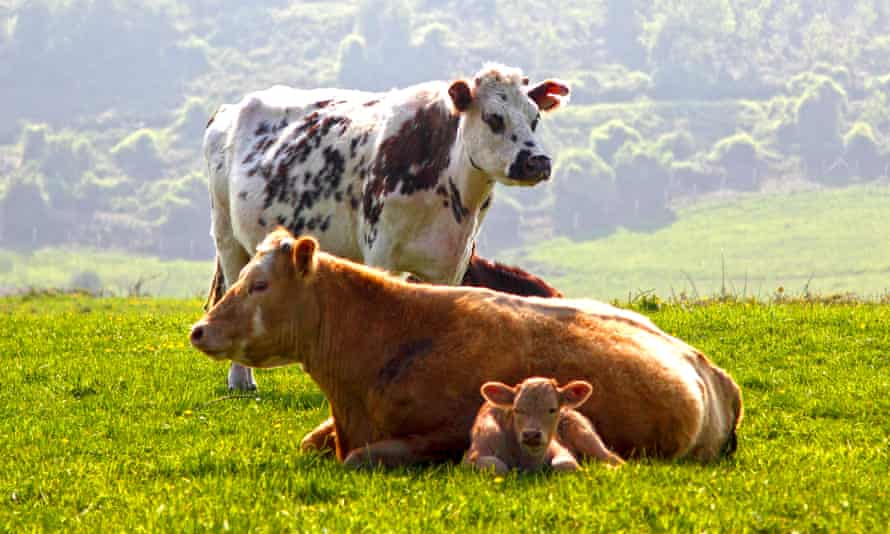
Research in 2018 showed that without meat and dairy consumption, global farmland use could be reduced by more than 75% – an area equivalent to the US, China, the EU and Australia combined – and still feed the world. Photograph: DBPITT/Getty Images/iStockphoto
The UK business secretary, Kwasi Kwarteng, is considering a “full vegan diet” to help tackle climate change, saying people will need to make lifestyle changes if the government is to meet its new emissions target of a 78% reduction on 1990 levels by 2035.
But how much difference would it make if everyone turned to a plant-based diet? Experts say changing the way we eat is necessary for the future of the planet but that government policy is needed alongside this. If politicians are serious about wanting dietary changes, they also need to incentivise it, scientists and writers add.
“Probably the most important thing to point out is that emissions are often viewed as the only metric of sustainability: they are not. Impacts of farming systems on carbon sequestration, soil acidification, water quality, and broader ecosystem services also need to be well considered,” said Matthew Harrison, systems modelling team leader at the Tasmanian Institute of Agriculture.
“There is also a need to account for farming systems that may replace livestock,” he said.
The writer and environmental campaigner George Monbiot says the numbers on the impact of going vegan are different because of what scientists measure. “There are two completely different ways look at the carbon impact of diet: one is carbon released by producing this or that food – that is ‘carbon current account’. But another one is ‘carbon capital account’, which is the carbon opportunity cost of producing this food rather than another one,” he said.
“If you are producing meat, for example, what might land be used for if you took meat away? If you are growing forests there instead or peat bog there.”
Monbiot says what we eat is a “huge issue”, alongside our transport habits. “Most of what you can do at an individual level is weak by comparison to what governments need to do … but changing diet does not. That has a major impact,” he said.
“It is easier done if the government acts to change the food system but in the absence of that, we should still try and change our diets.”
In 2018, scientists behind the most comprehensive analysis to date of the damage of farming to the planet found avoiding meat and dairy products was the single biggest way to reduce your environmental impact on the planet. The research show0ed that without meat and dairy consumption, global farmland use could be reduced by more than 75% – an area equivalent to the US, China, European Union and Australia combined – and still feed the world.
“There are lots of different sectors that have an impact on emissions and the food system is surely one of the most important ones as it is globally responsible for about a third of all greenhouse gas emissions,” said Dr Marco Springmann, senior researcher on environmental sustainability and public health at the University of Oxford.
He added that the overwhelming majority of emissions were due to foods such as beef and dairy, which “means that without changing emissions associated with those products it is hard to make progress”. He said there were no good technical solutions for the fact that “cows emit methane emissions”.
“You can change feed composition but that does not change the animal and the need to feed the animal a lot of feed product,” he said. He believes the government needs to offer price incentives for sustainable products, making beef and dairy more expensive.
Frank Mitloehner, professor and air quality extension specialist at the University of California and Davis, said putting the onus on the individual was a distraction from policy changes that are needed. He said literature suggests “going vegan for two years has the same saving impact as one flight Europe to the US would generate.”
“If we really want to make a difference in carbon emissions we need to change policy. We need to have a cost for carbon that is appropriate. We need to incentivise those who can reduce greenhouse gas emissions to do so,” he said.
He believes the most important individual choice someone can make is to “go and vote … That is number one.”
Martin Heller, a research specialist at the University of Michigan, said: “There are no silver bullets for climate change. Nothing in isolation will be ‘enough’.”
He added that studies showed that even with gracious assumptions in improvements in agricultural production, feeding an anticipated population at anticipated growing demand for animal-based foods by 2050 would occupy “all of the allowable emissions if we are to stay below a 2C temperature rise”.
“We have to change the way we eat,” he said. “That certainly isn’t saying that diet change – or even becoming vegan – will ‘save the planet’. It’s more of a necessary but not sufficient kind of thing.” He added that “these diet shifts need to come with government, corporate and every other kind of action”.
“It’s also probably naive to assume that people will just change these behaviours because it’s good for the planet. It will require directed policy, changes in the restaurant and foodservice industries,” he said.
BySydney HawkinsPublished:Apr. 24, 2021 at 3:53 PM PDT|Updated:18 hours ago
WAUSAU, Wis. (WSAW) – Dozens of people came together Saturday to support a Marathon’s man road to recovery.
Brent Nieslowski was diagnosed with quadriplegic paralysis last fall after a deer hunting incident.
“I’m a big deer hunter,” Brent explained. “it’s always been my passion. But unfortunately, on November 2nd, I fell out of my tree. My tree-stand broke and over 100 days later, here I am.”
After months of physical therapy, Brent has gained some mobility, but he says he will not stop until he’s able to walk again.ADVERTISEMENThttps://6e5ee0c6518cc85307ffa6c52e7d0c89.safeframe.googlesyndication.com/safeframe/1-0-38/html/container.html
“Through my faith in God and all the prayers,” Brent expressed, “I’m able to make a decent recovery and I’m going to continue to get stronger, and hopefully make a full recovery and walk again.”
Brent is planning to participate in more, intense aquatic physical therapy in…
A buck head-butted the owner of a Minnesota fur company last week before trashing the warehouse full of deer hides.
A six-point buck head-butted the owner of a rural Minnesota fur company last week before trashing the shop’s warehouse, currently full of deer hides being tanned for hunters.
The owner of Johnson Fur in rural Wilmar, Minnesota, claims the buck was looking for a mate when he smelled the deer hides and became confused.
J0hnson walked away with only minor bruises from the deer’s headbutt, but the deer dashed through the room, jumping over tables and destroying the office’s paperwork. Even a refrigerator was jumped upon by the buck.
The confused deer eventually ran back out the door and into the wild after the Johnsons’ Jack Russell terrier began nipping at his heels.
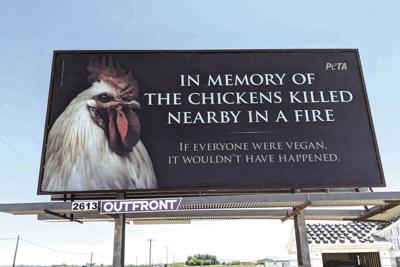
PETA erected a billboard near the main office of Hickman’s Family Farms “in memory” of the more than 165,000 birds who were killed in March in a fire at a facility owned by the company.
The billboard, at MC 85 between South 223rd and South 221st avenues, urges anyone upset by the animals’ suffering to take personal responsibility by no longer buying eggs and by going vegan.
“We’re encouraging people who were feeling sympathetic to those birds to take a look at their own actions that are also making those birds suffer on a daily basis,” said Amber Canavan, PETA senior campaigner spokesperson.
Canavan said PETA watches out for incidents in the news involving animals on farms.
“That goes for fires and transport trucks,” Canavan explained. “Transport trucks have fairly high incidents of crashes on the way to slaughterhouses, from facility to facility.
“There are least 100 a year. Many are not even reported or make it into the news. Those animals are crammed onto transport trucks, shoulder to shoulder, in there for days without food, water or rest.”
She said the public rarely thinks about animals locked behind closed doors, “out of sight, out of mind.”
“We want to make sure that they don’t just say, ‘Oh, that’s sad and go on about their day.’ We have the power to help them in many cases by not buying meat, dairy and eggs in the first place.”
PETA’s statement said hens used for egg production are confined to cramped barns, where each bird has no more than a square foot of space. Few farms install smoke detectors or fire-suppression systems.
PETA notes that going vegan spares animals immense suffering and helps prevent future epidemics and pandemics. SARS, swine flu, bird flu and COVID-19 all stemmed from confining and killing animals for food.
Montana Gov. Greg Gianforte signed a bill Friday allowing the use of private funds to reimburse wolf hunters or trappers for their expenses — reminiscent of bounties that widely exterminated the species in the last century.
Hunting and livestock groups, and their Republican allies in the legislature, contend not enough of the 1,200 wolves in Montana are being killed by hunters to limit their impact on big game outfitters or cattle and sheep producers.
The reimbursement program is similar to one in Idaho, where a private group pays its members up to $1,000 for costs incurred while scouting, hunting or trapping wolves.
Opponents argued there are tourists who come to Montana to see wolves and if too many are killed, they will return to protection under the Endangered Species Act.
Last week, Gianforte signed bills to allow the snaring of wolves, in addition to trapping; and another one to extend the wolf hunting season.
Lawmakers have also forwarded to the governor a bill to allow individuals to kill an unlimited number of wolves, hunt at night with artificial lights and night vision scopes and use bait to lure wolves into traps.
In Idaho, a bill that would allow the state to hire private contractors to reduce the wolf population from about 1,500 to 150 is quickly moving through the legislature. It allows the use of night-vision equipment to kill wolves as well as hunting from snowmobiles and all-terrain vehicles, among other changes.
Backers cite cattle and sheep deaths that cost ranchers hundreds of thousands of dollars, while opponents say the legislation threatens a 2002 wolf management plan involving the federal government.