“In Defense of Animals, TreeSpirit Project and ForELK are hosting a rally on Saturday, April 10 to highlight the deadly mismanagement of Point Reyes National Seashore.
“The National Park Service(NPS) announced that 152 Tule elk died in 2020, one in three elk inside a ‘Preserve.’
“Activists raised the alarm about the huge number of elk dying during the drought, but the NPS repeatedly failed to acknowledge the problem or enact its emergency plan. When activists delivered water to the elk, the NPS immediately dumped it.
“The Tule elk at this Preserve are precious since they are the largest remaining population of their species in the world. However, they are prevented from reaching water and forage in California’s drought season since they are trapped behind an 8-foot fence which stretches for miles across the peninsula.
“The fence preserves resources for private ranchers. Over 100 more of these rare native elk are expected to die this year if the NPS is allowed to enact its disastrous and controversial management plan.
“Fenced elk will continue to die from drought and elk in two other free-ranging herds will be shot to benefit private, profit-driven ranchers renting land at below-market rates in this public national park unit.
Listening to Dr. Martin Tobin testifying at the trial of Derek Chauvin was riveting. Here is a scientist, a world authority on breathing who explained what happened in great detail in a manner that the jury could understand and relate to.Dr. Tobin was the perfect expert witness with impressive knowledge of the science of breathing Dr. Tobin a world-renowned pulmonologist literally wrote THE book on the science of breathing.
According to the American Thoracic Society is “Dr. Tobin the supreme scholar of critical care medicine and editor or author of seven extraordinary textbooks on the subject.” The Lancet described his textbook Principles And Practice of Mechanical Ventilation as the “Bible” of the field of mechanical ventilation.Yet despite these prestigious credentials, defenders of accused murderer Derek Chauvin actually are questioning Tobin’s scientific knowledge or/and questioning his motivation, claiming that the fact that he did not charge a fee for his testimony indicates bias.If he had charged a fee, the claim would be that he was simply paid by the State to say what the State wanted him to say.So, what does this have to do with the Netflix film Seaspiracy?
Ali and Lucy Tabrizi have directed and produced a film in a way that the general public can understand and relate to, and the film includes some of the world’s foremost Ocean scientists and ocean activists.The other thing that Dr. Tobin’s testimony and Seaspiracy have in common are critics.The reality is that no matter what we do, no matter how good the science, no matter how well presented, there will be critics ready to question, ready to ridicule, ready to dismiss and ready to condemn.Critical constructive questions are okay and in fact encouraged but ridicule, dismissal and condemnation from critics are unacceptable and most likely influenced by a conflict of interests and/or simple jealously. I’m hearing criticisms about Seaspiracy from the usual suspects, all quick to challenge the science as they see it and to point out where they see flaws in the film. The usual suspects being people paid by the fishing industry or by NGO’s that profit from or support commercial fishing or even NGO’s that were not included in the film.Of course, there are things in the film that can be legitimately questioned. Every film certainly has flaws but usually the concerns are that the film did not cover certain issues. It is however quite difficult to cover a subject like global fishing in a mere 90 minutes.
The criticism of the science in the film is irrelevant and based on bias for the most part. There is always disagreement in science. The criticism that the film did not include experts is confusing. I don’t see how anyone can be regarded as more of an expert on the subject of the Ocean than Dr. Sylvia Earle.The criticism that the film promotes veganism is strange. The film never pretended to do otherwise. The fishing industry produces hundreds of films that promote the eating of fish. There is nothing secretive about the film’s position on eating fish.Will McCallum of Greenpeace U.K. criticized the film by saying “turning vegan can’t be the only answer.””A campaign that focuses only on veganism ignores the billions of people that depend on the oceans for survival,” said McCallum, head of oceans at Greenpeace UK.”And without finding a lasting solution that looks after people and planet, our oceans don’t stand a chance.” A predictable response considering even Greenpeace ships are not vegan and serve fish to their crew compared to Sea Shepherd ships having had a vegan diet policy for three decades but McCallum’s statement that billions of people depend on the oceans for survival skirts around the fact that artisanal fishers, poor nations and indigenous people are not the people industrialized fishing is catering too. The European and Asian commercial fleets catch fish for wealthy consumers and in doing so are literally stealing the fish from poorer nations.Greenpeace was not depicted in the film which may be on reason Greenpeace is not happy with it.Oceana’s responded by saying, “Choosing to abstain from consuming seafood is not a realistic choice for the hundreds of millions of people around the world who depend on coastal fisheries – many of whom are also facing poverty, hunger, and malnutrition,” the group said.Once again, they miss the point. The film never attacked coastal fishing communities but it did attack commercial operations that are plundering the waters offshore of coastal communities. They film is not advocating veganism for impoverished peoples facing hunger and malnutrition. In fact, the film stresses that it is industrialized fishing that is the cause of mass starvation and poverty.
The very fact that Oceana refers to living marine beings as “seafood.” Indicates their bias in favor of the fishing industry.I once attended a meeting on Ocean Conservation held by Conservation International in the Dominican Republic where both Dr. Sylvia Earle and I witnessed a smorgasbord of fish presented to the participants. We both marveled at the fact that the organizers did not see the contradictions. Ordering Chilean Sea Bass (Not a bass and not from Chile by the way) in a New York upper scale restaurant or eating Bluefin tuna on sushi rice in Tokyo has nothing to do with poor communities in Africa and India that have suffered greatly from the ravages of industrialized fishing. The criticism that the film was shoddy journalism would be concerning if not for the fact that the film was made by film makers not by journalists. Film makers have a story to tell whereas journalists report on stories about other people, things or happenings. The criticism that the film is racist is ridiculous. One fishing industry critic Fisheries consultant Francisco Blaha amusingly generalized the filmmakers by stating that the film has a tendency to generalize. He tweeted, “I’m over the set up where the ‘bad guys’ are predominantly Asian, the ‘victims’ predominantly black/brown, and the ‘good guys’ talking about it and saving the ocean are predominantly white.”Blaha admits in a tweet that he actually did not see the entire film and his bias is apparent in his job title as “fisheries consultant” to industrialized fishing corporations. In the film the bad guys are not predominantly Asian. The film’s focus is on European as well as Asian fishermen and shows how artisanal fishing communities in Africa are being devastated by industrialized fishing. Industrialized fishing corporations are the bad guys. His assertion that those in the film are predominantly white males is also incorrect. The film was made by a man of Middle Eastern background and a woman – Lucy Tabrizi and features the voices of Dr. Sylvia Earle, Dr. Jane Hightower, Tamara Arenovich, Lori Marino and Lamya Essemlali amongst others. A common tactic of the commercial fishing industry is to distract from the destruction they cause by attempting to make the public believe that the fishing industry is simply made up of hard-working fisherfolk out there in small boats in heavy weather, working hard and taking risks to provide a necessary need for the good of humanity.The reality is that commercial fisheries are instead huge corporate entities with 100 million-dollar vessels like super trawlers, bottom trawler, purse seiners, gill netters and long liners. They are not engaged in “catching” fish. What they are doing is raping and plundering life from the Ocean, destroying bottom structures and pulling trillions of animals from the sea in a systematic policy of biological extermination for the sake of profit.
The entire global fishing industry is a polished efficient extraction industry that utilizes deception and distraction to justify their greed and destruction.Despite the self-serving industry critics, this extraordinary film is a critically acclaimed success and that is a fact. It is a weapon of revelation influencing millions and it needs to be built upon and not dismissed or belittled, especially by people who profess to care about marine ecology. The Ocean does not have time for the justifiers, the appeasers and the complainers. Right now, the Ocean needs activists more than scientists.
Seaspiracy seeks to uncover ‘alarming global corruption’ – and is already facing backlash from the fishing industry before it’s reached screens, the leaked document revealedby Emily Baker16th March 2021Updated 17th March 2021
Share:
Print
Reading Time: 3 minutes
AUS seafood industry body is launching a campaign in response to the discoveries it labels ‘vegan propaganda’ showcased in the upcoming documentary, Seaspiracy – despite the fact the film is yet to be released.
It was revealed in a leaked document sent to Plant Based News.
Protecting the seafood industry
The National Fisheries Institute (NFI) is a trade group that represents the US seafood industry, and actively encourages people to eat marine life. Moreover, it claims to be committed to ‘sustainable’ fishing and ‘responsible aquaculture’.
In addition, the NFI says it works to ensure both the media and consumers ‘have the facts about seafood’.
The letter brands the documentary, soon to be screened on Netflix, a ‘dishonest attack’. This is in anticipation of its discoveries and claims it ‘disingenuously’ targets the fishing industry – despite not viewing it.
Seaspiracy branded a ‘dishonest attack’
NFI said: “But hijacking a lifestyle while disingenuously targeting an industry that provides billions of healthy meals and employs 1.7 million Americans is an unacceptable and dishonest attack.”
As a result, the organization is planning retaliation in order to protect the industry, the leaked private document confirms. The media strategy will ‘combat inaccuracies’ and ‘highlight Netflix’s lack of oversight when it comes to the presentation of facts’, it continues.
As a result, it is ‘reaching out’ to restaurant and retail customers in the seafood sector to arm them with ‘friendly talking points’ once the film debuts on March 24.
Letter to Netflix
It goes on to state that the NFI expects Seaspiracy to be an ‘unabashedly vegan activist production’ similar to that of hit Cowspiracy and What The Health?, as Kip Andersen produced all three.
Additionally, the NFI reached out to Netflix, accusing it of promoting ‘propaganda over facts’.
In a letter, it told the streaming service that both Cowspiracy and What The Health? contained a ‘litany of hyperbole’ over fears Seaspiracy will be similar.
The letter voiced grievances to Netflix’s Co-CEO, claiming the documentary is ‘masquerading’ as facts about seafood.
It reads: “The producers of this film are vegan activists… Veganism is a fine choice for some – but my heavens, they do miss out on the complete array of seafood options like enormous King Crab, buttery Maine lobster, succulent Iceland cod, and omega-rich Alaska salmon.”
In a separate press release, the NFI claims it called on Netflix to create a ‘propaganda’ tab on its website for ‘films based on exaggeration, fabrications and conspiracy theories’.
Plant Based News approached the NFI to comment. “We consider the film vegan propaganda and we’d like Netflix to start a whole new tab for just this type of content,” the organization said in response.
The NFI claims seafood industry workers’ welfare is ‘vital’.
It added: “Mistreatment of workers at any place in the seafood value chain should be exposed. And regulators, policymakers and law enforcement should engage where needed right away.”
This is despite the Seaspiracy documentary trailer showing snippets of a different picture. One clip includes the quote: ‘When the ships are in the ocean, they can throw you overboard’.
Defending animal agriculture
The NFI alerted the Animal Agriculture Alliance (AAA), an organization that claims to connect a range of figures in the industry, including farmers, and encouraging its members to eat meat.
On its website, it accuses animal rights advocates of ‘misleading consumers’ – in response to undercover footage obtained from farms.
AAA agreed to ‘push back publicly against Seaspiracy‘, the leaked document states.
A proposed bill aimed at controlling the hunting of coyotes in Maine will be discussed by lawmakers.
The130th Maine Legislature is taking on a few bills that would impact hunting in Maine. Bills to allow Sunday hunting, and banning the use of lead ammunition, are among topics of discussion. Another hunting related bill going before lawmakers seeks to control coyote hunting tactics in Maine.
LD 1265 -An Act To Control the Means of Hunting Coyotes, would drastically change the tactics of hunting coyotes in Maine. The bill would make it illegal to night hunt coyotes, hunt themwith the use dogs, and using bait. The bill also imposescivil violations on hunters caught breaking the amended rules of the hunt. Violations would cost a hunter $100-$500, and or the loss of their hunting privileges for a year.
PUBLISHED FRI, APR 9 20217:28 AM EDTVicky McKeever@VMCKEEVERCNBCSHAREShare Article via FacebookShare Article via TwitterShare Article via LinkedInShare Article via EmailKEY POINTS
“Of course I would love to attend the Glasgow COP26. But not unless everyone can take part on the same terms,” Thunberg tweeted Friday.
Thurberg said inequality was already at the heart of the climate crisis, adding that if people could not be vaccinated and travel to the summit to be equally represented, that would be “undemocratic.”
Greta Thunberg, climate activist, pauses during a panel session on the opening day of the World Economic Forum (WEF) in Davos, Switzerland, on Tuesday, Jan. 21, 2020.Jason Alden | Bloomberg via Getty Images
LONDON — Teenage climate activist Greta Thunberg has said she will not attend the high-profile United Nations climate change summit if current vaccination trends continue.
Thunberg tweeted Friday morning in response to aBBC report
In honor of Earth Day, this episode of UPC’s Hope for the Animals Podcast exposes the environmental impact of animal agriculture and the new “sustainable” labels that are becoming more prevalent on meat, dairy, and egg products. On the podcast today, Hope will be flying solo and sharing her knowledge about this issue. She has written a book on humane-washing and greenwashing called The Ultimate Betrayal: Is There Happy Meat? In Episode 25, Hope will reveal the truth about labels like local, organic, free-range, and grassfed.
Here are some reviews of the Hope for the Animals Podcast from listeners on iTunes:
“This is an excellent podcast where every episode is filled with educational and thought-provoking content on the animal agriculture industry.” -Greg_B_21
“Before listening to this podcast, I thought I knew everything there was to know about veganism. I always learn something new with every episode of Hope for the Animals. This is a must listen podcast!” -Namaste Kitten
“I always learn something from listening to Hope. The interviews are both a wealth of information and emotionally hard-hitting.” -Plant Based Janice
Love the wheat-based meat alternative? Meet The Seitan Appreciation Society.ByJulia Tausch04/09/2021 05:45am EDT
In 2018, I joinedThe Seitan Appreciation Society, the greatest Facebook group on earth.Seitan―pronounced “say-TAN,”not “satan” ― is an often misunderstood meat substitute, not to be confused with the devil. It also shouldn’t be confused with other meat substitutes like tofu and tempeh, in that seitan isn’t made from soy, but rather wheat.
Since joining the group, I’ve spent most Sundays whipping up scrumptious fake meat based on the group’s latest insights and ideas. I’ve upped my vegan cooking game tenfold, thanks to the group, but my obsession has always felt a bit niche and weird. When I tell my friends about The Society, I know I’m giving them “One time? At band camp?”vibes.
So, imagine how my heart leaped to discover that Gen Z has been…
Love the wheat-based meat alternative? Meet The Seitan Appreciation Society.By Julia Tausch04/09/2021 05:45am EDT
In 2018, I joined The Seitan Appreciation Society, the greatest Facebook group on earth. Seitan ― pronounced “say-TAN,” not “satan” ― is an often misunderstood meat substitute, not to be confused with the devil. It also shouldn’t be confused with other meat substitutes like tofu and tempeh, in that seitan isn’t made from soy, but rather wheat.
Since joining the group, I’ve spent most Sundays whipping up scrumptious fake meat based on the group’s latest insights and ideas. I’ve upped my vegan cooking game tenfold, thanks to the group, but my obsession has always felt a bit niche and weird. When I tell my friends about The Society, I know I’m giving them “One time? At band camp?” vibes.
So, imagine how my heart leaped to discover that Gen Z has been happily making seitan on TikTok, inspired by user futurelettuce’s “two ingredient vegan chicken.” The trend’s beencoveredeverywhere, and YouTube is ablaze with attempts. The moment I watched futurelettuce’s video, I knew he, too, was a Society member. He quickly confirmed this over email and agreed with me that some of the most innovative plant-based cooking going on today is happening in the group. Thanks to futurelettuce, seitan has entered the zeitgeist. It’s time to spread the word.THE MORNING EMAILWake up to the day’s most important news.Successfully Subscribed!Realness delivered to your inbox
But what the heck is seitan?
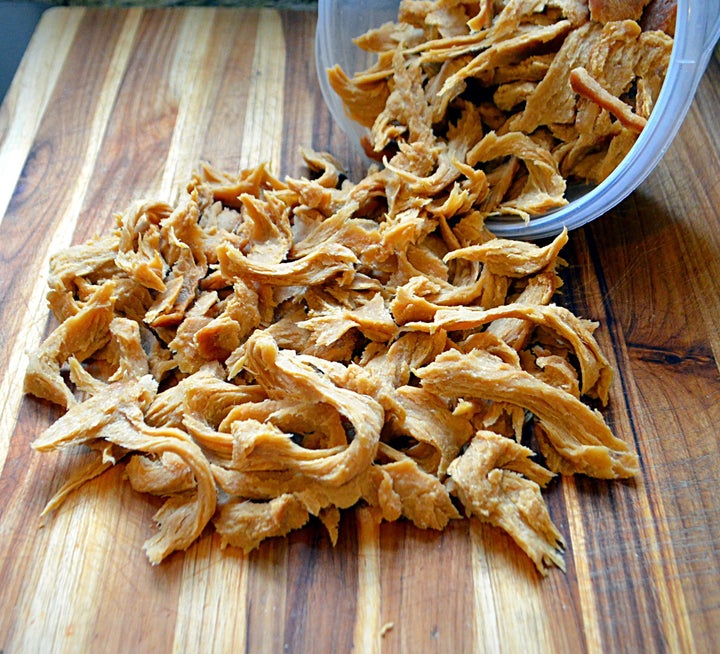
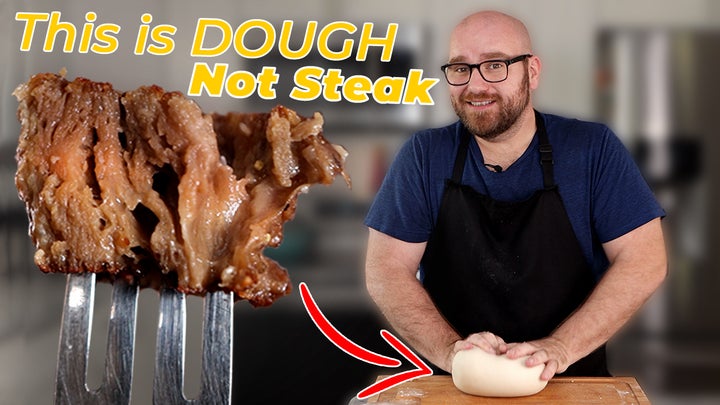
In much of the English-speaking world, seitan refers to a meat substitute made from gluten, the protein component of wheat. It can be made two ways: with vital wheat gluten, a powdered form of already-isolated protein; or by kneading a ball of dough underwater to wash the starch away. The latter takes longer, but it’s thrilling to watch the stretchy, protein-blob emerge, then cook it into fibrous “meat.”
(And if you’re wondering why vegans would want to eat something meat-like, futurelettuce puts it simply: “Veganism isn’t about not eating meat. It’s about not eating animals.”)
Seitan is nothing new, as many responders to futurelettuce were quick to point out; nor is it a “weird white vegan thing.” Of her Singaporean Chinese heritage, Society member Jaki Teo wrote on Instagram: “Mock meat is so common in our dietary culture that nobody gives a single f. Vegans eat it, non-vegans eat it, and we even offer it to dead people at their graves.”
Yancy Nurse, a commenter on BuzzFeed’s futurelettuce post, also reminisced about her Barbadian grandmother washing flour. “I never knew where she learned it from,” Nurse told HuffPost. “But when she made it, everyone showed up. Even meat eaters loved it!”
Futurelettuce told BuzzFeed: “People have [asked] ‘How did you figure this out?’ Which I feel bad about because these methods date back to China thousands of years ago.”
Indeed, gluten-based faux sausage and eel recipes appear in Chinese texts as early as 1301. In America, the 1930s gluten experiments of the Seventh-day Adventists birthed, among other curiosities, canned veggie hotdogs. A jerky-like product dubbed seitan was brought to America from Japan in the late 1960s by macrobiotics founder George Ohsawa, and the word evolved to refer to all gluten products in English. Western seitan recipes have becomeincreasinglycomplex, but until I joined The Society I had no idea I could come close to the deliciousness I’d tasted at Buddhist vegetarian restaurants in my own kitchen.
Enter The Seitan Appreciation Society
The first time I scrolled through the Facebook group, my jaw dropped. Home cooks from all over the world were making gluten-based steaks, turkeys, hams, lambs, spam, bologna, salami, bacon, bratwurst, pork belly, salmon, drumsticks, wings, nuggets, oxtails — any meat I plugged into the search bar brought back hits.
For flavor and texture, people used miso, wine, douchi, molasses, MSG, cocoa, coffee, marmite, rice paper, sourdough, sauerkraut, yuba, tapioca, “bones” made of parsnips, beetroot powder, and on and on. Techniques ranged from simple braising and roasting to sous vide and brining for days. I couldn’t sleep for inspiration.
The Society was created in May of 2017 by U.K.-based Mike Rigby, a tireless admin of many vegan groups. “Lacey Siomos was well-established as an amazing home chef, so I picked her straight away to help set it up,” Rigby said.
Siomos, the inventor of Chickwheat — a shredded chicken sub made from chickpeas, vital wheat gluten and a solid eight minutes in the food processor — was perfecting those elusive shreds when Rigby reached out.
“I’m a big fan of open source,” Siomos said. “We wanted a way to share ideas.”
Lacey Siomos’ chickwheat shreds.
“Once the geniuses of the seitan game moved in,” Rigby explained, “we had a lot of interest.”
Today, The Society has almost 80,000 members and grows every day. Though some early heavy hitters have moved on, there’s no shortage of geniuses. “Like, it’s actual food science. Molecular gastronomy. It’s fascinating,” Siomos said. “It started back with Buddhist chefs and now there are people all across the globe making amazing seitan.”
The Influencers:
Aleksandra
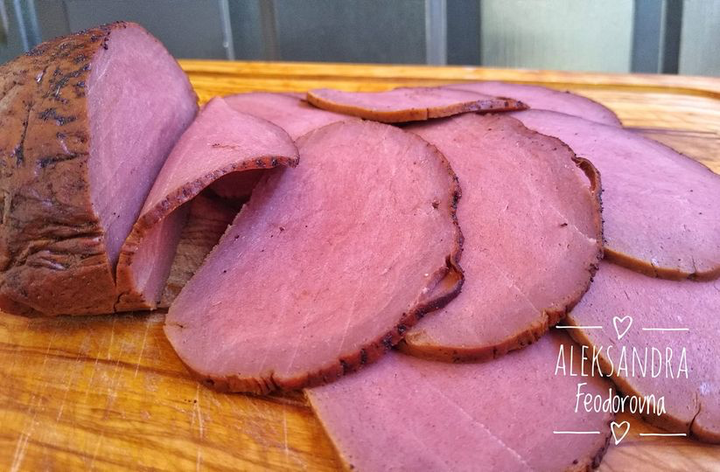
Aleksandra Feodorovna’s ham, created using a pâte feuilletée technique.
No one in the group makes more elegant fake meats than Aleksandra Feodorovna. Her posts have included filet mignon, salmon en papillote, steak tartare, a turducken, and a pâte feuilletée-inspired ham.
“I started cooking with my grandmother when I was 5,” said Feodorovna, an addiction counselor born in Mexico, based in Houston. “She was the first person I ever saw washing flour — this is 1966. Meat in Mexico then was expensive. I was mesmerized that a ball of dough turned into something like that!”
“Cooking is my form of activism,” Feodorovna added. “I share my food with co-workers and friends. Pâte feuilletée isn’t a technique for everybody — it takes a long time. But the results are amazing. I took that ham to work and they were like, ‘This is meat.’ And I’m like, ‘No, it’s wheat.’”
Currently, Feodorovna is documenting her non-seitan cooking in a group of her own and is working on a cookbook. “Mike has provided a wonderful meeting place for everybody,” she said.
Kat Ott
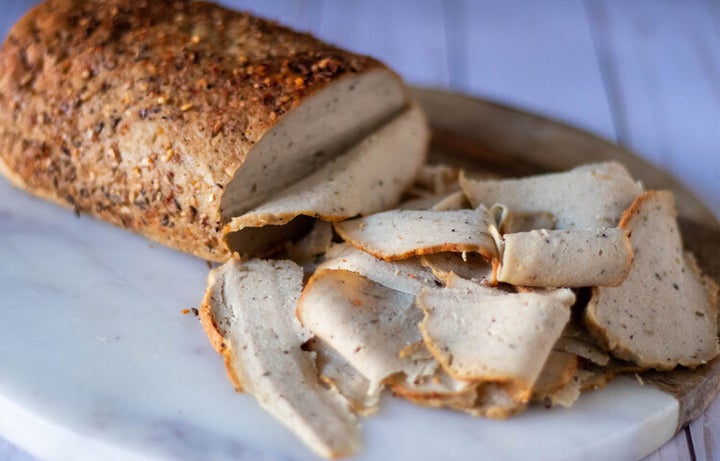
Kat Ott’s deli turkey.
Blogger and mom Kat Ott’s lunchmeat recipes have been many members’ (including futurelettuce’s) first seitans.
“I was inspired to dive deeper into experimenting once I joined The Society,” Ott said. “I was spending a lot on prepackaged vegan lunchmeats for my kids. I wanted to create a deli turkey that would slice super thin like the brands they liked.”
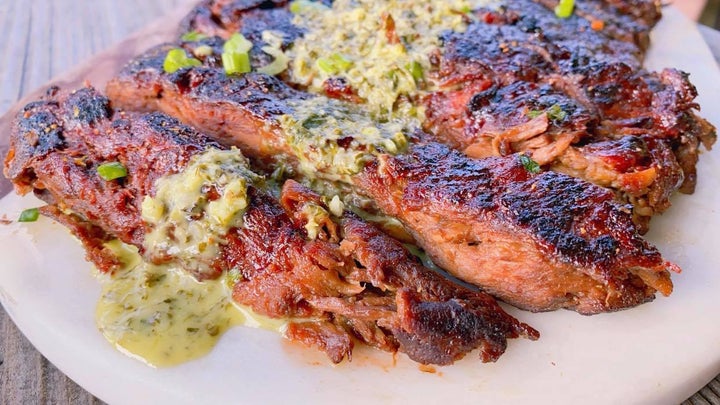
Yessica Infante’s washed flour brisket with chimichurri sauce.
While Ott and Feodorovna remain vital wheat gluten devotees, the washed flour method is having a moment. Yessica Infante, a sports center employee and mom from California, eliminated meat and dairy for health, but her family once enjoyed wings and steak.
“I love the chewiness,” Infante said. “I was like, ‘If we’re going to make this work, I have to have some mock meat we’re all going to enjoy.’ When I learned to wash flour, I couldn’t believe it. The flavor was so good.”
Infante now has YouTube tutorials for drumsticks, brisket, tacos al pastor and oxtails in birria sauce (jicama and rice paper stand in for bones and tissue).
“My family has a rating system,” she said with a laugh. “If a recipe’s an 8 out of 10 or above, I post it. If not, I play around more.”
The Society’s support gave her the confidence to start her channel. “People in the group are asking for my recipe, so why not deliver?”
Mark Thompson, aka Sauce Stache
Mark Thompson’s latest seitan creation for his YouTube channel, Sauce Stache.
Like everyone else I spoke to, Infante cites as an influence Mark Thompson, aka Sauce Stache. And Thompson, when we chatted, cited Infante right back. “I hope her stuff takes off,” he said. “During this seitan boom people are sharing my videos, but it’s like, share hers! That brisket’s mind-blowing!”
This enthusiasm permeates his channel — a food-sciencey test kitchen devoted to plant-based everything (including cracking the code on Beyond Meat sausages’ snap).
During a bout of vegan bacon tests, commenter Nigel Frazer-Ashbrook, a sign language interpreter from Scotland whose butter beany creation was ripping through The Society, suggested Thompson try his recipe. Thompson did a riff and promptly joined The Society himself.
While Thompson’s experiments have brought ingredients like methylcellulose to the seitan sphere, the inspiration goes both ways. Society member Oncle Hu’s pastrami, which involves washing out less starch to create “fatty” pockets, was the latest innovation to inspire a Sauce Stache video. “That was something really wild,” Thompson said.
Back to the future(lettuce)
Futurelettuce, too, is an Oncle Hu fan: “We message back and forth, he taught me a lot.” When I ask how it feels to have made washed flour viral, he’s thoughtful. “If I were wanting to see something on TikTok that was surprising … well, washing flour was something that surprised me more than anything.”
“I have a bit of regret that I didn’t go into more detail in the first video,” he added. “Some people don’t wash enough. They end up with fried bread. My dream is that someone watches, goes, ‘That’s interesting!’ and looks it up. I didn’t even have measurements! It’s as basic as it gets.”
If you’re ready to get beyond basic, The Society is here for you. While it is full of geniuses, the soul of the group are the thousands of members who share daily encouragement, techniques, incredibletutorialrecommendations and jokes about how stretched gluten looks like, well, see for yourself below.
Come join us (read the pinned FAQ!) and sink your teeth into homemade meat made of wheat!
byJULHAS ALAM | Associated PressFriday, April 9th 2021AA
John Kerry, the special U.S. envoy on climate, speaks with Bangladeshi Foreign Minister A.K. Abdul Momen standing beside him in Dhaka, Bangladesh, Friday, April 9, 2021. (AP Photo/Al-emrun Garjon)
DHAKA, Bangladesh (AP) — John Kerry, the special U.S. envoy on climate, said Friday that President Joe Biden is eager to work with Bangladesh in dealing with the impact of climate change after the United States’ return to the Paris accord.
Kerry arrived in Bangladesh’s capital, Dhaka, to hear what the low-lying South Asia delta nation has done to cope with weather extremes and rising sea levels ahead of a virtual summit on climate change that Biden is hosting this month.
“No one country can solve the problems of climate crisis,” he told reporters after visiting other vulnerable countries, including the United Arab Emirates and India. Biden returned the U.S. to the…

 APR10

 by