I Got My Second Shot Yesterday — and the US Saw 73,200 New COVID Cases

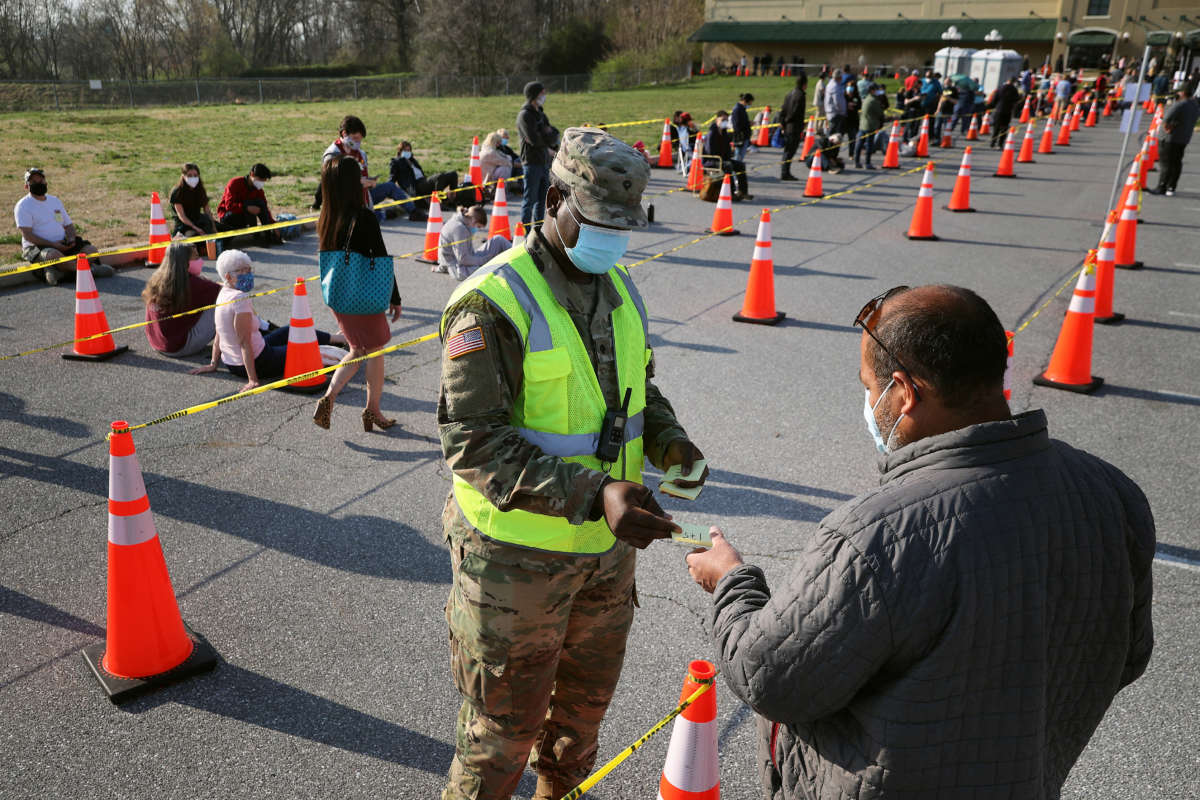
A member of the Maryland National Guard hands out Post-It notes with numbers to people arriving without appointments at the mass coronavirus vaccination site at Hagerstown Premium Outlets on April 7, 2021, in Hagerstown, Maryland.

BYWilliam Rivers Pitt, TruthoutPUBLISHEDApril 8, 2021SHAREShare via FacebookShare via TwitterShare via Email

Despair and Disparity: The Uneven Burdens of COVID-19

I’m not sure what I was expecting after receiving my second COVID vaccine shot. Would the skies part in glory? Would flights of angels sing me a tune? Maybe some dancing Grateful Dead bears on the hood of my car? “One way or another, this darkness has got to give…”

What happened was this: We rolled through a long line of cars to get into the vaccination site, parked at the direction of a smiling National Guardsman who was clearly enjoying her role in the endeavor, and waited. After about 15 minutes, a woman in PPE gear with a nametag that read “Dr. Nancy” came to my window and asked if I was ready. Yes, I replied. Yes, yes, oh hell yes.

Sleeve rolled up, needle went in, plunger went down, needle came out, and I hit the hazard lights for the obligatory 15-minute side-effects wait. Those minutes passed to the sound of Simon & Garfunkel on my radio, and I will long remember surveying that field packed with parked cars while quietly singing along to, “They’ve all come to look for America…”

Never miss another story

Get the news you want, delivered to your inbox every day.

  • Email

… and just like that, I had joined the growing millions in becoming a tiny part of scientific history. I still have two weeks to go before the full protections kick in, but even as I sat there counting my heartbeats in the low throb of the injection site, I felt my fear — my ocean of dread, my yearlong companion, my inescapable shadow — puddling out of me and slowly washing away.

“Grateful” is not a large enough word. It took a ruthlessly lethal pandemic combined with the deliberate indifference of authority to inspire it, but the science behind these vaccines represents the kind of forward leap that has only happened a few times in history. “Now, with the Moderna and Pfizer vaccines, the technology has been tested and it has succeeded,” writes Kesley Piper for Vox. “That success is likely to drive development of tons more mRNA vaccines targeting other diseases.”

There is a hollowness to the moment for me, however. I’m aware that I’m taking pleasure from survival when half a million of my fellow countrymen are gone forever; I feel selfish. I’m glad I didn’t get sick, and I worked very hard not to get sick, but how much of all that is luck? This thing could have had me as easily as picking an apple from an orchard, despite all my precautions.

There is, as ever, the rage. It did not have to be this way, and the authors of this misery are currently huddled down in Florida trying to game plan how to smash their way back into power, all the while turning a buck every which way they can. The negligent homicides of hundreds of thousands of people, the infection of and perhaps permanent harm done to millions more, goes unpunished to this day. It is a stone in my stomach I cannot sick up, and so long as it remains there, I will know no peace.There is a hollowness to the moment for me.

There is also very much this: It is not over yet by any measure. On the day I was vaccinated for the second time, there were 73,200 new cases of COVID reported in the U.S. The more virulent B.1.1.7 variant that emerged from Britain is now the dominant strain — not the dominant variant, the dominant strain — of COVID in this country. A fourth wave of infections is well underway because of this, and states like Michigan, Minnesota, Illinois and New York are getting clobbered with new cases.

In India and Brazil, the virus is running rampant. These kinds of mass COVID petri dishes are ripe for the emergence of new and more virulent strains, some of which could very well be capable of defeating our miraculous vaccines. To our immediate north, Canada has reached Level Four on infections, the highest measurement, and the CDC recommends no one travel there without being fully vaccinated. In Vancouver, the entire Canucks NHL hockey team is under quarantine after 25 players and coaches tested positive. That’s basically the entire team.

Because of all that, it feels too early for any kind of substantive What It All Means navel-gazing. In this moment, though, I feel strangely like a survivor from the Titanic bobbing in a lifeboat in the dark North Atlantic night. The analogy is apt if you imagine that doomed ship as an allegory for the nation, a gilded behemoth encrusted with the wealthy elite, while below in steerage sat the poorest passengers, who bore the brunt of the iceberg’s wrath.

COVID was our iceberg, and it exacted a murderous price, particularly among those who exist in the steerage quarters of our modern economy. I cannot avoid counting myself — vaccinated and alive — among the privileged, and I am unavoidably roiled with the queasy seasick sense that so many others deserve this more than I do.

Bollocks, I try to tell myself. Self-indulgent tripe. The vagaries of fate are no more mine to control than the tide that washed over Canute’s feet. Every medical professional I know is adamant: No one should feel guilty about getting vaccinated, because the more people get the vaccine, the closer we come to a possible end to this nightmare. I have these entirely valid sentiments playing on repeat in my head, but it is hard. It is hard. This has been a long, bleak passage, and the end is not yet in sight.

So here I sit in my lifeboat, Band-Aid on my arm, watching this awesome and terrible thing get cracked open like an egg by its own blundering incompetence, watching as it breaks in half and the lights go out, watching as it is swallowed by a frigid midnight sea, watching for sign of the rescue boats, and wondering what comes next.

Months after recovering from COVID-19, millions may suffer from “brain or psychiatric disorders”

Exposing the Big Game's avatarThe Extinction Chronicles

https://www.salon.com/2021/04/08/months-after-recovering-from-covid-19-millions-patients-may-suffer-brain-or-psychiatric-disorders/

A new study reveals troubling long-term brain and psychiatric aftereffects in COVID-19 patients

ByMATTHEW ROZSA

APRIL 8, 2021 10:50AM (UTC)

main article imageCoronavirus on the brain(Getty Images)Facebook35TwitterRedditEmail8comments

An astonishing study found that roughly one out of three COVID-19 survivors were diagnosed with either a brain or psychiatric disorder within six months of contracting COVID-19.

The shockingly high proportion of brain and psychiatric disorders in COVID-19 patientssuggests that 10 millionAmericans (out of the 30million who have contracted COVID-19)could suffer mental health repercussions in the coming years. That prophesiesan impending social crisis for which American society is unprepared.https://creative-p.undertone.com/2150/85665-1614866905/m213-0.htmlADVERTISEMENTSCROLL TO CONTINUE READINGAdvertisement:

In anarticlepublished in the journal The Lancet Psychiatry, researchers revealed that out of more than 230,000 COVID-19 patients (most of them from the United States), approximately one out of three (33.6%)developed either neurological or psychiatric issues. That number rose to 38.7%…

View original post 576 more words

1 in 3 People Who Survive COVID-19 Are Left With ‘Brain Disease’ or Psychiatric Disorders, Says New Study

Exposing the Big Game's avatarThe Extinction Chronicles

https://www.health.com/condition/infectious-diseases/coronavirus/covid-survivors-brain-disease-psychiatric-disorders

Anxiety and mood disorders were the most common issues among past COVID-19 patients—but more research is needed to know why.ByKorin MillerApril 07, 2021https://4996907f38d1d5f2b4553aa6924e2ea7.safeframe.googlesyndication.com/safeframe/1-0-38/html/container.htmlhttps://4996907f38d1d5f2b4553aa6924e2ea7.safeframe.googlesyndication.com/safeframe/1-0-38/html/container.htmlADVERTISEMENTSavePinFBMore00:1000:15https://imasdk.googleapis.com/js/core/bridge3.449.2_en.html#goog_562970050Share:1 in 3 People Who Survive COVID-19 Are Left With ‘Brain Disease’ or Psychiatric Disorders,×Direct LinkYou might like×1 in 3 People Who Survive COVID-19 Are Left With ‘Brain Disease’ or Psychiatric Disorders,COVID-Brain-Disease-Study14 COVID Vaccine Side Effects: Here’s What You Might Experience After You Get Your ShotCan You Still Spread COVID-19 Even After Getting Vaccinated? Here’s What We Know So FarCan You Get COVID-19 After Being Fully Vaccinated? This Woman Did—Here’s How It HappenedThis Man’s Skin Starting Peeling Off After He Got the COVID Vaccine in a Rare Reaction toCan You Drink Alcohol After Getting the COVID-19 Vaccine? Here’s What Doctors RecommendWhat Should You Eat Before and After the COVID…

View original post 1,455 more words

A third of Antarctic ice shelf risks collapse as our planet warms

Ropeless fishing tech could help save rare whale, say scientists

Exposing the Big Game's avatarThe Extinction Chronicles

https://www.theguardian.com/environment/2021/apr/08/ropeless-fishing-north-atlantic-right-whale-us-canada

Virtual buoys and time triggered traps reduce risk to endangered North Atlantic right whale, but reactions among fishers in US and Canada are mixed

EdgeTech Ropeless Fishing System
Ropeless tech avoids the need for vertical linesPhotograph: EdgeTech

Seascape: the state of our oceans is supported by

The David and Lucile Packard Foundation

About this contentAshifa Kassam@ashifa_kThu 8 Apr 2021 06.43 EDT

86

Ropes that spring to the water’s surface when summoned and virtual buoys could hold the key to saving one of the world’s most endangered whale species, scientists and conservation groups have said.

As the North Atlantic right whalenears the brink of extinction– amid reports of whales tangled in metres of thick fishing lines and findings suggesting85% of the population have been entangled at least once– calls have grown for the adoption of ropeless fishing, using gear that does not involve any vertical lines.

“Ropeless was seen as a kind of…

View original post 960 more words

Boy fatally shot in apparent hunting accident

Exposing the Big Game's avatarCommittee to Abolish Sport Hunting Blog

8:55 amAssociated PressKENTUCKY NEWS FROM THE ASSOCIATED PRESS

HOPKINSVILLE, Ky. (AP) — A coroner says a Kentucky boy has been fatally shot in an apparent hunting accident. Christian County Coroner Scott Daniel told WKRN-TV that the 11-year-old suffered a gunshot wound to the face Wednesday night while hunting alone near his home. He was pronounced dead from the injuries. The boy’s name hasn’t been released. Daniel says the shooting appeared to be accidental and self-inflicted.

View original post

How California snared two elite hunters posting ‘once a lifetime’ kills on social media

https://www.sacbee.com/news/investigations/the-public-eye/article250441186.html

BY RYAN SABALOWAPRIL 07, 2021 04:55 AM, UPDATED 4 HOURS 52 MINUTES AGO

Joe Frater and Chris Stone were on their way to social media stardom in the elite world of trophy deer hunting.

The two law enforcement officers — Frater is a corrections officer at a local prison; Stone is an investigator for the Amador County district attorney — regularly showed off their trophies from just a few years of hunting with bows and arrows in the Sierra foothills of Northern California.

They posed with impressive, mature bucks that they somehow managed to pull from a place known mostly for its scrawny deer with tiny racks. The men appeared on hunting websites, podcasts and YouTube videos, and they had sponsorships with companies that sell hunting equipment.TOP ARTICLESEl Dorado promoted to orange reopening tier while statewide coronavirus numbers stay low

Along the way, California wildlife officers were beginning to grow skeptical of the steady feed of social media posts featuring Frater and Stone. Most of their kills looked like the bruisers that celebrity hunters brag about on hunting shows — that is, extraordinary.

What unfolded next over five months in 2019 could be an episode of “CSI,” as wardens undertook a complex operation with covert stakeouts, DNA evidence, aerial surveillance and vehicle tracking devices — tactics that the men’s attorneys say went too far in upholding California’s stringent and complex hunting rules.

Get unlimited digital access

Subscribe now for only $1CLAIM OFFERhttps://d9a47f024a3d4e0b131a2bac81881a0c.safeframe.googlesyndication.com/safeframe/1-0-38/html/container.html

From the beginning, investigators thought the two archery hunters may have been cheating. They suspected Frater and Stone had lured in the deer using bait, a practice that’s considered unsporting. It’s also illegal in California.

“The caliber/type of deer is very rare for a legal CA hunter to harvest, especially with only using archery equipment,” Game Warden David Moskat wrote in a 2019 search warrant. “I have known many archery and rifle hunters who would be satisfied to harvest even one of this caliber of buck in a lifetime of legal hunting in California.”

In California — and elsewhere around the country — breaking the hunting rules can be a criminal offense. Violators can face misdemeanor charges for breaking even the most technical rules in a thick rule book dedicated to hunting and wildlife protection.

In 2010, one of the biggest names in the hunting world, rock musician Ted Nugent, showed himself hunting over bait as he killed a small “spike” buck on an episode of his “Spirit of the Wild” hunting program on the Outdoor Channel.

Nugent — who often hunts in Texas, where using bait is legal — pleaded no contest to two misdemeanors: illegally baiting a deer, and failing to have a hunting permit signed by a government official after a kill.

The Public Eye

Get The Bee’s big stories and major investigations into government wrongdoing, school spending, political corruption and more on Thursdays.SIGN UP

This site is protected by reCAPTCHA and the Google Privacy Policy and Terms of Service apply.https://d9a47f024a3d4e0b131a2bac81881a0c.safeframe.googlesyndication.com/safeframe/1-0-38/html/container.html

To figure out the methods used by Frater and Stone, a team of officers went on their own hunt, using the same tactics as any elite law enforcement agency would.

They used a surveillance plane to trail the men from overhead. They set out motion-activated cameras. They put tracking devices on their pickups. They took samples from the guts left behind from kills and swabbed the bed of Frater’s pickup for deer blood and hair for DNA evidence. They combed through their text messages and tallied who they called and the minutes they were on the phone.

After weeks of stakeouts both day and night, they raided the two men’s homes, going room to room, rifling through drawers, freezers and closets, seizing deer-head trophies, archery equipment, cell phones, frozen venison, computers, trail camera memory cards and taxidermy and butcher receipts.

At Frater’s home, they seized salt licks, mineral blocks and bags of feed, the sorts of bait used to lure in deer.

When the investigation was complete, the wardens said they found enough evidence the men were hunting deer using bait. Among several other violations: failure to report harvested deer as required by law, intentionally misrepresenting the location of their kills, and trespassing.https://d9a47f024a3d4e0b131a2bac81881a0c.safeframe.googlesyndication.com/safeframe/1-0-38/html/container.html

Because of a recently enacted state law designed to punish poachers specifically targeting trophy-class deer, Stone and Frater faced special sentencing enhancements that included up to a year in jail and up to $40,000 in fines.

In the end, the California Attorney General’s Office allowed the men to sign plea bargains that included no jail time and fines nowhere near the maximum the law allows. (The state agency prosecuted the case in Amador County Superior Court, given that Stone worked for the local district attorney.)

Stone’s and Frater’s attorneys argue the Attorney General’s Office knew the state’s case was overblown, which is why the trophy enhancement was never filed. They argue that the two men didn’t deliberately intend to violate the state’s strict prohibition on hunting deer using bait.

As for the other allegations, John Holbus, Stone’s Sacramento attorney, said they were for technical and “so meritless that the Attorney General’s office declined to even file them.”

Frater’s Sacramento attorney, Candice Fields, said the amount of time and resources spent on the case were wasted on her client “who has been licensed since around age 13, (and) has a spotless record.”https://d9a47f024a3d4e0b131a2bac81881a0c.safeframe.googlesyndication.com/safeframe/1-0-38/html/container.html

“My client and I are both disappointed that significant and precious law enforcement resources were expended on what the California Attorney General’s Office obviously deemed was an overblown investigation based upon the limited code violations which were ultimately charged,” she said in an email.

“If violent crime investigations receive less funding than did this investigation, the public really should be left wondering about the prioritization of how their tax dollars are spent.”

READ NEXT
STATE-WORKER

Here’s our best subscription deal, California state workers. Thank you for what you do

APRIL 08, 2020 5:00 AM


Holbus said that when he met with Fields and the attorney general’s prosecutor to go over the case, the seasoned criminal law attorneys were stunned at the number of DNA tests the wardens had ordered done.

“There were more DNA tests done than all three of us had seen in our careers put together,” Holbus said.https://d9a47f024a3d4e0b131a2bac81881a0c.safeframe.googlesyndication.com/safeframe/1-0-38/html/container.html

But some say that given what the wardens uncovered during their investigation, the punishment wasn’t severe enough — the latest example of what they say is a troubling trend.

“Judges, courts never take wildlife cases as seriously as drug offenses or violent crimes — they just don’t,” said former federal wildlife officer Michael Sutton, past president of the California Fish and Game Commission, the agency sets state hunting laws.

“There’s a big need to educate both prosecutors and judges about the serious nature of these offenses.”

The Attorney General’s Office said in an emailed statement that prosecutors were “unable to discuss charging analysis.”

SOCIAL MEDIA POSTS BECOME EVIDENCE

https://d9a47f024a3d4e0b131a2bac81881a0c.safeframe.googlesyndication.com/safeframe/1-0-38/html/container.html

Frater and Stone may have been the victims of their own desire, like millions of other people, to boast about their accomplishments and build their brand on social media. That’s exactly where the case began in August 2019, according to a pair of Department of Fish and Wildlife search warrants unsealed at The Sacramento Bee’s request in Amador County.

Moskat, the game warden, wrote in his affidavit that he was suspicious of Frater and Stone based on what he saw on their Instagram and Facebook accounts.

Stone had posted a picture from that year’s hunting season of him holding the antlers of a buck he’d shot with his bow. The deer didn’t have an orange piece of paper tied around its antlers, a state-issued “deer tag.” The state issues those permits to deer hunters, allowing them to kill one deer per tag. California hunters are allowed up to two deer tags each season.

A 2013 YouTube hunting video featuring Stone also showed him posing with three giant bucks that didn’t have tags on their antlers, Moskat wrote.https://d9a47f024a3d4e0b131a2bac81881a0c.safeframe.googlesyndication.com/safeframe/1-0-38/html/container.html

The law says hunters are required to “immediately” write on the form the date, time and exact location where the deer was killed, and tie it to the animal’s antlers. The purpose of the rule is to help prevent hunters from bagging too many deer or shooting them in areas where they’re not allowed to hunt.

Many hunters snap a photo with their kill just before they tag it, even though it’s technically a crime under the state’s strict rules.

Stone’s attorney, Holbus, said that’s what his client did when he posed for the cameras. He tagged the bucks moments later before they were moved from the site, Holbus said.

But for Moskat, it was a sign that Stone and his hunting partner were willing to bend or break the state’s hunting rules. He used it as his first example in his affidavit to convince the judge that he had probable cause to conduct his search.

Moskat wrote that he started digging into the online system that hunters use to report their kills after a successful hunt.https://d9a47f024a3d4e0b131a2bac81881a0c.safeframe.googlesyndication.com/safeframe/1-0-38/html/container.html

Frater and Stone had an impressive track record. Between 2012 and 2019, the men had reported killing around two dozen deer, most of them trophy-class bucks with large antlers and multiple tines and points.

But Moskat wrote that Stone didn’t report to the state at least three of the deer he killed and posed with in social media pictures and on the YouTube video. Moskat also pulled the deer tags the men had filed with the state. Moskat noted the men didn’t write down exactly where they’d killed the buck on the tags, instead merely noting a general landmark like a road or a ridgetop, according to the affidavit.

Holbus, Stone’s attorney, said this is another example of the highly technical violations the men were accused of committing, akin to how almost all drivers drive at least a little bit over the speed limit.

“If the rules were strictly enforced by the text of the law only, then every single hunter could be arrested on every single successful hunt,” Holbus said.

Capt. Patrick Foy, a spokesman for the wardens at the Department of Fish and Wildlife, however, said when it comes to this case, those technical distinctions mattered. In the game wardens’ minds, he said, it showed the two didn’t want to formally alert law enforcement to exactly where they killed a buck while trespassing or if they shot it over a pile of apples.https://d9a47f024a3d4e0b131a2bac81881a0c.safeframe.googlesyndication.com/safeframe/1-0-38/html/container.html

Around the time Moskat was digging into Frater’s and Stone’s hunting records, Moskat found evidence of baiting by looking at Frater’s small parcel from a neighbor’s place. Moskat wrote that he spotted “several heavily used deer trails,” “salt/mineral blocks” used to attract deer, birdfeeders, bales of feed and partially buried buckets placed near motion-activated trail cameras.

It’s not clear in the search warrants whether Frater was hunting on his property, but regardless of if he was, intentionally feeding large wildlife in California is a crime. It became another piece of evidence Moskat used to convince the judge he had probable cause to conduct searches that eventually led to the wildlife officers getting permission to track the hunters’ vehicles, read through their text messages, phone call logs, search their homes and seize their property.

WHAT THE WARDENS UNCOVERED

In September 2019, the wardens received the court’s approval to put tracking devices on Frater’s and Stone’s pickups, which they monitored for several weeks during the middle of the state’s deer hunting season.

At one area that Frater frequented, Moskat wrote that he found a pile of around 100 apples next to a trail camera.

At another site Frater visited, one of Moskat’s fellow wardens allegedly found a tree stand that hunters use to shoot deer from above. A pile of apples and a salt or mineral block was placed nearby, Moskat wrote.

The wardens set out motion-activated surveillance cameras at the site, which later showed Frater carrying a bow and wearing a climbing harness, a sign that he was hunting, according to the affidavits. Meanwhile, a plane overhead was tracking Frater’s movements. The pilot spotted him one day practicing with his bow before driving to go hunt at a baited site, Moskat wrote.

Stone also was being surveilled. A camera on the road outside his home took photos of him coming and going. His vehicle, which has a customized license plate that translates to “Turkey Slayer” was spotted at a site where Moskat wrote he found bait pellets in front of one of Stone’s trail cameras, and a spray-painted bottle filled with “sweet smelling liquid similar to molasses” hanging from a tree.

This, Moskat alleged, was another form of attractant to lure in deer. Later, the wardens also later found plum skins and pits that they say were evidence the fruit had been intentionally placed in one of Stone’s hunting areas to lure in deer.

Moskat put out a camera at one site, which later showed Stone walking past it with a rifle slung over his shoulder.https://d9a47f024a3d4e0b131a2bac81881a0c.safeframe.googlesyndication.com/safeframe/1-0-38/html/container.html

Holbus, Stone’s attorney, said that was the only violation for which Stone ended up being charged. He said Stone hadn’t actually been hunting that day, but he had merely been going to check the memory cards on his game cameras.

“While checking on one of them, he walked through a field that was baited two months previously,” Holbus told The Bee in an email. “Mr. Stone did not think the bait, from two months earlier, was still in the field.”

Holbus said his client, who prefers to archery hunt, didn’t have any intention to shoot a deer that day and even walked up on a nice buck he didn’t shoot with his rifle.

But there was evidence that bucks had died on Stone’s baited properties, according to the affidavits. Wardens said during their stakeouts they watched as Stone hunted with friends other than Frater. Over the course of their investigation, they found four gut piles from where the hunters cleaned their kills, Moskat wrote. The warden took samples from the guts to be used as DNA evidence in the case.

In his affidavit, Moskat wrote that he believed the untagged buck Stone had posed with on social media earlier that season was likely shot over bait.https://d9a47f024a3d4e0b131a2bac81881a0c.safeframe.googlesyndication.com/safeframe/1-0-38/html/container.html

He also wrote he believed that Frater’s kills that year — two bucks and a black bear — had been targeted over bait as well.

It was enough for the judge to authorize searching the men’s trucks, homes and properties in December 2019. The Attorney General’s Office filed formal charges against the men in August in Amador County.

That same month, Stone, 41, pleaded no contest to one count of hunting over bait. He was fined $780 and placed on three-years probation along with a suspension of his hunting privileges during the probationary period.

Frater, the 38-year-old prison guard, pleaded no contest in January to two counts of hunting deer over bait. He was fined $5,000, placed on one year of informal probation and agreed to forfeit his hunting privileges for a year.

“He has accepted responsibility, paid a fine to one of CDFW’s wildlife conservation funds, and surrendered one of his bows which he understands will be used to raise additional conservation funds,” Fields, Frater’s attorney, told The Bee. “He is happy to support a cause so close to his heart.”https://d9a47f024a3d4e0b131a2bac81881a0c.safeframe.googlesyndication.com/safeframe/1-0-38/html/container.html

Frater remains employed at Mule Creek State Prison where he’s worked for the past seven years. A California Department of Corrections and Rehabilitation spokeswoman declined to comment on whether he’d been disciplined, citing personnel confidentiality rules.

It’s also not clear whether Stone was disciplined as a result of the case by his bosses at the Amador County District Attorney’s Office.

District Attorney Todd Reibe declined to comment, citing the same personnel rules.

Fields said that since baiting is what’s known as a “strict liability” regulation, it means wardens don’t have to prove that a hunter intended to violate the law.

“In other words, if there are apples on the ground from a nearby tree, a hunter who otherwise legally hunts a deer within 400 yards of those apples (that’s four football fields) violates the regulation,” she said in an email. “That’s what happened here.”https://d9a47f024a3d4e0b131a2bac81881a0c.safeframe.googlesyndication.com/safeframe/1-0-38/html/container.html

Capt. Foy, the game warden spokesman, said the evidence the wardens uncovered clearly showed the men repeatedly killing big bucks over bait and then boasting of their successes, “claiming they’re legitimate and then posting them on multiple social media platforms.”

That was no accident or simple misunderstanding, Foy said.

“Not when it happens,” he said, “over and over again.”

RELATED STORIES FROM SACRAMENTO BEE

ENVIRONMENT

Nothing Wild: California’s relationship with the animal kingdom is broken. Can it be fixed?

‘Ecocide’ movement pushes for a new international crime: Environmental destruction

Exposing the Big Game's avatarThe Extinction Chronicles

https://www.nbcnews.com/news/world/ecocide-movement-pushes-new-international-crime-environmental-destruction-n1263142

A growing number of world leaders advocate making ecocide a crime before the International Criminal Court, to serve as a “moral line” for the planet.

Image: Photo illustration of Deepwater Horizon, Amazon fires, city pollution, ocean oil spill and refinery exhaust.

As rainforests burn and ice sheets melt, criminalizing ecocide could serve as a deterrent for companies and governments that harm the environment, advocates say.Chelsea Stahl / NBC News; Getty ImagesApril 7, 2021, 2:00 AM PDTByNicholas Kusnetz, Inside Climate News,Katie Surma, Inside Climate NewsandYuliya Talmazan

This article was published in partnership withInside Climate News, a nonprofit, independent news outlet that covers climate, energy and the environment. It is part of “The Fifth Crime,” a series on ecocide.

In 1948, after Nazi Germany exterminated millions of Jews and other minorities during World War II, the United Nations adopted a convention establishing a new crime so heinous it demanded collective action. Genocide, the nations declared, was “condemned by the civilized world” and justified intervention in…

View original post 3,057 more words

‘Bad’ Bison Bills In Montana Set Back Conservation of America’s Official National Mammal

https://mountainjournal.org/montana-bills-for-bison-represent-major-blow-to-conservation?fbclid=IwAR2YWcEy36hEA4k3qJK4U3icb4TFN6gpXk-YiU7xyQYnRMaL66_2ifi3kkA

MARCH 29, 2021

WILDLIFE BIOLOGIST, AUTHOR AND CONSERVATIONIST JIM BAILEY SIZES UP WHAT HE CALLS “THE FULL CATASTROPHE” REGARDING MONTANA LEGISLATURE’S BACKWARD ATTITUDE TOWARD BISON. WILL THE CONTROVERSIAL GOVERNOR

by Jim BaileySUPPORT USGET NEWSLETTERBailey writes: “Currently, there are no public-trust wild bison, year-round, in Montana. Two bills in the Montana legislature would prevent any restoration of the species, as wildlife, in the state. While touting ‘protect public lands’ as a smokescreen, Montana lawmakers are betraying their public trust responsibilities to manage a resource for all people. They are bulldozing a whole history of bison conservation efforts into the refuse pile of the ‘once best place.'”
Opinion guest essay by Jim Bailey
Bison are the official land mammal of the United States. They are on the flag of the US Interior Department, they appear on the insignia of the National Park Service, they were featured on one side of the buffalo nickel and, in Montana, the skull of a bison, as portrayed by famous Western artist Charles M. Russell, was showcased on the Montana collectible 25-cent piece.
Bison were once the most abundant large land mammal in the world. Their great numbers, their basis for a renowned Native American horse culture on the Great Plains, and their demise are legendary parts of American and Montana histories. But, two bills moving through the Montana legislature and headed for the desk of Governor Greg Gianforte would undo years of attempts to securely recover this iconic species, widely loved by the American people, as a wildlife species.
The vast majority of plains bison are being domesticated in private herds for commercial purposes. Many tribes have bison herds, managed to fulfill important needs of Native Americans. American conservation herds in parks and refuges are mostly small, on small ranges, and most are managed with domesticating interventions, much like livestock. But, there are no public-trust, wild bison year-round in Montana. (Yellowstone bison are only seasonal visitors to Montana from most of the park encompassed by Wyoming.)
As wildlife, bison are a natural resource jointly and cooperatively managed by state and federal legislatures and administrations having trust obligations to benefit all the people, including future generations.
A long history of federal and state legislation, policy and planning, has been established to guide and constrain bison management – to benefit and protect the people. These actions, listed below, have included decisions under federal and state laws developed under agencies representing over a million Montanans and over 300 million American citizens who own Montana wildlife.
House Bill 302 would permit any county commission in Montana to veto any publicly analyzed and examined proposal for local bison restoration, even on federal land. House Bill 318, in narrowly redefining “wild bison” in Montana law, would disqualify all possible plains bison for use in restoring any population of public-trust, wild bison in the state.
Both of those bills 302 and 318 would ignore, duplicate, violate or render meaningless the following Montana history regarding bison restoration:Mandates in Article IX of the state Constitution to care for natural resources and objects of historic, cultural and recreational value; and to preserve the opportunity to harvest wild game.
Legislative guidelines in MCA 87-1-216, developed in response to the constitutional mandate, providing requirements for restoring public, wild bison in Montana.
The Montana Environmental Policy Act, MCA 75-1-103, for making difficult decisions. Abundant public effort under MEPA could simply be vetoed and wasted, with little county analysis or explanation.
Twelve years, (so far) of effort and expense by Montana Fish, Wildlife & Parks to develop a statewide plan for restoring at least one herd of public, wild bison in the state.
Three polls demonstrating that 70 percent of Montana voters support bison restoration on the Charles M. Russell Refuge.
For restoration of public-trust—getting wild bison established on the Charles M. Russell National Wildlife Refuge—house bills 302 and 318 would ignore, preclude or render meaningless the following federal mandates, plans and policies (again, set in bold for emphasis)The mission statement of the U. S. Fish & Wildlife Service.
The mission statement of the Fish and Wildlife Service’s cherished National Wildlife Refuge System.
The Refuge System Improvement Act of 1997.
The U. S. Department of Interior’s recent Bison Conservation Initiative.
The National Environmental Policy Act, for use in decision-making.
The ability of the Russell Refuge to achieve its overall goal of restoring natural ecosystems on the Refuge, as stated in the Refuge Plan.
House Bill 302 would duplicate existing requirements for notifying rural counties and citizens of the details in any plan for restoring wild, public bison in Montana.
Any proposal for bison restoration must be developed under either or both the Montana and National Environmental Polcts and under MCA 87-1-216. These laws provide all citizens with detailed project analyses and abundant opportunities to comment. Rural counties are not being discriminated against in this public outreach.“Domestication is the most serious threat to the future of bison as a wild species,” Bailey writes. “The vast majority of North American plains bison exist in privately-owned commercial herds where they are being domesticated by replacing natural selection with human-determined selection, augmented by genetic effects of small population sizes.”For example, the current MEPA process to develop a state plan for restoring at least one herd of public, wild bison has been ongoing for 12 years, with abundant public outreach and input, including public hearings around the state. A preliminary review  by Adams and Dood, 2011) and the current, interim “programmatic” plan and impact statement include abundant information on diverse issues related to bison restoration. This information, developed by professional biologists and others, has been widely available.
Likewise, under the NEPA process, the Charles M. Russell National Wildlife Refuge Conservation Plan was developed with public outreach and input. Public hearings were held in 6 Montana towns and cities.
House Bill 302 would allow a local government, representing perhaps only 1000-5000 Montanans, to preclude the needs and privileges of the majority of citizens of the state and the nation, as these needs and desires are provided for under existing statutes.
In contrast to the small numbers of citizens in many rural counties, Montana Fish, Wildlife & Parks received over 21,000 public comments in response to the 2015 Draft Environmental Impact Statement for bison conservation and management. Also, the U. S. Fish and Wildlife Service received over 23,000 public comments during scoping and over 21,000 Public comments on the draft conservation plan for the CMR Refuge.
Again, three polls of citizens have shown that about 70 percent of Montana voters support restoration of public-trust, wild bison on the CMR Refuge.
House Bill 302 would duplicate existing legal requirements for protecting private property, while restricting private and public property rights for many citizens. 
Private landowners cannot be discriminated against with restoration of wild bison.  Existing law (MCA 87-1-216) does not permit Fish, Wildlife & Parks to allow wild bison on any property where the landowner does not accept them. Further, this law requires Fish, Wildlife & Parks to compensate for any damage caused by wandering bison. Among many other requirements, it minimizes possible transfer of disease from wild bison to livestock and requires a pre-restoration public hearing in any affected county.
In contrast, HB 302 could prevent any landowner who would accept wild bison from enjoying that option, limiting private property rights. Moreover, HB 302 could prevent the majority of Americans and of Montanans from restoring a native species, with its important ecological functions, on their public property.
House Bill 302 would be an imprudent precedent in negating the role of the Fish, Wildlife & Parks Commission to determine policy for conserving and managing state wildlife.
House Bill 318 would disqualify all possible plains bison for any transplant to restore public, wild bison in Montana. 
Aside from redefining “wild bison”, HB318 amends MCA 15-24-921 to clearly exempt tribal bison from the per capita livestock fee. Redefining wild bison is not necessary for this purpose.
Under HB 318, a wild bison: has not been reduced to captivity; has never been owned by a person; has never been taxed as livestock; nor is the offspring of a bison once taxed as livestock. These proposed redefinitions of “wild bison” have no basis in biology. There is no reason why the past ownership of a bison, or its parents, should disqualify and animal from initiating a new, wild herd.
In particular, HB 318 at least implies that a wild bison is one that has never been in captivity. Since the vast majority of plains bison, including conservation herds in public ownership, are fenced-in, mostly small herds on small ranges, and the very few unfenced herds would have to be captured for months or years of quarantine or inspection and for transportation, HB 318 would disqualify all possible plains bison for use in restoring a public wild herd in Montana. No bison, anywhere, would clearly qualify to be used in restoring bison as wildlife in Montana.
House bills 302 and 318 would expedite gradual disorganization and domestication of the wild bison genome.The International Union for Conservation of Nature and Natural Resources has concluded that large herds of bison subject to the full range of natural limiting factors must be of pre-eminent importance to the long-term conservation, global security and continued evolution of bison as wildlife. The Alternative is gradual domestication of the species (Gates et al. 2010).
As large, highly mobile grazing mammals, restoration of bison as wildlife has been difficult. In the USA, most conservation herds of bison are small, genetically inadequate, limited to small ranges, and managed much like livestock. Gradual deterioration of the wild bison genome is underway in a domesticating process including loss of genetic diversity.
It is a national goal of the US Department of Interior’s Bison Conservation Initiative to forestall this deterioration of wild bison. This will require restoring at least one large herd on a large, diverse landscape. Realistically, this will require a large area of all or mostly public land where conflicts with private interests, especially livestock production, can be minimized. For plains bison, the best option, anywhere, for such restoration of wild bison exists on the Charles M. Russell National Wildlife Refuge in Montana. The CMR Refuge is the largest federal refuge within the historic range of plains bison.
Seven rural counties include some of the CMR Refuge. HB 302 would allow one county commission, representing a few thousand citizens, to prevent achievement of global and national goals for conserving bison as a wild species.Observes Bailey, “The Charles M. Russell National Wildlife Refuge in east-central Montana is the largest refuge within the historic range of plains bison. But the refuge has no bison and lacks the diverse ecological effects of this keystone species. Despite mandates in federal law and policy, the Refuge Management Plan cedes the right to restore, or not restore, wild bison to the state of Montana.”House bills 302 and 318 would prevent diversification and enhancement of rural economies with opportunities from bison-based hunting and tourism.
Thirty-three contiguous counties in eastern and north-central Montana have been losing population for many decades. Most lack a critical population necessary to support a comprehensive county government, adequate health care, emergency services, quality education, communication facilities and other infrastructure. Poverty levels are the highest in the state. Livestock production has remained the primary economic foundation for these counties, and this industry has opposed any projects that might compete with cattle production.
Under the requirements of MCA 87-1-216, a large herd of public-trust, wild bison could be restored with minimal or no negative impacts on the livestock industry, especially if bison are reestablished on the CMR National Wildlife Refuge.
Bison restoration has potential to augment and diversify local economies by enhancing tourism and with monies spent during months-long hunting seasons for lodging, meals, supplies and outfitting services (Sage, 2017). Either HB 302 or HB 318 would prevent bison restoration in these counties, perpetuating an economic strategy that has failed for decades.
House bills 302 and 318 would justify and encourage independent federal action to restore wild bison on the CMR Refuge.The Fish and Wildlife Service and its refuge system are mandated to collaborate and cooperate with the states in the management of wildlife on federal lands. However, the states’ trust responsibilities for wildlife are subordinate to the federal government’s statutory and trust obligations over federal lands and their integral resources (Nie et al. 2017). Federal agencies have often abdicated this responsibility and authority to the states. HB 302 could be an ultimate expression of Montana’s obstinacy and lack of cooperation for restoring bison, a keystone species, on the CMR Refuge. 
This may lead the Fish and Wildlife Service to fulfill its legal mandates by exercising its ultimate authority and proceeding with bison restoration without state approval.

Bison conservation and the future of bison as wildlife are not merely a local or state issue. The state of Montana, especially the Charles M. Russell National Wildlife Refuge, have a unique and important role to play in preserving a future for public-trust, wild bison. Under HBs 302 and 318, Montana will fail to fulfill an irreplaceable opportunity to conserve a wild resource that is a unique component of global biodiversity.

In conclusion, any proposal for a Montana bison restoration project must be developed by professionals and abundantly vetted under MEPA and MCA 87-1-216. HB 302 adds nothing to this comprehensive process. However, a county veto of a professionally developed and vetted bison restoration plan could be based upon a narrow sample of public goals, by commissioners having no staff to evaluate complex biological issues. 
Either house bills 302 or HB 318 would almost certainly prevent any restoration of public-trust wild bison in Montana, preempting economic opportunities in many rural counties, ignoring the desires and statutory privileges of most citizens of the state and nation, and disregarding a host of state and federal legal mandates and policies. 
Bison conservation and the future of bison as wildlife are not merely a local or state issue. The state of Montana, especially the Charles M. Russell National Wildlife Refuge, have a unique and important role to play in preserving a future for public-trust, wild bison. Under HBs 302 and 318, Montana will fail to fulfill an irreplaceable opportunity to conserve a wild resource that is a unique component of global biodiversity.
In 1910, William Hornaday of the Smithsonian Institution proposed a preserve for wild bison on the south side of the Missouri River in Montana. In Congress, he was thwarted by the Montana Woolgrowers Association. Now, 111 years later, we still have no herd of public, wild bison in the state. Citizens of Montana and the nation must be heard. If Montana’s obstinacy toward bison restoration offends you, contact Governor Greg Gianforte at mt.gov, phone 406-444-3111, or write him at PO Box 200801, Helena, MT 59620-0801. 
Silence is complicity.
EDITOR’S NOTE: For more information, visit the Montana Wild Bison Restoration Coalition and the Buffalo Field Campaign.  Mountain Journal welcomes a rebuttal to Bailey’s essay provided it is based upon science and established fact.