HSUS’s Chimpanzee Debacle

APRIL 6, 2021 BY DONNY MOSS — LEAVE A COMMENThttps://www.facebook.com/plugins/share_button.php?href=https%3A%2F%2Ftheirturn.net%2F2021%2F04%2F06%2Fhumane-society-fails-project-chimps%2F&layout=button&size=small&appId=560935960731324&width=67&height=21https://platform.twitter.com/widgets/tweet_button.e16c6ecf9d86005b77fc7c17beced5d8.en.html#dnt=false&id=twitter-widget-0&lang=en&original_referer=https%3A%2F%2Ftheirturn.net%2F2021%2F04%2F06%2Fhumane-society-fails-project-chimps%2F&size=m&text=HSUS%27s%20Chimpanzee%20Debacle%20-%20Their%20Turn&time=1617824164287&type=share&url=https%3A%2F%2Ftheirturn.net%2F2021%2F04%2F06%2Fhumane-society-fails-project-chimps%2FShare on TumblrSave

The News

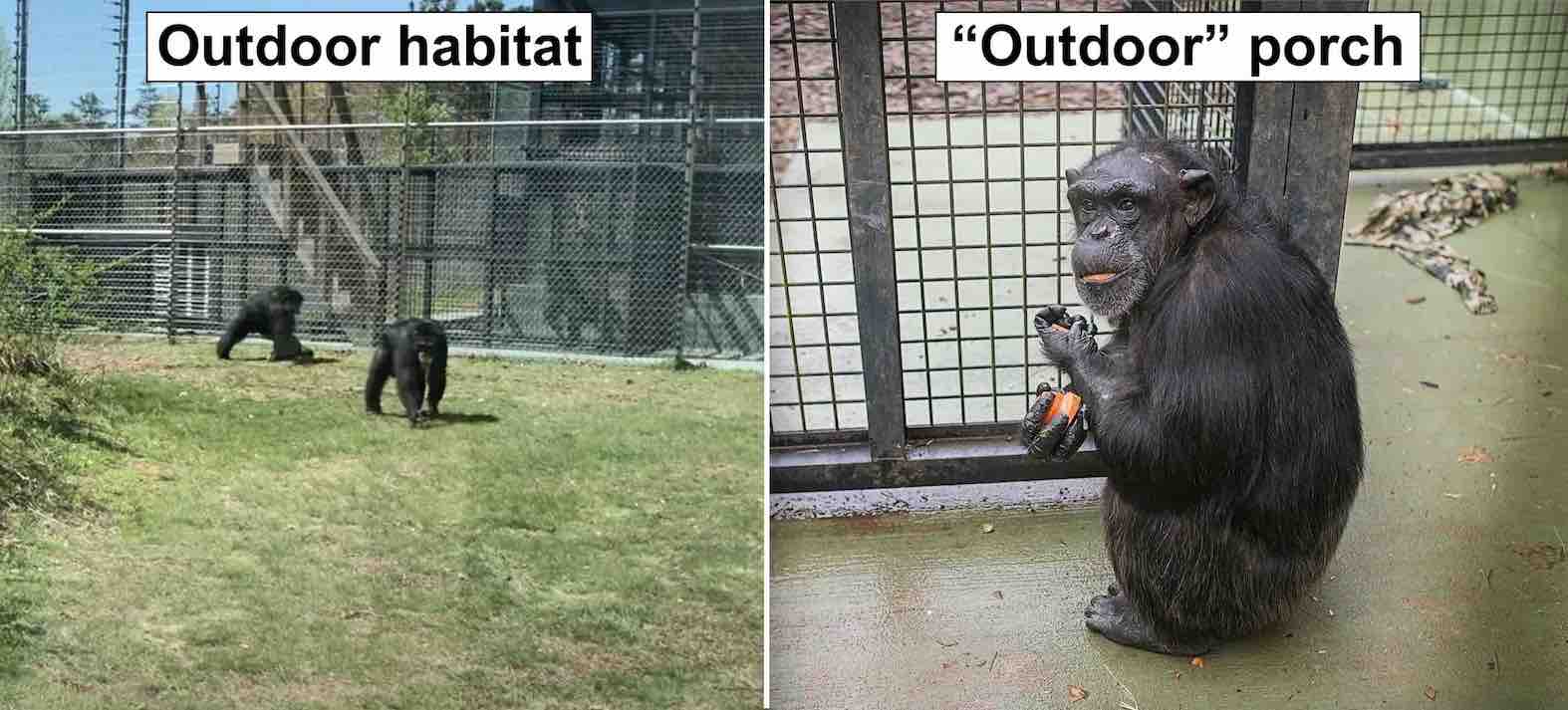
In June 2020, I posted an article entitled “Why I’m Blowing the Whistle on HSUS” in order to raise awareness of the plight of chimpanzees at two sanctuaries run by the Humane Society of the United States (HSUS) – Project Chimps in Georgia and Second Chance Chimpanzee Refuge in Liberia. Both are plagued by substandard facilities, deficient veterinary care and unqualified management. At Project Chimps, the residents are held in concrete rooms for all but about 10 hours a week because HSUS has not created enough enclosed yards on its “236-acre wooded habitat” to be able to provide the 77 chimps with daily access to the outdoors. Instead of acknowledging and fixing these serious, systemic problems, HSUS has used its PR machine to minimize them or deny that they exist. It has also used its lawyers to silence and intimidate those who speak out.

Precious, a chimpanzee at Project Chimps

In May 2020, HSUS inadvertently shined a national spotlight on Project Chimps by suing two women who came forward with credible and extensive evidence of animal neglect. Appalled that HSUS would sue whistleblowers (an intimidation tactic typically associated with big animal ag), animal advocates around the country, including several with expertise in captive primate care, stepped in to support the whistleblowers and amplify their calls for reform at Project Chimps.

Project Chimps, an HSUS sanctuary, sued former employees Crystal Alba and Linsday Vanderhoogt after they came forward publicly with evidence of animal cruelty

Despite not having visited Project Chimps, I believed the whistleblowers – not only because of the evidence they provided, but also because I saw the same problems during my two visits to HSUS’s chimp “sanctuary” in Liberia. There, HSUS is overseeing the care of over 60 ex-lab chimpanzees who the New York Blood Center (NYBC) moved to islands on a river when they no longer needed the chimps for experiments. Despite having received a $6 million check from NYBC in 2017 and hundreds of thousands of dollars in large and small donations from the public since 2015, HSUS has not built any desperately needed infrastructure on the islands.

National Geographic published an in-depth story that corroborated their allegations.

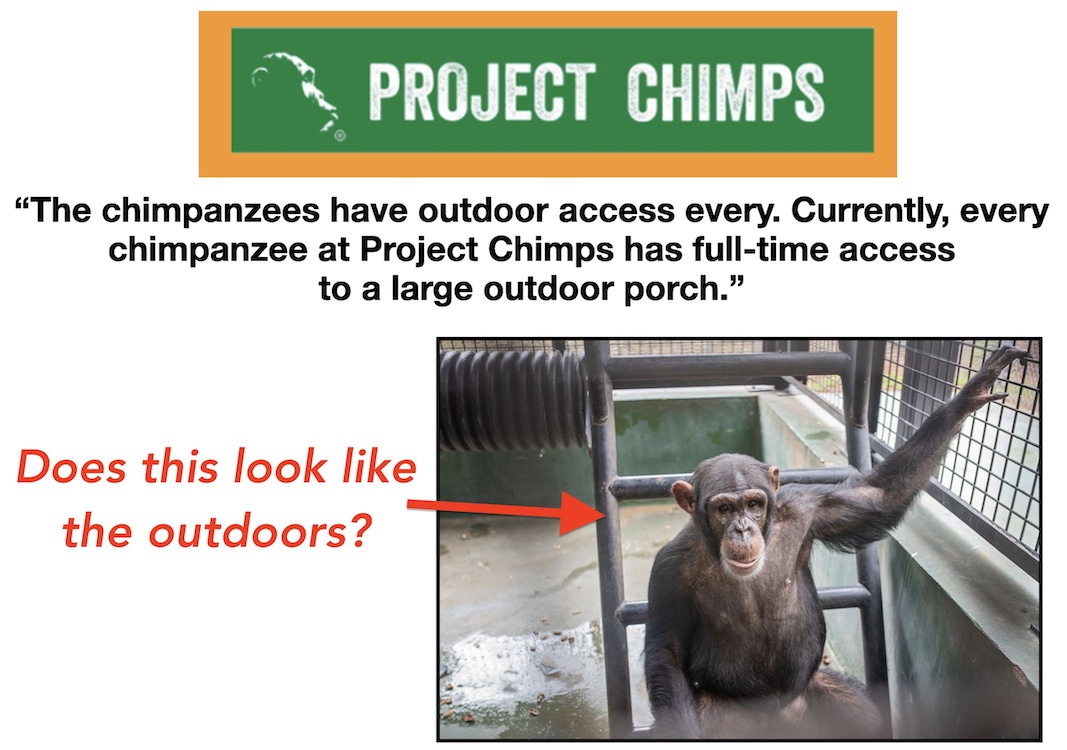
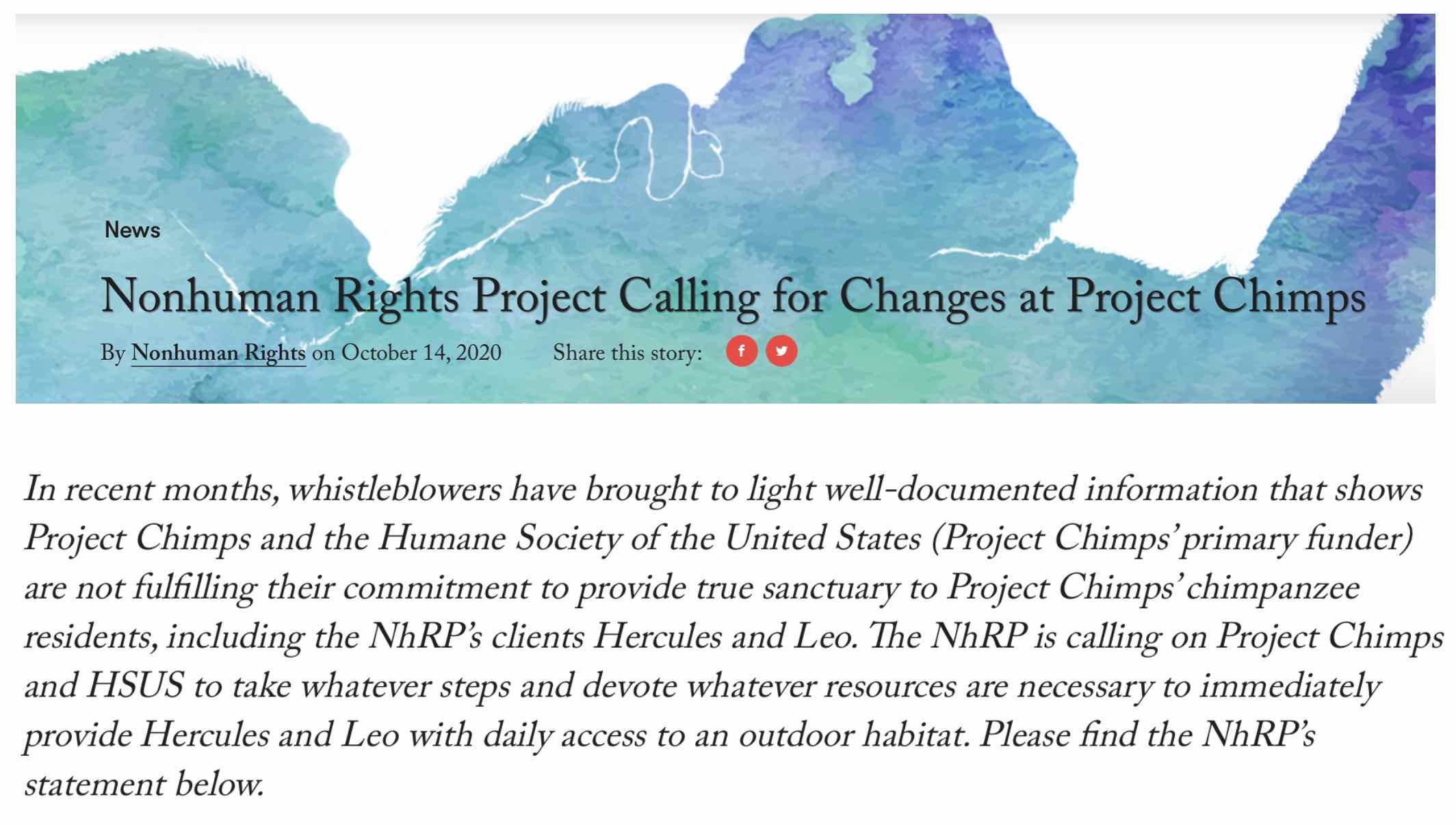
In October 2020, The Nonhuman Rights Project (NhRP), an organization of animal rights lawyers who represent captive chimpanzees and elephants, took the unusual step of issuing a public statement calling on HSUS to improve animal welfare at Project Chimps. NhRP was particularly distressed by the fact that Hercules and Leo, chimpanzees who they freed from a laboratory, did not have daily access to the outdoor habitat. HSUS dismissed their concerns, arguing that the concrete porches where they spend their days are outdoors.

HSUS claims that the 77 residents of Project Chimps have daily access to the outdoors, but advocates believe this is misleading because the “porches” are enclosed concrete rooms

The Nonhuman Rights Project issued a public statement demanding that Project Chimps provide its clients, Hercules and Leo, with daily access to the outdoors

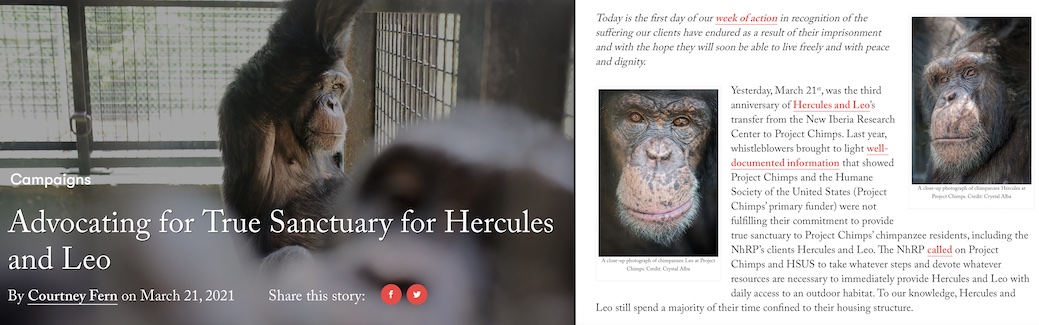
On March 21st, NhRP marked the three year anniversary of Hercules’ and Leo’s arrival at Project Chimps by issuing another public statement, this time asking its global network of supporters to call on HSUS CEO Kitty Block to provide Hercules and Leo with daily access to the outdoors. NhRP and PETA, which also issued a statement, must have agonized about publicly criticizing another animal advocacy group, but, by repeatedly dismissing the concerns they raised in private, HSUS left them with no choice.

The Nonhuman Rights Project is asking its supporters to call on HSUS CEO Kitty Block to give the chimpanzees the choice to spend their days in the forested habitat

Primate community stakeholders (sanctuary directors, primatologists and veterinarians) are aware of the systemic failures at Project Chimps, but they have not spoken out publicly. That can be attributed to a desire to avoid infighting or, more likely, to a fear of retaliation. HSUS is well known in the animal advocacy community for using its resources to intimidate and silence its critics. It used its lawyers at Seyfarth Shaw LLP, a global law firm with 12 offices in the U.S., to represent Project Chimps in its lawsuit against the whistleblowers. (HSUS ultimately dropped the suit, but not before the whistleblowers spent $30,000 on legal fees, a very large sum for young people earning a modest sanctuary salary.)

Fear of retaliation also helps to explain why former Project Chimps employees, who bonded with the chimpanzees, have been silent for the last year. Their fear of violating their termination agreements, however, could be outweighed by their desire to help the chimps.

The Nonhuman Rights Project is calling on The Humane Society of the United States (HSUS) to provide its clients, Hercules and Leo, with daily access to an outdoor yard.

A conflict of interest could also explain why stakeholders in the primate sanctuary community have been silent. Many receive monetary and/or non-monetary support from HSUS that they cannot afford to turn down.

Since writing my first article about the plight of the chimps in HSUS’s care, advocates have asked me why HSUS, an organization whose mission is to protect animals, is failing the animals in their own care. I can only surmise, based on my experience at its chimpanzee sanctuary in Liberia, that HSUS doesn’t want to spend the money to transform Project Chimps into a real sanctuary. This frugality is inexcusable not only because of HSUS’s considerable wealth, but also because the organization has raised millions of dollars off of the plight of captive chimps.

The 77 chimpanzees at Project Chimps have access to an outdoor habitat for approximately 10 hours per week. They spend the remainder of their days in concrete porches that HSUS and Project Chimps describe as “outdoors”

Over the past several months, outside inspections that revealed serious deficiencies have left HSUS with no choice but to publicly acknowledge problems at Project Chimps in Georgia, but the organization has downplays the problems as minor. If HSUS were to acknowledge the seriousness of the problems, then it would be forced to make the necessary investments and to acknowledge that the whistleblowers who they sued were right all along.
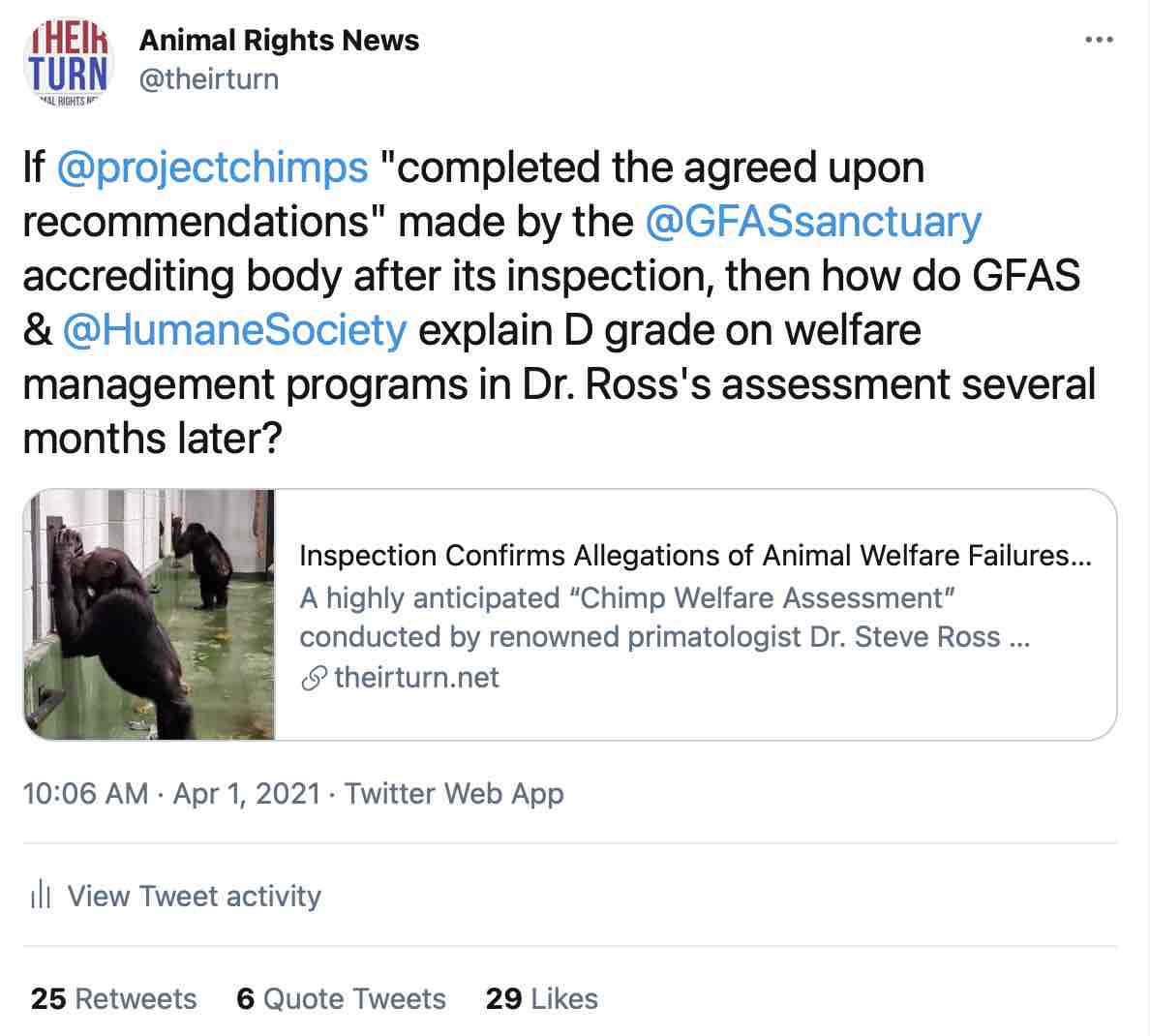
Continued public pressure will ultimately compel HSUS to fix the systemic failures at Project Chimps, but shouldn’t HSUS have wanted to live up to its promise to provide a “great home for retired chimpanzees” in the first place?

Progress For Science, a Los Angeles-based animal rights group,  protests at the Santa Monica home The Humane Society of the United States board member Steven White over the mistreatment of animals at its Project Chimps sanctuary

Kanawha County woman recovering from hunting accident

Exposing the Big Game's avatarCommittee to Abolish Sport Hunting Blog

FacebookTwitterEmailSMSByMetroNews StaffApril 7, 2021 – 1:29 pm

CHARLESTON, W.Va.— A Kanawha County woman is recovering from a gunshot wound to the leg in what investigators describe as a hunting accident in Kanawha County.

The 30-year old victim from Clendenin was shot in the thigh around 9:30 p.m. Tuesday night. Reports indicate the woman was coyote hunting in a remote part of the county and leaned a 30-30 Winchester rifle against the side of her four-wheeler.

State Police indicated the rifle was cocked and apparently tipped over, discharged, and struck her in the leg. She was flown via HealthNet to the Charleston Area Medical Center and is undergoing treatment today.

The West Virginia Division of Natural Resources Police have also been called in to investigate the incident.

View original post

New York lowers bear and deer hunting age to 12 in state budget

Exposing the Big Game's avatarCommittee to Abolish Sport Hunting Blog

https://www.foxnews.com/great-outdoors/new-york-lowers-big-game-bear-deer-hunting-age-12

21 hours ago

Junior hunters between the ages of 12 and 13 will be able to participate in big game hunting

ByCortney Moore| Fox News

https://static.foxnews.com/static/orion/html/video/iframe/vod.html?v=20210405182002#uid=fnc-embed-1

Fox News Flash top headlines for April 6

Fox News Flash top headlines are here. Check out what’s clicking on Foxnews.com.

New Yorkstate’s finalized budget for the fiscal year of 2022 says junior big gamehuntingwill be expanded to pre-teens as young as 12-years-old.

In a sub-section titled “Expand Hunting and Crossbow Licensing,” the state’sExecutive Budget Briefing Bookclaims: “The Budget includes expanding the existing crossbow season and increasing the pool of possible big game hunters to 12- and 13-year olds to encourage and expand outdoor recreation.”

9-YEAR-OLD MISSOURI HUNTER SHOOTS HUGE BUCK

The expansion of big game hunting in New York will reportedly generate revenue for the state from licensing fees.

View original post 383 more words

New Research by Born Free USA Calls for End to Trapping as Crushing Cruelty is Uncovered

Exposing the Big Game's avatarCommittee to Abolish Sport Hunting Blog

https://finance.yahoo.com/news/research-born-free-usa-calls-110000078.html

Tue, April 6, 2021, 4:00 AM·4 min read

WASHINGTON,April 6, 2021/PRNewswire/ — Leading animal welfare nonprofitBorn FreeUSAhas today launched a comprehensivereport on animal trappinginthe United States, amending and updating work carried out in 2017 and providing each state with a score out of 100 based on its action to protect animals from cruel trapping. Only two states scored above 50/100, and almost half of the states scored just 25/100 or under. The findings present a sobering insight into this practice, which causes suffering and death to millions of animals each year. In addition to inadequate regulation, Born Free found traps, including those that are illegal to use in all 50 states, to be widely available for sale without restriction on online e-commerce platforms such as Amazon. The organization is calling for a ban on such sales, and a complete regulatory overhaul of trapping nationwide —…

View original post 551 more words

Seaspiracy Response: Here’s What NGOs & Other Organizations Are Saying About The Documentary, Plus Our Take

ALT PROTEINANIMAL RIGHTSBIODIVERSITYBy Sonalie Figueiras Published on Apr 6, 2021 Last updated Apr 6, 2021

9 Mins Read

Seaspiracy premiered on Netflix less than two weeks ago. Just four days after it was released, it had already made it to the Top 10 lists on Netflix in more than 32 countries, including the U.K. and the U.S. Netflix does not release viewing numbers often (or in most cases, at all) but we can take this as a strong indication that the film is getting a lot of viewing traction. The documentary is also getting its fair share of blowback. A barrage of criticism from NGOs, marine biologists, scientists, fisherpeople, fishing industry heads and social media commentators suggest that the film is too (Redditors are having a field day). Below, we dive into the backlash, starting with the responses from the various organizations depicted in the film.

Marine Stewardship Council (MSC)

Overally, MSC’s statement is rather mild, given how they are portrayed in the film (or not portrayed)- remember that they did not answer calls or requests for interviews and . The gist of their response is that sustainable fishing is very much what they believe the world needs.

“While we disagree with much of what the Seaspiracy documentary-makers say, one thing we do agree with is that there is a crisis of overfishing in our oceans. However, millions around the world rely on seafood for their protein needs. With the global population set to reach 10 billion by 2050, the need to harness our natural resources more responsibly is more urgent than ever. Sustainable fishing has a vital role to play in securing those resources.”

Plastic Pollution Coalition

Their statement is on the shorter end and mostly involves disputing the film’s representation of their funding and highlighting that both Greenpeace and Sea Shepherd Conservation Society are members of their Coalition.

“Plastic Pollution Coalition is not funded by Earth Island Institute or working with other projects of Earth Island Institute to support the commercial fishing industry. Plastic Pollution Coalition has a small but mighty staff supporting a growing global alliance of more than 1,200 organizations, businesses, and thought leaders in 75 countries working toward a world free of plastic pollution and its toxic impacts on humans, animals, waterways, oceans, and the environment.”

April 6 2020 Update: the above statement was taken on March 28th. The response page has since been updated with a more complete list of Q&As about the film above the original response, included one about their relationship to Earth Island Institute:

“We are not funded by Earth Island Institute; rather, we pay Earth Island Institute to run our human resources and payroll for our small and mighty staff of 9 people. Our work is in no way dictated by Earth Island Institute.”

Oceana

Oceana’s statement, fairly concise as well, mostly focuses on their policy victories and disputes the movie’s conclusion- they believe coastal communities need to consume fish for survival.

“We believe people have the right to choose what they eat, and we applaud those who make personal choices to improve the health of our planet. However, choosing to abstain from consuming seafood is not a realistic choice for the hundreds of millions of people around the world who depend on coastal fisheries – many of whom are also facing poverty, hunger, and malnutrition. Oceana campaigns to save the oceans for both the people who depend on them and to protect the marine animals (and other forms of life) who live in them.”

Will McCallum of Greenpeace

This article is not presented as a response to Seaspiracy, in fact the movie is not referenced at all. Still, given the arguments presented and the publication date (Mar 23 2021), it’s reasonable to infer that it’s meant to engage with the discussion. McCallum, who is Head of Oceans at Greenpeace, elaborates on the problem of overfishing that he has seen first hand, while underlining that populations in the Global South that rely on fishing for their livelihood must be supported.

“During my time as an oceans campaigner at Greenpeace, I’ve sat in a tiny boat in the middle of the Indian Ocean, watching a fishing boat pull in miles of drift nets.  The nets were full of tuna, but there were also dead spinner dolphins, manta rays, thresher sharks and more – a grim demonstration of devastation at sea. I’ve been right up close with some of the biggest fishing vessels in the world, watching as they haul out incomprehensible numbers of fish.”

“For years, Greenpeace has been telling our supporters that eating less fish and eating a more plant-based diet is key for ocean health. But campaigning for a blanket ban on fishing would undermine the rights of people worldwide who depend on the oceans for their food and livelihoods and who are in desperate need of allies prepared to speak up on their behalf.”

Earth Island Institute (Dolphin Safe)

Earth Island Institute, which manages the Dolphin Safe label that was harpooned in the film, issued a statement on behalf of their International Marine Mammal Project, which in their own words “worked assiduously for the protection of marine mammals for more than 40 years” backing their Dolphin work.

“David Phillips, director of the International Marine Mammal Project stated, ‘The dolphin-safe tuna program is responsible for the largest decline in dolphin deaths by tuna fishing vessels in history. Dolphin-kill levels have been reduced by more than 95 percent, preventing the indiscriminate slaughter of more than 100,000 dolphins every year.’

Phillips added, ‘While covering critical topics, Seaspiracy unfortunately does a disservice to a number of organizations that are doing critical work to protect oceans and marine life. It’s no surprise that the New York Times panned the film for entrapping interviewees with leading questions and getting lost in a sea of murky conspiratorial thinking.’ “

Global Aquaculture Alliance (GAA)

The Global Aquaculture Alliance, which later this year will become the Global Seafood Alliance given its work around wild fisheries as well as farmed setups, was not directly named in the film, though it has responded to Seaspiracy by inviting Tabrizi and Kip Anderson, the movie’s executive producer to join them in a roundtable debate, a gesture worth applauding.

“In light of the documentary “Seaspiracy,” released on Netflix on March 24, GAA invites director Ali Tabrizi and executive producer Kip Anderson to join the nonprofit organization’s responsible-seafood journey by participating in its upcoming discussion on social accountability as part of its series of GOAL 2021 virtual events.”

GAA says “is committed to continually raising the bar on social accountability through the adoption of standards and certification demonstrating best practices in aquaculture and fisheries as well as through its pre-competitive education and advocacy work.”

What should you believe?

Now you’ve got a handle on the other side of the story. Here’s the gist of most of the arguments and statements: the film raises important issues about illegal overfishing, but it’s wrong to insist that there is no such thing as sustainable fishing and many low income communities rely on fishing for subsistence. Further, the more angry commenters and debaters add that it’s elitist to ask people to convert to veganism, and that the film is one-sided in its arguments.

Our take on the above:

  • If you don’t like the film, that’s your right. However, do make sure you have actually watched it before you critique it.
  • Do your own homework- you don’t have to believe Tabrizi and the Seaspiracy producers, but don’t blindly believe the NGOs and other interested parties either. Everyone has an agenda (and most of the most ardent critiquers make their money from, your guessed it, fishing). Tabrizi’s agenda may be to promote veganism. He is not hiding this.
  • Almost every single headline mentioned in the film has been reported on before. You can check out this Green Queen article from 2019: 10 Reasons Why You Should Reconsider Eating Fish & Seafood– it’s nothing new.
  • The film is one-sided, this is a fact. For the better part of the last few decades, we have been fed the other one-sided side, aka the fishing industry’s story.
  • Veganism is an all encompassing lifestyle choice based first and foremost on compassion for all beings. This includes fish and marine wildlife. End of story.
  • As a consumer, you likely have very little oversight into whether the fish you are eating is 1) mercury & heavy metal free, 2) was fished without marine bycatch, 3) is actually the species you believe it to be, 4) was fished legally and without any slave/indentured labor and 5) was partially responsible for any fishing gear debris left in the ocean. If you feel you can be sure on all these points, then by all means, go ahead and consume fish. If not, reduce as much as you can.
  • It’s taken many years and relentless work by experts and activists (including films such as Cowspiracy), but finally people are starting to reduce their meat consumption. The problem? They are turning to fish instead. If this film helps stem this tide, it’s a net positive.
  • As for aquaculture, here’s a recent report about salmon farming and the US$47 billion in losses the sector has incurred since 2013– remember, the global fishing industry is subsidized to the the tune of US$38 billion per year.
  • The argument that the film is looking to punish low-income coastal fishermen communities is a stretch- quite on the contrary, the Somali pirates segment does the opposite, illustrating how industrial overfishing led poor fishermen to lives of crime. This seems like an easy way for those with industrial fishing agendas to discredit it and on the whole, rings hollow.

Famous last words: Captain Paul Watson

Captain Paul Watson founder of Sea Shepherd Conservation Society and a human who has spent 60 years of his life at sea may deserve the last word here:

“Predictably, the successful release of Seaspiracy on Netflix is receiving some criticism from the usual subjects. That was expected, but it really is not all that important. Many documentaries that I have been involved with over the years have been met with similar negativity and vitriol. […] Seaspiracy as a film is what it is, a message transmitted by a medium to provoke discussion and to expose and illustrate a global problem and as such it is both powerful and influential and most importantly thanks to Netflix it is reaching millions and trending phenomenally. […] Filmmaking is storytelling. It’s meant to be emotive. It’s designed to captivate viewers and to entice discussion and controversy. If people are talking about it that means it’s a success. If people are criticizing it, that means it is having an impact. If some people are condemning it, that means that some people are threatened by it. Personally, I don’t care if there are scientists and industry people who dislike the film. I don’t need bio institutes and P.R. firms to lecture me on something I have seen and witnessed with my own eyes over the last 60 years. There is no such thing as a sustainable fishery. That is my considered observation based on 60 years of experience. Phytoplankton populations in the sea have been reduced by 40% since 1950 and that is probably the most important validated scientific fact to be concerned about. (Source: Scientific American). Life in the Ocean is being diminished and that diminishment is escalating. I’m not surprised that there are many who wish to deny this just as there have been many quick to deny climate change. Change comes about through stories and in today’s world, the most powerful communication medium is film. […] If they [the critics] want to make a film with what they consider to be “real” science they should do it. […] This film despite the naysayers and the critics is a critically acclaimed success and that is a fact. It is a weapon of revelation and it is influencing millions and it needs to be built upon and not dismissed or belittled, especially by people who profess to care about marine ecology. The Ocean does not have time for the justifiers, the appeasers and the complainers. Right now, the Ocean needs activists more than scientists.

Read Captain Watson’s full statement on his Facebook page.


Lead image courtesy of Seaspiracy.

Commercial Fishing is an Abomination

By Captain Paul Watson

There is no such thing as a sustainable commercial fishing industry. Over 2 trillion fish are taken from the sea every year and that figure does not include the 120 billion killed on fish farms. This kill is far larger than the estimated 65 billion animals slaughtered each year for meat and fur. The critics of Seaspiracy are trying to say that fishing can be sustainable and necessary by pointing to artisanal and indigenous communities suggesting that the film is racist. That is a ridiculous accusation. The film is directed at the reality of industrialized commercial fishing. The fishermen in their tiny boats in the waters off Africa or India are not the problem. In fact they are the victims of the problem as industrialized highly technological ships plunder their seas for profit. Traditional artisanal fishing communities in the Southwest coastal province of Kerala have long suffered from the mechanized vessels funded by Norway.

Commercial Norwegian fishing off India forced hundreds of thousands of Indians into poverty with the result that today Norway, the 2nd largest exporter of fish in the world (And the world’s No. 1 killer of whales) is a major exporter of fish to India. By destroying artisanal fishing, Norway reduced competition in India and increased their export sales to India.

Norway is also the world’s largest producer of farm raised salmon. Pirate fishing is also a major problem and many of these illegal operations are funded by companies in Spain and China and untraceable trans-shipping of fish at sea makes it difficult to track fish catches. Who are the pirates of Somalia? Why is piracy becoming a problem now in the West African Gulf of Guinea? The answer is desperate artisanal fishermen forced into piracy by the depredations of the highly efficient illegal operations by Europe and Asian commercial fisheries.

When consumers order fish on the menu or buy it from the market they are supporting the destruction worldwide of marine eco-systems. They are supporting the impoverishment of artisanal and indigenous communities. They are supporting slavery and the murder at sea of observers and rebellious slaves. When consumers eat meat or wear fur they are also supporting the destruction of marine eco-systems and slavery because some 40% of fish caught are rendered into fishmeal to feed chickens, pigs, domestic salmon and farm raised fur-bearing animals. Additionally 2.4 million tons of wild fish caught each year is used directly for cat food.

This is more fish for cats than consumed by all four species of seals ((Harp seals (Phoca groenlandica), Hooded seals (Cystophora cristata), Grey seals (Halichoerus grypus) and Harbour seals(Phoca vitulina) in the waters of the Northwestern Atlantic Ocean. Chickens and pigs eat more fish than all the world’s puffins and albatross. This translates into a world out of balance and the antithesis of the word sustainable.In recent years the use of the words “sustainable” or “sustainability” has increased as species and eco-systems are depleted. It is the green-washing or blue-washing term of choice by the commercial fishing industry.

In 2021, no self respecting environmental NGO should be justifying, rationalizing and enabling commercial fishing operations. If they do so they are in willful denial of the reality of the threats to survival of life in the sea and on land.Since 1950, the seas have lost 40% of phytoplankton populations (Source: Scientific American). from pollution and diminishment of the nutrient base provided by marine life. Phytoplankton provides up to 70% of the oxygen in the air that sustains all life.

The Ocean is the life support system of this planet. Yes it provides food (Far too much for us and far too less for other species) but more importantly it provides oxygen and regulates climate and temperature. This life support system is maintained by a crew of living beings and we the human passengers feasting merrily and ignorantly oblivious at the table are murdering and consuming the crew that sustains this life support system.

NYS budget update: Minimum age for hunting deer with firearm, crossbow drops from 14 to 12

Exposing the Big Game's avatarCommittee to Abolish Sport Hunting Blog

https://www.newyorkupstate.com/outdoors/2021/04/nys-budget-minimum-age-for-hunting-deer-bear-with-firearm-crossbow-drops-from-14-to-12.html

Updated Apr 06, 4:30 PM;Posted Apr 05, 4:33 PM

2020 Columbus Day Weekend Youth Firearms Hunt
Alex Taylor, 15, shot this spike buck on Saturday during the Youth Hunt Weekend, while hunting with her father, Eric, in Whitehall in Washington County. She shot it with 243 rifle.

Facebook ShareTwitter Share4,424sharesByDavid Figura | dfigura@nyup.com

Editor’s note: This story originally noted the legislation would include hunting for both deer and bear. In it’s current form, the change would only apply just to deer hunting.)

The final version of New York State budget for the coming year, which could be approved this week, includes a provision lowering the minimum age for hunting deer with a firearm or crossbow from age 14 to 12.

The legislation entails a two-year pilot program that takes effect June 1 and expires Dec. 31, 2023. The change will impact most of the state, excluding Long Island, New York City and Westchester County.https://4d2df21a0d84c1089aed956da047dbbc.safeframe.googlesyndication.com/safeframe/1-0-38/html/container.html

Another…

View original post 612 more words

Yellowstone bison migration minimal; hunter kills down, trapping paused

Exposing the Big Game's avatarCommittee to Abolish Sport Hunting Blog

https://www.kpvi.com/news/regional_news/yellowstone-bison-migration-minimal-hunter-kills-down-trapping-paused/article_89ce3446-67fe-5c5c-9c3c-1bf04ae7b98c.html

  • BRETT FRENCH french@billingsgazette.com
  • Apr 4, 2021UpdatedApr 5, 2021
  • 4 min to read

1of 5

Fewer Yellowstone National Park bison migrated out of the park this winter meaning hunters had fewer chances for success and the park staff decided not to trap any for slaughter.

  • RYAN BERRY, Billings Gazette

The remnants of a bison hunt outside Yellowstone National Park near Gardiner lie in the sun after being picked clean by birds and at least one grizzly Wednesday, March 31.

  • RYAN BERRY, Billings Gazette

A Yellowstone ranger and an employee from the Department of Livestock watch from a cliff overlooking a herd of elk near the Yellowstone National Park boundary as tribal hunts near Gardiner continued.

  • RYAN BERRY. Billings Gazette

A post marks the northern boundary of Yellowstone National Park near Beattie Gulch, signifying one edge of the area where bison hunters can take down their prey.

  • RYAN BERRY, Billings Gazette

View original post 1,091 more words

Two sentenced for hunting violations in Licking County

Exposing the Big Game's avatarCommittee to Abolish Sport Hunting Blog

https://www.newarkadvocate.com/story/news/2021/04/05/two-sentenced-hunting-violations-licking-county/4851807001/

Michaela SumnerNewark Advocate

.

NEWARK – The following people were sentenced for misdemeanor offenses in Licking County Municipal Court. The Advocate publishes sentences where court costs and fees exceed $500 and sentences with jail time of any kind.

Lucas E. Glandon, 36, of Dayton, hunting license violations, failure to check deer, illegal possession of deer, $875.

Nathaniel A. Butterworth, 35, of Tipp City, deer and turkey permit, hunting license violations, and wild animal violations, $520.

Christopher Mobley, 33, of Columbus, domestic violence, $528 and 180 days in jail with 178 suspended and credit for two, and a year of probation.

Michael R. Bratton, 40, of Etna, criminal damaging/endangering and criminal mischief, $738.75 and 30 days in jail with 30 suspended and a year of probation.https://6162b3f831d1a12808b3078d517ca08c.safeframe.googlesyndication.com/safeframe/1-0-38/html/container.html

Randall Ruppersburg, 62, of Newark, aggravated menacing, $598.30 and 90 days in jail with 90 suspended and a year…

View original post 229 more words

Your Diet Is Cooking the Planet

https://www.theatlantic.com/health/archive/2021/04/rules-eating-fight-climate-change/618515/

But two simple changes can help.ANNIE LOWREY6:00 AM ET

A woven bag containing carrots, apples, two oranges, and some greens, against a lavender background
GETTY

What’s for dinner?

https://www.theatlantic.com/health/archive/2021/04/rules-eating-fight-climate-change/618515/

On a planet wracked by rising seas, expanding deserts, withering biodiversity, and hotter temperatures, that’s a fraught question to answer. Food production accounts for roughly a quarter of the world’s greenhouse-gas emissions, and scientists have found that limiting global warming will be impossible without significant changes to how the world eats. At the same time, climate change is threatening the world’s food supply, with land and water being exploited at an “unprecedented” pace.  

A new guide to living through climate change

The Weekly Planet brings you big ideas and vital information to help you flourish on a changing planet.Join the Newsletter

Reforming the food system to save the planet is going to require new corporate practices, and new laws and regulations at the national and international levels. But individual consumer behaviors matter as well—more than you might think. Your diet is likely one of your biggest sources of climate emissions. But what should you do? Eat locally? Get your food from small-scale farmers? Choose organics and fair trade? Avoid processed foods? Eat seasonally?

The choices are many; the stakes are high. But experts on land use, climate change, and sustainable agriculture told me that two habits tower above all others in terms of environmental impact. To help save the planet, quit wasting food and eat less meat.

The conservation nonprofit Rare analyzed a sweeping set of climate-change mitigation strategies in 2019. It found that getting households to recycle, switch to LED lighting and hybrid vehicles, and add rooftop solar systems would save less than half the carbon emissions combined than would reducing food waste and adopting a plant-based diet.

Let’s begin with the role of food waste. Americans waste a lot of food. Nearly one-third of it, in fact. More than 130 billion pounds a year, worth roughly $160 billion. We throw away enough food to close our own “meal gap” eight times over. Food is the single biggest component of our country’s landfills, and the average American sends more than 200 pounds of food there every year. More than 1,250 calories per person a day, or more than 140 trillion calories a year, get tossed in the garbage.

Households, not restaurants or schools or corporate cafeterias, are the dominant wasters. The problem is worse in the United States than in most other countries, and it has worsened over time. When you toss a spoiled chicken breast or moldy tomato into the trash, you’re wasting a greenhouse-gas-intensive product. You’re also sending it to a landfill, where it will emit methane.

Addressing food waste would be low-hanging fruit: The country could save money, emit less carbon into the atmosphere, alleviate the burden on landfills, reduce the number of animals subjected to life on a factory farm, and address its hunger crisis just by eating all the food it makes. Households consuming more of what they buy, and thus buying less, would have a major effect on the whole food system. Food suppliers would produce less to meet the country’s more efficient demand. Supermarkets would stock less food. Fewer trucks would need to run from plant to store. Fewer refrigerators would be needed in stores and industrial facilities to keep groceries cold. Fewer cows would fill up feedlots. Fewer acres of corn and soy would be grown to feed them.

How to do it? For one, get wise about expiration labels and quit throwing out perfectly good food. Research shows that nearly all Americans misinterpret date labels and toss their groceries out prematurely, for fear of food poisoning, and understandably so. Retailers and production companies use 50 different use by–type labels, and none is federally regulated, except for those on infant formula. sell by stamps tend to be for inventory management, and have nothing to do with food safety; best if used by and use by stamps tend to be about freshness and food quality, not whether you are about to enjoy a serving of mycotoxins. As a general point, most food is safe to eat as long as there is no evident spoilage, such as visible mold or an off smell. “Use your senses,” says Yvette Cabrera of the Natural Resources Defense Council, the conservation nonprofit, noting that those senses were refined through millennia of natural selection in no small part to help us figure out whether food is safe to eat.

SPONSOR CONTENT

What Makes Collaboration In Health Care Hard?

BI-LILLYhttps://d858d25b90763dc6b2a9f8f70ad934b6.safeframe.googlesyndication.com/safeframe/1-0-38/html/container.html

Experts also point to a series of simple, old-fashioned techniques households can use to ensure that they eat more of the food they buy. They amount to thinking like your Depression-era forebears, pretty much. Figure out appropriate portion sizes; eat your leftovers; store food in appropriate containers and at the right temperature; prepare and freeze perishables instead of letting them linger and go bad; and shop in your refrigerator and cabinet before you hit the store.

And when you’re at the store, there is one dietary change to consider that beats all others in terms of its climate impact. It is not eating locally or seasonally. It is not eating organic or fair-trade. It is not eating unprocessed foods or avoiding big-box and fast-food retailers. It is eating less meat. Roughly three-quarters of the world’s farmland is used to pasture livestock or raise crops to feed that livestock. That contributes to deforestation, destroys the planet’s natural carbon sinks, erodes the planet’s biodiversity, and uses up fresh water.

The main, mooing offender is beef. Cattle are responsible for roughly two-thirds of the livestock sector’s greenhouse-gas emissions, while beef and dairy products are responsible for about one-tenth of global emissions overall. Gram for gram, beef produces roughly eight times more greenhouse-gas emissions than farmed fish or poultry, 12 times more than eggs, 25 times more than tofu, and even more compared with pulses, nuts, root vegetables, bananas, potatoes, bread, or maize.

Beef is so bad for two reasons, Michael Clark, a scholar of food systems and health at the University of Oxford, explained to me. The first is that it takes a lot of inputs to produce beef as an output: about 20 kilograms of corn and soy protein to produce one kilogram of beef, he said. The second is that cows produce methane as they digest their food. “Other types of animals don’t do that,” he said. “And methane is a more potent greenhouse gas than carbon dioxide.”

Trading your rib eyes and cheesesteaks for lentils and tofu is one of the best things you can do as a consumer for the environment; if all Americans did, the country would be roughly halfway to hitting its Paris Agreement targets. Still, the all-or-nothing way the choice is often presented is a mistake. There is enormous acreage between the Atkins diet, or even the meat-heavy diet of the average American, and full-on veganism, which remains a niche lifestyle choice that few follow for long. Better all Americans cut meat consumption by 40 percent than 3 percent of Americans cut it out completely. Experts encourage taking small, meaningful steps to reduce your meat consumption, and trying to find some joy in doing it. Participate in Meatless Monday; try learning to cook dishes from a plant-heavy cuisine you like; offer a vegetarian option at work events; opt for dishes where meat plays a supporting, rather than leading, role.https://d858d25b90763dc6b2a9f8f70ad934b6.safeframe.googlesyndication.com/safeframe/1-0-38/html/container.html

After wasting less food and eating less meat, all other changes a person might make are marginal, experts said, among them eating locally, organically, and seasonally. Moreover, the climate impact of those food choices is in many cases contradictory. “I work in food, and it’s confusing for me,” Cabrera, of the NRDC, told me. “Is this lettuce better than this lettuce? Consumers are faced with so many choices, and it is really hard to know.”

Humanely raised, local meat, for instance, can produce more emissions than meat coming from a concentrated industrial operation, Clark told me. Cows in concentrated animal-feeding operations are generally slaughtered at 12 to 18 months of age, while cows raised exclusively on pastures typically live twice as long. “The cow that lives for longer is going to emit more methane over the course of its lifespan,” he said, though he added that there were still compelling reasons to opt for the local beef.

Similarly, growing a given amount of organic produce usually requires more emissions and acres of land than growing the same amount using conventional farming methods. One study conducted in Sweden, for instance, showed that organic peas and wheat have a bigger climate impact than their conventionally farmed cousins.

That said, when it comes to the emissions related to shipping food around the world, experts argue that—surprisingly—local is not always better. There’s a certain uncanny decadence to eating Peruvian avocados and Chinese grapes in the dead of winter, or opening a bottle of French Beaujolais or a package of Scottish smoked salmon at will. But transporting food around the world tends to make up only a small share of a given product’s total greenhouse-gas emissions. What you are eating and how it was farmed is far more important than how it got to you, and imported food typically has a low carbon impact.

For all that, experts said there are good reasons to opt for organic, locally produced, seasonal food, even if it might not be as efficient to produce, or might not have the lowest greenhouse-gas emissions. Many smaller-scale operations outside Big Ag produce food without pesticides, without monoculture, with manure instead of chemical fertilizers, and with respect for biodiversity and soil health. Those are all important facets of environmental preservation too.

Complicating things, what’s good for the environment isn’t always what’s good for animal welfare. When it comes to eating animals, “unfortunately, the cruelty scale is the flip of the emissions scale,” Leah Garcés, the president of Mercy for Animals, a nonprofit that advocates for better conditions for animals raised in industrial environments, told me. A family can easily eat a chicken in a single night, but might struggle to eat a whole cow over the course of a year. Moreover, transportation and processing is much rougher on birds, which have delicate bodies. (Each year, more than 1 million chickens die en route to slaughter, and half a million are not actually dead when they hit the scalding tank.) For these reasons, a chicken breast represents much more suffering than a steak, even though the steak is worse for the planet. But the fact remains: The fewer animals you eat, the fewer die, and the better off the planet is.https://d858d25b90763dc6b2a9f8f70ad934b6.safeframe.googlesyndication.com/safeframe/1-0-38/html/container.html

Diets that are good for the planet tend to be good for people too. Research by Clark and his colleagues has shown that foods associated with good health generally have low environmental impacts, “indicating that the same dietary transitions that would lower incidences of noncommunicable diseases would also help meet environmental sustainability targets.”

Our diets are cooking the planet, and changing them, even in small ways, might help avert catastrophe. A burger for lunch, a bag of wilted greens in the trash—these may not be as obviously destructive to the environment as a private jet or a gas-guzzling car. But they are choices we make daily, and they matter.