Updated March 26, 2021: Thank you to everyone who contacted Sik Gaek restaurant in Queens, New York, to ask it to stop serving live octopuses and lobsters. Before disabling its Facebook page, the restaurant posted, “Sikgaek is no longer available for live octopus. We decided not to serve octopus and lobster alive.” We hope this is the truth and that this abject cruelty won’t simply be available “off menu.” Rest assured, we’ll be watching, and we hope you will, too.
Original post:
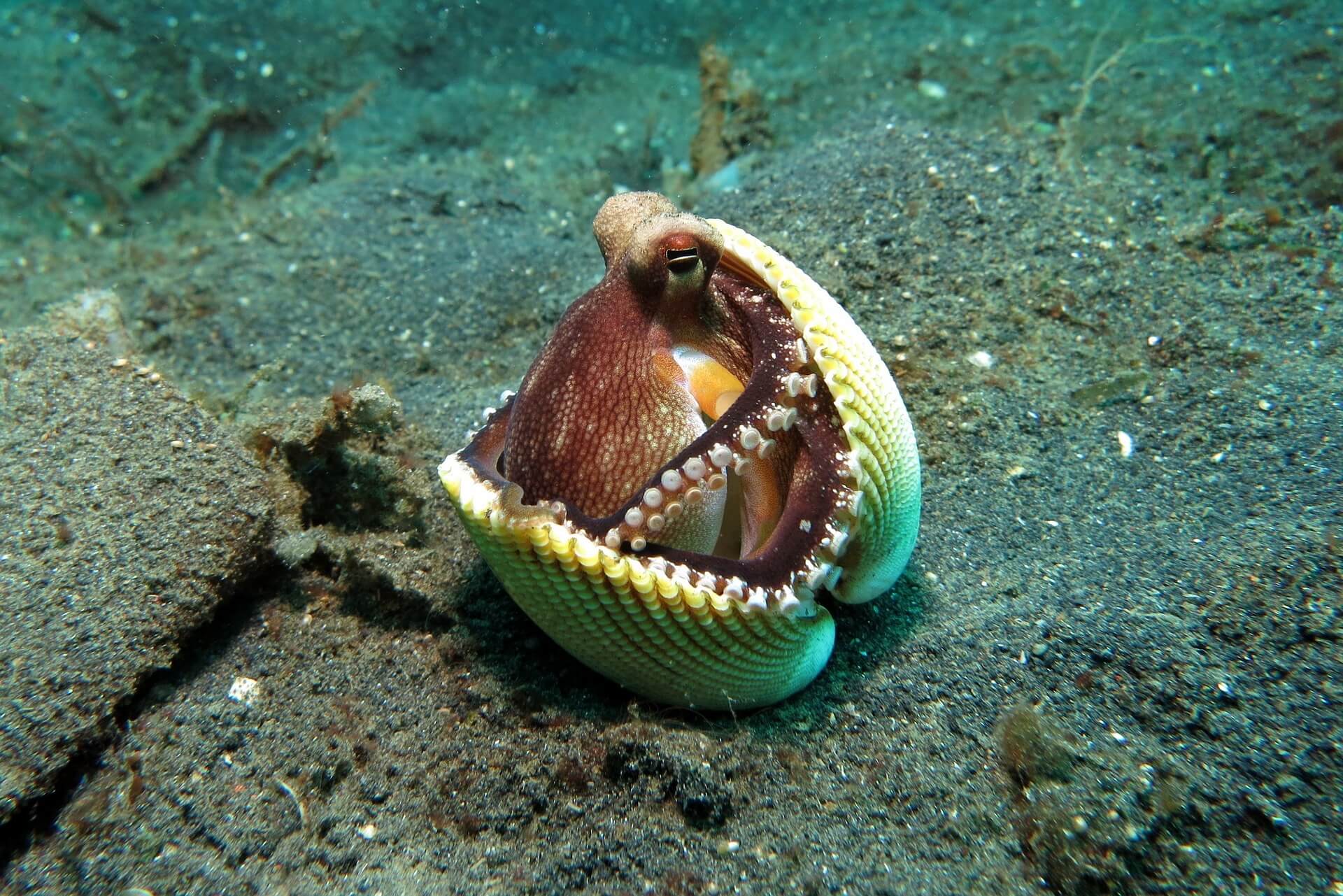
The intelligence of octopuses is well known, but did you know that they have been observed decorating their homes with pretty bits of glass, shells, and bottle tops? They’ve also been seen using tools and playing games! Octopuses have extremely sensitive skin for both touch sensation and chemical recognition. Their suckers are the equivalent of a tongue or fingertip, and the linings are regularly shed to maintain sensitivity to touch and taste. These brilliant beings are like us in so many ways that for most people, the thought of eating one alive is unimaginable.
However, Sik Gaek in Queens, New York, has for years insisted on serving octopuses and lobsters—another complex, misunderstood species also known to have the ability to experience great pain—still squirming on dinner plates, to those customers who find slowly hacking apart living, suffering animals to be appetizing. The restaurant even brags about this horrific practice on its website.
Please feel free to use our sample letter, but remember that using your own words is always more effective.
House Bill 367would protect trapping under the Montana Constitution.
Hunting and fishing are already included in the Montana Constitution.
Trapping is brutal treatment of Montana’s wildlife.
Over 80 years ago, preservationist Rosalie Edge described steel leg-hold traps as torturing animals before killing them. I have personally come across several wild animals in traps, and these horrific images still haunt me to this day.
This bill is a total power grab by trappers against the citizens of Montana. In 2016, nearly 186,000 Montana voters supported Initiative 177 to rid public lands of traps and snares. I-177 was an effort that involved many volunteers, including many hunters and anglers, and was primarily financed by Montanans.
The Montana Trappers Association, on the other hand, accepted big money from out-of-state organizations and individuals, and thus was able…
Montana Gov. Greg Gianforte said he should have known about a state-mandated certification class before trapping a wolf near Gardiner last month, an action for which he received a written warning.
BUNCOMBE COUNTY, North Carolina (WLOS) — There is a growing concern in the mountains over the safety of bears as the number of reported 3-legged bears grows. Private groups are now forming to investigate bear poaching and illegal activity to harm bears.
“I enjoy watching them,” said Col. Scotty Morgan talking about bears roaming through his Buncombe County yard.
Morgan says the bears are just a part of living in the mountains. “The bears live a hard life. They’re mischievous, they are really a lot like people,” said Morgan.
When he speaks of a hard life, Colonel Morgan knows what he is talking about. He was a prisoner of war in North Vietnam and knows what it is like to be locked up in…
UPDATE: Carson Tahoe Health has released the following statement regarding Steve Foley, a Registered Nurse, who died from an accidental gunshot during a hunting trip:
“Carson Tahoe Health is devastated by the untimely, accidental death of Steve Foley, RN. Steve was a much loved friend and stellar employee who worked with us for about 15 years, the last five years in the regional medical center Cath Lab. Our hearts are grieving with this tragic loss and he will be sorely missed. Our sympathies and prayers go out to Steve’s family and friends during this time of unimaginable suffering.” ***
ELKO, Nev. (AP) – Elko County sheriff’s officials say a Carson City man is dead after being accidentally shot by his friend on a hunting trip.
Covid-19, a virus that many experts believe came to us from bats, has been transmitted on from humans to pets and other animals. Here’s why some scientists are worried that so-called spillbacks could potentially perpetuate a cycle of infection. Photo: Markus Scholz/Zuma Press
Video Transcript
-What’s the common link between a gorilla, a cat, and us? All of these can be infected with the novel coronavirus. And what’s more worrying is that we, humans, can transmit the virus to these species and some others. Scientists around the world are testing all kinds of animals to study the so-called spillbacks of the virus that causes COVID-19 SARS-CoV-2.
The spillback is basically when an animal virus leaps from humans back to animals. Many scientists believe COVID-19 came over to us from wild animals.
-–infected, believed to be by an asymptomatic zookeeper.
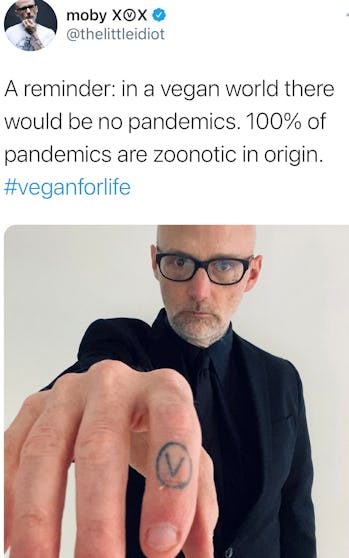
While it’s might be easy to dismiss his statement as a celebrity weighing in on a subject about which he has no expertise, it is reasonable to question how our relationship to animals might be contributing to pandemics. Our current pandemic, after all, is hypothesized to be the result of a virus that jumped from an animal species to humans — likely a bat.
It’s unquestionably true that our relationship to animals plays a big part in whether or not pandemics happen, Amesh Adalja, a senior scholar at the Johns Hopkins University Center for Health Security, tells Inverse. But it’s not the physical consumption of the animal that’s usually the problem, Adalja says — it’s how we live and how the animal ends up on our plate.
Moby’s controversial tweet on Tuesday ignited a debate about veganism.Moby
“It’s not getting a chicken sandwich from Chick-fil-A that’s causing bird flu to be an issue,” Adalja says. “It’s the way we raise it.”
As humans, we’re animals on a planet with other animals — it’s inevitable that we’re going to interact with species other than our own. “You can get bitten by a raccoon and get rabies, not because you were going to eat it, but just because you happened to encounter it in the wild,” Adalja says.
In fact, there are a number of really damaging diseases that have nothing to do with eating animals, even though those diseases can be transferred through animal vectors. For example, malaria is transmitted by mosquitos and Lyme disease is transmitted from deers to humans by ticks. It’s the “no pandemics” element of Moby’s message that’s the most incorrect.
CAN GOING VEGAN STOP ANIMAL DISEASE SPREAD?
What matters more than eating animals is how we’re interacting with animals.
Although it’s true that most of the recent diseases found in humans in recent decades are pathogens that jumped from animals to humans, there’s actually a lot that needs to go right in order for an animal borne-pathogen to become a human pandemic.
There are a few hurdles any pathogen needs to be able to accomplish before it becomes a pandemic in humans, Adalja explains.
It needs to be able to jump from an animal to a human effectively
Once in the human, it needs to cause some kind of disease
That disease needs to be contagious (humans have to be able to pass it to each other effectively)
Throughout history, there have been sporadic outbreaks that “came and went on their own” after a pathogen jumps from animals to humans, Adalja explains.
The difference now, he says, is how we live. And that’s more complicated than just whether or not we consume animals or animal products.
“As humans, we evolved to be omnivores,” Adalja says. “10,000 years ago, there were no vegans. There were also no pandemics.”
WHAT CAUSES PANDEMICS
Other than the fact that many humans still eat animals, everything else about how we live has changed since 10,000 years ago. We transitioned from a hunter-gatherer society to an agricultural society. We started having more people living in one place and population density begins to increase.
Adalja says that humans also, “started going to the bathroom where they lived and domesticating animals.” But even then, we didn’t start seeing the really big pandemics until industrialization.
“10,000 YEARS AGO, THERE WERE NO VEGANS. THERE WERE ALSO NO PANDEMICS.”
That doesn’t mean there were no plagues (the plague of Athens might have something to say). But even the Black Death in the mid-1300s was largely the result of population density, urbanization, and people interacting with each other more — not animal consumption.
Now, we’re more packed into spaces than we ever have been. And while our hygiene and understanding and treatment of diseases is infinitely better than it was in the 1300s, there’s one really big difference that adds to our pandemic risk: how small our world has become.
“An outbreak that happens on one side of the globe can get to the other side of the globe before you have even noticed it,” Adalja says. “And that’s what happened with Covid-19.”
Globalization, the rise of megacities, and increased population density have increased the rates and severity of pandemics more so than consuming animals and animal products, Adalja says.
IS THERE ANY LINK BETWEEN EATING MEAT AND PANDEMICS?
In some ways, yes. Our consumption of animals isn’t entirely unrelated to some pandemics, and, when it is related, it’s important to understand how we can change our behavior to minimize risk as much as possible.
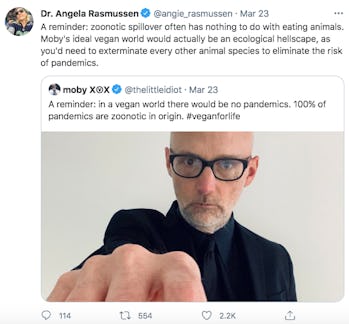
Dr. Angela Rasmussen, a virologist, responds to Moby.Angela Rasmussen
Some studies suggest we could further reduce our risk of some pandemics by changing the way we farm animals. This is especially true for influenza viruses stemming from birds. A 2008 study looking at biosecurity and farming explains, “The high throughput and confinement of highly concentrated animal populations increases the intensity of microbial exposures for farmers, their families, farmworkers, veterinarians, and others in contact with these operations.”
A different study from 2008 stresses the importance of biosafety measures and educating workers, especially poultry workers, about best practices. The study, published in Public Health Reports, concludes:
“Critical components of worker protection include educating employers and training poultry workers about occupational exposure to avian influenza viruses. Other recommendations for protecting poultry workers include the use of good hygiene and work practices, personal protective clothing and equipment, vaccination for seasonal influenza viruses, antiviral medication, and medical surveillance.”
Adalja agrees. “Most of the time, those transmission events can be minimized if you just actually practice biosafety,” he says. “That might mean if you’re butchering an animal, you’re washing your hands, or not doing it with open arms, or rubbing your eyes or doing whatever it might be.”
Global monitoring and transparency would also go a long way to preventing potential pandemics by stopping the disease locally before it has a chance to spread as much as Covid-19 did.
If you want to go vegan or have a primarily plant-based diet, there are plenty of environmental and health reasons to do so. Preventing pandemics isn’t really one of them.
Iowa reports 1,354,035 vaccine doses administered in the state, with 524,948 individuals completing the vaccination series. Find out how you can get vaccinated in Iowahere.
The state’s positivity rates continue to climb. Iowa’s 14-day positivity rate increased from 4.2% to 4.3% overnight. The 7-day rate moved from 4.7% to 4.8%. State data shows 4,389,556 COVID-19…
InShanna Swan’s new book, she details how pollution isleading to an “existential crisis” in fertility rates with a chemical used in plastics called phthalates leading to male babies being born with smaller or malformed penises, Sky Newsreported on Wednesday.



 Updated: 9:59 AM CDT Mar 26, 2021Infinite Scroll EnabledPlay VideoSHOW TRANSCRIPT


