A new “double mutant” variant of the coronavirus has been detected from samples collected in India.
Officials are checking if the variant, where two mutations come together in the same virus, may be more infectious or less affected by vaccines.
Some 10,787 samples from 18 Indian states also showed up 771 cases of known variants – 736 of the UK, 34 of the South African and one Brazilian.
Officials say the variants are not linked to a spike in cases in India.
India reported 47,262 cases and 275 deaths on Wednesday – the sharpest daily rise this year.
The Indian SARS-CoV-2 Consortium on Genomics (INSACOG), a group of 10 national laboratories under India’s health ministry, carried out genomic sequencing on the latest samples. Genomic sequencing is a testing process to map…
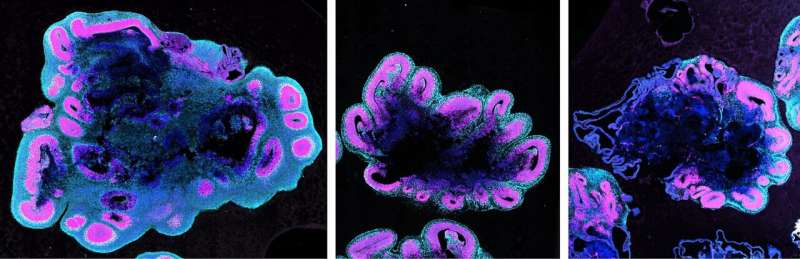
Human brain organoids grow substantially bigger than gorilla and chimpanzee (left to right). These brain organoids are 5 weeks old. Credit: S.Benito-Kwiecinski/MRC LMB/Cell
A new study is the first to identify how human brains grow much larger, with three times as many neurons, compared with chimpanzee and gorilla brains. The study, led by researchers at the Medical Research Council (MRC) Laboratory of Molecular Biology in Cambridge, UK, identified a key molecular switch that can make ape brain organoids grow more like human organoids, and vice versa.
The study, published in the journal Cell, compared ‘brain organoids’ – 3-D tissues grown from stem cells which model early brain development—that were grown from human, gorilla and chimpanzee stem cells.
Similar to actual brains, the human brain organoids grew a lot larger than the organoids from other apes.
Dr. Madeline Lancaster, from the MRC Laboratory of Molecular Biology, who led the study, said: “This provides some of the first insight into what is different about the developing human brain that sets us apart from our closest living relatives, the other great apes. The most striking difference between us and other apes is just how incredibly big our brains are.”
During the early stages of brain development, neurons are made by stem cells called neural progenitors. These progenitor cells initially have a cylindrical shape that makes it easy for them to split into identical daughter cells with the same shape.
The more times the neural progenitor cells multiply at this stage, the more neurons there will be later.
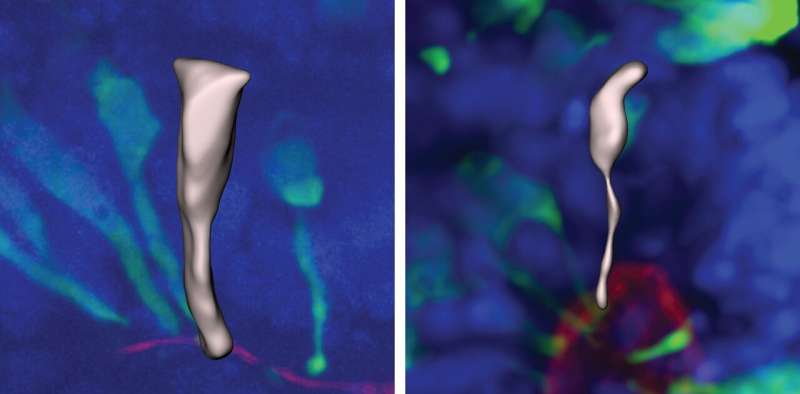
As the cells mature and slow their multiplication, they elongate, forming a shape like a stretched ice-cream cone.
Previously, research in mice had shown that their neural progenitor cells mature into a conical shape and slow their multiplication within hours.
Now, brain organoids have allowed researchers to uncover how this development happens in humans, gorillas and chimpanzees.
They found that in gorillas and chimpanzees this transition takes a long time, occurring over approximately five days.
After only 5 days, gorilla neural progenitor cells have matured into a conical shape (right), while human cells (left) remain cylindrical. Credit: S.Benito-Kwiecinski/MRC LMB/Cell
This difference in the speed of transition from neural progenitors to neurons means that the human cells have more time to multiply. This could be largely responsible for the approximately three-fold greater number of neurons in human brains compared with gorilla or chimpanzee brains.
Dr. Lancaster said: “We have found that a delayed change in the shape of cells in the early brain is enough to change the course of development, helping determine the numbers of neurons that are made.
“It’s remarkable that a relatively simple evolutionary change in cell shape could have major consequences in brain evolution. I feel like we’ve really learnt something fundamental about the questions I’ve been interested in for as long as I can remember—what makes us human.”
To uncover the genetic mechanism driving these differences, the researchers compared gene expression—which genes are turned on and off—in the human brain organoids versus the other apes.
They identified differences in a gene called ‘ZEB2’, which was turned on sooner in gorilla brain organoids than in the human organoids.
To test the effects of the gene in gorilla progenitor cells, they delayed the effects of ZEB2. This slowed the maturation of the progenitor cells, making the gorilla brain organoids develop more similarly to human—slower and larger.
Conversely, turning on the ZEB2 gene sooner in human progenitor cells promoted premature transition in human organoids, so that they developed more like ape organoids.
The researchers note that organoids are a model and, like all models, do not to fully replicate real brains, especially mature brain function. But for fundamental questions about our evolution, these brain tissues in a dish provide an unprecedented view into key stages of brain development that would be impossible to study otherwise.
The New Mexico Legislature (barely) passed the Wildlife Conservation and Public Safety Act, better known as Roxy’s Law, making some forms of trapping on public land a misdemeanor, effective April 1, 2022. That’s no April Fool’s joke: the law will not take effect for a year.
Any law outlawing any form of trapping is a step forward for wildlife, however small. But in a state with a poor history of law enforcement and a game department which promotes hunting and trapping, one might wonder whether this law will provide any real protection for dogs on hiking trails, the main motivation for passing the law, not to mention (as legislators and lobbyists rarely do) wildlife. The answer may be found in an obscure 1912 state law still on the books.
According to Section 17-2-20 NMSA 1978: “Every net, trap, explosive, poisonous or stupefying substance, or device used or intended for use in taking or killing game or fish in violation of this chapter is declared to be a public nuisance and may be abated and summarily destroyed by any person and it shall be the duty of every officer authorized to enforce this chapter to seize and summarily destroy the same and no prosecution or suit shall be maintained for such destruction.”
I am not an attorney, but my reading of this century-old law is that once Roxy’s Law takes effect, anyone has the legal right to seize or destroy a trap (such as a steel-jawed leghold trap) or a poisonous device (such as an M-44) found on public land. Moreover, conservation officers now have a legal duty to seize and destroy traps and poisons found on public land. Or to put it simply, New Mexicans will soon have the legal right to “steal traps.”
On March 11, U.S. Senator Cory Booker and U.S. Representatives Rosa DeLauro and Bennie Thompson (D-MS) reintroduced the Safe Line Speeds During COVID-19 Act, which would suspend all current and future waivers from the U.S. Department of Agriculture that allowed slaughterhouses to increase slaughter line speeds during the COVID-19 pandemic. While the successful passage of this bill could be an improvement over current conditions at many slaughterhouses, it is just a start.
Big Meat—like Big Oil, Big Tobacco, and Big Pharma—is a ravenous exploitation machine pursuing profits at any cost. It readily treats its workers, the public’s health, and the environment with the same sacrificial logic as it treats the billions of terrestrial animals it farms and kills every year.
It is clear that adequately addressing the harms of this industry requires ambitious policies that confront the problem head-on, such as banning the sale of meat altogether.
FACTORY FARMING AND ITS OPPONENTS
Industrial farms claim the lives of billions of animals around the globe each year to feed the global demand for meat.U.S. Meat Consumption Is Growing at an Alarming Rate:Despite an increasing number of companies producing meatless alternatives and growing interest among consumers in plant-based products, U.S. meat consumption is growing.
“As of 2017, America had the second-highest meat consumption in the world, surpassed only by Hong Kong,” writes Caroline Christen, who explores the questions: “How much meat do Americans eat, and what are the impacts of their meat consumption?” Factory Farming Is on the Rise, But Communities Are Fighting Back: “The number of animals being raised in intensive confinement has increased significantly in the last decade alone,” writes Claire Hamlett. “This uncontrolled expansion is now a major driver of environmental destruction and pollution and a significant threat to public health,”
Yet, in the face of the industry’s growth, communities are turning against factory farming and taking action. Why Protein Isn’t a Problem for Vegans: Among the most common questions vegans hear are, “How do you get your protein?” Yet, research shows that protein deficiency is not a problem among vegans.
Not only can vegans easily incorporate plant-based sources of protein into their diets, but Matthew Chalmers writes, “In the developed world, rather than failing to meet the daily requirement of protein, many exceed the necessary daily intake of protein by a substantial amount—the average intake of an American adult is around 90 grams of protein per day. This in itself can have bad outcomes for one’s health.” Can Veganism Help End World Hunger?: Although veganism alone cannot solve the problem of hunger around the world, which as Matthew Chalmers writes, is “an issue that primarily hinges around the distribution of food and not necessarily the creation of it,” it could be part of the solution.
“The widespread adoption of a vegan diet would have enormous positive implications for the globe, freeing up large quantities of land and producing more food with fewer resources,” writes Chalmers. Read more from Sentient Media.We are reporting the truth about secretive animal agriculture. Your donation fuels our work.
The industry’s cruel response to the COVID-19 pandemic has in many ways highlighted the extent to which it is willing to sacrifice its workers.
Just as the industry has become a leader in human rights violations and public health threats, so too has it become one of the most significant threats to the environment. Commonly cited reports from the UN Food and Agriculture Organization estimate that Big Meat contributes anywhere between 14.5 percent and 51 percent of global greenhouse gas emissions.
Given both the quantity and quality of these collective harms, it is not a stretch to say that the animal industrial complex’s hyper-externalization of all these costs onto the public and the environment has brought us to the brink of multiple disasters.
NEW YORK—Responding to recent events on Earth, God, the omniscient creator-deity worshipped by billions of followers of various faiths for more than 6,000 years, angrily clarified His longtime stance against humans killing each other Monday.
“Look, I don’t know, maybe I haven’t made myself completely clear, so for the record, here it is again,” said the Lord, His divine face betraying visible emotion during a press conference near the site of the fallen Twin Towers. “Somehow, people keep coming up with the idea that I want them to kill their neighbor. Well, I don’t. And to be honest, I’m really getting sick and tired of it. Get it straight. Not only do I not want anybody to kill anyone, but I specifically commanded you not to, in really simple terms that anybody ought to be able to understand.”
Worshipped by Christians, Jews, and Muslims alike, God said His name has been invoked countless times over the centuries as a reason to kill in what He called “an unending cycle of violence.”
“I don’t care how holy somebody claims to be,” God said. “If a person tells you it’s My will that they kill someone, they’re wrong. Got it? I don’t care what religion you are, or who you think your enemy is, here it is one more time: No killing, in My name or anyone else’s, ever again.”
The press conference came as a surprise to humankind, as God rarely intervenes in earthly affairs. As a matter of longstanding policy, He has traditionally left the task of interpreting His message and divine will to clerics, rabbis, priests, imams, and Biblical scholars. Theologians and laymen alike have been given the task of pondering His ineffable mysteries, deciding for themselves what to do as a matter of faith. His decision to manifest on the material plane was motivated by the deep sense of shock, outrage, and sorrow He felt over the Sept. 11 violence carried out in His name, and over its dire potential ramifications around the globe.Top ArticlesREAD MORESpring Breaker Not Going To Let Curfew Stop HimFrom Doing Whatever It Is He Does While Blackout DrunkSKIP AD
“I tried to put it in the simplest possible terms for you people, so you’d get it straight, because I thought it was pretty important,” said God, called Yahweh and Allah respectively in the Judaic and Muslim traditions. “I guess I figured I’d left no real room for confusion after putting it in a four-word sentence with one-syllable words, on the tablets I gave to Moses. How much more clear can I get?”
“But somehow, it all gets twisted around and, next thing you know, somebody’s spouting off some nonsense about, ‘God says I have to kill this guy, God wants me to kill that guy, it’s God’s will,’” God continued. “It’s not God’s will, all right? News flash: ‘God’s will’ equals ‘Don’t murder people.’”
Worse yet, many of the worst violators claim that their actions are justified by passages in the Bible, Torah, and Qur’an.
“To be honest, there’s some contradictory stuff in there, okay?” God said. “So I can see how it could be pretty misleading. I admit it—My bad. I did My best to inspire them, but a lot of imperfect human agents have misinterpreted My message over the millennia. Frankly, much of the material that got in there is dogmatic, doctrinal bullshit. I turn My head for a second and, suddenly, all this stuff about homosexuality gets into Leviticus, and everybody thinks it’s God’s will to kill gays. It absolutely drives Me up the wall.”
God praised the overwhelming majority of His Muslim followers as “wonderful, pious people,” calling the perpetrators of the Sept. 11 attacks rare exceptions.
“This whole medieval concept of the jihad, or holy war, had all but vanished from the Muslim world in, like, the 10th century, and with good reason,” God said. “There’s no such thing as a holy war, only unholy ones. The vast majority of Muslims in this world reject the murderous actions of these radical extremists, just like the vast majority of Christians in America are pissed off over those two bigots on The 700 Club.”
Continued God, “Read the book: ‘Allah is kind, Allah is beautiful, Allah is merciful.’ It goes on and on that way, page after page. But, no, some assholes have to come along and revive this stupid holy-war crap just to further their own hateful agenda. So now, everybody thinks Muslims are all murderous barbarians. Thanks, Taliban: 1,000 years of pan-Islamic cultural progress down the drain.”
God stressed that His remarks were not directed exclusively at Islamic extremists, but rather at anyone whose ideological zealotry overrides his or her ability to comprehend the core message of all world religions.
“I don’t care what faith you are, everybody’s been making this same mistake since the dawn of time,” God said. “The Muslims massacre the Hindus, the Hindus massacre the Muslims. The Buddhists, everybody massacres the Buddhists. The Jews, don’t even get me started on the hardline, right-wing, Meir Kahane-loving Israeli nationalists, man. And the Christians? You people believe in a Messiah who says, ‘Turn the other cheek,’ but you’ve been killing everybody you can get your hands on since the Crusades.”
Growing increasingly wrathful, God continued: “Can’t you people see? What are you, morons? There are a ton of different religious traditions out there, and different cultures worship Me in different ways. But the basic message is always the same: Christianity, Islam, Judaism, Buddhism, Shintoism… every religious belief system under the sun, they all say you’re supposed to love your neighbors, folks! It’s not that hard a concept to grasp.”
“Why would you think I’d want anything else? Humans don’t need religion or God as an excuse to kill each other—you’ve been doing that without any help from Me since you were freaking apes!” God said. “The whole point of believing in God is to have a higher standard of behavior. How obvious can you get?”
“I’m talking to all of you, here!” continued God, His voice rising to a shout. “Do you hear Me? I don’t want you to kill anybody. I’m against it, across the board. How many times do I have to say it? Don’t kill each other anymore—ever! I’m fucking serious!”
The gold standard for the measurement of drought in America is theU.S. Drought Monitor. It measures drought levels down to the state level. It shows that vast parts of the western United States have been hit by the worst drought in years and, in some cases, more than a century. Scientists have a plan to combat this, and it is not entirely new.https://www.dianomi.com/smartads.epl?id=3533
The Drought Monitor shows that much of Nevada, Utah, New Mexico and Arizona have the worst possible drought grade. This is labeled “exceptional drought,” and it “corresponds to an area experiencing exceptional and widespread crop and pasture losses, fire risk, and water shortages that result in water emergencies.” Some…
Mark McClean searches for deer in a foggy field near Mount Spokane on Nov. 15, 2019. A bill that would have increased hunting and angling fees for the first time since 2011 was not approved by the Washington Legislature.Spokesman-Review file photo by ELI FRANCOVICH
Washington wildlife managers will consider a passel of changes to hunting rules next week, including limiting whitetail hunting opportunity in Northeast Washington and allowing hunters to use dogs to track injured game animals.
The Washington Department of Fish and Wildlife commission meeting starts Thursday and ends Saturday with opportunity for public input throughout. The commission will vote on the proposals during its April meeting. The season-setting process happens every three years, with slight adjustments made year to year as needed.
The commission is also considering allowing 1x scopes on muzzleloading weapons and allowing hunters to shoot turkeys with rimfire rifles during the fall season, among other things.
Dogs tracking wounded game
The commission will also consider a proposal to allow hunters to use a dog to track injured game animals. If approved, the rule would allow the use of one dog, on a leash, to track an injured game animal within 72 hours of shooting it. Hunters would not be allowed to use dogs to track bears or cougars.
WDFW staff recommend the commission approve this proposal.
“A lot of hunters really like the idea, because you don’t want to lose a wounded animal,” Thorburn said.
Marie Neumiller, the Inland Northwest Wildlife Council’s executive director, said members of the Spokane-based group had concerns initially about the dog proposal. The organization, however, supports the proposal as presented.
“You’re cutting down on waste,” she said. “And you’re enabling that hunter to find that animal.”
1x scopes on muzzleloaders
Under current Washington hunting regulations, muzzleloading firearms must have open or peep sights. Some hunters, however, have petitioned the department to allow 1x scopes and red dot scopes on muzzeloading firearms.
The commission will consider allowing 1x and red dot scopes.
“One-power scopes do not magnify the target, but rather provide a clearer sight window, in much the same way eyeglasses correct someone’s vision (for example, they make the target clearer, but don’t make it bigger),” according to a WDFW rule-making publication on the topic. “Common arguments against their use are typically related to the use of scopes not adhering to the spirit of primitive weapons.”https://a04fa444d49f3821c59181a8582e5148.safeframe.googlesyndication.com/safeframe/1-0-37/html/container.html
WDFW staff is not opposed to the change because it would not “result in more animals being harvested.”
Some hunters are opposed to the proposed change because of the effect it would have on the primitive hunting season.
“Our membership generally wants to keep the traditional hunting devices as traditional as possible,” Neumiller said.
Turkeys and rimfire rifles
The commission will consider allowing hunters to shoot turkeys with rimfire rifles between Oct. 15 and Nov. 15. It’s illegal now to shoot a turkey with a rifle.
Some have petitioned WDFW to change the rule in efforts to control nuisance turkeys, Aoude said.
“As birds get smart, they’re just out of range of the shotgun,” he said. “This may give an opportunity to harvest a few more turkeys in those areas.” It would also allow hunters to hunt multiple small-game species with the same weapon.
Delay the start of forest grouse season
The commission will also consider shifting the start of forest grouse season. Under the proposal, the season would run from Sept. 15 to Jan. 15, which would delay the start by two weeks and add two weeks to the end. The proposed change is in response to long-term declines in the forest grouse population.
In September, brood hens are particularly vulnerable. Delaying the start of the season, biologists believe, may improve forest grouse populations by increasing the survival of brood hens.
“That may be a way to reduce the prevalence of the disease,” Aoude said.
The commission will consider two proposals for whitetail hunting in Game Management Units 101 (Sherman), 105 (Kellyhill), 108 (Douglas), 111 (Aladdin), 113 (Selkirk), 117 (49 Degrees North) and 121 (Huckleberry).
The Washington Department of Fish and Wildlife Commission will consider a number of hunting-rule proposals between March 25-27.
Commissioners will vote on the proposals during their April meeting.
The first option, which is supported by WDFW staff, would make no change to the current, any buck season structure in Northeast Washington. Since 2019, there has been no antlerless whitetail opportunity in Northeast Washington. That restriction happened after hunters expressed concerns about faltering whitetail populations following an outbreak of bluetongue in 2015 and severe winter conditions in 2016 and 2017.
The second proposal would change season dates in GMUs 105-121 to a nine-day late season occurring Nov. 11-19. The late season now runs Nov. 7-19.
A vocal group of hunters in Northeast Washington has pushed for antlerpoint restrictions in that region. Between 2011 and 2014, there was a four-point minimum for whitetail deer in GMUs 117 and 121, despite WDFW staff not supporting the move. WDFW returned to all buck season in 2015.
“It’s based on habitat manipulation,” she said. “It’s not dealing with natural biological stuff. It’s a lot of management, as it says.”
As part of the 2021-23 season-setting process, WDFW partnered with Washington State University and surveyed deer hunters in Washington. The survey was emailed to more than 44,000 hunters that reported hunting in GMUs with white-tailed deer. Approximately 13,000 responded.
Most respondents were unhappy with mature white-tailed buck opportunity in the state. Respondents also didn’t support implementing more restrictive regulations, according to WDFW. In particular, respondents were against a four-point restriction.
Anis Aoude, WDFW game division manager, doesn’t believe an APR would improve quality. But at the end of the day the decision to not include an antlerpoint restriction in the proposals was due to the lack of public support.
“If everyone thought that was the way to go, we would have done it,” he said.
Dale Magart, the secretary of the Northeast Washington Wildlife Group, is a proponent of antlerpoint restrictions. He believes the department will have to adjust the rules in the next three years.
“If it gets bad enough (hunter opportunity), they will have to address it,” he said. “We’re hoping when they do decide to do something that’s (four-point restriction) something they decide to do.”
Published:26/02/2021Updated:Saturday, 27 February 2021 8:33 am AEDT
Sydney driver’s incredible escape from burning car
The risk of human-to-human spread of the H5N8 strain of bird flu appears low after it was identified for the first time worldwide in farm workers in Russia, the World Health Organisation says.
A separate bird flu strain, H1N1, that spread rapidly worldwide among humans led the WHO to declare an influenza pandemic in 2009-2010.
The outbreak turned out to be mild among humans although deadly among poultry.
Russia registered the first case of a strain of bird flu virus named influenza A(H5N8) being passed to humans from birds and has reported the matter to the WHO, Anna Popova, head of consumer health watchdog Rospotrebnadzor, said on Saturday.
Seven people in Russia were found to be infected with H5N8 but all were asymptomatic following an outbreak on a poultry farm…
A tourist in a bathing suit wearing a mask is seen sitting on the sand of Caleta Beach, which has no restrictions amid the coronavirus pandemic, on March 19, 2021, in Acapulco, Mexico.
Len Lisenbee0:010:35https://imasdk.googleapis.com/js/core/bridge3.447.1_en.html#goog_103533461
It doesn’t happen often, but I do have some problems with the Department of Environmental Conservation from time to time. And based on what that organization is proposing for deer hunters, this is one of those times.
Real potentially dangerous times, if the truth be known.
It seems that big game hunter numbers are in a long-term decline. At the same time, the DEC points up that existing hunters should be given more opportunities to keep the deer population as close to “sustainable” as possible. Their reasoning is that keeping the animals in that range reduces damage to forest ecosystems and agricultural areas, and minimizes deer-vehicle collisions.
That is the overall “takeaway” from the DEC’s draft (proposed) 10-year deer management plan. (Note: you can read the entire 79 page document on the DEC’s website at dec.ny.gov/animals/7211.html).
Their “suggestions” for increasing the overall deer take include:
►Extending shooting hours from (to) 30 minutes before sunrise to 30 minutes after sundown.
►Permit crossbow use during the entire archery season (currently they are allowed only during the final two weeks before the opening of firearms hunting plus one week after).
►Lower the minimum age for youth hunters from 14 years to 12 years.
►Create tax incentives for landowners to allow public hunting on their property.