For Immediate Release: March 19, 2021Contact:Michelle Lute, Project Coyote, 406-848-4910, mlute@projectcoyote.orgMilestone moment for New Mexico’s animals“Roxy’s Law” to ban traps, snares, and poisons on public lands passes the New Mexico House; advances to the desk of Governor Michelle Lujan GrishamSANTA FE, N.M.—Last night, by a vote of 35-34, the New Mexico House of Representatives passed Senate Bill (SB) 32, the Wildlife Conservation and Public Safety Act, aka “Roxy’s Law,” sponsored by Senator Bobby Gonzales (D-Ranchos de Taos) and Senator Brenda McKenna (D-Corrales) in the Senate and Representative Matthew McQueen (D-Galisteo) and Representative Christine Chandler (D-Los Alamos).SB 32 prohibits the use of traps, snares, and poisons on public lands (with several important exemptions). Having passed the New Mexico Senate by a vote of 23-16 last month, Senate Bill 32 now advances to the desk of Governor Michelle Lujan Grisham.“I am proud that we have passed Senate…
Sign up for our email newsletter for the latest science newsSign up for the NewsletterSIGN UP
The largest animals that have ever existed on our planet descended from a miniature deer-like creature that walked on four legs in the swamps of ancient India.
Cetaceans include everything from dolphins to whales. They are fairly unique among mammals in that they live permanently in the sea — something they share with only a few other types of live-bearing, warm-blooded species.
But their evolutionary ancestors weren’t always the seafaring types. In fact, just 50 million years ago, ancestors of all cetaceans were small creatures calledIndohyusthat waded through swamps on four legs.about:blankabout:blank
Esake, photographed at the Lola ya Bonobo sanctuary in the Democratic Republic of the Congo in 2019, was rescued from a hunter who killed her mom.Ley Uwera for NPR
It’s feeding time at Lola ya Bonobo, a sanctuary for bonobos in the Democratic Republic of the Congo.
“Allez,” caretaker Bernard Nsangu shouts in French as he gets ready to distribute a morning snack. The air fills with piercing shrieks as bonobos nearby tell their friends in the forest that pineapple is coming.
Soon, more than a dozen bonobos have assembled near the grassy perimeter of their enclosure.
With chimpanzees, the prospect of food can lead to aggression.
But bonobos take a different approach, says Suzy Kwetuenda, a biologist at Lola, for whom English is a third language.”As you see, there is many action of sex, many negotiation,” she tells me. “So that make peace.”
This sort of harmony is why, for more than a decade, scientists from around the world have been coming to this sanctuary just outside Kinshasa, along the banks of the Lukaya River. The researchers think bonobos may help explain how humans evolved the capacity to be nice – at least some of the time.
Same genes, different behavior
Bonobos look like smallish chimpanzees, with whom they share 99.6% of their DNA. And both of these great apes share 98.7% of their DNA with humans, making them our closest living relatives.Article continues after sponsor message
What intrigues scientists is that bonobos and chimps often behave very differently, despite their genetic similarity. What’s more, human behavior seems to incorporate aspects of both species.
For example, chimps tend to rely on cunning and competition, while bonobos emphasize cooperation and sharing. The two species also diverge when it comes to leadership, says Dr. Jonas Mukamba, the head veterinarian at Lola.
Bonobos willingly share their food with strangers and value cooperation among members of their group.Ley Uwera for NPR
“Chez bonobo,” he tells me, “it is the females who dominate and it is a female who is chief of the group.”
That’s one reason meals at Lola ya Bonobo are so peaceful, Kwetuenda tells me as we watch a group of bonobos gather for what will soon turn into a sort of polyamorous picnic.
She points to the alpha female. “This is Semendua, big mom, tough mom,” she says. “And as you can see she is in the front just to show that she is very concerned by all organization in the group.”
Semendua is smaller than many of the males around her. But if a male were to become aggressive, all the females would rally around her to chase him into the forest.
Sharing with strangers
One way that bonobos differ from other great apes is in their eagerness to share, something that has been documented in a series of experiments here at Lola.
The experiments were carried out by a team that included Kwetuenda and Brian Hare, a professor of evolutionary anthropology at Duke University. They were done in Lola’s “bonobo lab,” a building that features room-size cages and a place for scientists to observe what happens inside them.
In one experiment, the scientists put two bonobos in adjacent rooms. Then they gave one of the animals a plate of prized food, like bananas or apples, which have to be imported. The fruit plate was topped with a type of cream Kwetuenda calls “bonobo sauce.”
The bonobo with food was given a choice: eat alone, or use a special key to let in their neighbor.
“In our mind, we thought that because of nice food they would first eat,” Kwetuenda says. “But we were surprised to see that roommate is more important than favorite food.”
Later, the scientists repeated the experiment with three bonobos, one of whom was a stranger. This time, the bonobo with food usually shared with the stranger first, then invited the friend to join in.
Bonobos avoid confrontation and promote cooperation, often through sex.Ley Uwera for NPR
In another study, scientists showed that bonobos are willing to help one another obtain food even if they know they won’t get to share it. This generosity with food does not extend to tools, though.
Apparently selfless behavior may seem odd from an evolutionary perspective. But scientists believe it paved the way to the sort of large-scale cooperation that has helped Homo sapiens outlast other early humans, like Homo erectus. And this sort of cooperation has allowed our species to share new ideas, create vast nations and explore other planets.
A lab in the forest
Research at Lola ya Bonobo has produced more than 75 published studies. Scientists keep returning because the DRC is the only place on earth where these animals still live in the wild, and this sanctuary provides a unique place to study their behavior in a naturalistic setting.
Lola was founded nearly 30 years ago by Claudine André, a Belgian whose father was a veterinarian in Kinshasa. In 1991, while working at the Kinshasa Zoo, André looked into the eyes of a bonobo and, she says, “fell in love with this species.”
After Lola moved into its current home (once a summer residence for former president Mobutu Sese Seko), André began hosting scientists from countries including the U.S., Japan and Germany. Over the years, scientific research has been able to document many of the bonobo behaviors that André and the Lola staff see every day.
A trio of young bonobos play under the watchful eyes of their caregivers.Ley Uwera for NPR
For example, André has often said that bonobos are “full of empathy.” And sure enough, an Italian team found that if one bonobo yawns, others will yawn too — a behavior closely associated with empathy.
Research also support André’s belief that bonobos have a keen understanding of what’s going on in another individual’s mind, and when that individual wants to help them.
In their book Survival of the Friendliest, published in 2020, Brian Hare and Vanessa Woods describe an experiment in which a researcher would hide a treat under one of two upside-down cups. Then they invited several different animal species to figure out which cup hid the treat.
Chimps, despite their cleverness, just kept choosing one of the cups at random. But bonobos (and dogs) almost immediately learned to look to the scientist for a gesture indicating the right cup.
One study even found a structural difference between the brains of bonobos and chimps. The difference involved circuits controlling social and emotional behaviors.
What all the science suggests is that bonobos have evolved in a way that predisposes them to sharing, tolerance, negotiation and cooperation.
Those are all traits you can see in humans, on a good day, André says.
“Humans can be a fantastic bonobo with a big heart or a very dangerous warrior,” she says. “We are mixed.”
Lessons from a close relative
It’s been about 6 million years since the death of the last common ancestor we shared with chimps and bonobos. Since then, we humans have channeled our inner bonobo to share and cooperate on a massive scale.
But we’ve often acted more like chimps — whose murder rate in the wild is comparable to our own — when it comes to behaviors like violence against members of our own species.
Humans do not share bonobos’ assumption that every stranger is a potential friend. Studies show we may not even consider a stranger fully human if they belong to a group perceived as other and threatening.
When that happens, scientists say, we tend to suppress empathy and embrace cruelty.
Human cruelty is something Yvonne Vela Tona, a caretaker at Lola ya Bonobo, has seen up close.
Yvonne Vela Tona, one of the “mamas” at the sanctuary, looks after the young bonobo Esake.Ley Uwera for NPR
Vela Tona fled Angola more than 20 years ago to escape a civil war that would eventually kill more than 500,000 people. Since then, she’s lived in the DRC, a nation where decades of armed conflict has led to millions of deaths.
Vela Tona has raised children of her own and served as a surrogate mother to more than 20 bonobos. She’s seen both the chimp and bonobo sides of human behavior.
What people can learn from bonobos, she tells me through an interpreter, is that war and violence are not inevitable, that we, like bonobos, have the capacity to resolve conflicts through other means.
SALEM, Ore. (AP) — Oregon authorities say five wolves were found dead in northeastern Oregon in February. Oregon State Police said Friday when asked about it by The Associated Press that on Feb. 9, a collar on a wolf indicated a mortality signal in the Mt. Harris area in Union County. Police Capt. Timothy R. Fox said in an email that arriving officers found a total of five wolves dead. He says the cause of death is unknown. Fox says all the carcasses were taken to the U.S. Fish and Wildlife forensic lab to determine the cause of death. A state Fish and Wildlife spokeswoman said the incident is under investigation. No further information was released.
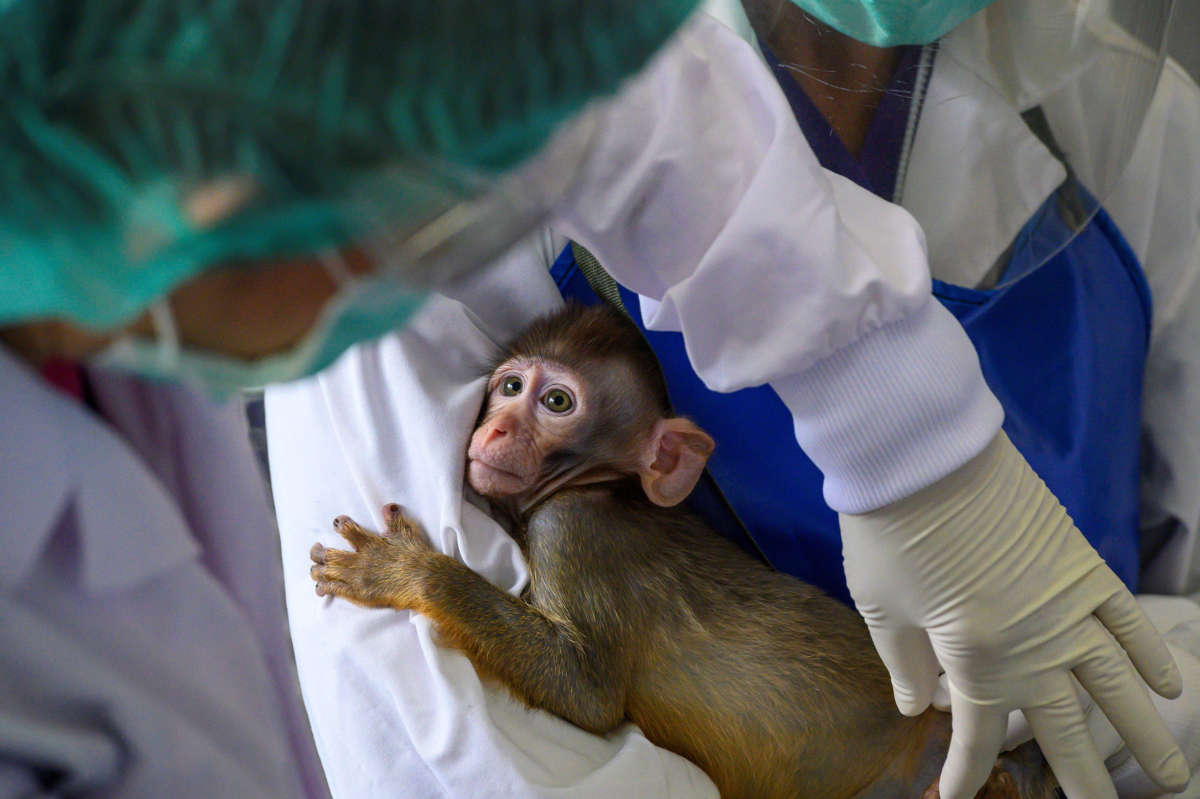
A baby monkey in a laboratory is examined by employees in the National Primate Research Center of Thailand at Chulalongkorn University in Saraburi, Thailand, on May 3, 2020. Scientists at the center tested potential vaccines for the novel coronavirus (COVID-19) on animals, including monkeys.
There have been concerted efforts on the part of primate researchers to convince the public and political leaders that more money and monkeys are needed for COVID-19 vaccine research. It’s not surprising that monkey researchers would attempt to exploit people’s fears about the pandemic to increase “supplies” and funding for their work.
What is surprising, however, is the complete lack of differing scientific views offered. The problem with the assertions made by pro-monkey research groups is their lack of supporting evidence.
Most findings in animals, including nonhuman primates (NHPs), do not predict human results — and, thus, far from being helpful, they are actually misleading.
More than 700 human trials of potential HIV/AIDS vaccines have been conducted, all of which gave encouraging results in animals including monkeys and chimpanzees — yet not one has worked in humans. In fact, some HIV vaccines actually increase the risk of HIV in humans. And as models of human diseases, NHPs have failed for Alzheimer’s and Parkinson’s diseases, neuroscience/brain research, stroke, cancer, hepatitis C, and many more.
More than 90 percent of drugs that appear to be safe and effective in animals fail in human trials. Vaccine development has an even higher failure rate. Only 6 percent of vaccines make it to the market. Can you imagine if you boarded a plane, and the pilot announced that you have a 6 percent chance of landing safely at your destination? You would demand an overhaul of the entire airline industry. Yet, when it comes to the safety and effectiveness of the vaccines and drugs we put into our bodies, monkey researchers want you to believe that clinging to the tools of old (i.e., monkeys) is a good idea. We don’t see anyone suggesting we should stick to the 8-track tape when we can stream music on our phones.
There is a valid reason why we need diverse representation in human clinical trials. No one human can accurately represent how a vaccine or drug will work in another human. How can we expect another species to effectively predict biological responses in humans?
Although COVID vaccines were tested in animals for regulatory reasons — tradition-based, rather than science-based — there is devil in the detail. Biologically, very different processes are occurring with the COVID-19 virus. Mice proved difficult to infect with the virus, even when genetically modified to make them more susceptible. If they did show symptoms, they were mild. Different species of monkeys also failed to replicate human symptoms, and where symptoms did appear, they too tended to be mild, reflecting different infectious processes.
Human trials of the Oxford/AstraZeneca vaccine proceeded despite prior monkey data that showed it did not prevent infection, and the Moderna vaccine was first encountered by humans without preceding animal trials. This would not have happened if the animal trials had been a crucial step in ensuring safety and efficacy.More than 90 percent of drugs that appear to be safe and effective in animals fail in human trials.
Expert opinion agrees: the chief medical officer at Moderna stated, “I don’t think proving this in an animal model is on the critical path to getting this to a clinical trial.” Operation Warp Speed’s chief scientific adviser said Human data is “100 times more significant” than NHP data, and Anthony Fauci stated that translating animal vaccine results to humans has been “one of the banes of our existence.” Pfizer and BioNTech recognized early on that mRNA vaccines work very differently in animals compared to humans.
Biomedical research is increasingly utilizing innovative techniques that are human-specific. These techniques include human mini-organs (organoids) and human organs-on-a-chip, where 3D cultures of human cells are housed on small chips, with circulatory systems and other means of mimicking real-life function and physiology of actual human organs and the human body.
These techniques are being used ever more widely in disease research and in drug discovery and development, and were used in pivotal stages of the COVID-19 vaccine development, alongside computational approaches to their design. Entire human immune systems can be cultured, as can lymph nodes (pivotal to immune function) specific to individual people to reflect interhuman variability, and reflective of both diseased and healthy states — all without the confounding issues of extrapolation between different species.
For the sake of human health, our tax dollars should be directed into the best science. Whichever way you look at it, future biomedical research, including vaccine development for pandemics like COVID-19, will be based on human biology and human-specific testing methods. These methods are quicker, cheaper, more humane and — most importantly — relevant.
ACTION ALERT – 3/18/21! OPPOSE BILLS A3216/S4119; A238/S1721; A1299; S2643; A3550; A4281 THAT LOWER THE HUNTING AGE TO 12 FROM 14 FOR DEER AND BEARS, ALLOW 12 YEAR OLDS TO USE CROSSBOWS TO KILL DEER AND BEARS, AND HAVE OTHER PROVISIONS BENEFICIAL TO THE FIREARMS AND BOW AND ARROW INDUSTRIES, BUT DETRIMENTAL TO THE PUBLIC. Consider that 12-YR OLDS ARE NOW ABLE TO USE AR-15 AND AK-47 SEMI-AUTOMATIC RIFLES! And they are more likely to use them on “big game,” thus encouraging more purchases of those weapons. Meet crossbows – with such names as “Killer Instinct”! Please call and/or email the following legislators to voice your opposition: Assembly Member Steve Englebright 518-455-4804 engles@nyassembly.gov Senator Kaminsky 518-455-3401 kaminsky@nysenate.gov Majority Leader Andrea Stewart-Cousins 518-455-2297 scousins@nysenate.gov Speaker Carl J. Heastie 518-455-3791 speaker@nyassembly.gov Please see the attached Memo of Opposition if you wish to add additional points. Thank you…
The wolves of Northwest Montana have generated unlimited controversy. (Jeremy Weber/Valley Press)ByAssociated Press |March 17, 2021 12:00 AM
HELENA (AP) — Hunters and trappers who kill wolves in Montana could be reimbursed for their expenses by private groups under a proposal advanced by state lawmakers last Monday that critics said is akin to the bounties that nearly exterminated the predators last century.
The Republican-controlled Senate voted to allow the payments amid pressure from livestock and hunting groups that say Montana has too many wolves.
A separate measure advanced by senators would allow individuals to kill unlimited numbers of wolves, hunt at night with artificial lights and night vision scopes and use bait to lure wolves into traps.
The bills passed in 30-20 votes by the Senate largely along party lines, with most Republicans in favor and most Democrats opposed. The Senate will vote on the…
It’s official: two wolves that have been carving out a territory in Siskiyou County over the past few months have made the area their home – and now they have a new name.
The Whaleback Pair’s territory encompasses about 480 square miles of Siskiyou County and extends slightly south into Shasta County, according to a map recently released by the California Department of Fish and Wildlife.
“Typically packs are named for some geographical feature where their home range is,” Laudon explained. A map of the area from 1900 refers to the mountain as Black Crater, but it was renamed Whaleback on a 1930 map.
Siskiyou County Wolf Liaison Patrick Griffin said there have been no confirmed issues between the wolves and local livestock since the male wolf, OR-85, first came to the county in November 2020 in search of a mate.
The wolves have been moving around Siskiyou County together since then, and Laudon has been hard at work collecting samples of their genetic material to determine more about the mysterious female wolf’s origins.
“We don’t have a full DNA profile on her yet,” Laudon said of the gray colored wolf. “We have her DNA on some hair and a scat – neither yielded complete profiles but the hair is more complete than the scat and based on that our CDFW geneticist reports that the results are consistent with female.”
That sample has gone to a genetics lab at University of Idaho, Laudon said, where geneticists will compare it to other wolf DNA from Oregon, Washington and Idaho to see if they can determine what pack she was born in before dispersing to find a mate.
“OR-85’s ID will remain the same. If there are pups this year, all of their profiles will be collected from pup poops at pup rearing locations after they have left,” Laudon said. “They will be named WHA02, WHA03, etc. with the relevant sex initial. So all the known wolves that we have sampled in California have identification.”
Griffin, who worked as Siskiyou County’s Agricultural Commissioner for 10 years before retiring in 2015, is a local rancher himself. He works closely with Laudon, the CDFW, the U.S. Department of Fish and Wildlife, local ranchers and the county to mitigate issues that might arise with Siskiyou’s new wolf residents.
Wolves that are dispersing “usually move on,” he said, but these two wolves “tend to stay in this location,” hence their new moniker.
Griffin said there has been mortality among local livestock since November, but in the suspicious cases there was not enough evidence to determine how the animals died or whether wolves were involved.
“When there are wolves around, people are always suspicious,” Griffin said. “Ranchers think, ‘will a wolf kill this calf or not?’”
Laudon said OR-85 and his friend continue to travel through cattle operations on winter range “but there’s been no issues so far.”
Wolves typically survive on big game like deer and elk, but they will also eat roadkill, Laudon said.
It’s important to note that the CDFW nor any other organization has reintroduced wolves to California, Laudon said. Instead, these wolves and their predecessors have traveled hundreds of miles after being reintroduced to Yellowstone National Park and Idaho in 1995 and 1996 in search of mates and territories to call their own.
OR-85 was born part of Oregon’s Mt. Emily Pack. He was collared in February of 2020 and struck out on his own in June. The wolf, with shaggy black fur, took a short trip to Nevada and then returned to Oregon before crossing the border into California’s Modoc County in early November.
Two days after entering the state, OR-85 made his way to Siskiyou County and has been here ever since, Laudon said.
Skye Kinkade is the editor of the Mt. Shasta Area Newspapers and the Siskiyou Daily News. She is a fourth generation Siskiyou County resident and has lived in Mount Shasta and Weed her entire life.
Iranian officials ordered thekilling of 1.4 million birdslast month after a widespread outbreak ofH5N8bird flu was found on over fifty farms across the country. The virus allegedly spread rapidly around the region after an egg farm failed to report a positive case for nearly three weeks, fearing serious fines. A total of 75 million egg-laying hens currently reside on farms in Iran.
“Highly pathogenic avian influenza has been reported in the European Union, Kazakhstan, Japan, Saudi Arabia, Iraq, and Russia. Now all countries on the path of free-flying birds are affected by the wave of the disease,” said Ali Safar Maknali, head of the Iran Veterinary Organization.Advertisement


 For Immediate Release: March 19, 2021Contact:Michelle Lute, Project Coyote, 406-848-4910, mlute@projectcoyote.orgMilestone moment for New Mexico’s animals“Roxy’s Law” to ban traps, snares, and poisons on public lands passes the New Mexico House; advances to the desk of Governor Michelle Lujan GrishamSANTA FE, N.M.—Last night, by a vote of 35-34, the New Mexico House of Representatives passed Senate Bill (SB) 32, the Wildlife Conservation and Public Safety Act, aka “Roxy’s Law,” sponsored by Senator Bobby Gonzales (D-Ranchos de Taos) and Senator Brenda McKenna (D-Corrales) in the Senate and Representative Matthew McQueen (D-Galisteo) and Representative Christine Chandler (D-Los Alamos).SB 32 prohibits the use of traps, snares, and poisons on public lands (with several important exemptions). Having passed the New Mexico Senate by a vote of 23-16 last month, Senate Bill 32 now advances to the desk of Governor Michelle Lujan Grisham.“I am proud that we have passed Senate…


 Updated: 10:23 AM EDT Mar 20, 2021
 coronavirus SOURCE: WMTW-TV