B.C. mink farmer decides to destroy 1,000 animals after positive COVID-19 tests

The Canadian PressStaff

ContactPublished Tuesday, January 5, 2021 12:56PM PSTMinks

Denmark has ordered the slaughter of all of the country’s minks, estimated at up to 17 million. (AFP)

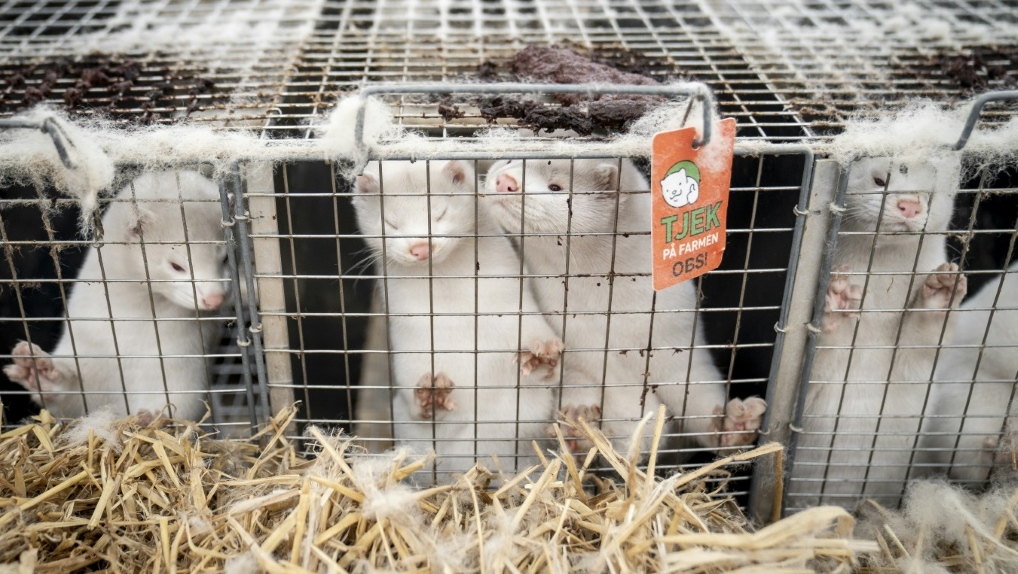
VICTORIA — British Columbia’s chief veterinarian says a mink farmer decided to euthanize the remaining 1,000 animals on his Fraser Valley operation after some of the mink tested positive for COVID-19.

Dr. Rayna Gunvaldsen says the operator was not ordered by the provincial government to euthanize the animals as more tests are underway to determine the extent of the presence of COVID-19.

The first farm where the virus spread to mink also had eight workers who tested positive and Gunvaldsen says both farms remain under quarantine.

She says there are no other reports of COVID-19 at B.C.’s eight other mink farms.

Alan Herscovici, a spokesman for the Canada Mink Breeders Association, says imposing strict quarantine and biosecurity measures at mink farms for about two weeks appears to limit the spread of COVID-19 to other animals.

After COVID-19 was diagnosed on the first farm, the B.C. Society for the Prevention of Cruelty to Animals called for a moratorium on mink farming in the province.

This report by The Canadian Press was first published Jan. 5, 2021.

https://bc.ctvnews.ca/b-c-mink-farmer-decides-to-destroy-1-000-animals-after-positive-covid-19-tests-1.5254551

Greyhound racing comes to an end in Florida

Chris Perkins, South Florida Sun Sentinel  5 days ago

https://www.msn.com/en-us/sports/more-sports/dog-gone-greyhound-racing-comes-to-an-end-in-florida/ar-BB1codmo?ocid=sf&fbclid=IwAR0eis-aHrppDhmEiB5-uqlxGaiiIEP820a6ZO18POW2_NWqMtAxHBmZebw


A top scientist explains why a more infectious coronavirus variant is a…Here’s who won’t be getting a $600 stimulus checkSun Sentinel logoDog gone: Greyhound racing comes to an end in Florida

Ewart Johnson, an 80-year-old West Palm Beach resident, was a bit melancholy Thursday afternoon as he scrutinized his racing form at the Palm Beach Kennel Club.a sign on the side of a fence: Greyhounds race at Palm Beach Kennel Club in West Palm Beach on Dec. 31, 2020.© John McCall/South Florida Sun Sentinel/South Florida Sun Sentinel/TNS Greyhounds race at Palm Beach Kennel Club in West Palm Beach on Dec. 31, 2020.

It was the last day greyhound racing was legal in Florida, something that should represent a financial upturn for Johnson.

“I lose my money every day,” he said with a smile.

Still, Johnson, who has been going to the Palm Beach Kennel Club since 1987, couldn’t shake his sense of loss.

Although the mood was generally festive at the Kennel Club with live music, giveaways and plenty of racing, Johnson considered Thursday a sad day.

And so did the 3,000 or so people who went to the venue on New Year’s Eve. Regulars said it was the largest crowd in years. It figures it came on the final day the greyhounds were running.a dog that is covered in snow: Greyhounds round a corner during a race at Palm Beach Kennel Club in West Palm Beach on Dec. 31, 2020, the last day of legal dog racing in Florida.

Should Wildlife Be Granted the Right to Own Their Homes?

Exposing the Big Game's avatarCommittee to Abolish Sport Hunting Blog

Marc Bekoff Ph.D.

https://www.psychologytoday.com/us/blog/animal-emotions/202011/should-wildlife-be-granted-the-right-own-their-homes?fbclid=IwAR1tgNXP5kHQHYAvDQa3sUkSmwdaetohhJ1GbBdeby2Brbdto9qRV77Eq-8

Animal Emotions

Karen Bradshaw says “yes” and they should not be viewed as transient renters.

Posted Nov 29, 2020

“Affording a property right to animals has both dignity and practical benefits.” — Karen Bradshaw,Wildlife as Property Owners(p. 132)

Pixabay, Pexels free download

Source: Pixabay, Pexels free download

I recently read a fascinating book by Arizona StateUniversity distinguished legalscholarKaren BradshawcalledWildlife as Property Ownersthat is an extremely timely addition to books and essays that focus on the lives and rights of nonhuman animals (animals) and the complicated and often vexing relationships they have with us.1,2My learning curve was vertical as she wove in information from numerous disciplines including different aspects oflegal scholarship,ethology and cognitive ethology (the study of animal minds), and the social sciences in an easy-to-read fashion.

I’ve long beeninterested in all the topics aboutwhichKarenwrites,perhapsmoreso now as numerous animals…

View original post 1,848 more words

Sixth graders learn hunter safety, ethics in PE class

Exposing the Big Game's avatarCommittee to Abolish Sport Hunting Blog

Greybull Game Warden Rob Hipp works with a sixth grade student at an outdoor range during a field trip for hunter education students from Burlington Middle School.

Greybull Game Warden Rob Hipp works with a sixth grade student at an outdoor range during a field trip for hunter education students from Burlington Middle School.PHOTO COURTESY WYOMING GAME AND FISH DEPARTMENTPosted Tuesday, January 5, 2021 8:10 am

https://www.powelltribune.com/stories/sixth-graders-learn-hunter-safety-ethics-in-pe-class,28713

Sixth grade students attending Burlington Middle School recently earned hunter education certificates as part of their regularly scheduled physical education class.

Over several months this fall, students completed 16 hours of coursework relating to ethics and responsibility, wildlife identification, Wyoming laws and regulations, wildlife conservation and management, firearms safety and more. In November, the class culminated in a field trip to Gunwerks in Cody to shoot .22 long rifles and practice marksmanship.

“The field trip gave students an opportunity to practice safe firearms handling practices they learned as part of class and was a fun way to finish the course,” said Game and Fish Information and Education Specialist Tara Hodges.

Hodges conducted the…

View original post 225 more words

Climate change: Threshold for dangerous warming will likely be crossed between 2027-2042

Exposing the Big Game's avatarThe Extinction Chronicles

Scientists introduce a new way to predict global warming, reducing uncertainties considerably

https://www.sciencedaily.com/releases/2020/12/201221160425.htm

Date:December 21, 2020Source:McGill UniversitySummary:The threshold for dangerous global warming will likely be crossed between 2027 and 2042 — a much narrower window than the Intergovernmental Panel on Climate Change’s estimate of between now and 2052. Researchers introduce a new and more precise way to project the Earth’s temperature. Based on historical data, it considerably reduces uncertainties compared to previous approaches.Share:    FULL STORY


Photo concept, hourglass | Credit: © denyasapozhnik / stock.adobe.com

Photo concept, hourglass on beach (stock image).Credit: © denyasapozhnik / stock.adobe.com

The threshold for dangerous global warming will likely be crossed between 2027 and 2042 — a much narrower window than the Intergovernmental Panel on Climate Change’s estimate of between now and 2052. In a study published inClimate Dynamics, researchers from McGill University introduce a new and more precise way to project the Earth’s temperature. Based on historical data, it considerably reduces uncertainties…

View original post 456 more words

The moon controls the release of methane in Arctic Ocean

https://www.sciencedaily.com/releases/2020/12/201214104716.htm

Date:December 14, 2020Source:UiT The Arctic University of NorwaySummary:The moon controls one of the most formidable forces in nature – the tides that shape our coastlines. Tides, in turn, significantly affect the intensity of methane emissions from the Arctic Ocean seafloor. High tides may even counter the potential threat of submarine methane release from the warming Arctic.Share:    FULL STORY


It may not be very well known, but the Arctic Ocean leaks enormous amounts of the potent greenhouse gas methane. These leaks have been ongoing for thousands of years but could be intensified by a future warmer ocean. The potential for this gas to escape the ocean, and contribute to the greenhouse gas budget in the atmosphere, is an important mystery that scientists are trying to solve.

The total amount of methane in the atmosphere has increased immensely over the past decades, and while some of the increase can be ascribed to human activity, other sources are not very well constrained.

A recent paper in Nature Communications even implies that the moon has a role to play.

Small pressure changes affect methane release

The moon controls one of the most formidable forces in nature — the tides that shape our coastlines. Tides, in turn, significantly affect the intensity of methane emissions from the Arctic Ocean seafloor.

“We noticed that gas accumulations, which are in the sediments within a meter from the seafloor, are vulnerable to even slight pressure changes in the water column. Low tide means less of such hydrostatic pressure and higher intensity of methane release. High tide equals high pressure and lower intensity of the release” says co-author of the paper Andreia Plaza Faverola.

“It is the first time that this observation has been made in the Arctic Ocean. It means that slight pressure changes can release significant amounts of methane. This is a game-changer and the highest impact of the study.” Says another co-author, Jochen Knies.

New methods reveal unknown release sites

Plaza Faverola points out that the observations were made by placing a tool called a piezometer in the sediments and leaving it there for four days.

It measured the pressure and temperature of the water inside the pores of the sediment. Hourly changes in the measured pressure and temperature revealed the presence of gas close to the seafloor that ascends and descends as the tides change. The measurements were made in an area of the Arctic Ocean where no methane release has previously been observed but where massive gas hydrate concentrations have been sampled.

“This tells us that gas release from the seafloor is more widespread than we can see using traditional sonar surveys. We saw no bubbles or columns of gas in the water. Gas burps that have a periodicity of several hours won’t be identified unless there is a permanent monitoring tool in place, such as the piezometer.” Says Plaza Faverola

These observations imply that the quantification of present-day gas emissions in the Arctic may be underestimated. High tides, however, seem to influence gas emissions by reducing their height and volume.

“What we found was unexpected and the implications are big. This is a deep-water site. Small changes in pressure can increase the gas emissions but the methane will still stay in the ocean due to the water depth. But what happens in shallower sites? This approach needs to be done in shallow Arctic waters as well, over a longer period. In shallow water, the possibility that methane will reach the atmosphere is greater.” Says Knies.

May counteract the temperature effects

High sea-level seems thus to influence gas emissions by potentially reducing their height and volume. The question remains whether sea-level rise due to global warming might partially counterbalance the effect of temperature on submarine methane emissions.

“Earth systems are interconnected in ways that we are still deciphering, and our study reveals one of such interconnections in the Arctic: The moon causes tidal forces, the tides generate pressure changes, and bottom currents that in turn shape the seafloor and impact submarine methane emissions. Fascinating!” says Andreia Plaza Faverola

The paper is the result of a collaboration between CAGE, Centre for Arctic Gas Hydrate, Environment and Climate at UiT The Arctic University of Norway, and Ifremer under the project SEAMSTRESS — Tectonic Stress Effects on Arctic Methane Seepage

John Smith retells hunting accident

Exposing the Big Game's avatarCommittee to Abolish Sport Hunting Blog

  • Adam Engel, Staff Reporter, @AdamEngel9
  • Jan 5, 2021Updated22 hrs ago
John Smith
Courtesy of Ethan Kyle

John Smith walked into the dimly lit, orange filled Oklahoma State wrestling room.

It’s a simple routine Smith has completed thousands of times, but that day was different.

Smith’s forehead and eyes were wrapped in gauze. The wrestlers present at this Sunday afternoon workout begin to freeze and turn their attention to their leader.

“I fell off a deer stand,” Smith said.

The group erupted in laughter.

Former Cowboy Ethan Kyle, who said he thinks the year was 2004, and his teammates immediately sensed a feeling of surprise.

“I just knew that this guy, who was basically Superman, went out and fell off a deer stand,” Kyle said. “Life is nuts, man. Anything can happen.”

The hunting scare occurred the day before — a Saturday before an OSU football game.

Smith, accompanied by his father…

View original post 202 more words

IS A NEW HUMAN SPECIES EMERGING FROM AN UNDERGROUND CAVE?

Exposing the Big Game's avatarThe Extinction Chronicles

Homo Naledi

More infoi

Contributed by

Elizabeth Rayne@quothravenrayneJan 5, 2021, 8:45 PM EST (Updated)283Shared

Tag:ScienceTag:NewsTag:ArchaeologyTag:EvolutionTag:Early Man

Most of us know by now that if anyone ever thinks “Neanderthal” is an insult, it’s probably true on both ends, becauseHomo sapiensinterbred with Neanderthals. But is another human species hiding somewhere in our past?

Deep in the caves of Johannesburg, South Africa, manyancient human remainshave been found.Lee Berger and his research teamfrom the University of the Witwatersrand have found human bones that have survived thousands and thousands of years. They previously unearthed two new hominid species, and might have just stumbled on anotherone. Some of the many bone fragments scattered in Cave UW 105 stood out. These remains are unlike any from known hominids or modern humans —possibly an altogether different species.

MORE ARCHAEOLOGY

pyramid 3

Rare Great Pyramid artifacts lost for…

View original post 563 more words

Scientists Warn of an ‘Imminent’ Stratospheric Warming Event Around The North Pole

Exposing the Big Game's avatarThe Extinction Chronicles

main article image

(Simon Berger/Unsplash)ENVIRONMENT

https://www.sciencealert.com/scientists-warn-imminent-stratospheric-warming-about-to-blast-the-uk-with-cold

MIKE MCRAE6 JANUARY 2021

Every winter in the Northern Hemisphere, a cold wind circles the North Pole like water around a drain. It’s an annual weather pattern meteorologists keep an anxious eye on – any significant changes could suggest Europe is in for a serious cold snap.Right now, that wind is ripping in two.https://cb24d9547dd945f51d9a064cfa0148ca.safeframe.googlesyndication.com/safeframe/1-0-37/html/container.html

Researchers from the Universities of Bristol, Exeter, and Bath have come up with a new way to predict the knock-on effects of various changes to this major air current high up in thestratosphere, 10 to 50 kilometres (6 to 30 miles) overhead.

Ironically, the cause of this chill is a sudden burst of heat seeping into the whirling currents over a window of just 24 to 48 hours.

With its temperature surging by as much as 40 degrees Celsius, the vortex undergoes some rapid changes, changing course or dramatically…

View original post 590 more words