A pair of Pennsylvania hunters exit the woods on the first Sunday of firearms deer season in November. States have seen a substantial increase in hunting during the pandemic.
Conservationists and wildlife officials have spent years trying to stave off the decline of hunting in America. In 2020, they finally saw a glimmer of hope.
“I’ve been working on this issue for 15 years,” said Matt Dunfee, the director of special programs at the Wildlife Management Institute, a national conservation nonprofit that focuses on restoring wildlife populations. “All I needed was a pandemic.”
For decades, the number of hunters—who are mostly older, white males—has steadily dwindled. That’s led to a loss of conservation funding at state wildlife agencies, which largely rely on license sales to support…
Missouri’s first black bear hunting season will begin in February.
The framework for the season, which will allow black bear hunting in the state’s southern regions for Missouri residents only, was approved Friday by the Missouri Conservation Commission.
Missouri residents submitted a slew of negative comments to the state after the commission’s decision to approve the regulatory framework in September.
Out of 1,059 public comments, 1,013 — 96% — were generally opposed to the season, according to Mike Hubbard, resource science supervisor for the commission.
Missouri’s first Elk Hunting Season begins today for the first time ever.
This season will run from December 12-20, and will be firearm exclusive. An archery season is scheduled for October 17-25.
Only five permit holders will be able to bag the massive deer species this year. One is for qualifying area landowners, and four are for the general public.
Elk were reintroduced to the state after being hunted to extinction in the 19thcentury.
The new elk hunting season will be used to control their population and manage herd location.
Fishermen, swimmers and seafood enthusiasts may already know the dangers of “red tides,” but a recent study in Frontiers in Climate shows that climate change is increasing the frequency of one type of highly toxic algal bloom off the US west coast. These algae produce a neurotoxin—called domoic acid—that causes severe and potentially lethal digestive and neurological symptoms. This threat to marine wildlife and humans is restricting shellfish harvest in the region, but local bulletins are helping to forecast the blooms.
“This study shows that climate change can influence the occurrence and intensity of some harmful algal blooms (HABs) by creating new seed beds for their survival and distribution,” says lead author Dr. Vera L Trainer, of the US National Oceanic and Atmospheric Administration (NOAA) in Seattle, Washington. “Coastal communities, including Native Tribes, will suffer from the effects of HABs more frequently in the future, illustrating the importance of early warning systems such as Harmful Algal Bloom Bulletins that are becoming operational in the US and other parts of the world.”
Starting in 1998, Trainer and her colleagues began monitoring domoic acid—which is produced by Pseudo-nitzschia algae—in shellfish samples and ocean water along the US west coast. In 2015, the severe heatwave in the northeast Pacific Ocean triggered a new record-breaking Pseudo-nitzschia bloom that closed shellfish harvest and caused widespread marine mammal mortalities. As a result, a region in northern California near the Oregon border has become a new toxic hotspot that has prevented shellfish harvest every year since that heatwave event.
A related finding used multi-model datasets to show that the 2013-2015 heatwave was five times more likely to have been caused by human, rather than natural, influences. Models also predict that extreme marine heatwaves are now 20 times more likely to occur than they would be without climate change. These models include several decade’s worth of data, including temperature, wind and ocean current measurements, which allow researchers to make a wide variety of climate predictions and risk assessments.
Due to the water currents and coastal topography, the region near the California/Oregon border provides favorable conditions for recurring algal blooms in the future—called retentive regions. At this site, and other retentive regions along the US west coast, Pseudo-nitzschia can remain dormant in sediments for years until ocean upwelling brings the algal cells to the surface and temperatures become warm enough for the algae to multiply.
In response to these now frequent blooms, a regional partnership between NOAA, the University of Washington, the Washington State Departments of Health and Fish and Wildlife and Native Tribes with support from the Northwest Association for Networked Observing Systems has created the Pacific Northwest Harmful Algal Bloom Bulletin to forecast these events and warn local communities of when and where it is safe to collect shellfish. Trainer’s team found that these Bulletins have become a cost-effective tool to help minimize the health and economic toll of the algal blooms.
“There is evidence that bacteria associated with seagrasses have algicidal properties, indicating that seagrass planting may be used to successfully control some HABs in Puget Sound,” says Trainer. “But for large-scale marine HABs, early warning is our best defense and these HAB Bulletins will help preserve a way of life that includes wild shellfish harvest, on which coastal people depend.”
Analysis: Rat Poison Found in 85 Percent of Tested Mountain Lions, Bobcats, FishersPoisonings Prompt California to Reassess Super-toxic RodenticidesSACRAMENTO, Calif.— A new state analysis has documented super-toxic rat poisons in more than 85 percent of tested mountain lions, bobcats and protected Pacific fishers, prompting state regulators to open a new evaluation of whether to further restrict or ban the powerful toxins.The California Department of Pesticide Regulation’s analysis of 11 different wildlife studies indicates non-target animals continue to be poisoned in large numbers despite state restrictions on the sale and use of the deadliest rodenticides since 2014. The long-lasting super toxins often poison non-target animals that eat poisoned rodents.“This alarming new evidence should spur the state to ban these dangerous poisons,” said Jonathan Evans, legal director of the Center for Biological Diversity’s environmental health program. “There are safer, cheaper alternatives that greatly reduce risks to wildlife, pets and children. Pesticide regulators have no excuse for continuing to allow California’s wildlife to die slow, excruciating deaths.”Four years ago the state limited the sale and use of the so-called super-toxic rat poisons — known as second-generation anti-coagulant rodenticides — to licensed applicators. But they are still allowed throughout the state for agricultural users and licensed pest-control operators.The ongoing wildlife poisonings and legal pressure from wildlife advocates prompted the Department of Pesticide Regulation to open a reevaluation of the powerful rodenticides. As part of the assessment, the public can submit comments through Jan. 16.The new state analysis documented super-toxic rat poisons in more than 90 percent of tested mountain lions, 88 percent of tested bobcats and 85 percent of protected Pacific fishers tested.Along with the high percentage of poisoning among tested mountain lions, fishers and bobcats, the re-evaluation analysis documented the potent rat toxins in seven out of ten endangered northern spotted owls tested and 40 percent of tested barred owls.In addition, research included in the analysis suggested that anticoagulant rodenticides are associated with the often-deadly mange, a malady that can result in population level harms to bobcats.Background The harm caused by the super-toxic second generation anticoagulant rodenticides in California is well documented. More than 70 percent of wildlife tested in California in recent years has been exposed to dangerous rodenticides. Officials have found poisonings in more than 25 different species of animals, including endangered wildlife such as the San Joaquin kit fox and Pacific fisher.More than 4,400 children under age 6 were poisoned with the long-acting anticoagulant rodenticides in the United States in 2016, according to the American Association of Poison Control Centers. The Environmental Protection Agency has found that children in low-income families are disproportionately exposed to the poisons. Thousands of incidents of pets being poisoned by rodenticides have also been reported, many resulting in serious injury or death.Effective affordable, alternatives to rat poison include rodent-proofing of homes and farms by sealing cracks and crevices and eliminating food sources; providing owl boxes in rural areas to encourage natural predation; and using traps that don’t involve these highly toxic chemicals. For more information on nontoxic rodent control methods, visit SafeRodentControl.org.
Mountain lion photo courtesy USFWS. This image is available for media use.
The Center for Biological Diversity is a national, nonprofit conservation organization with more than 1 million members and online activists dedicated to the protection of endangered species and wild places.
Updated 6:00 AM ET, Mon December 14, 2020https://www.cnn.com/2020/12/13/americas/new-species-bolivian-andes-spc-intl-scn/index.html
Photos:With vibrant patterns and striking colors, Catesby’s snail sucker is specialized to feed on snails and slugs.Hide Caption8 of 14
Photos:Although the species are new to science, they are familiar to local indigenous communities. A newly discovered bamboo has been regularly used by indigenous people for construction materials and to make wind musical instruments called sikus or zampoñas.Hide Caption9 of 14
Photos:In the cloud forest of Zongo Valley, a caterpillar from a Morpho butterfly feeds on bamboo. Morpho butterflies are highly sought after due to their bright blue color.Hide Caption10 of 14
Photos:Zongo Valley is full of dreamy, natural waterfalls and is known as the “heart of the region.” Locals depend on the forest as Zongo supplies building materials, hydroelectric power and water for Bolivia’s capital of La Paz and surrounding areas.Hide Caption11 of 14
The theory of evolution shows that all of life stems from a single root and that we are related, more or less distantly, to every other living thing on Earth. Our closest ancestors, as Charles Darwin recognized, are to be found among the great apes. But beyond this, confusion over the branching pattern of the tree of life means that things become less clear.
We know that life evolved from a common universal ancestor that gave rise to bacteria, archaea (other types of single-celled microorganisms) and eukaryotes (including multi-cellular creatures such as plants and animals). But what did the first animals look like? The past ten years have seen a particularly heated debate over this question. Now our new study, published in Science Advances, has come up with an answer.
Sponge vs comb jelly
From the 19th century to about ten years ago, there was general agreement that our most distant relatives are sponges. Sponges are so different from most animals that they were originally classified as members of the algae. However, genes and other features of modern sponges, such as the fact that they produce sperm cells, show that they certainly are animals. Their distinctness and simplicity certainly fit with the idea that the sponges came first.
But over the past decade, this model has been challenged by a number of studies comparing DNA from different animals. The alternative candidates for our most distant animal relatives are the comb jellies: beautiful, transparent, globe-shaped animals named after the shimmering comb-rows of cilia they beat to propel themselves through the water.
Comb jellies are superficially similar to jellyfish and, like them, are to be found floating in the sea. Comb jellies are undoubtedly pretty distant from humans, but, unlike the sponges, they share with us advanced features such as nerve cells, muscles and a gut. If comb jellies really are our most distant relatives, it implies that the ancestor of all animals also possessed these common features. More extraordinarily, if the first animals had these important characters then we have to assume that sponges once had them but eventually lost them.
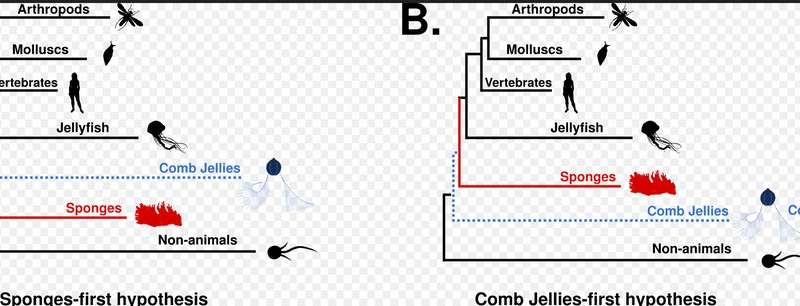
To understand how species evolved, scientists often use phylogenetic trees, in which the tips of the branches represent species. The points where branches split represent a common ancestor. The below image shows an example of a phylogenetic tree in which the sponge splits off first, and one in which the comb jelly splits off first.
Both the sponges-first and comb jellies-first evolutionary trees have been supported by different studies of genes, and the dispute seems to have resulted in a transatlantic stalemate, with most Europeans preferring the traditional sponges-first and the North Americans generally preferring the novel comb jellies-first.
The argument boils down to a question of how best to analyze the copious genetic data we now have available. One possibility put forward by the sponges-first supporters is that the animal tree that put comb jellies first is the result of an error. The problem occurs when one of the groups being studied has evolved much faster than the others. Fast evolving groups often look like they have been around for a long time. The comb jellies are one such group. Could the fast evolution of the comb jellies be misleading us into thinking they arose from an earlier split than they really did?
Are we being fooled by jellies?
We have approached this problem in a new way—directly investigating the possibility that the fast-evolving comb jellies are fooling us. We wanted to ask whether the unequal rates of evolution we see in these animals are likely to result in a wrong answer.
Two different evolutionary trees. Author provided
Our new way of working was to dissect the problem by simulating how DNA evolution happens using a computer. We started with a random synthetic DNA sequence representing an ancestral animal. In the computer, we let this sequence evolve, by accumulating mutations, under two different conditions—either in accordance with the sponge-first model or the comb jelly-first model. The sequences evolve according to the branching patterns of each tree.
We ended up with a set of species with DNA sequences that are related to one another in a way that reflects the trees they were evolved on. We then used each of these synthetic data sets to reconstruct an evolutionary tree.
We found that when we built trees using data simulated according to the comb jellies-first model, we could always easily correctly reconstruct the tree. That’s because the bias coming from their fast rate of change actually reinforced the information from the tree—in this case also showing they are the oldest branch. The fact that the tree information and the bias both point in the same direction guarantees we would get the right result. In short, if the comb jellies really were the first branch, then there would be no doubt about it.
When we simulated data with the sponges as the first branch, however, we very often reconstructed the wrong tree, with the comb jellies ending up as the first branch. This is clearly a more difficult tree to get right and the reason is that the tree information—in this case showing that the sponges are the oldest branch—is contradicted by the bias coming from the fast evolving comb jellies (which supports comb jellies-first).
The long branch leading to the comb jellies can indeed cause them to appear older than they really are and this difficulty reconstructing the tree is exactly what we encounter with real data.
So, who came first? The chances are that the genetic analyzes suggesting that comb jellies came first may in fact suffer from not accounting for the bias that makes these animals look older than they really are. In the end, our work suggests that the sponges really are our most distant animal relatives.
When world leaders get serious about reducing carbon emissions, we can raise families determined to improve the planet’s future
Family time: ‘In a conversation like this the stakes are so high that the largest reasons for having children – love, hope – can be dismissed in an inch of ink.’Photograph: Alamy Stock PhotoSun 13 Dec 2020 03.00 EST
122
When I had my daughter I felt like the first person to have a baby; now I’ve had my son, I feel like I might be the last. An academic study into how young people factor climate change into their reproductive choices makes for dark reading, with 96% “very or extremely” concerned about their potential children in a climate-changed world. For some the concern is so severe they’ve decided not to have children at all. “I can’t in good conscience bring a child…
Hungarian biologist Tibor Gánti is an obscure figure. Now, more than a decade after his death, his ideas about how life began are finally coming to fruition.
An oil painting of Hungarian biologist Tibor Gánti.PAINTING BY LÁSZLÓ GULYÁS7 MINUTE READBY MICHAEL MARSHALL
WHEN BIOLOGIST TIBORGánti died on April 15, 2009, at the age of 75, he was far from a household name. Much of his career had been spent behind the Iron Curtain that divided Europe for decades, hindering an exchange of ideas.
But if Gánti’s theories had been more widely known during the communist era, he might now be acclaimed as one of the most innovative biologists of the 20th century. That’s because he devised a model of the simplest possible living organism, which he called the chemoton, that points to an exciting explanation for how life on Earth began.