@jforaniContactPublished Tuesday, December 15, 2020 2:11PM ESThttps://imasdk.googleapis.com/js/core/bridge3.432.0_en.html#goog_559350355Volume 90%Deer found with crossbow bolt through its headNOW PLAYINGA family was surprised when Carrot, a regular visitor to their property, was seen with a crossbow bolt through its head
TORONTO — When Carrot first wandered onto Lee-Anne Carver’s lawn as a fawn a few years ago, she knew there was something different about the deer.
It was gentle, affectionate and even endeared itself to Carver’s golden retriever.
“He didn’t hold the normal characteristics of a deer. It was something else and I can’t explain it,” said Carver, a wildlife photographer who has been close to hundreds of deer.
The USDA said it had found one positive case in “free-ranging, wild mink” in Utah as part of wildlife surveillance around infected farms.
Several animals from different wildlife species were sampled and all tested negative, the agency added.
It said it had notified the World Organisation for Animal Health, but there is no evidence the virus has been widespread in wild populations around infected mink farms.
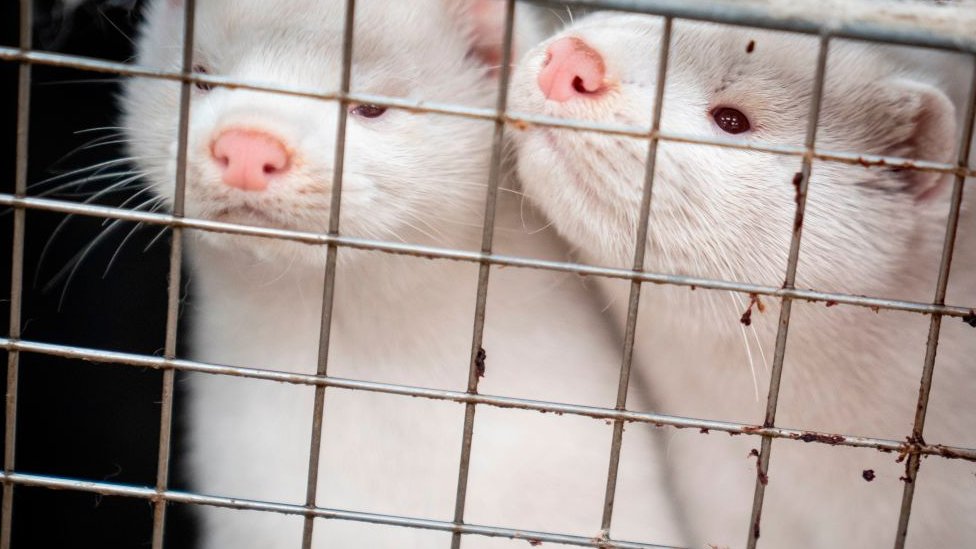
image captionThe virus spreads rapidly in fur farms
The discovery raises concerns that the infection could spread between wild mink, said Dr Dan Horton, a veterinary expert at the University of Surrey, UK.
The case “reinforces the need to undertake surveillance in wildlife and remain vigilant”, he added.
Mink are known to escape from mink farms and become established in the wild. In the UK, a population of mink that escaped from fur farms many years ago is thought to exist, but they are sparsely distributed and rarely come into contact with people, Dr Horton added.
The virus has also been found in zoo tigers, lions and snow leopards in the US, and in a small number of household cats and dogs.
The Trump administration on Tuesday narrowed habitat protections for endangered species, finalizing its second major rollback to the Endangered Species Act.
The latest rule narrows the definition of habitat to areas that can currently support a species,a move environmentalists say ignores the changing climate or efforts that could be made to modify a landscape.
Environmentalists argue the government must be able to step in to protect land that could support an animal in the future, by protecting forests, for example, that in a few decades would have enough old growth trees to house spotted owls that currently dwell elsewhere.
“Habitat protections are essential if we want our incredible wild species, who are dwindling to shockingly low numbers, to continue to exist. Many endangered species occupy only a tiny fraction of their former range…
Forecasts predicting where plants and animals will inhabit over time rely primarily on information about their current climate associations, but that only plays a partial role.
Underclimate change, there’s a growing interest in assessing whether trees and otherspeciescan keep pace with changing temperatures and rainfall, shifting where they are found, also known as their ranges, to track their suitable climates. To test this, a University of Maine-led research team studied the current ranges of hundreds of North American trees and shrubs, assessing the degree to which species are growing in all of the places that are climatically suitable. Researchers found evidence of widespread “underfilling” of these potential climatic habitats—only 50% on average—which could mean that trees already have disadvantage as the world continues to warm.
Benjamin Seliger, a then UMaine Ph.D. student with the…
Forecasts predicting where plants and animals will inhabit over time rely primarily on information about their current climate associations, but that only plays a partial role.
Under climate change, there’s a growing interest in assessing whether trees and other species can keep pace with changing temperatures and rainfall, shifting where they are found, also known as their ranges, to track their suitable climates. To test this, a University of Maine-led research team studied the current ranges of hundreds of North American trees and shrubs, assessing the degree to which species are growing in all of the places that are climatically suitable. Researchers found evidence of widespread “underfilling” of these potential climatic habitats—only 50% on average—which could mean that trees already have disadvantage as the world continues to warm.
Benjamin Seliger, a then UMaine Ph.D. student with the Climate Change Institute, spearheaded the study with his doctoral adviser, Jacquelyn Gill, a UMaine associate professor of paleoecology and plant ecology. Brain McGill, a UMaine professor of biological sciences, and Jens-Christian Svenning, a macroecologist and biogeographer from Aarhus University in Denmark also contributed.
The team used species distribution models to assess the degree to which 447 North American trees’ and shrubs’ “fill” their potential climatic ranges by comparing regions that are climatically suitable, known as potential ranges, against where trees are actually found, or their realized ranges.
The Journal of Biogeography published the team’s research paper for the study.
“We found tree ranges are more limited by non-climatic factors than expected, suggesting trees may not simply track warming climates.” Seliger says.
Species distribution models (SDMs) are a common tool to predict how climate change will affect biodiversity and the future ranges of plants and animals. Various studies, including the one from the UMaine-led group, however, caution that because this tool assumes that species live in all areas that are climatically suitable, known as experiencing climatic equilibrium, it may not provide an accurate prediction of where species will be found in the future.
An SDM relies on what has been considered a foundational principle, “that geographic ranges generally appear to be in equilibrium with contemporary climate,” according to researchers. Growing evidence suggests otherwise for many species, which experience climatic disequilibrium.
Seliger and his team found that North American trees and shrubs with large ranges tended to show much stronger evidence of climatic equilibrium, meaning they had high range filling. Small-ranged species, however, had much lower range filling overall, performing worse than predicted by a null model. According to researchers, that means small-ranged tree species, including many rare trees and species the International Union for the Conservation of Nature (IUCN) lists as vulnerable, will face additional challenges as they try to track their climates into the future.
The group also found that small-rage species may be more limited by nonclimatic influences, such as soils or pathogens. Conservation efforts for these plants and animals, therefore, should “account for a complex interplay of factors in addition to climate when preparing for the next century of global change,” according to researchers.
Their findings support a growing body of evidence that for a climatic disequilibrium among various flora. As to what causes the disequilibrium could be due to two factors, according to researchers: dispersal lags that date back to the time when glaciers covered large portions of North American 21,000 years ago, or by non-climatic factors that may influence ranges more than previously appreciated, such as soil, competition with other plants, or symbiosis.
“It’s been thought that if you zoom out to the scale of North America, climate was the most important factor in determining where species would be found. This study reveals some striking gaps in our knowledge; even at the scale of an entire continent, soils or other plants and animals may be playing an important role too. We used to think those were more important at the more local scale—think of how the trees might change across two areas of your favorite park,” Gill says. “All of this means that when it comes to plants, our predictive tools need to get a lot more sophisticated, if they’re going to be useful for conservation.”
Earlier this year, when the coronavirus pandemic led to a global wave of lockdowns, the world sawmarked declines in carbon dioxide (CO2) emissionsdue to closed borders, restricted travel and shifting energy demands. At the height of the lockdown, estimates pin the daily CO2 emission reductions as high as 17 percent, while current numbers indicate that the global emission reductions for the year could fall between 4.2 percent and 7.5 percent.
These trends, however, don’t necessarily translate into a drop in atmospheric CO2 levels, which is the accumulated total of current and past emissions.
That’s because CO2 concentrations, which reached a record high in 2019, continue to rise…
The North Pole’s most famous couple may have exposed roughly 50 children to Covid-19 in Ludowici, Georgia at a Long County Chamber of Commerce event.Dec. 15, 2020, 7:17 AM PSTBy Tim Fitzsimons
A Santa parade and photo-op in Georgia last Thursday may have exposed up to 50 children to Covid-19 after Santa Claus and Mrs. Claus later tested positive for the virus.
Long County Board of Commissioners chairman Robert D. Parker confirmed the positive tests and downplayed the risk of the possibly dozens of exposures in a statement posted on the Board’s website.
“While this is cause for concern, I feel that it is important to note that exposures happen every day as we go about our day to day lives, often without any knowledge,” the statement said.
The North Pole’s most famous couple tested positive on Saturday, two days after the Thursday evening event at which they did not show symptoms.
In his statement, Parker said the event was, for the Clauses, “one of the most important parts of their lives” and added that he said he believes he and others in town “still stand by the decision of the Chamber to move forward with these holiday traditions, and to bring some sense of normalcy to these trying times.”
“Without them filling these roles locally, I know there are countless underprivileged children who would never have experienced the joy of meeting Santa Claus,” he said
DECEMBER 15, 2020 / 1:45 PM/ CBS NEWShttps://www.cbsnews.com/embed/video/?v=b757838fb084d02338ffe86f5eb294be#xVbbbtw2EP0VQY%2BFuaJEXRcoCicpmiCpY8RJC8QKFryMdlnrVlHy7jbwv3coaS92UCR5SW0YpsghZ%2BbM4Rl%2BdvnQN23J9%2B6y7wa4cO%2B1gsZdfnZ1D5Vxl7ef3X7fgrt07xvlXrha4dBXqeI0kySQgSKhooykRcRIxjLpKx7ymIVoW7W7d1C8sjveXQ1NHP%2Fx8W%2F6UVz9uX0evvrnt1qXr192q5dv3%2B4BrU05rNGy5v3QAan0uuO9rtekamreyY1Bk173pQ3larRZOr8fjJwzIwV3aIKDYijLb9ohed3UWvLy%2FbdY97oC0%2FOqdZd%2BTMM0zPAf%2FqDnwVo3tbsMaHb6fMMFlHgqZcsgwwPK6bvG8BDPiq%2FBWMCNxWnT961Z5l7uSWFq2JpggQON%2FnotF7Kpcm8ziNzTudflXkADmnu%2Bn3s0zT2VZQWEISNxFAAJ%2FVQRkSYxSYJEZqksIg5Z7vWboRI112XuxSHdsRhP4IEUWYG7OAsyGgkQaRgrJmTCApZGce5hKFNhDkD4WUBJlLLIp2Q%2BZ%2FFXu8b0Nj88Dz9I6S6xR6RU%2BSxJs1BENE0BikKwVGZ%2BwahPgyz7jkQeLty2g3sN2w9d%2BSgj05ZawoJX5XqhG0SvxSzuA%2Fyzdyf3vsb13JsPzj33eOHOzm%2B7Ri3wto0rixm%2FCbP5A10hapvSPIXOT%2F2EZkmSRRHFqtm0aLwaDStueugWFRvSg9fgh7stmq7iPbrlrQVxvB65tyNVC%2BsP796gxfAE7O12%2BziWGeT%2FlIkRVG1eVW1jPbvLgpcGhQ1lTstR2Cw%2FAx77jKecJBHSy%2FchIJnyA0KpnxaQckoFPWmSGWrF9%2Biiq9GV5biGznpD2bydV53D6ickDu%2Bg7t9bj1e8sopyM9n8%2FuUJz%2FaTye1Tm0%2FIQGi1aRSu%2BhgLcGO1xfVtYLCu0MW0MLRIKGOOqfKyvJQSZ56Vjbw7Ko35YKC7GYSRnRagjuambWrTdAe7DewuX0DBh9IWil7grzvOPjvNsuwijC4iq2Z9x%2BWdjRehxQIZ2XQwjpFdjFK8hzEqbIibnj%2B7uZrLaEU3xqmfrEv8qM3K9Ku1RcpWeprh7YrbfK9y79J9eLA63VrCmO%2FTl8Our1%2FMBVditatsQNWwu%2B6aFrp%2B%2Fxr2ljBhAopHMfMT5UdhhqofMMZZ7D5gwSvo%2BajhiEYP670d49ymURPXoVZjBjOfChjZq4i0LQJsX52bLEaO1bCVPXU7HKLE4OBI%2Ft0G76FsyhLkdIOO23Lv6dm594s2q7JZr0GtdP0ztcp2XjRtfq25KC0hpicA7xDDEi4HjL%2Bz3fvWZTSWmL0iEQslCaOEEiESQTKJN13KDGQWWOI%2F2nrgtWlaZLtTwlabM6PxXRDQlKtIRYTJMMSXBIqwCJQimYAoFKlgkiXuccv1IF5gTuM%2BVG28r37k%2BOkyjJbnZoc2julUrcNVpWs9VgaxchTga8c4WBFerwGBckwLUoNxUAD7CVAHderQ8h0x9KgjRbl3cheX%2Bg04otP1ndMUjq0Bbw3k7pn3QyXrHguymmct448Fm0ClMacxjQWBIIoIEioivPAFCSAJMpmyQhWFxeu074CoLPHZ0IMjNzYHa6OwociDawXmDuVu1MEXcG%2Fhcq0orQ8G9sKs7APPKgn%2Bf6mtUN66w1gfO3MzOUTbwcxG815UGqsX%2Bh6cLQh3FtaxmEVCFaRMYAmhmESVs4IS7Ly%2Bn2IjTybFONPF8XTMRqOqhEcIb5qhkyOIwjizIIiO1%2Bq65L3tIaO7%2BeavbHCrU872cz59trA%2BgZd6qCzfscyFLs%2BW7QY0gdoiZbug%2B3D2Jnza%2Fb9oSFNnHLlGHnONTFwjJ66RmWvkxDXSbzq8slDj6kw5cqTc2MwqUJpfNxgmms9VKIGruab%2Ff4A2ihnxH%2BBt1MCvJv0Nz4SHh38B
Trump administration officialsannouncedTuesday that thebeloved monarch butterflyis a “candidate” for federal designation as a threatened species — but will not receive the designation for several years, as there are other priorities.
The U.S. Fish and Wildlife Service was asked to protect the butterfly in 2014, with a decision expected this week. However, officials proposed Tuesday listing the monarch under theEndangered Species Actin 2024, delaying several legal protections for the butterfly and its habitat.
Charlie Wooley, head of the U.S. Fish and Wildlife Service’s Great Lakes office, said that the species’ status will be reviewed annually, “until it is no longer a candidate.”https://www.cbsnews.com/newsletters/widget/e879?v=b757838fb084d02338ffe86f5eb294be&view=compact#zVPLbtswEPwVgmcz1tOWdEuRAu2lCJD2VBcBH6uIiEQKJGXDCPLvXUpy7PZeoDdpd2Yfs8M3asegrfG0eaMgrQLaUKj2Nd3Qo4YT%2Fkk7jFwGDIzW6wjG4L33EMgnq870fUOD4%2FJVm5dYRPvPhoseFG2Cm2BDuQta9nA%2Fhc66rxj%2BSfNkJxUvFSvzQrKi3CdMiL1gtczLRMoaZJ3RX39Rv%2FEBItnbsdNAejhpfwOKlWmWVFyVqmS5LApWqBQLZ0qxWkBZiErkMt%2FTD8rjJB54gJmXJSzNWFqStGqKsrmFfdehjyBcZxgJV4M22uPKUQqioOdnT8Aobl7AgSJ%2BBKnBk9HZAHIGtdaRwRruZEfEFAK4tj%2BTA8VU6IAIp80rsS2Rtu%2F56OFAb7qfR5ivYAKY8LxGMR%2FBS%2F1F1GTHk12yEwyysmRFnZaMt6lgGeyzWlZ5q9o26nXlXRSVvR5QByK7uEPEKDhqeWmtwL8GO2JL7R%2FgGOWKZuAvF4CBk3%2FWAQYMo0PgiwYX607zfWLkaWmIWIwtoZXrwI9oP30EcgKBOeyk5XzMdp8oqHKBJ4SWpSlkjOdtwpKsTtOqSKt9WV8IyypL9cmDW6tzg003FPfTgTbFh6hPdnJyllV4EsdHkHDcqMeeB7zWMA%2BAyXm1OO7zVYX4u%2FZbEXEK4L2ehvgC8PCt7m%2FSkYAQMFE7zKr4ZmScTUve%2F3A9hrsQRt8ctoft6XS6W4l3%2BPYO2%2Fh12M7uY3%2B6jy3uY1f3sdV97Oo%2BFjoHeF6D2dWE7MOEh%2B16yv9jilXWf97t%2Ff03
“We conducted an intensive, thorough review using a rigorous, transparent science-based process and found that the monarch meets listing criteria under the Endangered Species Act. However, before we can propose…
A black bear stands near the side of Highway 881 near Conklin, Alberta on Tuesday May 10, 2016. THE CANADIAN PRESS/Jonathan Hayward
SUDBURY — Two hunters from southern Ontario have been convicted of illegally hunting black bear at night while in the north, fined $3,000 and one ordered to forfeit his firearm.
Ministry of Natural Resources and Forestry (MNRF) said in a news release the hunting partners were contacted by conservation officers Aug. 24, 2019, as they were returning to a temporary residence in St. John Township.
“The two had been hunting for black bear beyond legal hunting time over a known bear baiting station,” the MNRF said. “Upon inspection, an un-encased, loaded firearm was discovered on their all-terrain vehicle. A scope with night vision capability and infrared lighting was attached to…