PORTLAND, Ore.— The Oregon Fish and Wildlife Commission today rejected a petition filed by the Center for Biological Diversity, scientists, and other conservation groups to permanently close commercial and recreational beaver trapping and hunting on the state’s federally managed public lands. Beavers are Oregon’s official state animal, but they can be legally hunted and trapped with few limits.
After nearly five hours of testimony and deliberation, the commission voted 5-1 to deny the petition and instead directed agency staff to make recommendations on beaver management and continue with a stakeholder work group. The Commission did not establish a timeline for this process or commit to future rulemaking.
“This disappointing decision ignores science and puts Oregon in a worse place to combat threats like climate change, habitat loss and wildfire,” said Quinn Read, Oregon policy director at the Center. “Beavers have an important role to play…
Trilobites are weird creatures — they look like giant swimming potato bugs wearing helmets, and lived onEarthfor a whopping 270 million years. These armored invertebrates, whose species once numbered in the thousands, thrived in the oceans as they scavenged and dug for food, and even managed to survive two mass extinctions.
But about 252 million years ago, trilobites disappeared from the fossil record. What finally wiped out this class of resilient bottom dwellers?
The trilobite’s disappearance coincided with the end-Permian extinction (also known as the Permian-Triassic extinction), the third and the most devastating mass extinction event. Volcanic eruptions in Siberia spewed enormous amounts of lava for around 2 million years, according to Melanie Hopkins, an associate curator of paleontology at the American Museum of Natural History…
A medical professional is about to administer a drug via injection to a patient. Image source: geargodz/AdobeBy Chris Smith@chris_writesNovember 14th, 2020 at 9:01 AM
The most significant coronavirus mutation so far has been detailed in many studies, most of them saying thatthe D614G mutationhas made the virus more infectious.
A new paper details an experiment that proves the D614G strain can bind to cells more efficiently, and it also replicates faster than the original strain.
The researchers believe that since the mutation binds better to cells, it may also help make coronavirus vaccines even more effective.
The novel coronavirus mutates just like any other virus, and there’s nothing we can do about it. A virus adapts to its host. Once the genetic material penetrates a cell and the replication process begins, all sorts of mistakes can happen…
Nellie, a Brittany spaniel owned by Linda and Jim Dishman, ran into trouble Tuesday morning when her leg got caught in a trap near Diggins Hill. Jim managed to free her and is now warning other dog owners not to take their dogs back there.Courtesy Linda Dishman
CADILLAC — Jim Dishman was walking his Brittany spaniel, Nellie, in the trails behind the Diggins Hill tennis courts on Tuesday morning when the dog started “screaming.”
“Before I knew what happened she went to smell something and all of a sudden she’s screaming,” Dishman told the Cadillac News. Nellie was on a six-foot leash, but he’d happened to be looking in the other direction when the dog set off the trap.
Fortunately, Dishman managed to free Nellie, and she’s not too badly hurt.
Minks are transmitting Covid-19 to humans. Don’t blame the minks.
From Denmark to the US, outbreaks on mink farms raise concerns that a virus mutation could make our vaccines ineffective.By Sigal Samuel Nov 13, 2020, 11:20am EST
When minks are bred for their pelts — which are used to make fur coats and accessories — they are confined in small cages for their entire lives. They cannot engage in natural behaviors like roaming territories, digging, or swimming.
This story is part of a group of stories called
Finding the best ways to do good.
Denmark’s fur farms are home to 17 million minks, and last week, the government announced it would kill all of them.
This week, however, the government rolled that back a bit. Now, the government merely recommends killing all farmed minks in the country. It will only requirethe killing of minks —weasel-like animals prized for their fur —on farms where Covid-19 has been detected.
Danish Prime Minister Mette Frederiksen initially said all 17 million minks would be culled because the virus that causes Covid-19 had moved from humans to minks and back to humans. The country’s public health officials reported that while in the mink, the virus had mutated, raising the risk of a new strain circulating among us that our vaccines would be ineffective against — a finding that, to be clear, is preliminary and has not been confirmed in peer-reviewed research. In a worst-case scenario, that could set back the clock on our pandemic recovery.
This fear isn’t limited to Denmark. There have also been Covid-19 outbreaks on mink fur farms in the Netherlands, Spain, Sweden, Italy — and the US. At least a million minks have already been culled by gassing in the Netherlands and Spain, though the US has so far avoided culling. On farms in Utah, Wisconsin,and Michigan, thousands of minks have died of the disease, but mink-to-human transmission has not yet been detected.
The threat to public healthseems to raise an ethical dilemma: Should farms kill all their minks in order to prevent a mutated form of the virus from spreading among all human beings? Is causing that much animal suffering justifiable if it prevents a lot of human suffering, which could result if our future vaccines are ineffective against the new strain?
Denmark, at first, thought the answer was yes. But it was forced to backtrack after experts pointed out that the government couldn’t legally mandate a mass cull without passing new legislation, and after infectious disease experts questioned the scientific basis for the cull.
If it turns out to be true that the mink variant would jeopardize our vaccines and that there’s a strong chance that thousands or evenmillions of people will therefore die if we don’t cull the minks, you could make the case that a cull is the lesser of two evils. But we just don’t have enough data right now to know whether that’s true.
We do, however, know one thing with certainty. The fact that we are being forced to choose between two reasonable impulses — wanting to prevent animal suffering and wanting to prevent human suffering — is the result of another decision made: to farm thousands and thousands of animals in close quarters and unsanitary conditions.
Large-scale animal farming amplifies the threat of pandemics
Mink fur farms have a reputation for cruelty. The animals spend their entire lives confined in small cages, where they grow so distressed that they sometimes resort to self-mutilation and even cannibalism.
In both environments, animals live in cages under harsh conditions that compromise their immune systems. They’re tightly crowded together, often coming into contact with each other’s secretions and excrement. To make matters worse, selection for specific genes makes the animals almost genetically identical. That means that a virus can easily spread from animal to animal without encountering any genetic variants that might stop it in its tracks. As it rips through a herd, the virus can mutate and grow more virulent.
That’s why Michael Greger, an expert on zoonotic viruses, previously told me, “If you actually want to create global pandemics, then build factory farms.”
Both with fur farms (which contain thousands of animals) and with larger factory farms (which contain tens or hundreds of thousands of animals), we have created perfect-storm environments for the emergence and spread of disease. As the Humane Society Veterinary Medical Association recently wrote, “Fur farms often lack naturally mitigating factors — such as abundant sunlight, genetic variability, and healthy distance between animals. For these reasons, fur farms provide potential channels for diseases to propagate.”
The sheer number of animals we keep on these farms makes it likely for disease to spread. It’s also what makes it hard for us to think of a way to stamp out the problem other than by killing all the animals.
Jeff Sebo, a professor of environmental studies, bioethics, and philosophy at New York University, said the moral of the story is obvious: “As a general rule, if you have so many animals in your care that you are unable to care for them during crises, then that is too many, and you should not be allowed to own or keep that many animals in the first place.”
Culling animals en masse is not as rare as we might like to think. This spring, millions of animals were euthanized on American factory farms because there were no meat plants to send them to for slaughter; many plants had been shuttered after workers contracted Covid-19. And right now, hundreds of birds in the UK are being culled because an outbreak of the H5N2 avian influenza has been detected.
The way we’ve designed our animal farming system forces us to make tragic choices. “It basically makes us have to get into some contorted ethical reasoning,” Sebo said.
The mink situation has forced even some animal advocates to support a cull, for fear that leaving minks alive with untreated Covid-19 will cause them severe respiratory distress. “If mink on a farm are infected, suffering respiratory problems, and are not being culled, their welfare will also be seriously compromised,” said Joanna Swabe, a policy adviser for Humane Society International. Animal Protection Denmark CEO Britta Riis likewise said it was a “necessary decision” to cull, expressing concern about the welfare of the minks before they die.
And of course there are the potential public health risks for humans, which require more research but are not farfetched. The bottom line:“We have placed ourselves in this situation where we’re forced to make a choice that we never should have had to make,” Sebo said.
If we decide to keep raising thousands of animals on high-density farms, it’s clear we will keep finding ourselves in terrible and unnecessary moral binds where we have to choose between animal welfare and human welfare. We need to ask ourselves whether the benefit — a fur coat, a cheap cut of meat — is really worth the cost.
Sign up for the Future Perfect newsletter. Twice a week, you’ll get a roundup of ideas and solutions for tackling our biggest challenges: improving public health, decreasing human and animal suffering, easing catastrophic risks, and — to put it simply — getting better at doing good.
Humanity is beyond the point of no return when it comes to halting the melting of permafrost, a new study says.
To stop the warming, “enormous amounts of carbon dioxide have to be extracted from the atmosphere.”
Some experts are skeptical of the computer model used in the study.
Even if human-caused greenhouse gas emissions can be reduced to zero, global temperatures may continue to rise for centuries afterward, according to a scientific study published Thursday.
“The world is already past a point of no return for global warming,” the study authors report in the British journal Scientific Reports. The only way to stop the warming, they say, is that “enormous amounts of carbon dioxide have to be extracted from the atmosphere.”
The burning of fossil fuels such as oil, coal and gas release greenhouse gases such as carbon dioxide and methane into the atmosphere, causing global temperatures to increase and sea levels to rise.
“According to our models, humanity is beyond the point of no return when it comes to halting the melting of permafrost using greenhouse gas cuts as the single tool,” lead author Jorgen Randers, a professor emeritus of climate strategy at the BI Norwegian Business School, told AFP.
The study said that by the year 2500, the planet’s temperatures will be about 5.4 degrees Fahrenheit warmer than they were in 1850. And sea levels will be roughly 8 feet higher.
The authors suggest that global temperatures could continue to increase after human-caused greenhouse gas emissions have been reduced as the continued melting of Arctic ice and carbon-containing permafrost increase water vapor, methane and carbon dioxide in the atmosphere.Get the Coronavirus Watch newsletter in your inbox.
Stay safe and informed with updates on the spread of the coronavirusDelivery: VariesYour Email
The melting of Arctic ice and permafrost also would reduce the area of ice reflecting heat and light from the sun.
According to the study, to prevent the authors’ projected temperature and sea-level rises, all human-caused greenhouse gas emissions would have had to be reduced to zero between 1960 and 1970.
To prevent global temperature and sea level rises after greenhouse gas emissions have ceased, and to limit the potentially catastrophic effects on Earth’s ecosystems and human society, at least 33 gigatons of carbon dioxide would need to be removed from the atmosphere each year from 2020 onward through carbon capture and storage methods, according to the authors.
That’s roughly the total amount of carbon dioxide the global fossil fuel industry emitted in 2018, according to Business Insider.
One expert, Penn State University meteorologist Michael Mann, told USA TODAY that he was skeptical of the computer model used in the study: “The climate model they have used is a very low complexity model. It doesn’t realistically represent large-scale atmospheric circulation patterns, such as ocean circulation, etc.
“While such models can be useful for conceptual inferences, their predictions have to be taken with great skepticism. Far more realistic climate models that do resolve the large-scale dynamics of the ocean, atmosphere and carbon cycle, do NOT produce the dramatic changes these authors argue for based on their very simplified model.
“It must be taken not just with a grain of salt, but a whole salt-shaker worth of salt,” Mann said.
“What the study does draw attention to is that reducing global carbon emissions to zero by 2050 is just the start of our actions to deal with climate change,” Maslin said.
The study authors urge other scientists to follow up on their work: “We encourage other model builders to explore our discovery in their (bigger) models, and report on their findings.”
On November 10,The Atlanticpublishedan article titled “The Worst Day of the Pandemic Since May.” The piece reported that 61,964 people were hospitalized with COVID-19, 17 states were at peak hospitalizations, and the nation’s health care system was trembling on the verge of collapse, again.
Two days later, it is much worse.
More than142,000 new COVID cases— another new daily record — were diagnosed today, bringing the overall count to 10 million total infections nationwide. Nearly 242,000 people have died. “On Wednesday,” reportsThe New York Times, “65,368 people were hospitalized with Covid-19, a figure that has doubled in little over…


 (Image: © Shutterstock)
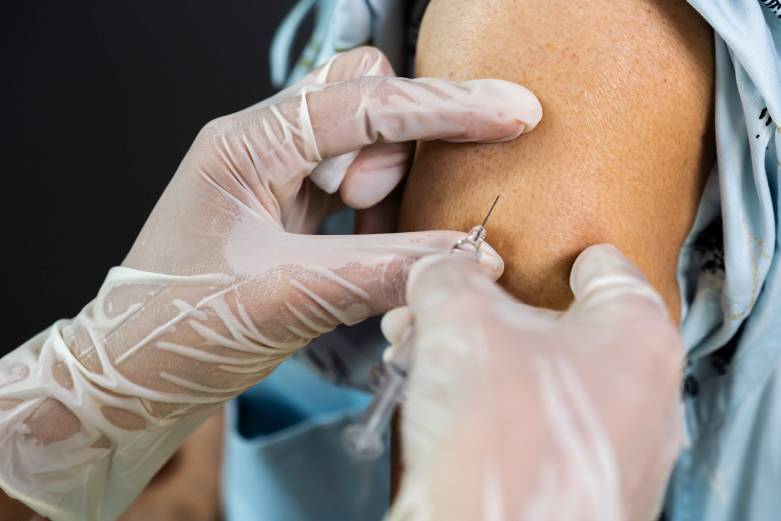 A medical professional is about to administer a drug via injection to a patient. Image source: geargodz/AdobeBy


