A prolonged heatwave in Siberia is “undoubtedly alarming”, climate scientists have said. The freak temperatures have been linked to wildfires, a huge oil spill and a plague of tree-eating moths.
On a global scale, the Siberian heat is helping push the world towards its hottest year on record in 2020, despite a temporary dip in carbon emissions owing to the coronavirus pandemic.
Temperatures in the polar regions are rising fastest because ocean currents carry heat towards the poles and reflective ice and snow is melting away.
Russian towns in the Arctic circle have recorded extraordinary temperatures, with Nizhnyaya Pesha hitting 30C on 9 June
(CNN Business)With meat prices on the rise, a plant-based protein purveyor is making a play for consumers’ pocketbooks.
Beyond Meat (BYND)next week plans to launch a value pack of its plant-based burger patties for sale in retailers’ frozen food sections. The Cookout Classic 10-pack, which Beyond Meat is positioning as a limited-edition product, was developed as a way to sell patties that otherwise would have been produced for restaurants, which have been devastated by the pandemic and stay-at-home measures.
The company wants to narrow the price gap between plant-based and animal meat, Chuck Muth, Beyond Meat’s chief growth officer, said via email to CNN Business. The 10-pack has a suggested retail price of $15.99, or $1.60 per quarter-pound patty. By comparison, Beyond Meat’s two-patty pack sells for $5.99, just shy of $3 per patty.
The product launch comes at a time when meat has been getting a lot more expensive. Prices for meat, fish, poultry and eggs rose 3.7% in May from April, according to the Bureau of Labor Statistics. Beef and veal prices were up 11%, the largest ever monthly increase.
“We know that to be successful we have to win on taste, win on nutrition, and ultimately win on price,” he wrote. “If we can do those three things, we see tremendous opportunity to transition consumers from animal-based to plant-based meat.”
The cheaper plant-based products are still expected to be sold at a premium to animal beef — even though the traditional meat is pricier than this time last year.
Beef patties averaged $5.26 per pound as of June 12, according to the US Department of Agriculture. Those prices are up 5.26% from the week before and 17.7% from the comparable year-ago period.
The value-pack launch is one of several efforts to garner new customers. Beyond Meat plans to launch a direct-to-consumer website this summer and also is offering some of its current lineup at a discount.
The value pack concept could offer an attractive entry point for new and more price-sensitive customers, wrote Jon Andersen, a William Blair analyst, in a June 10 note.
Additionally, the move serves as an operational solution for lost sales at restaurants and other foodservice locations negatively affected by shutdowns, Andersen noted.
APRIL 9TH 20__DAN ROBITZSKI__FILED UNDER: EARTH & ENERGY
Dire Warning
The global ecosystem is in far greater danger than scientists previously thought, according to a new study — and that’s really saying something.
The research predicts that without dire action to reverse global climate change, entire ocean ecosystems could suddenly collapse this decade, The Guardian reports. It’s a dire warning: as various organisms face temperatures higher than anything they have before, the study predicts sudden, massive die-offs.
Free Fall
The study, published Tuesday in the prestigious journal Nature, examines the temperatures that 30,000 land and sea organisms can withstand, and plots those ranges against the expected temperature increases through the year 2100.
As species hits their temperature thresholds, they may effectively vanish — and many are expected to do so at the same time, in what the researchers call an “abrupt exposure event.”
Logan Spanel, 30, of Broken Bow, was sentenced on Tuesday in federal court in Omaha for violating the Lacey Act.
According to the United States Attorney Joe Kelly, the act prohibits the trafficking in interstate commerce “tainted” (for example taken in violation of a law or regulation) wildlife, fish or indigenous plants.
Spanel admitted to two misdemeanor counts of the illegal taking of wildlife in interstate commerce.
He was sentenced to five years probation for the counts. During probation, Spanel will not be allowed to hunt, trap, or assist or be present with anyone engaged in those activities. He also had to forfeit a custom 300 caliber bolt-action rifle with a Sig Sauer tactical scope and SilencerCo suppressor utilized in one of the unlawful hunts and pay a $7,500 fine.
Spanel was employed by Hidden Hills Outfitters (HHO), a commercial big game guiding and…
A Florida man who shot and killed a black bear on the Kenai Peninsula and then transported it to the Lower 48 in violation of federal law received his sentence this week.
James L. Connolly, 63, of St. Petersburg, Florida, shot and killed the bear in the Skilak Wildlife Recreation Area in May 2018, according to a news release from the U.S. Attorney in the District of Alaska. The area is closed to all hunting and trapping.
After killing the bear, Connolly transported it to a tannery in California, which ultimately shipped it to Connolly in Florida.
Witnesses reported seeing the remains of a black bear near Skilak Lake Loop Road and others said Connolly told them he’d recently shot and killed a black bear in the area.
Investigators matched DNA samples from the blood at the kill site with samples…
The Mata Atlantica rainforest in Brazil. The government has reduced enforcement leaving the Amazon at risk from illegal logging and land conversion ( Getty Images )
Humanity’s broken relationship with nature has led to the coronavirus and other pandemics will follow, WWF International said, if the world continues to reject the warning signs.
WWF’s new report calls for an international effort to reduce the risk of the next animal-borne, or zoonotic, disease outbreak, including stopping the trade and consumption of high-risk wildlife, rampant deforestation and booming industrial agriculture and animal farming.
A long line of conservation and public health leaders have issued dire warnings in the wake of the pandemic, which has caused more than 439,000 deaths globally, and called for recovery plans to take into account both the environment…
Stop the Wildlife Trade exclusive: Bears, monkeys, wolves and birds of prey sold for hundreds of euros on popular Albanian websites, investigation finds
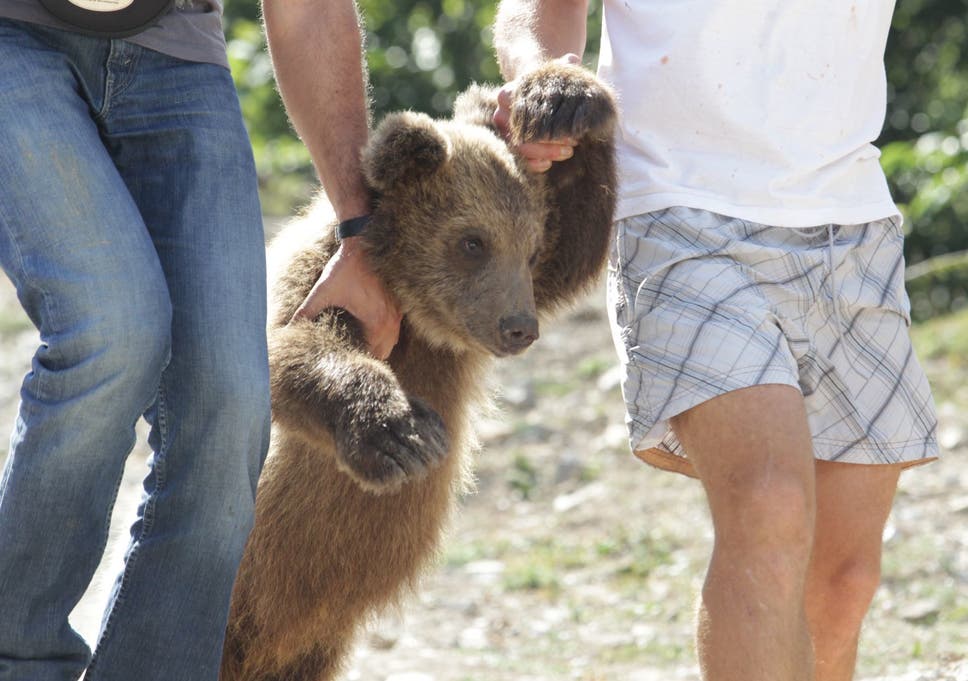
A cub kept by a hotel owner to attract tourists – a common practice in Albania ( Four Paws )
A restaurant in Albania is offering diners meat from illegally hunted bears – part of an illicit trade in wildlife that is “out of control” in the country, investigators claim.
Researchers said it was the first time they had seen bear meat cooked in Europe, and experts warned that the crude butchering of animals may lead to outbreaks of zoonotic diseases such as coronavirus.
Bears, monkeys and birds of prey are among live animals being sold on popular Albanian online marketplaces, the investigation found, raising fears for the survival of some species in the country.
Animal-protection charity Four Paws discovered that two of Albania’s leading online sites were carrying dozens of adverts selling brown bears and other species that are legally protected.
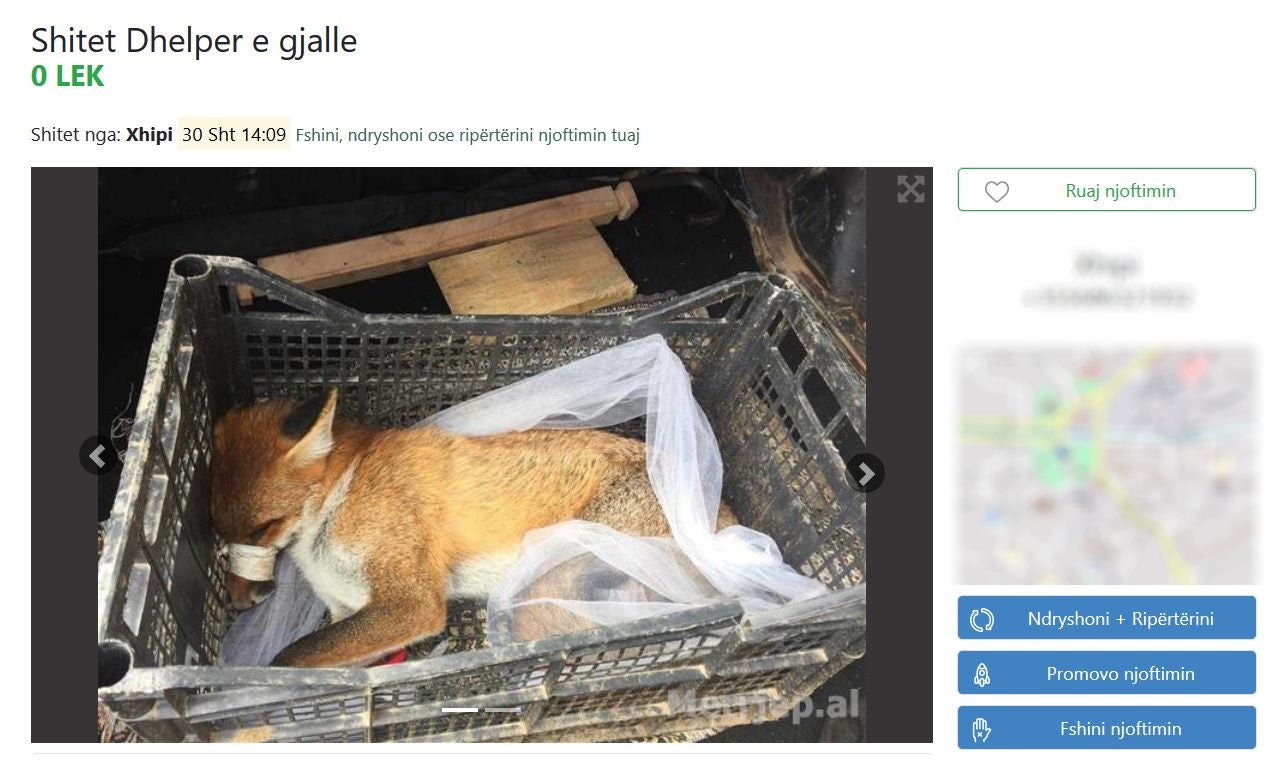
Many photographs of the animals – along with foxes, barn owls and wolves – showed them with their mouths taped up or their claws chained.
Stop the Wildlife Trade: Live animals for sale
Show all 10
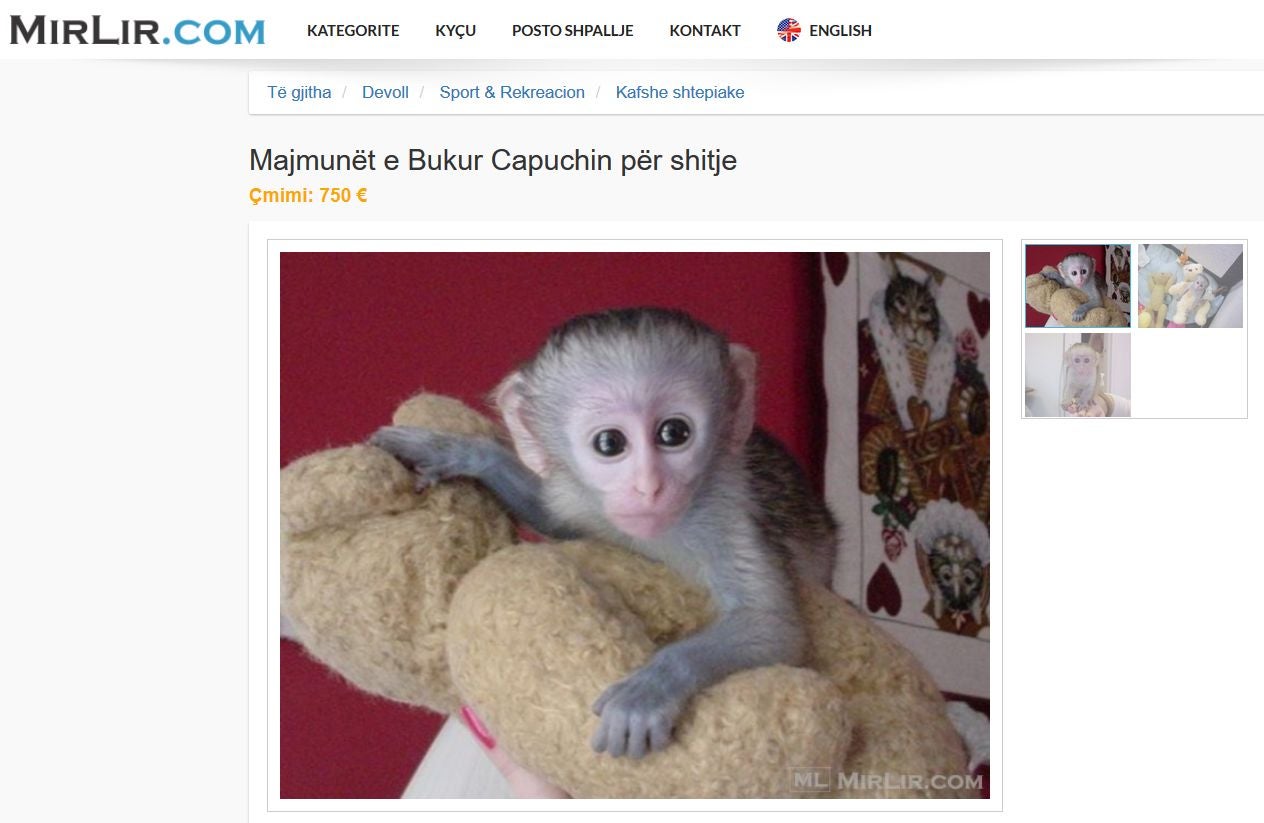
It’s a profitable business: a tiny capuchin monkey was offered for €750 (£675), and a barn owl, a bear cub and a wolf for €500 each.
The buyers are mostly restaurant and hotel owners who keep the animals to attract tourists, or individuals who want the animals as pets and status symbols, charity workers said.
Eagles, the national symbol of Albania, are especially popular with buyers and are often found stuffed as trophies in public places.
The menu featuring mish ariu – bear meat (PPNEA)
But hunting protected species, keeping them captive and selling them is banned in Albania, following a huge decline of native wildlife in the country.
Offenders may be jailed under the law, which was tightened in October, but enforcement of it is lax.
Four Paws said that after its team reported some of the illegal adverts, they were deleted but new ones reappeared.
“A large majority of the photographs displayed severe animal cruelty, such as foxes with sealed muzzles in plastic boxes, bear cubs in chains and birds with their feet tied,” said Barbara van Genne, of the chaity.
A tiny capuchin monkey on sale for €750 (Four Paws)
Monkeys and birds of prey are often kept in bars and restaurants in Albania as a tourist attraction, while foxes are sold for their fur, according to the investigators.
Wolves are bought to be cross-bred with dogs for the puppies to be sold as guard dogs, commonly used in the mountains against wolves. But other animals are killed, stuffed and put on display.
Animals’ mouths are often taped to prevent them biting and their feet chained to stop them running away.
A restaurant in the town of Drilon has also been found advertising bear meat on its menu on Facebook. The listing, for “mish ariu” – Albanian for bear meat – added “ne sezone”, meaning “according to season”.
A live fox with its mouth taped up advertised for sale (Four Paws)
An online restaurant portal, updated earlier this month, confirms the restaurant offering.
A spokesperson for Protection and Preservation of Natural Environment in Albania (PPNEA) said: “What is especially alarming about this is not only the fact that bear meat is being sold, it is also the addition in brackets of “ne sezone”, which gives the impression that there’s a hunting season for bears.
“In fact there’s no hunting season for any wild animals in Albania, there’s a hunting moratorium and hunting ban for years throughout the whole country – passed in 2014 and extended in 2016 until March 2021.
“The massive decline of wildlife in Albania triggered this.”
Bear meat dishes have previously been seen in Asian countries. The meat can trigger disease caused by parasites, with symptoms including diarrhoea, cramps, fever and hallucinations.
Prof James Wood, head of department of veterinary medicine and an infection expert at the University of Cambridge, said Covid-19 and other zoonotic viruses can be carried by contaminated meat from any species.
“However, the risks are far greater from butchering and hunting than they are from simple consumption,” he said.
“Bears are no more likely to act as a source of a zoonotic virus than any other species group.” He added that cooking was a highly effective means of destroying the Covid-19 virus and other infections, but that “eating bears is, of course, highly undesirable for many reasons, including conservation and animal welfare, if they have been kept in captivity before being killed”.
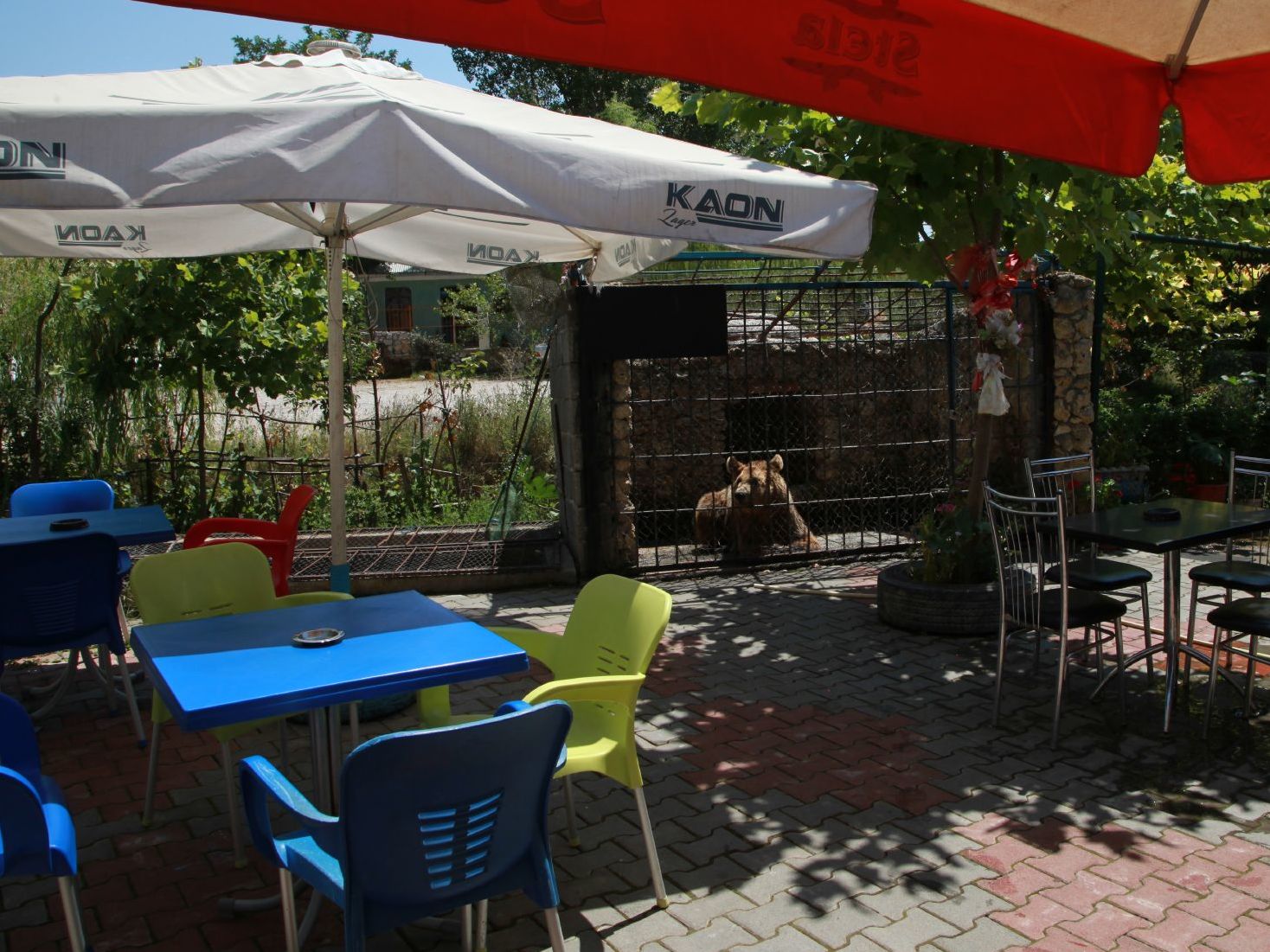
A bear kept in a cage at a restaurant (Four Paws)
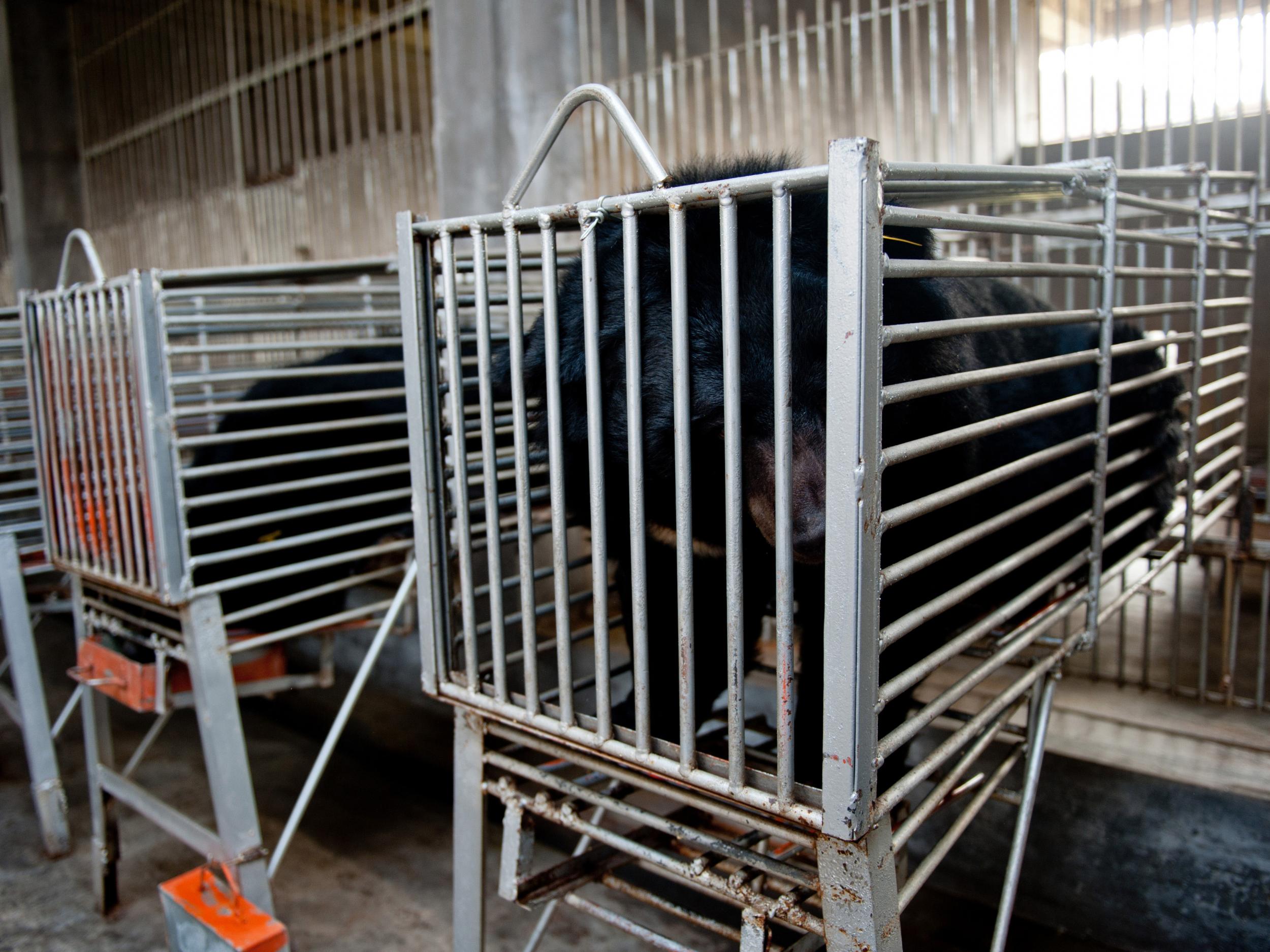
Ms van Genne said: “Four Paws has been active in Albania since 2015 but we have never seen such atrocities before. Until now we have mainly focused on restaurants that keep bears in small cages for entertainment of guests.
“This bizarre new discovery is a further indication that the commercial wildlife trade in Albania is out of control.”
She warned that if the government did not intervene soon, “the few native wild animals left will be history”.
“The platforms need to introduce preventive measures such as seller identification to stop these ads. However, the main problem for the illegal trade remains – the lack of control and enforcement by the authorities,” she claimed.
In the 1990s, there were still about 200 pairs of eagles in Albania, but today the number has halved.
A wildlife sanctuary that can carry out criminal prosecutions, take in rescues and educate people in species protection was urgently needed in Albania, Ms van Genne said.
Indian protesters burn effigies of President Xi after China border clash – video
What has happened?
At least 20 people have died in clashes between Indian and Chinese troops along the disputed Himalayan border running along the Ladakh area of Kashmir. It is the first fatal clash since 1975 and the most serious since 1967.
Fighting broke out on Monday evening when an Indian patrol came across Chinese forces on a narrow ridge. During the confrontation an Indian commanding officer was pushed and fell into the river gorge, sources told the Guardian. Hundreds of troops from both sides were called in and fought with rocks and clubs. Several fell to their deaths.
The Indian Army said there were casualties on both sides, and confirmed three of its soldiers were killed during the clashes, with another 17 later succumbing to injuries.
Beijing has refused to confirm any deaths on its side, but accused India of crossing the border twice and “provoking and attacking Chinese personnel”. The editor in chief of state-run the Global Times, said he understood there had been Chinese casualties, but the People’s Liberation Army wanted to avoid “stoking public mood” by comparing numbers.
Why now?
Tensions have been escalating since late April, when China sent thousands of troops into the disputed territory along the Line of Actual Control (LAC), bringing artillery and vehicles.
Analysts say the Chinese government, which has been more assertive in building infrastructure in the area, is anxious to frustrate any effort by India to upgrade its own military installations.
Their refusal to leave disputed areas, including the Galwan Valley inside Indian territory, has triggered shouting matches, stone-throwing and fistfights in key border areas. Last month, there was a massive brawl between patrols, but no deaths.
Earlier this month senior military leaders from both sides met and made a commitment to disengagement.
What is the history of the dispute?
India and China fought a war in 1962 over their contested border in the Himalayas. The war ended with a truce and the formation of a de facto boundary, known as the Line of Actual Control.
No official border has ever been negotiated, the region where the clashes occurred is hostile terrain, at high altitude and sparsely populated, running through the Ladakh region bordering Tibet, home to a Buddhist-majority population. It is a popular tourist destination.
What is the Line of Actual Control?
The LAC is a rough demarcation line separating Indian-controlled territory from Chinese-controlled territory. The exact location of sections of the line, particularly in the western Ladakh region, have remained in dispute. Efforts between the two countries to clarify the LAC have stalled in the past two decades, according to Indian media.
What do the two sides want?
Both countries have sought to establish their claims to territory, by heavily militarising the region. Both have built roads, airstrips, outpost stations, and other infrastructure, such as telephone lines. Troops conduct regular patrols along the disputed border. China claims more than 90,000sq km in the eastern Himalayas and another 38,000sq km in the west, both of which are disputed by India.
What next?
The conflict has enormous geopolitical consequences for the world. China and India are the two most populous nations on earth, and both are nuclear powers. They are led by governments run strongly along nationalist lines, and whose militaries are seen as markers of national status and pride.
Chinese state media has reported the PLA is conducting joint military exercises “aimed at the destruction of key hostile hubs in a high-elevation mountainous region”. The PLA Tibet Military Command conducted live fire drills with heavy artillery on Tuesday, with reports linking the PLA’s preparedness for high elevation combat to the clashes with India.
PORTLAND, Ore.— After a contentious 12-hour meeting, the Oregon Fish and Wildlife Commission rejected conservation proposals to adopt a uniform 24-hour trap check time for all wildlife and to ban beaver trapping on federally managed public lands.
The commission also voted 6-1 last Friday to continue the state’s existing furbearer trapping and hunting regulations for the next two years. Oregon’s trapping policies currently allow animals to languish in traps anywhere from 48 hours to 30 days, depending on how they are categorized by statute or rule.
“It’s troubling that the commission upheld Oregon’s cruel, outdated and wasteful trapping program for the benefit of just 1,000 licensed trappers in the entire state,” said Quinn Read, Oregon policy director at the Center for Biological Diversity. “This decision is completely out of step with Oregonians’ changing wildlife values. It’s time to relegate trapping to the dustbin of Oregon’s history.”
While the commission declined to adopt the conservation proposals, they voted unanimously to direct agency staff to review trap-check time requirements and identify proposals for rule changes by January 2021. The commission also supported the concept of forming a beaver working group and indicated its intent to define the roles and responsibilities of such a group at its July meeting.
The Center and its conservation allies advocated for two proposals to reform Oregon’s trapping program. The first proposal asked the commission to close federally managed public lands to commercial and recreational beaver trapping and hunting. Beavers and their dam-building activities are crucial to restoring riparian ecosystems and reducing the harms of climate change, yet beavers are still widely trapped and hunted across the state.
The second proposal asked the commission to adopt a more humane and consistent approach to trap check times by adopting a 24-hour trap-check time for all categories of native wildlife. This state’s current approach, which can leave traps unchecked for days or even weeks, imposes arbitrary suffering on different animals and is out of step with the majority of states that have adopted a daily or 24-hour trap-check requirement.
Oregon’s furbearer regulations govern the trapping of furbearers for their hides and pelts and accompanying reporting requirements. Under Oregon law furbearers include such animals as bobcats, muskrats, river otters, beavers and raccoons.
The Center for Biological Diversity is a national, nonprofit conservation organization with more than 1.7 million members and online activists dedicated to the protection of endangered species and wild places.