Exposing the Big Game

Forget Hunters' Feeble Rationalizations and Trust Your Gut Feelings: Making Sport of Killing Is Not Healthy Human Behavior

Exposing the Big Game

US producers ‘in tears’ at having to cull livestock on their farms

With slaughterhouse capacity in crisis due to Covid-19, one farmer believes he has developed a more humane way of ‘depopulating’ animals
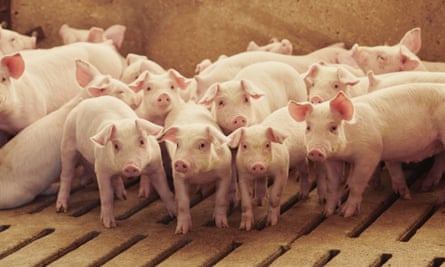
Pigs at a farm near Le Mars, Iowa

Pigs at a farm near Le Mars, Iowa. Breeders are having to slaughter animals on their farms. Photograph: Dan Brouillette/Bloomberg /Getty Images

Animals farmed is supported by

Animals farmedAbout this content

Published onWed 10 Jun 2020 06.29 EDT

As traumatised US farmers continue to cull their animals in response to the slaughterhouse crisis, an Iowan pig producer has developed an on-farm method which he believes is quicker and more humane than other available options.

The coronavirus crisis has hit US meat plants particularly hard. As a result there is a lack of slaughter capacity, and farmers are being forced to cull or “depopulate” their animals on-farm.

Approved methods include gassing with CO2, but the practice is controversial. “Dying this way is not a peaceful experience”, even under normal circumstances, let alone in makeshift sheds or trailers, said president of welfare group, Mercy for Animals, Leah Garcés.

Gassing the animals is currently thought to be one of the fastest and most humane methods, leaving animals unconscious within two minutes and dead within 10. The carcasses are incinerated, composted or rendered for fat, fertiliser and pet food.

But for Dwight Mogler of Iowa’s Pig Hill Farms, that is too long. Mogler is a sixth-generation pig farmer with firsthand experience of gassing newborn pigs. “I have talked to people who have been on site for a CO2 depopulation and we have used it for neonatal [new-born] pigs. It can take up to a minute,” he said.

Mogler, who produces about 150,000 pigs a year, says he is fairly confident the gassing is not painful for newborns, but it is disturbing. “There are muscle spasms and the limbs flail, but no vocalising,” he said.

Another depopulation option is overheating, or hyperthermia, commonly known as ventilator shutdown (VSD). A recent undercover video of an alleged VSD pig cull at a different Iowa producer contained disturbing scenes and sounds.

Asked about the video, Mogler said it would have involved turning off the ventilation, turning up the temperature and then the introduction of steam. “It would take less than one hour and any remaining pigs would be shot with bolt guns. It might only take 10 minutes in fact for the pigs to die. But for us that is too long.”

Having rejected CO2 and VSD, Mogler decided to build his own cull facility. It will replicate a slaughterhouse death time of less than two seconds. Ready to undergo testing, Mogler’s system consists of a mobile unit with a V-restrainer, an electrical stunning point and a captive-bolt gun.

Mogler aims to slaughter about 170 pigs every 45 minutes, using a rotating slaughter crew to avoid mental or physical fatigue. “Our capacity would be about 1,500 to 2,000 pigs a day,” he said, and no pig caretakers will be involved in the slaughter.

As well as developing his own cull technique, Mogler donated two pigs to a Missouri sanctuary. Initially reluctant, because the goals of a sanctuary are so at odds with those of a farmer, Mogler changed his mind after talking to a rescue coordinator. “ I found we had so much more in common [than expected]”, he said.

Donating pigs to food programmes is another option for farmers, particularly with so many Americans facing increased financial and food insecurity, but slaughtering remains a challenge. For a few there is still space at local lockers, as Iowa’s smaller, state-inspected butchers are known. Most, however, are already overwhelmed, with some fully booked into 2021.
Despite donation difficulties, psychologist and Iowan farmer Dr Michael Rosmann thinks it’s worth the effort. “It helps the farmers a bit, to know they have tried to find a solution for at least some of their pigs,” Rosmann said. “It’s probably only going to help with about 1% of their animals. These are farmers with anywhere from 3,000 to 10,000 pigs. It’s a very complex situation and it is not going to end soon.”

Farmers are extremely distressed by the possibility of having to depopulate their animals, said Rosmann, who has talked to several in the past few weeks. “One of them was in tears. He could not bring himself to kill his pigs and he was asking for advice,” Rosmann said. “My suggestion was to find food programmes or local butchers, or people who are able to butcher the animals themselves – that’s allowed by law, if you kill it and eat it yourself.” Sadly, he said, many of those able to slaughter their own animals might be illegal migrants and afraid to come forward.

At industry level, Iowa Pork Producers Association spokesperson, Dal Grooms, said its newly created food-bank donation programme, Pass the Pork, has seen 48,404lb of pork, about 456 pigs, enter the food chain via local lockers.

Wandering humpback whale likely killed in ship collision, says necropsy team

Dead whale shows signs of acute trauma, says veterinary professor

The lifeless body of young humpback whale was found drifting in the St. Lawrence River, near the Verchères archipelago, early Tuesday. (Paul Chiasson/The Canadian Press)
229
comments

Preliminary results of a necropsy show a boat strike likely killed the humpback whale whose body was found drifting down the St. Lawrence River near Varennes, Que., early Tuesday, say veterinarians who are examining the carcass where it was hoisted from the water, in Sainte-Anne-de-Sorel.

The whale, vigorous when she was first spotted near the Jacques Cartier Bridge on May 30, drew hundreds of people to the Old Port to catch a glimpse of the rare sight. The whale was last spotted alive Sunday near Pointe-aux-Trembles, at the northeastern end of the island of Montreal and was then seen, lifeless, near Île-Beauregard, six nautical miles away.

Université de Montréal Prof. Stéphane Lair, a veterinary pathologist leading the team conducting the necropsy, said the whale had suffered trauma under its skin and in its muscles. The accumulation of blood in the whale also suggests that a collision fatally wounded the animal, said Lair.

Lair confirmed the young humpback was a female, between two and three years of age.

He said his team will analyze samples from the necropsy in the lab before confirming the cause of death in a month or two.

If indeed a boat did strike and kill the whale, Laird said, the vessel would have had to have been very large.

WATCH: Veterinarian on what he found in whale necropsy:

Watch

Preliminary findings show whale was hit by boat

  • 1 day ago
  • 0:30

The team led by Université de Montréal veterinary Prof. Stéphane Lair says early findings from the necropsy suggest the humpback whale was struck by a boat. Lair says a final diagnosis could take as long as two months. 0:30

“If they hit the whale during the night, there’s a good chance they might not have noticed it,” Lair said.

The whale had some skin damage from the time it had spent in fresh water, Lair said, but it otherwise looked to be in good health.

Humpback whales can survive a journey through fresh water for at least three weeks and return safely to the ocean, said Robert Michaud, the co-ordinator of the Quebec Marine Mammal Emergency Response Network.

“We thought this animal could make it,” said Michaud, who is also the founder and scientific director of the Group for Research and Education on Marine Mammals, based in Tadoussac, Que.

Lair said he can’t yet confirm if the whale had been eating but said it is possible the whale, at least in the early part of her journey from salt water upstream to Montreal, could have been chasing schools of fish.

Michaud and his network had hoped they could help the whale return safely to her natural habitat, keeping close tabs on her until they lost track of the whale Sunday morning, he said.

A crew from the University of Montreal veterinarian school performs a necropsy on the whale in Sainte-Anne-de-Sorel, Que. (Paul Chiasson/The Canadian Press)

Seattle law enforcement experts urge police to take back CHAZ before it’s too late

Law enforcement officials are urging the Seattle Police Department to retake control of the East Precinct after hundreds of demonstrators overtook Monday the six-block area that surrounds it.

Officers effectively abandoned the area during violent clashes with demonstrators calling to defund the police.

Demonstrators have since set up occupancy in that section of downtown Seattle and have renamed it “Capitol Hill Autonomous Zone” (CHAZ).

SEATTLE ‘AUTONOMOUS ZONE’ HAS ARMED GUARDS, LOCAL BUSINESSES BEING THREATENED WITH EXTORTION, POLICE SAY

The portion of downtown Seattle that the protesters are now occupying.

The portion of downtown Seattle that the protesters are now occupying.

“It can’t continue like that,” Jim Fuda, a law enforcement expert and the director of law enforcement services for Crime Stoppers –­ which works with SPD –­ told Komo news.

“Some action is going to have to be taken. Is there federal laws broken? Does the FBI need to come in? But at some point, arrests and these people are going to have to be removed, if they don’t move.”

A volunteer works security at an entrance to the so-called "Capitol Hill Autonomous Zone" on June 10, 2020 in Seattle, Washington. The zone includes the blocks surrounding the Seattle Police Departments East Precinct, which was the site of violent clashes with Black Lives Matter protesters, who have continued to demonstrate in the wake of George Floyd's death. (Photo by David Ryder/Getty Images)

A volunteer works security at an entrance to the so-called “Capitol Hill Autonomous Zone” on June 10, 2020 in Seattle, Washington. The zone includes the blocks surrounding the Seattle Police Departments East Precinct, which was the site of violent clashes with Black Lives Matter protesters, who have continued to demonstrate in the wake of George Floyd’s death. (Photo by David Ryder/Getty Images)

Photos of the area show protesters have remained peaceful –­ pitching tents, painting, watching outdoor movies and holding gatherings with music and speeches –­ but police have also said they have received numerous complaints about armed guards surrounding the perimeter and asking residents who live in the area to show ID.

Police have also alluded to the potential extortion of local businesses and citizens.

placeholder

Despite concessions by the city, including a 30-day ban by Mayor Jenny Durkan on officers deploying tear gas to disperse large crowds, as well as police officers shuttering the Third Precinct and retreating from the area, protesters have not shown signs of allowing police back in.

People sit in Cal Anderson Park in the so-called "Capitol Hill Autonomous Zone" on June 10, 2020 in Seattle, Wash. (Photo by David Ryder/Getty Images)

People sit in Cal Anderson Park in the so-called “Capitol Hill Autonomous Zone” on June 10, 2020 in Seattle, Wash. (Photo by David Ryder/Getty Images)

“Where are the rest of the citizens and their need for service?” Fuda said, pointing to the fact that police have limited their activity completely and are only responding to 911 calls.

The SPD is working on a strategy to negotiate with protesters but has been unable to identify the leaders of the group.

Michael Solan, president of the Seattle Police Officers Guild, told Fox News’ Laura Ingraham on Wednesday that the occupy-style demonstrations have gone too far and “is absolutely unreasonable activism.”

“We lost a precinct, now, what’s next? Are we going to lose another precinct? The city council has removed our ability to have less lethal ammunition for us to properly protect those facilities and protect ourselves,” Solan said.

Coronavirus Infections Are Actually Rising in at Least 20 States as Nation Reopens, Hits 2 Million Cases

Exposing the Big Game's avatarThe Extinction Chronicles

Reuters / Jason Redmond

View original post

Agriculture and livestock: Are they victims or perpetrators of climate change?

June 11, 2020 /https://www.thedailystar.net/opinion/news/agriculture-and-livestock-are-they-victims-or-perpetrators-climate-change-1912177
LAST MODIFIED: 01:54 AM, June 11, 2020

Though much of the world is focused on transitioning away from fossil fuels as a way to fight climate change, there are other often overlooked contributors to the conundrum resulting from climate change. Two of them are agriculture and livestock. Sure, they provide us with the food we eat every day. But cumulatively, they are also the second largest contributor to greenhouse gas emissions after fossil fuels.

While the majority of global warming activities give off carbon dioxide, the agricultural sector primarily releases methane, which is a greenhouse gas 28 times as potent as carbon dioxide over a 100-year period. The source is mainly rice that is grown on flooded fields with depleted dissolved oxygen. In the absence of oxygen, organic matter in the soil decomposes and produces methane that escapes into the atmosphere. Rising temperatures would cause rice cultivation to release even more methane.

Another source of methane is ruminants, particularly cows and goats. As part of their digestion cycle, they expel intestinal gases, mostly methane, via belches. Methane can also escape from stored manure and organic waste in landfills. If manure is stored as a liquid or slurry in ponds, tanks or pits, it decomposes anaerobically (in the absence of air) and emits a prodigious amount of methane. However, when handled as a solid or deposited naturally on grassland, manure decomposes aerobically and creates negligible methane emissions. Ruminants, manure and rice cultivation account for almost 25 percent of anthropogenic methane emissions.

One of the methods of reducing methane emissions from rice fields, as suggested by scientists at the World Resources Institute, is to plant rice in a raised bed and flood only the furrows. This method has the potential to cut methane emissions in half.

Controlling methane emissions from ruminants is more difficult than trimming or regulating methane emissions from fossil fuels. A large number of mitigation options—namely, diet manipulation, vaccines, chemical additives and genetic selection—have been proposed. They have different efficiencies in lowering production of intestinal methane.

Methane emissions from manure depend on temperature and storage duration. Results from typical Canadian farms indicate that use of underground manure storage tanks, maintained at lower temperatures, lessens methane emissions. Additionally, farmers found that if they clean the tanks regularly, it took longer for methane-producing organisms to grow back. Consequently, methane emissions decrease substantially.

As for agriculture, according to a report of the United Nations published last year, about 50 percent of the Earth’s cultivable land is dedicated to growing crops for humans and roughly 30 percent is used to grow grain for livestock. Given how much land it takes to grow food to feed livestock, a very vocal segment of environmentalists insist that “meat is heat” and encourage consumers to go vegan.

Moreover, in line with the projected population growth, global demand for food is expected to grow by up to 70 percent in the coming decades. This substantial increase in demand would require clearing more space for agriculture and cattle grazing, so that the per capita threshold of land required for a nation to be self-sufficient in food production could be maintained. Vast swaths of the Amazon Rainforest, along with lands and forests in other places, are already being cleared for growing crops and grazing cattle. If current trends continue, most of our planet’s remaining land and forests would need to be cleared to feed the world.

Deforestation and land degradation indirectly contribute to the negative impacts of atmospheric carbon dioxide. One of the main reasons for this is because forests are natural carbon sinks. They absorb carbon dioxide from the atmosphere and converts it into oxygen that we breathe in. Hence, by cutting down big areas of forest without replacing the trees that are removed, we are causing an inadvertent change in the amount of carbon dioxide in the atmosphere.

Several studies indicate that planting more than two billion acres of trees could remove two-thirds of all the carbon dioxide that human activity has pumped into the atmosphere since the Industrial Revolution. Trees also recharge the water table and create microclimates that increase local rainfall. In addition, deforestation puts biodiversity at risk, further undermining nature’s ability to cope with the impacts of climate, for example absorbing heavy rainfall.

Clearly, agriculture in general, and livestock in particular, contribute considerably to climate change. Nevertheless, climate change is also a major threat to the sustainability of livestock globally. An increase in air temperature as a result of global warming directly affects milk and meat production, reproductive efficiency and health of the animals. Also, excessive heat would reduce their body size and fat thickness.

Agriculture is also highly vulnerable to climate change. It is affecting food security by raising the risks to food supply due to heat waves, drought, flood, storms, soil depletion and desertification. Over the coming dozen years or so, farmers in developing countries, especially in South and Southeast Asia, will be the ones to bear the brunt of global warming, as per a recent report of the Food and Agricultural Organization of the UN.

It could, therefore, be said that agriculture and livestock farming are caught in a vicious cycle that makes them both victims and perpetrators of the harmful effects of climate change. Most of the times when agriculture perpetrates its crimes, it is not even contributing to feeding the ever-increasing world population. Instead, a good portion of the agricultural products are consumed by livestock—mostly bovines—which demonstrates this paradox.

How do we solve this complex problem? The solution obviously requires a coherent and integrated approach to climate change, energy usage and food security. Faced with global warming, competition for scarce resources, and inaction by world leaders, we, the people, have to transform the entire global food system and make it much more resource-efficient while continuously curbing its environmental impacts, including its greenhouse-gas emissions.

We also have to increase yields while curtailing dependence on agrochemicals. Besides, we should minimise food waste, cut down consumption of resource-intensive and greenhouse gas-producing foods, notably meat, and switch to climate-friendly vegetables, such as the nutritionally rich seaweed kelp. Farming kelp is beneficial for the ocean.

Furthermore, employing sustainable practices, like organic agriculture, has enormous potential to help in the fight against global warming, whereas maintaining the status quo with widespread industrial agricultural practices will continue to be terribly detrimental to the climate. In short, making agriculture and livestock industries and all associated activities sustainable is the answer to win the battle against global warming, as well as accelerate the transition to a healthier and more just society.


Quamrul Haider is a Professor of Physics at Fordham University, New York.

WILD WHITE STORK CHICKS HATCH FOR THE FIRST TIME IN OVER 600 YEARS

Wild White Stork Chicks Hatch for the First Time in Over 600 Years

In an incredible historic event, five white stork chicks have hatched in the United Kingdom for the first time in over half a century. The last record of white stork chicks hatching in the wild in the UK was in 1416 on the roof of St. Giles Cathedral in Edinburgh.

In April, five eggs were observed in a nest, and in May, The White Stork Project announced that all the baby storks had successfully hatched at the Knepp Estate in West Sussex.

“After waiting 33 days for these eggs to hatch, it was extremely exciting to see signs that the first egg had hatched on May 6,” said Lucy Groves, a project officer for the White Stork Project. “The parents have been working hard and are doing a fantastic job, especially after their failed attempt last year. These are early days for the chicks, and we will be monitoring them closely, but we have great hopes for them. This is just one step towards establishing this species in the South of England. It may be a small step, but it is an exciting one.”

White Stork Project@ProjectStork

We are excited about the news of the first white stork chicks in hundreds of years.

They are only recently hatched & take 60 days to fledge.

We are asking that people give them the space needed at this critical time & do not disturb the nesting sites at @KneppSafaris

Photo credit : Brad Albrecht
43 people are talking about this

Nested in a large oak tree, the family is doing well, and the vigilant parents have been observed regurgitating food to feed their new arrivals.

The mother stork is from Poland and came to the project in 2016, and her mate is believed to be one of the 20 or so transient storks that fly to the country every year.

“This stunning species has really captured people’s imagination,” Groves added, “and it has been great following the sightings of birds from the project during the period of lockdown and hearing about the joy and hope they have brought to people.”

The White Stork Project is a joint venture between wildlife conservation groups and private landowners. It aims to restore the white stork population to at least 50 breeding pairs in southern England by 2030.

Trump administration opens Alaska’s national preserves to cruel practices like trophy-hunting denning bears and wolves and their cubs; proposes disbanding protections on Kenai Wildlife Refuge

By Kitty Block and Sara Amundson

June 10, 2020 0 Comments

The Trump administration has given trophy hunters the green light to commit some of the worst sort of carnage on 20 million acres of Alaska’s pristinely beautiful national preserves.

Under a new rule finalized this week, trophy hunters can, starting next month, kill hibernating mother black bears and their cubs in their dens with the aid of artificial lights, shoot wolf and coyote pups and mothers at their dens, use bait like donuts and meat scraps to attract brown and black bears, shoot vulnerable caribou while they are swimming (including with the aid of motorboats), and use dogs to hunt black bears.

This is yet another dastardly move from an administration that, from the start, has carried out a no-holds-barred assault on America’s—and the world’s—most precious wildlife. From weakening protections for native American wildlife covered by the Endangered Species Act to allowing trophy hunters to import the trophies of endangered animals likerhinos and lions, the Department of the Interior, under Trump, has consistently played into the hands of trophy hunters and other corporate interests to dismantle the progress we’ve made for wildlife over decades.

A lot of this, including the National Park Service rule finalized this week, has involved reversing protections for wildlife put in place by the Obama administration.

And they’re not done. Just today, the Department of the Interior proposed another rule, again to overturn the prior administration’s rule that barred baiting of brown bears on two million acres of public lands in the state’s Kenai National Wildlife Refuge. Hunting of brown bears over bait is an extreme practice and biologists have been raising alarms about the loss of brown bear populations in Alaska.

We already know what the carnage sanctioned by these rule changes will look like. Before the 2015 rule, thousands of bears and wolves were shot from the air, killed over bait barrels, clubbed or shot in their dens and hunted down with lights at night. Many of these cruel practices professed to reduce numbers of iconic predators in order to boost prey species for hunters, but science has shown that nature cannot be manipulated this way without terrible results.

We have seen brown bear numbers across Alaska dwindle because of intensive management. State lands, where the egregious practices now permitted by the NPS rule are already allowed by the Alaska Board of Game, have seen sharp drops in wildlife populations. Alaska state officials should prefer their wildlife alive rather than dead because the tens of thousands of wildlife watchers who trek into the state each year put far more money into the state’s coffers than a handful of trophy hunters seeking to kill the animals do.

The Humane Society of the United States, along with a coalition of organizations, is currently in federal court defending the Obama-era NPS and Kenai rules. These changes are unlawful because Congress requires that the Department of the Interior conserve and protect wildlife in national preserves and national wildlife refuges. By opening season on the animals it’s supposed to protect just to appease a few trophy hunters, the agency—and this administration—have not only shown themselves to be extremely poor stewards of our public lands, they have let down a majority of Americans who would never sanction such cruelty against our native wildlife.

Sara Amundson is president of the Humane Society Legislative Fund.

White House goes quiet on coronavirus as outbreak spikes again across the US

Exposing the Big Game's avatarThe Extinction Chronicles

It’s been more than a month since the White House halted its daily coronavirus task force briefings.

The coronavirus task force’s daily updates to state officials have been sent with less regularity | Saul Loeb/AFP via Getty Images

It’s been more than a month since the White House halted its daily coronavirus task force briefings. Top officials like infectious disease expert Anthony Fauci have largely disappeared from national television — with Fauci making just four cable TV appearances in May after being a near fixture on Sunday shows across March and April — and are frequently restricted from testifying before Congress. Meanwhile, U.S. President Donald Trump is preparing to resume his campaign rallies after a three-month hiatus, an attempted signal…

View original post 1,787 more words