Hospitalizations from coronavirus rose sharply in at least nine U.S. states following Memorial Day weekend.
Seven-day average cases of coronavirus have risen across the country in a trend not attributable solely to an increase in testing, the Washington Post has found. While coronavirus hospitalizations are difficult to track because of differences in how states report data, the nine states in which hospitalizations have clearly risen are Texas, California, Oregon, North and South Carolina, Mississippi, Utah, Arkansas, and Arizona.
Texas has seen a 36 percent increase in new cases since Memorial Day, with coronavirus hospitalizations at a record high of 2,056 as of Tuesday. There were 1,935 hospitalizations in the state on Monday.
Arizona reported a 49 percent increase in hospitalizations, from 833 on Memorial Day to 1,243 by Tuesday. At the same time, 76 percent of the state’s ICU beds were occupied…
Coronavirus found in men’s semen. Can it spread through sex?01:33
(CNN)The New York City Health Department is encouraging people to “be creative” in its updated guidelines to help people have safer sex during the Covid-19 pandemic.
While the department still urges people to stay home as much as possible and minimize contact with others, the guidance says that during the pandemic people “will and should have sex.”
The guidelines were created to reduce the risk of spreading Covid-19. They’ve been updated periodically to reflect the changing understanding of the disease.
A brown bear hunts for salmon in a river. VWPICS/Gavriel Jecan/Universal Images Group via Getty Images
The Trump administration just scrapped an Obama-era ban on a series of hunting practices that limited how hunters killed bears and wolves on Alaskan national preserves.
Hunters will soon be able to blind bears with lights, hunt them down with dogs, and bait them with human food like doughnuts.
They’ll also be able to kill wolves and coyotes in summer, when mothers wean pups, and it will be legal to shoot caribou from motorboats or while they’re swimming.
Some Alaskan politicians have welcomed the rollbacks, but conservationists have called them “amazingly cruel,” The Guardian reported.
The Secret Service protection for Donald Trump Jr.’s August 2019 trip to Mongolia, where he reportedly hunted a rare breed of sheep, cost taxpayers $76,859.36, according to documents published Wednesday by a Washington ethics watchdog.
The first set of Security Service documents obtained by Citizens forResponsibility and Ethics in Washington through a Freedom of Information Act request put the cost of protection for President Donald Trump’s eldest son’s eight-day trip at about $17,000. CREW appealed that response to its request, believing it was undercounting the actual cost.
A source close to Trump Jr. told USA TODAY that the president’s son personally paid for “100%” of the trip other than the protective detail.
In May, Secret Service Deputy Director Leonza Newsome informed CREW in a letter that its appeal was granted and that a new search uncovered “an additional document containing costs” regarding the trip. Newsome said an updated…
The increase in cases can’t solely be attributed to increased testing in Arizona, experts say.
Instead, it looks like the state is trending upward in a way that is concerning and could need another stay-at-home order to curb the spread.
“I would go so far as to say alarming,” said Dr. William Hanage, an epidemiology professor at Harvard University’s T.H. Chan School of Public Health. “The only sort of crumb of comfort that I can find is that I think, in general, it’s sort of easier to social distance in Arizona than it is in some places.”
Argali sheep are considered a near-threatened species, in large part due to trophy hunting. Long Zhiyong / Moment / Getty Images
Donald Trump Jr.’s hunting expedition to Mongolia last summer, where he had the distinction of killing a rare breed of sheep, cost taxpayers at least $76,859.36, according to documents unearthed by a watchdog group.
Citizens for Responsibility and Ethics in Washington, or CREW, originally received Secret Service documents in March that showed that Secret Service protection for the trip cost at least $17,000, a fraction of the more than $75,000 it actually cost taxpayers. However, those numbers looked fishy to CREW, since it did not make any mention of flight costs, nor it did it account for Trump Jr.’s trip to Mongolia’s capital city, Ulaanbaatar, where he had a secretive meeting with Mongolian President Khaltmaagiin Battulga…
The glossy ibis, a migratory bird that winters in the tropical island of Sri Lanka, has been observed nesting there for the first time in nearly 150 years.
Sri Lanka is a key stopping point for nearly 250 species of migratory birds, many of which have in recent years appeared to be staying over for longer or visiting in larger numbers.
While climate change has been identified for changes in the migratory behavior of many species, in this case it appears that local conservation efforts have succeeded in attracting bird species that historically used to frequent Sri Lanka in large numbers.
Bundala National Park, where the glossy ibis flock is nesting, has been shut to visitors since mid-May because of the COVID-19 pandemic; once it reopens, park managers plan to keep visitors away from the nesting site so as not to disturb the birds.
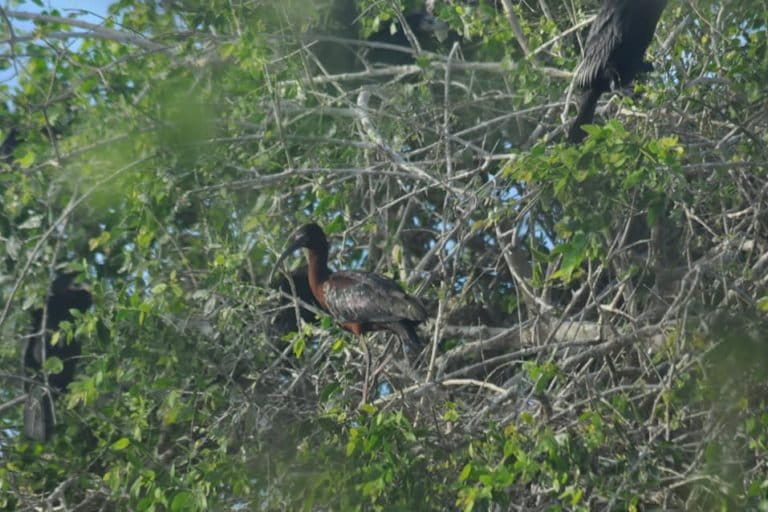
BUNDALA, Sri Lanka – The glossy ibis (Plegadis falcinellus) is a fairly rare but regular winter visitor to Sri Lanka, seen at the Bundala National Park in the island’s south before it leaves again in spring. So the sight of these black birds in the middle of May left park warden Ajith Gunathunga puzzled. He kept his trained eye focused on the species, and on May 21 discovered them nesting — with chicks in the mix.
“The glossy ibis build their nests in a colony where some other waterbirds also nest. I could observe about 20 glossy ibis in the location and total of six nests with a few of them having little chicks, fed by the adults,” Gunathunga told Mongabay.
Six glossy ibis nests have been observed in Bundala National Park in southern Sri Lanka. Image courtesy of Ajith Gunathunga.
Bundala is Sri Lanka’s first Ramsar wetland and is popular with migratory and pelagic birds. The ibis nesting colony was discovered near a safari jeep track popular with tourists; but because all national parks across Sri Lanka have been closed since mid-March in response to the COVID-19 pandemic, the birds were able to enjoy undisturbed parenting time.
Authorities now plan to keep this particular jeep track closed beyond the lockdown period to prevent disturbance to the nesting birds. Sri Lanka has eased many of the restrictions imposed during the lockdown, but all national parks remain closed. Gunathunga said that once Bundala opens, visitors including birdwatchers will be kept away from the nesting sites.
At a distance, the glossy ibis appears rather blackish and dull, but a closer look at a breeding bird shows up the glossiness of its plumage — a spectacular combination of deep maroon, emerald, bronze and violet. Image courtesy of Vimukthi Weeratunga.
Protecting breeding sites
The May 21 observation of the glossy ibis nests with chicks in them came almost 10 weeks after the park was shut down. Glossy ibis eggs take about three weeks to hatch; before that, the breeding pair needs about four weeks for site selection and nest building. That suggests they benefited for much of that cycle from having a visitor-free park to themselves, says Sampath Seneviratne, senior lecturer in zoology with the University of Colombo and president of the Field Ornithology Group of Sri Lanka.
“It is possible that these birds found conditions favorable for breeding even before the lockdown, though the lockdown itself would have contributed to a calmer environment,” he told Mongabay.
He added that migratory waterbirds tend to nest in this ad-hoc manner if conditions are suitable, and that it’s possible the glossy ibis would breed in Sri Lanka next spring too. “If the new chicks after maturity also breed in the island, then we can safely record that Sri Lanka has a resident breeding population of the glossy ibis,” Seneviratne said.
A flock of glossy ibis in the semi-urban Thalawathugoda wetland in Sri Lanka’s commercial capital, Colombo. Image courtesy of Rishi Gunasinghe.
That wouldn’t be unprecedented, says Jagath Gunawardana, an environmental law expert and birding enthusiast. He points to an 1872 observation by the ornithologist William Vincent Legge on glossy ibis breeding in Sri Lanka. According to Legge’s History of the Birds of Ceylon, eight nests were recorded at a lake in Thissamaharama in the south, just 16 kilometers (10 miles) from Bundala national park. But the birds disappeared in the first quarter of the 20th century for reasons unknown, Gunawardana told Mongabay. The glossy ibis made a comeback in 1952 to Kalametiya, also close to Bundala, and after that in Bundala itself, Gunawardana said.
In 1973, a solitary glossy ibis was reported in the Nedimala wetlands in suburban Colombo, Sri Lanka’s commercial capital. A flock of eight glossy ibis was recorded in 1990 from the urban Bellanwila-Attidiya sanctuary; 34 individuals were recorded at the same site in 1995, Gunawardana added.
“Glossy ibis dons breeding plumage just before leaving Sri Lanka in end-March or April,” he told Mongabay. “On a number of occasions, I observed them collecting twigs that are used for nest building. However, no nests were built in the urban locations this time around.”
According to Seneviratne, Sri Lanka is home to 508 bird species, nearly half of which (245) are migratory. Their routes are known as flyways, and Sri Lanka is the last landmass south along the Central Asian flyway.
Glossy ibis flocks with large numbers of individuals are a common sight on the island of Delft off Sri Lanka’s northern tip. Image courtesy of Amal Karunatilaka.
Unusual observations
The glossy ibis is just one of a growing number of migratory birds increasingly passing through Sri Lanka. In 2012, the knob-billed duck (Sarkidiornis melanotos) reappeared on the island after an absence of more than half a century. Since that first sighting, the duck has become a regular winter visitor to Sri Lanka with a growing number of sightings.
The glossy ibis has increased its visits to the country since 2015, according Seneviratne. He said he observed a flock of more than 100 individuals this past May, with many in their breeding plumage. While he could not find evidence of breeding, he has continued to observe large flocks of glossy ibis.
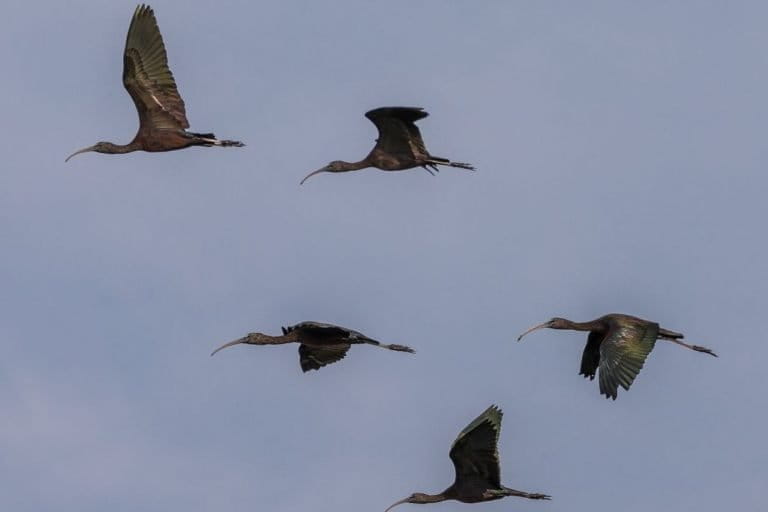
A flock of glossy ibis in flight. Image courtesy of Evarts Ranley.
Climate change has been cited as a factor for changes in migratory patterns among many species, but the main factor here appears to be the success of conservation measures in attracting migratory birds to breed and nest, Seneviratne said.
“This could be a positive response to some of the conservation efforts bearing fruit, resulting in populations of birds increasing as conditions become favorable for them,” he said.
The decision carried further significance because it was attributed in part to Kim Yo Jong, the sister of North Korean leader Kim Jong Un.
Kim Yo Jong, right, sister of North Korean leader Kim Jong Un, helps Kim sign joint statement following the summit with South Korean President Moon Jae-in at the Paekhwawon State Guesthouse in Pyongyang in 2018.Pyongyang Press Corps Pool / AP file
North Korea announced Tuesday it was axing all communications with South Korea, a move analysts believe could be an attempt to manufacture a crisis and force concessions from its neighbor.
The decision carried further significance because it was attributed in part to Kim Yo Jong, the sister of North Korean leader Kim Jong Un, who has risen in prominence in recent weeks.
North Korea said it was suspending contact in anger at activist defectors who have fled to…
An environmental group on Tuesday said it will sue the White House if President Trump doesn’t walk back an executive order that waives endangered species protections along with a host of other environmental laws.
The Thursday order from Trump relies on emergency authority to waive the requirements of a number of environmental laws, arguing the U.S. needs to fast-track construction projects to fight the economic fallout tied to the coronavirus pandemic.
The order could be a boon to controversial projects that have lingered while agencies undertake environmental reviews, ranging from pipelines to oil and gas drilling to highway construction.
Weighing how those projects might impact imperiled plant and animal life is just one of the considerations.
But the suit from the Center for Biological Diversity argues the Trump administration is violating laws that allow for sidestepping environmental review only in fast-moving emergencies like an environmental disaster.
“Congress made the deliberate decision not to elevate general economic activity and ordinary infrastructure projects above the interests of imperiled species but, rather, to ‘afford’ listed species ‘the highest of priorities’ even above the ‘primary missions’ of federal agencies,” the Center wrote in its letter of intent to sue.
The letter follows guidelines requiring a 60 day notice before filing a suit.
“President Trump has used his lawful executive authority to expedite infrastructure projects and the economic recovery while protecting the environment, and CBD is misreading the plain text of the order to push a radical, Green New Deal-like agenda,” White House spokesman Judd Deere said in an email, using an abbreviation for the Center.
The Trump administration has taken a number of steps to weaken the Endangered Species Act.
A rule finalized by the administration in August dramatically scales back America’s landmark conservation law, limiting protections for threatened species and how factors like climate change can be considered in listing decisions. It also curbs the review process used before projects are approved on their habitat.
The Thursday order also lifts environmental review required under the National Environmental Policy Act and the Clean Water Act — all of which Trump argued was necessary.
“From the beginning of my Administration, I have focused on reforming and streamlining an outdated regulatory system that has held back our economy with needless paperwork and costly delays,” Trump wrote in the order. “The need for continued progress in this streamlining effort is all the more acute now, due to the ongoing economic crisis.”
However, numerous legal experts have expressed concern over the use of emergency authority by the White House, and additional lawsuits are likely.
“Trump’s authoritarianism seems to reach deranged new levels every week,” Kierán Suckling, the Center for Biological Diversity’s executive director, said in a release.
“The president’s not above the law. Inciting federal agencies to violate the Endangered Species Act is part of a pattern he’s displayed throughout his presidency. He’s encouraging officials to ignore the rules and obey his whims,” he added.