Exposing the Big Game

Forget Hunters' Feeble Rationalizations and Trust Your Gut Feelings: Making Sport of Killing Is Not Healthy Human Behavior

Exposing the Big Game

Apply for urban archery deer hunts

LITTLE ROCK — If you’re looking for an extra opportunity to put some meat in the freezer this fall, feed needy Arkansans and help control urban deer populations, now is the time to start planning.

Registration for the 2020 Arkansas Urban Archery Hunts is open until midnight Aug. 12 at https://www.agfc.com/en/hunting/big-game/deer/urban-archery-hunt.

Russellville is included in the areas open for the hunt.

Urban archery hunts are more than an added opportunity for hunters, they’re a sound technique to manage deer populations where they have become too abundant and have caused conflicts with people.

Ralph Meeker, the deer program coordinator for the Arkansas Game and Fish Commission, says certain wildlife populations have flourished in the last five decades, but there can be a downside. Each year, deer cause thousands of dollars in damage to people’s landscaping and present a danger to motorists in rural neighborhoods.

Archery hunter in tree stand”All wildlife have what is called ‘social carrying capacity,’” Meeker said. “That’s the density of a wildlife population where they begin to become a nuisance or danger. A few areas in Arkansas that have high populations of people in relatively rural settings have reached this threshold, so the AGFC works with those cities and towns to find solutions.”

Urban hunts are one of the best tools wildlife managers can use to reduce these populations without more expensive techniques such as sharpshooters.

Hunting is the most efficient means we have to control deer populations,” Meeker said. “We have hunters who want to help, and the harvest helps control the deer’s numbers.”

Even deer that are not harvested will scatter back to surrounding wildlife habitat once the added hunting pressure is apparent.

“These hunts allow hunters to enjoy their sport while offering an important service to the public and contribute to needy Arkansans throughout the state,” Meeker said. “All hunters must donate their first adult deer harvested to Arkansas Hunters Feeding the Hungry.”

Meeker works with the Arkansas Bowhunters Association and city officials to coordinate the hunts throughout the state. Hunters who participate in the hunts must attend an orientation where they must pass a proficiency test with the archery equipment they intend to use during the hunt. An orientation fee is collected, which covers the insurance policy for the hunt most cities require.

Meeker says the added attraction of an early September hunt also helps drive people to participate.

“Urban hunts open Sept. 1, so they’re the best chance an Arkansas hunter has at getting a buck in velvet, which is on some hunter’s bucket lists,” Meeker said. “Early season hunting isn’t for everyone, but the hunts continue all the way through the end of February for some locations, giving hunters plenty of time to harvest an urban deer.”

Bowhunting qualifierAll urban hunts follow stringent guidelines to ensure the safety of hunters and local landowners is maintained, some of these guidelines differ from hunt to hunt. In addition to orientations and shooting proficiency tests, all hunters must have passed the International Bowhunters Education Program course to participate.

Deer harvested during urban hunts do not count toward a hunter’s seasonal limit. There are no limits to the number of deer that can be harvested in urban hunts and all antler restrictions are lifted. All deer harvested must still be checked to the appropriate urban deer zone.

OVERSET FOLLOWS:Additional hunting areas are Fairfield Bay, Cherokee Village, Horseshoe Bend, Heber Springs, Helena/West Helena, Hot Springs Village, Bull Shoals, and Lakeview.

https://www.boonevilledemocrat.com/sports/20200609/apply-for-urban-archery-deer-hunts

Bugs and Daffy can rest easy: No more hunting rifle for Elmer Fudd

Exposing the Big Game's avatarCommittee to Abolish Sport Hunting Blog

Elmer Fudd (and hunting rifle) in 2012's "Daffy's

Elmer Fudd (and hunting rifle) in 2012’s “Daffy’s Rhapsody.” Credit: Warner Bros. / Courtesy Everett Collection

Elmer Fudd is hanging up his hunting rifle.

“We’re not doing guns,” Peter Browngardt, executive producer of the new HBO Max series “Looney Tunes Cartoons,” told The New York Times in a May 29 article, which did not gain widespread notice until a trade report about it was published on Saturday. Browngardt, 40, a Sag Harbor native who attended Pierson Middle School there, added, “But we can do cartoony violence. TNT, the Acme stuff. All that was kind of grandfathered in.”

In this latest iteration of the Warner Bros. theatrical cartoons that reached their creative peak in the 1940 and ’50s, neither put-upon hunter Elmer Fudd nor Old West cowpoke Yosemite Sam carry firearms. The same also was true of the 2011-14 Cartoon Network series “The Looney…

View original post 158 more words

Coronavirus in DR Congo captured on camera

Exposing the Big Game's avatarThe Extinction Chronicles

A collaborative online project is documenting the challenges facing the Democratic Republic of Congo as it tackles Covid-19, measles and Ebola in 2020.

Vendors and shoppers at Kituku market on the shores of Lake Kivu in GomaImage copyrightMOSES SAWASAWA FOR FONDATION CARMIGNAC

Congo in Conversation is a website that chronicles the country’s human, social and ecological challenges in the current health crisis.

A stream of articles, photo reports and videos will be uploaded to the site from journalists and photographers based in DR Congo, many of whom are Congolese.

The website was produced by Foundation Carmignac and the Canadian-British photographer Finbarr O’Reilly.

The Foundation Carmignac provides a grant each year to an individual who will produce work that focuses on topical issues such as human rights and the environment.

O’Reilly was awarded the 11th Carmignac Photojournalism Award. As part of the award, the photographer planned to produce a photo report on DR Congo in…

View original post 989 more words

Whether it’s hogs or hawks, game wardens stay busy

In the midst of a pandemic and all the social distancing that involves, life still goes on out in the boonies, where game wardens ply their trade among the hunters and fishers of Texas.

And since I get their press release reports, I like to pass them on, since you never know what’s going to turn up next in our great state.

One of the current occupations, designed to rid our countryside of marauders, is the hunting of feral hogs, which is not only legal, but encouraged, everywhere.

I have a friend who shoots them and burns their carcasses in a pit on his farm. But that’s sort of a waste, don’t you think? Rumor has it that those big old pigs make great pork roasts.

A game warden in Freestone County was called by a landowner who said he allowed a man to hunt hogs on his land, but the man also killed a deer, which isn’t legal except during the proper season.

The guy said he had shot it by accident. Questionable?

So, he got charged with a bunch of stuff.

In the same county, there were people hunting hogs from a helicopter. And that’s allowed, with proper credentials.

A man and wife were working cattle on their land when the helicopter began to hover and shoot feral hogs. They waved their arms and the helicopter flew away, but the warden found it and filed charges.

If the copter pilot had gotten permission, he probably could’ve bagged all the hogs he managed to shoot.

Somebody needs to get rid of them all because they’re not only tearing up pastures and woodlands but destroying people’s lawns and flower gardens.

One report that I liked said meat from hogs killed by hunters had been given to needy people. That also happens with deer killed illegally.

More: https://www.galvnews.com/opinion/guest_columns/article_91b1368d-fd2b-58da-98ae-20df518b852f.html

Increasing Escape of Oxygen From Oceans Under Climate Change

Exposing the Big Game's avatarThe Extinction Chronicles

Geophysical Research Letters June 16, 2020

Abstract

The global oxygen cycle is one of the most important cycles on Earth for all aerobic organisms, and it is a basic constraint sustaining aerobic life. As a major component of the cycle, oceans are now experiencing widespread declines in oxygen concentrations. Here, based on model simulations we found that ocean deoxygenation occurs as a result of oceanic oxygen outgassing, which is tightly related with the marine warming. Although the O2 flux from the ocean to atmosphere is quite small compared with that of oceanic oxygen production, this outgassing accounts for almost all of the decline in marine oxygen and even exceeds the amount of the loss. The model projections indicate accelerated oxygen escape from the ocean under climate change. The oceanic outgassing will…

View original post 460 more words

Probe ends into Manitoba Mountie’s hunting accident; officer refused interview


WINNIPEG —Manitoba’s police watchdog says an investigation into an off-duty Mountie who reportedly shot himself in the foot while goose hunting has ended because of a lack of information.

The Independent Investigations Unit’s report into the Sept. 7 shooting notes that RCMP didn’t report it for nearly three months, which made collection of evidence from the scene near Grunthal, south of Winnipeg, difficult.

The unit’s civilian director, Zane Tessler, says initial information indicated the officer had surgery and may have had a toe or toes amputated, but he exercised his right to refuse to be interviewed by investigators.

The officer also wouldn’t consent to the release of his medical records.

The report says officers saw the Mountie being treated by ambulance staff and he had a bandage on his big toe, but they didn’t take adequate notes at the time.

The officers also didn’t record the name of a potential witness and decided no further action was necessary.

No gun wasn’t seized and officers recorded no information about the weapon, other than that it appeared to be a shotgun.

The report says investigators were not able to determine the nature or extent of the officer’s injuries. And because so little could be determined, the file was closed.

“For all intents, this investigation ended almost as soon as it began. If not for the diligence of senior RCMP management, who discovered the oversight of the delayed notification and took immediate steps to rectify the matter, IIU would never have known,” Tessler wrote.

“We anticipate that senior RCMP management will deal with the issues identified in this report that effectively rendered this investigation null.”

This report by The Canadian Press was first published May 11, 2020.


Trump Jr.’s argali trophy hunt in Mongolia cost American taxpayers $77,000

Trump Jr.’s argali trophy hunt in Mongolia cost American taxpayers $77,000

By Kitty Block and Sara Amundson

June 9, 2020 3 Comments

We’ve just learned that Donald Trump Jr.’s trophy hunting trip to Mongolia, where he hunted an argali sheep—an animal listed as “threatened” under the U.S. Endangered Species Act—cost American taxpayers a whopping $77,000.

The revelation comes from the watchdog group Citizens for Responsibility and Ethics in Washington (CREW), which dug into expenses Trump Jr. incurred for this controversial trip made last year. Following an initial Freedom of Information Act request, the group was provided with Secret Service protection costs alone—around $17,000 for the trip. It was only after an appeal that CREW received information of other expenses, including flight costs and a stop Trump Jr. made in the capital city of Ulaanbaatar, where he met with the Mongolian president, putting total expenses for that trip at the much higher figure of $76,859.36.

Trump Jr. is an avid trophy hunter and his exploits targeting at-risk animals, including leopards and elephants, are well documented. While all trophy hunting—done purely for fun and the thrill of killing a majestic animal—is unethical and disturbing, what is more outrageous about the president’s son’s pursuit of his deadly pastime is that Americans now have to pay for it.

The trip to Mongolia last August was an ethical minefield from start to finish. ProPublica, which originally broke the story of that trip, reported Trump, Jr. did not even have a permit from Mongolian officials when he shot the animal – it was offered to him afterwards, raising questions about whether he received special treatment from the Mongolian authorities. Argali are prized as a national treasure in Mongolia, and the permitting system for hunting one, according to ProPublica, is based on money, connections and politics.

The hunt itself was conducted at night, with a laser-guided rifle.

Back home, Trump Jr. has established himself as a champion of trophy hunting interests, peddling his famous last name for more privileges and perks, always at taxpayer expense because he receives Secret Service protection on all his trips. In February, he was the guest of honor at the Safari Club International’s annual convention, where the lives of 860 animals, including lions, polar bears, zebras and buffalo, were auctioned off. This included winning bids totaling $340,000 by two hunters for an opportunity to stay on a yacht with and join Trump Jr. in hunting black-tailed deer and sea ducks in Alaska.

Trophy hunters are usually a privileged lot with pockets deep enough to influence policies that favor their bloodlust. But Trump Jr. is not just any trophy hunter. As the president’s son he has an unparalleled ability to potentially influence our government’s policies on the world’s most endangered animals. But just like the Trump administration—which has launched repeated attacks against the most at-risk wildlife in the world, including hacking at the Endangered Species Act to benefit trophy hunters and mining and oil-drilling interests—Trump Jr. has failed to use his power to do good.

We are not staying silent. We’re challenging the administration’s changes to the ESA in court, and we are in good company, with many animal protection and environmental organizations joining us. We have also petitioned the U.S. Fish and Wildlife Service to refuse a permit for Trump Jr. to import the trophy of that sheep. Argali from Kyrgyzstan, Mongolia and Tajikistan are listed as threatened in the ESA, and import of a hunting trophy of an ESA-listed species can be authorized only if it furthers conservation. There is no evidence that this was the case here, or that recreational killing for trophies ever promotes conservation.

Being the president’s son may come with perks, like a retroactive permit from Mongolia to slay an argali and a red-carpet welcome from the world’s largest trophy hunting group; but it also comes with the scrutiny of his questionable spending of taxpayer resources by organizations like ProPublica and CREW, and opposition to his wildlife-killing activities from animal protection groups like ours. Americans do not want their money misused in a manner that will do permanent damage to the world’s most at-risk animals, and we will hold those who do so accountable, no matter how powerful and influential they are.

Sara Amundson is president of the Humane Society Legislative Fund.

China raises protection for pangolins by removing scales from medicine list

Exposing the Big Game's avatarCommittee to Abolish Sport Hunting Blog

Campaigners hope the move will help end global trade in the scaly anteater, identified as a possible host for Covid-19

Published on Tue 9 Jun 2020 12.30 BST

Pangolin scales have been removed from an official 2020 listing of ingredients approved for use in traditional Chinese medicine in a move lauded by animal protection groups as a key step in stamping out trade in the scaly anteater, the world’s most trafficked mammal.

As many as 200,000 pangolins are consumed each year in Asia for their scales and meat and more than 130 tonnes of scales, live and dead animals were seized in cross-border trafficking busts last year, a figure estimated to represent up to 400,000 animals, according to conservation group WildAid.

Trade in all eight species of pangolin are protected under international law and three of the four native to Asia are included on the red list of the International…

View original post 764 more words

Cruel practice of trapping animals with explosive fruit should stop

Elephants or Wild Boars:  By Shreya | Updated: Monday, June 8, 2020, 13:20 [IST] New Delhi, June 08: The death of a starving, pregnant elephant in Palakkad allegedly consuming a pineapple stuffed with explosives caused outrage on social media. The jumbo went through unthinkable trauma, stood impassively in a river and died a slow death. Video grab Various theories have shrouded the ghastly death of the elephant. While people are blaming the farmer responsible for the incident, it is important to note that the elephant was an unintended target. Primary investigations into the death of pregnant elephant in Kerala has found that it may have accidentally consumed a cracker-stuffed fruit, the environment ministry noted. NGT takes cognisance of elephant death in Kerala, seeks action-taken report from panel India public places reopen even as Covid-19 infections surge by 9000 for 5 days | Oneindia News The government noted that many a times locals resort to an illegal act of planting explosive-filled fruits to repel wild boars from entering plantation farms. In a series of tweets, the ministry has said that one person has been arrested in the matter. “Primary investigations revealed, the elephant may have accidentally consumed in such fruit.” Ministry is in constant touch with Kerala Govt and has sent them detailed advisory for immediate arrest of culprits & stringent action against any erring official that led to elephant’s death,” the ministry said. “As of now, one person has been arrested & efforts are on to nab more individuals who may have participated in this illegal & utterly inhuman act. The @WCCBHQ has also been directed to act on this matter with utmost sense of urgency. #WildlifeProtection,” the ministry posted on its official Twitter handle. So now, it has come to the light that the elephant had strayed into a trap that was intended for wild boars. Wild boars are a chronic problem to farmers because they tend to destroy crops in their search for food. To avert them, farmers have come up with cruel methods like the explosive-laced traps that claimed the elephant’s life. It’s a common practice in most of the Indian states to ward-off the animals. But that does not make this practice less evil and it has to stop at any cost. The intended target is an elephant or a wild boar, it is an inhumane method of dealing with wildlife.

Read more at: https://www.oneindia.com/india/elephants-or-wild-boars-cruel-practice-of-trapping-animals-with-explosive-fruit-strap-should-stop-3101171.html

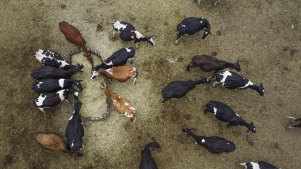
Scientists lock horns over climate change impact of cattle

https://www.smh.com.au/politics/federal/scientists-lock-horns-over-climate-change-impact-of-cattle-20200602-p54ymo.html

The livestock industry says the standard method of calculating the global warming contribution of methane significantly overstates the impact of cattle and is calling for policy changes that could slash the emissions counted against the industry.

While some scientists are backing the proposed change, others argue it could lead to an overly optimistic assessment of the climate change contribution of the industry, which committed in 2017 to achieve net zero emissions by 2030.

Due to a series of droughts, the national cattle herd has shrunk 12 per cent in the past 20 years.
Due to a series of droughts, the national cattle herd has shrunk 12 per cent in the past 20 years.CREDIT:ALEX ELLINGHAUSEN.

Livestock are the main contributor to agriculture sector emissions. Cows’ gassy burps are loaded with methane, a byproduct of digesting grass. Last year agriculture emissions accounted for 12.9 per cent of Australia’s total greenhouse gas output, down 5.8 per cent as farmers reduced their stock due to drought.

In 1997 the Intergovernmental Panel on Climate Change agreed on a methodology to account for the global warming potential of greenhouse emissions over a 100-year time frame, known as the GWP100.

However, some scientists promote a new accounting methodology known as GWP Star, which counts the global warming potential of greenhouse gases over 20 years.

Methane emissions break down in the atmosphere over 12 years, much quicker than carbon dioxide, which takes 100 years to break down.

Tony Hegarty from the Cattle Council said GWP Star could provide a “more accurate approximation of the actual warming” caused by methane over its lifetime.

“We are prepared to allow the scientists to do the analysis. It’s better for us to call on the government and international community to have a serious conversation. I’m very confident it’s a more accurate approach and it could make a significant difference to our [cattle industry] emissions,” Mr Hegarty said.

The GWP Star method says the greenhouse effect of methane should not be calculated in the same way as carbon dioxide. Under this methodology, when an industry increases above the baseline of emissions starting in 1997, that is counted as growth.

But significantly, a decrease below the 1997 baseline is counted as emission reduction. In this way, when industry emissions fall below the baseline set 23 years ago, it can claim not to be contributing to additional global warming.

Melbourne University agriculture Professor Richard Eckard, who endorses using GWP Star, said the Australian national herd has declined by 12 per cent over 20 years and under GWP Star this would be recognised as net greenhouse gas reduction.

“This calculation shows that livestock in Australia have potentially contributed to a cooling rather than warming, relative to the period prior to 1997,” Professor Eckard said.

However, other scientists say the rate of breakdown doesn’t change the impact of a gas on warming if it’s continually topped up by grazing cows, even while emissions break down.

Australia National University Climate Change Institute director Professor Mark Howden said the atmospheric heating effect of methane “is not fundamentally different to carbon dioxide”.

“There’s a difference in the lifespan of the gases but because there are constant emissions the build-up in the atmosphere is the same,” Professor Howden said.

He said the 20-year accounting time frame also ignores historical emissions.

“GWP Star is trying to compensate for the different lifespan of greenhouse gases, but in doing so it actually grandfathers previous emissions levels (before 1997), which brings all sorts of problems into the system.”

Professor Howden said under GWP Star when an industry reduced its methane emissions by 12 per cent, it may claim to contribute to global cooling and “get a green light”, whereas under the existing GWP100 approach it would still get a red light – just slightly less red.

“These are pretty fundamental differences,” he said.