Dugan Traversie was sentenced June 4 in federal court to a year of probation and ordered to pay $9,000 restitution to the Timber Lake Elk Ranch where he poached this buck on or about Oct. 28, 2019 near Isabel, S.D., which is on the Cheyenne River Indian Reservation. The ranch had clients slated to pay $25,000 to hunt the buck, a prosecutor said Thursday at the sentencing. Traversie posted this photo of himself with the deer’s severed head in early November on social media. It got picked up by hunting-related social media across the country, including Hunting News.
Courtesy photo
A federal magistrate judge in Pierre on Thursday sentenced Dugan Traversie to a year of probation, a year without hunting, and to pay restitution of $9,000 to the Timber Lake Elk Ranch where he poached a whitetail buck with a freakishly huge set of antlers.
Coronavirus outbreaks at U.S. meatpacking plants continue to soar as the beleaguered industry ramps up production, scales back plant closures and tries to return to normal in the weeks after President Donald Trump declared it an essential operation.
Trump’s April 28th executive order followed the industry’s dire warnings of meat shortages and invoked the Defense Production Act to compel slaughterhouses and processing plants to remain open.
The order had a chilling effect on the steady drumbeat of closures that had come to symbolize the crisis throughout April and early May. Nearly three dozen coronavirus-affected plants temporarily shuttered in the month leading up to Trump’s executive order. In the five weeks since then, just 13 have closed, according to tracking from the Midwest Center for Investigative Reporting.
But the number of coronavirus cases tied to meatpacking plants has more than doubled since then, topping 20,400 infections across 216 plants in 33 states, according to tracking from USA TODAY and the Midwest Center for Investigative Reporting.
At least 74 people have died.
That’s despite widespread implementation of protective measures like temperature checks, plastic barriers and social distancing meant to curb the virus’ spread inside the plants. Some of the recent outbreaks happened at facilities that had taken such steps.
Tyson Foods, for example, announced in mid-April it was providing face masks to all employees and installing barriers between workers. Since then, 24 of its plants have reported outbreaks, including two in Iowa that sickened more than 800 workers total. The company had just five plants with outbreaks prior to the announcement of safety measures.
Likewise, Smithfield Foods said it was installing barriers, adding more hand sanitizing stations and “enhancing cleaning and disinfection” at its facilities after an outbreak at Sioux Falls, South Dakota, plant in early April. Since then, 11 of its plants have reported outbreaks, including one in southern California in late May. It had just one plant outbreak prior to the announcement of safety measures.
One federal meat inspector in the Midwest told USA TODAY that workers in several plants she visits on the job were not wearing masks and practiced only limited social distancing. Some, she said, had also recently tested positive for COVID-19.
“I’m thinking, ‘Wow,’ I don’t think I’m safe here,” said the inspector, who agreed to an interview on the condition of anonymity because she was not authorized to speak to the media.
Even after informing a supervisor at the U.S. Department of Agriculture’s Food Safety and Inspection Service about the lax conditions inside the plants, she said, she was told that as long as she had a mask, she had to work. Otherwise, she said, she was told she could use vacation time or take unpaid leave.
“I shouldn’t be forced to not take pay or use my vacation, or take the chance of losing my life,” she said.
Across the United States, some of the highest spikes in coronavirus cases recently occurred in counties with one or more meatpacking plants — Buena Vista County, Iowa; Beadle County, South Dakota; Yell County, Arkansas; and Titus County, Texas, for example. All saw their case counts more than double in the past two weeks, a USA TODAY data analysis found.
‘Callous disregard’ for health
Experts say Trump’s executive order prioritized meat production over the lives of plant workers, many of whom are rural, immigrant and undocumented and who face already dangerous conditions for low wages.
“I think it’s a callous disregard for the health, safety and even lives of the people who work for you,” said Lawrence Gostin, a Georgetown professor and director of the WHO Collaborating Center on National & Global Health Law. “Employers and government, including the president, hold a duty to every American to keep them safe, and there’s a breach of that duty.”
The White House did not respond to requests for comment on the effect of the executive order or the continued rise in COVID-19 cases across slaughterhouses and processing facilities.
“We strongly believe the safety measures we’ve put in place are helping to protect our team members and minimize the spread of the virus in the communities where we operate,” said Tyson spokesman Gary Mickelson.
Without the safety measures in place, the case counts might have been even higher, said KatieRose McCullough, director of regulatory and scientific affairs at the North American Meat Institute, an industry lobbying group.
The United Food and Commercial Workers Union, many times an adversary to major meatpacking companies, also vouched for the industry’s efforts.
Mark Lauritsen, the union’s director of food processing, meatpacking and manufacturing, said conditions at plants where the UFCW represents workers have almost “universally improved.” That’s particularly true, he said, in facilities that closed amid outbreaks to fully rework their processes before re-opening.
“It really gave us the opportunity to push these employers to take that down time to reengineer and increase the safety protocols,” Lauritsen said. “An expansion of (personal protective equipment), enhanced sanitation, all of the other things we were pushing. Those things have all taken place.”
“But I want to be clear,” Lauristen said. “There’s still a lot of work to be done.”
Some worker protections, though, have started to roll back.
The USDA rescinded its policy that all at-risk inspectors can stay home, said Paula Schelling, acting president of the American Federation of Government Employee’s Council 45, citing the workplace improvements that are supposed to take place under the CDC guidance.
And Tyson recently reinstated a policy that effectively penalizes workers for taking sick leave, although the company said workers sick with COVID-19 or displaying symptoms were being asked to stay home and provided with short-term disability pay.
Tyson’s Mickelson said he’s unsure why the company’s plants continue to have outbreaks.
“We don’t think anyone can say with certainty why COVID-19 affects different communities across the country at different times and in different ways,” Mickelson said.
Order stopped a likely shutdown
Experts argued Trump’s order doesn’t prevent state and local public health officials from shutting down plants, though it might have discouraged them.
That was certainly the case in St. Joseph, Missouri, where Trump’s order was a “very important” part of the city’s decision to leave a coronavirus-affected meatpacking plant open, the city’s Director of Health Debra Bradley told USA TODAY.
In late April, Bradley and other city leaders debated whether they could close the local Triumph Foods pork processing plant amid numerous complaints that employees were forced to work while sick and a small but steady rise in coronavirus cases.
“Shut it down,” St. Joseph Mayor Bill McMurray told city attorney Bryan Carter and others in an April 22 email obtained by USA TODAY. With nine cases at Triumph at the time, he pushed for the state to be notified.
“Given the other meatpacking plant problems around the country, I was just very concerned that we were going to grow to a huge number of cases,” McMurray said in an interview.
The next day, Bradley emailed local officials that the state Department of Health and Senior Services drafted a policy allowing local health authorities to close a business in a pandemic.
She added that DHSS Director Randall Williams “asked what Triumph’s threshold was for closing and I told him that I don’t think they intend to close.”
Williams advised waiting on the results of some 2,800 tests the state sent to St. Joseph before deciding. And given the changes Triumph had made — including temperature checks and putting up barriers in the cafeteria — Bradley advised giving the plant time to act.
Trump’s order on April 28 seemed to have stopped any such discussion, according to Bradley’s emails. That day, Carter sent her a link to a CNN article about Trump’s executive order. The article’s headline: “Trump orders meat processing plants to stay open.”
“You may have seen this already, but it looks like closing Triumph may not be an option,” Carter wrote.
Two days later, DHSS announced that 126 Triumph employees had tested positive for coronavirus, including at least 92 who had no symptoms.
To date, 490 Triumph employees have contracted the virus. One of them, a 40-year-old man, has died. He had tested positive on April 22 — the day local officials began debating whether they could close the plant.
Triumph Foods has remained opened despite a Change.org petition with more than 7,000 signatures calling for its closure. It has not reported any new cases since May 15. The company did not immediately respond to a request for comment.
“It wasn’t until we did the mass testing that we realized how widespread it was within the facility,” Bradley told USA TODAY. “At that point, my staff was essentially saying that because it was so widespread that it wouldn’t really necessarily make a difference whether it was closed or not. And because it is identified as a critical infrastructure facility, we just went ahead and left it open.”
Those guidelines take priority over any state or local order to close, according to a statement released the same day by OSHA’s lead agency, the U.S. Department of Labor.
Public health agencies face potential litigation if they try to close the plants, experts said. But many agreed that state and local health officials retain the authority to close them.
“What I think we can conclude is that the executive order is meant to add weight to the CDC and OSHA guidance, but it is just that — guidance,” said Jill Krueger, Northern Region director for The Network for Public Health Law.
Working with plants is generally preferable to shutting them down because it lets public health officials put controls in place that they can’t in workers’ homes and communities, said Nathaniel Smith, director of the Arkansas Department of Health and president of the Association of State and Territorial Health Officials.
“We didn’t close any down at the time because when it was kind of in vogue to close down we weren’t really having any cases or not having very many cases,” Smith said. “Now we’re having lots of cases, but we’re still not closing down. … If we can make the work site safer, that’s a major control point.”
Weakened guidelines
At stake is worker safety. But the joint guidance issued by OSHA and the CDC and cited in Trump’s executive order say plants must make only “good faith” efforts to keep workers safe.
“Modify the alignment of workstations, including along processing lines, if feasible, so that workers are at least six feet apart in all directions … when possible,” the guidelines stipulate.
A month later, it’s unclear what, if any, impact the guidelines have had.
“They can say, ‘Well we tried but it costs too much money,’ then they’re off the hook,” Lauristen said. The guidelines “are as worthless as the copy paper they’re printed on.”
It’s also unclear who’s enforcing the joint guidance.
It’s not federal food inspectors, said Schelling of the American Federation of Government Employee’s Council 45, the union representing USDA inspectors.
Despite the government’s official position that the joint guidelines should be in place at every plant, Schelling said regional supervisors and frontline employees have no power to ensure compliance.
“We have no regulation in place that we can hang our hat on that says, ‘Plant, you need to put these controls in place,’” Schelling said. “You can have the conversation, but there’s nothing enforceable that can be taken against the plant.”
Officials from OSHA have previously said they can enforce the guidelines under a legal provision that employers have a general duty to provide safe working conditions. But it’s unclear how rigorously the USDA follows up with plants to ensure changes have been made.
While Schelling agreed major companies like Smithfield and Tyson have largely improved their work spaces, smaller plants that employ a few dozen workers and have more limited resources have not.
“There’s no social distancing,” she said. “There’s no PPE that the company employees are being mandated to wear.”
The USDA issued letters to governors and major meatpacking companies on May 5 to set clear expectations for the implementation of the executive order, an agency spokesperson said in an email to USA TODAY.
“Since then,” the spokesperson said, “the USDA has worked with the CDC and OSHA, state and local leaders and public health officials, and meat processing facilities to affirm they will operate in accordance with the CDC/OSHA guidance to keep these critical facilities open while maintaining worker safety.”
But the industry’s continued inability to prevent the spread of the virus points to an ineffectiveness of those guidelines, said Adam Pulver, an attorney at the watchdog group Public Citizen.
“It’s certainly not like we’re out of the woods and the problems have stopped — we’re still seeing daily reports of outbreaks in plants,” Pulver said. “The recommended precautions are not anywhere sufficient to really prevent transmission. The only real way to prevent transmission would require really significantly slowing down and reconfiguring the way these plants operate, spacing out workers in a way that they’re just not willing to do.”
This story is a collaboration between USA TODAY and the Midwest Center for Investigative Reporting. The Center is an independent, nonprofit newsroom based in Illinois offering investigative and enterprise coverage of agribusiness, Big Ag and related issues. Gannett is funding a fellowship at the center for expanded coverage of agribusiness and its impact on communities.
The WHO warns Latin American countries not to reopen too quickly01:22
Mexico City (CNN)It’s been another bad week for Latin America.
Coronavirus-related cases and deaths across the region are rising faster than anywhere in the world. And in the worst-hit countries, they show no signs of slowing down. The region has recorded nearly 1.2 million cases and more than 60,000 deaths.
“We are especially worried about Central and South America, where many countries are witnessing accelerating epidemics,” World Health Organization Director-General Tedros Adhanom Ghebreyesus said on Wednesday.
The WHO does not believe either Central or South America have reached peak transmission, meaning the number of people getting sick and dying might continue to rise.
The World Health Organization (WHO) on Friday broadened its recommendations for the use of masks during the coronavirus pandemic.
It is now advising that in areas where the virus is spreading people should wear fabric masks when social distancing is not possible, such as on public transport and in shops.
WHO Director-General Tedros Adhanom Ghebreyesus said people over age 60 or with underlying medical conditions also should wear masks in situations where social distancing cannot be maintained.
WHO previously had recommended that only health care workers, people with COVID-19 and their caregivers wear medical masks, noting a global shortage of supplies.
During a press briefing discussing the revised guidance, Tedros added that “masks on their own will not protect you from COVID-19” and emphasized the…
(CNN)New cases of the novel coronavirus are rising faster than ever worldwide, at a rate of more than 100,000 a day over a seven-day average.
In April, new cases never topped 100,000 in one day, but since May 21, there have only been less than 100,000 on five days, according to data from Johns Hopkins University. Newly reported cases reached a high of 130,400 on June 3.
Different nations’ epidemics have followed different trajectories. The number of new cases has slowed in many of the countries that were hit hard earlier on in the pandemic, including China, the US, UK, Italy, Spain and…
Protesters hold a section of a banner reading “Crisis” during a Fridays for future demonstration, a worldwide climate strike against governmental inaction towards climate breakdown and environmental pollution.NICOLÒ CAMPO / LIGHTROCKET VIA GETTY IMAGES
The Earth just experienced its hottest May on record, scientists said Friday — just a day after it was announced that atmospheric CO2 levels hit a new high.
Scientists at Europe’s Copernicus Climate Change Service (C3S) announced the temperature record Friday. The agency said that globally, last month 0.63°C warmer than the 1981-2020 average for May. That tops the previous warmest May, which occurred in 2016, by 0.05°C.
The last 12-month period, C3S added, was nearly 0.7°C warmer than average.
A new Centers for Disease Control report indicates Americans are putting household disinfectants including bleach into their bodies because they believe such practices can ward off coronavirus — “preventive” measures are both ineffective and dangerous.
“These practices pose a risk of severe tissue damage and corrosive injury and should be strictly avoided,” the report said. “Although adverse health effects reported by respondents could not be attributed to their engaging in high-risk practices, the association between these high-risk practices and reported adverse health effects indicates a need for public messaging regarding safe and effective cleaning and disinfection practices…
‘Selling off the future’: Trump allows fishing in marine monument
830
Donald Trump is easing protections for a large marine monument off the coast of New England, opening it to commercial fishing.
But ocean experts caution that the rollback to the Northeast Canyons and Seamounts Marine national monument will hurt the environment and won’t help fishermen who are struggling during the Covid-19 pandemic and economic downturn to find buyers for what they already catch.
“This rollback essentially sells off the future of the ocean and the future of the ecosystem for almost no present economic benefit,” said Miriam Goldstein, the ocean policy director at the Center for American Progress (Cap). “[That’s] why it’s so puzzling to do it at all and even more puzzling that the president is doing it now, in the middle of the pandemic and with police riots going on around the country.”
He opposed public lands and wildlife protections. Trump gave him a top environment job
Read more
Trump’s announcement follows several others by the administration to weaken environment rules during the pandemic, including an executive order he signed yesterday to bypass reviews of big infrastructure projects that could threaten public health.
Advertisement
The president unveiled the decision in Bangor, Maine, at a roundtable discussion with commercial fisheries companies. The White House said Trump’s proclamation would allow commercial fishing within the monument but would not alter its boundaries.
The protected area is about 130 miles from Cape Cod, Massachusetts, and it contains endangered right whales and sensitive deep sea corals. It is one of five marine monuments in the country. The other four are in the western Pacific Ocean. After this rollback, less than .1% of the US waters outside the western Pacific Ocean will be protected from commercial fishing, according to an analysis by Cap based on federal data.
“Even fishing done well still has an impact, so for that reason it’s important to have special areas of the ocean set aside. And this has been shown through a lot of science, that it is beneficial to ocean ecosystems, to biodiversity, to threatened and endangered species – and beneficial to those fisheries themselves,” Goldstein said.
Environment groups quickly responded that they plan to sue. The Natural Resources Defense Council is undertaking a similar lawsuit against the administration for opening up two Utah monuments, Bears Ears and Grand Staircase-Escalante, to mining. The Utah monuments and the marine monument were established at the end of the Barack Obama administration.
Goldstein acknowledged that fishermen and aquaculture growers in coastal communities have been hard hit by the coronavirus pandemic and economic downturn, but she said there are other actions the administration could take that would help.
The US Regional Fishery Management Councils on 29 May sent a letter to the commerce department arguing that “the ban on commercial fishing within Marine national monument waters is a regulatory burden on domestic fisheries”. The group had been making that same argument since 2016.
Rip Cunningham, the conservation editor at Saltwater Sportsman and former chair of the New England Fishery Management Council, criticized the move.
“As a recreational fisherman, it troubles me to see the monument opened to commercial fishing,” Cunningham said. “These are fragile and vulnerable resources, and I am concerned for their future health.”
‘Selling off the future’: Trump allows fishing in marine monument
Administration opening areas off New England coast up to commercial fishing, a move experts say will hurt the environment
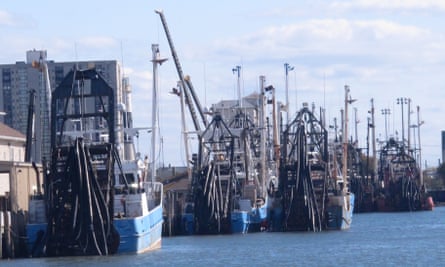
Commercial fishing boats docked in Atlantic City, New Jersey. Photograph: Wayne Parry/AP
Donald Trump is easing protections for a large marine monument off the coast of New England, opening it to commercial fishing.
But ocean experts caution that the rollback to the Northeast Canyons and Seamounts Marine national monument will hurt the environment and won’t help fishermen who are struggling during the Covid-19 pandemic and economic downturn to find buyers for what they already catch.
“This rollback essentially sells off the future of the ocean and the future of the ecosystem for almost no present economic benefit,” said Miriam Goldstein, the ocean policy director at the Center for American Progress (Cap). “[That’s] why it’s so puzzling to do it at all and even more puzzling that the president is doing it now, in the middle of the pandemic and with police riots going on around the country.”
He opposed public lands and wildlife protections. Trump gave him a top environment job
Read more
Trump’s announcement follows several others by the administration to weaken environment rules during the pandemic, including an executive order he signed yesterday to bypass reviews of big infrastructure projects that could threaten public health.
The president unveiled the decision in Bangor, Maine, at a roundtable discussion with commercial fisheries companies. The White House said Trump’s proclamation would allow commercial fishing within the monument but would not alter its boundaries.
The protected area is about 130 miles from Cape Cod, Massachusetts, and it contains endangered right whales and sensitive deep sea corals. It is one of five marine monuments in the country. The other four are in the western Pacific Ocean. After this rollback, less than .1% of the US waters outside the western Pacific Ocean will be protected from commercial fishing, according to an analysis by Cap based on federal data.
“Even fishing done well still has an impact, so for that reason it’s important to have special areas of the ocean set aside. And this has been shown through a lot of science, that it is beneficial to ocean ecosystems, to biodiversity, to threatened and endangered species – and beneficial to those fisheries themselves,” Goldstein said.
Environment groups quickly responded that they plan to sue. The Natural Resources Defense Council is undertaking a similar lawsuit against the administration for opening up two Utah monuments, Bears Ears and Grand Staircase-Escalante, to mining. The Utah monuments and the marine monument were established at the end of the Barack Obama administration.
Goldstein acknowledged that fishermen and aquaculture growers in coastal communities have been hard hit by the coronavirus pandemic and economic downturn, but she said there are other actions the administration could take that would help.
The US Regional Fishery Management Councils on 29 May sent a letter to the commerce department arguing that “the ban on commercial fishing within Marine national monument waters is a regulatory burden on domestic fisheries”. The group had been making that same argument since 2016.
Rip Cunningham, the conservation editor at Saltwater Sportsman and former chair of the New England Fishery Management Council, criticized the move.
“As a recreational fisherman, it troubles me to see the monument opened to commercial fishing,” Cunningham said. “These are fragile and vulnerable resources, and I am concerned for their future health.”
International flights taking off from the UK must be taken into account in the government’s calculations on reaching net zero emissions as part of a “green” recovery for the airline industry, a transport thinktank has urged.
+included in net zero calculations – at present they are not counted at all – but the government has yet to respond to the committee’s letter.
“The government should ensure international aviation and shipping emissions are including within the net zero target,” said Greg Archer, the UK director of Transport and Environment. “The aviation industry is currently relying on buying cheap, unreliable offsets for its emissions. This is no solution to avoiding a climate catastrophe.”


 May
 Globally, it was the warmest May in our record, at 0.63°C above average