Ohio animal hospital offers free care for police horses injured during weekend protests

NEWS

CINCINNATI, Ohio (WJW) — An Ohio animal hospital is looking to help horses that were injured during the police violence protests this weekend.

Demonstrators across the nation took to the streets in response to the death of George Floyd. He died Monday while in Minneapolis police custody.

The Animal Eye Institute, located in Cincinnati, is offering to treat police force horses that received eye injuries during the protests.

Our sister station in Columbus, WCMH, shared video on Twitter of protesters throwing objects at mounted officers during the downtown demonstration Saturday.

NBC4 Columbus

✔@nbc4i

Tear gas fired after objects thrown at mounded officers during downtown protests. https://nbc4i.co/2XIiTeN 

Embedded video

51 people are talking about this

While it is unclear from the video if any of the horses were injured, the Animal Eye Institute has extended their hand to officers located anywhere from Columbus to Lexington, Kentucky.

“We aren’t in any way going to get political here, but if any police horses have eye injuries from protests from Columbus down to Lexington, we will treat them for free,” the hospital wrote on Facebook. “Just call the office or send us an email. The big gentle giants don’t deserve to be hurt.”

While the Columbus protest turned violent, causing the Ohio governor to activate the National Guard and Columbus officials to issue a state of emergency and an indefinite city-wide curfew, most of the protesters in Lexington remained peaceful.

**Watch the video above for a look at the Columbus protests**

According to the Lexington Herald-Leader, protests erupted in Lexington for the second night in a row Saturday.

While some were seen turning over garbage cans, other protesters picked up the spilled trash. Some protesters confronted police, chanting “No Justice, No Peace!” and “I can’t breathe!”

Alex Slitz

✔@AlexSlitzPhoto

Protesters confront police in front of the library on Main. @heraldleader @HLpublicsafety

Embedded video

See Alex Slitz’s other Tweets

A third “socially distant, non-violent protest” has been planned for Sunday night at 8 p.m. at the Lexington courthouse.

In Cincinnati, where the Animal Eye Clinic is located, protests have been violent. FOX 19 reports several protesters threw bottles and rocks at police. An Ohio State Highway Patrol trooper’s helmet was even stuck by a bullet. The officer is ok.

Some protesters were seen throwing trash cans into the streets and starting fires. Some businesses were also vandalized.

Nationwide more than 1,400 people in 17 U.S. cities have been arrested since Thursday. While most protests being held in Floyd’s name have been peaceful, several have erupted in violence.

“Extinction breeds extinctions”: How losing one species can wipe out many more

Exposing the Big Game's avatarThe Extinction Chronicles

Ethiopian wolf, Canis simensis, also know as Abyssinian wolf, Simien wolf, Simien jackal, Ethiopian jackal, red fox, red jackal, in Bale Mountains National Park, Ethiopia.
The Ethiopian wolf, Canis simensis, is an endangered species. Fewer than 1,000 individuals are left in the wild.
 Roger de la Harpe/Universal Images Group via Getty

Earth is now in the middle of a mass extinction, the sixth one in the planet’s history, according to scientists.

And now a new study reports that species are going extinct hundreds or thousands of times faster than the expected rate.

The researchers also found that one extinction can cause ripple effects throughout an ecosystem, leaving other species vulnerable to the same fate. “Extinction breeds extinctions,” they write in their June 1 paper in the Proceedings of the National Academy of Sciences.

With the accelerating pace of destruction, scientists are racing to understand these fragile bits of life before they’re gone. “This means that the opportunity…

View original post 392 more words

Listen Up! The Bloodbath of Killing Contests

Exposing the Big Game's avatarCommittee to Abolish Sport Hunting Blog

by Marty Irby

Wildlife Killing Contests (WKCs) are a disgrace. And, for all the right reasons, they are under siege.

In September 2019, the Arizona Governor’s Regulatory Review Council (GRRC) voted unanimously to approve a rule initiated by the Arizona Game and Fish Commission banning WKCs for predators and other furbearing animals in the Grand Canyon State. A grassroots effort energized by concerned animal welfare advocates and even hunters, and led by Animal Wellness Action’s Lain Kahlstrom and Tina Meredith, provided the impetus for the rulemaking action.
Events like the “Santa SLAY” and “Fox Frenzy” killing contests – slaughter-fests where participants compete to win cash and prizes for killing the greatest number, the heaviest, or even the smallest of the targeted species within a certain time frame (usually 24 hours or a weekend) – soon became a closed chapter in the book of Arizona’s wildlife management history.
But the practice…

View original post 309 more words

State government plans to pay to promote S.D. pheasant hunting, will halt brood-route counts

Exposing the Big Game's avatarCommittee to Abolish Sport Hunting Blog

https://www.keloland.com/news/capitol-news-bureau/state-government-plans-to-pay-to-promote-s-d-pheasant-hunting-will-halt-brood-route-counts/
pheasant2c28fbe406ca6cf291ebff0000dce829_451763540621

PIERRE, S.D. (KELO) — Big changes are coming in an effort to revive pheasant hunting in South Dakota.

Two state government departments plan to spend $700,000 on advertising this year to market South Dakota as the nation’s best place to pursue ring-necks.

Paid advertising that starts in mid-June will cover 16 states and run through November.

The state Wildlife Division meanwhile will halt the summer brood routes that have been used since the 1940s to gauge pheasant populations.

Wildlife Division Director Tom Kirschenmann said proposals will come in July to extend the season deeper into January, expand the late-season bag limit, and expand shooting hours.

The main season this year runs October 17 through January 3. A hunter can take three roosters daily. The first eight days of the season open at noon local time and then switch to 10 a.m.

The…

View original post 471 more words

Atmospheric CO2 levels rise sharply despite Covid-19 lockdowns

Exposing the Big Game's avatarThe Extinction Chronicles

Scientists find coronavirus crisis has had little impact on overall concentration trend

Grounded British Airways planes at Glasgow airport
 Grounded British Airways planes at Glasgow airport. Photograph: Jeff Holmes/JSHPIX/REX/Shutterstock

Carbon dioxide levels in the atmosphere have risen strongly to a new peak this year, despite the impact of the global effects of the coronavirus crisis.

The concentration of CO2 in the atmosphere reached 417.2 parts per million in May, 2.4ppm higher than the peak of 414.8ppm in 2019, according to readings from the Mauna Loa observatory in the US.

Without worldwide lockdowns intended to slow the spread of Covid-19, the rise might have reached 2.8ppm, according to Ralph Keeling, a professor at the Scripps Institution of Oceanography. He said it was likely they had played a small role, but that the difference was too small to show up against other factors causing year-to-year fluctuations.

“People may be surprised…

View original post 535 more words

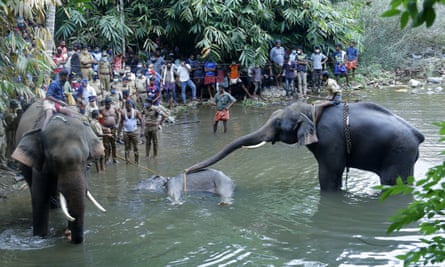
Killing of elephant with explosive-laden fruit causes outrage in India

Exposing the Big Game's avatarCommittee to Abolish Sport Hunting Blog

Death of pregnant animal from pineapple filled with firecrackers sparks anger

Two elephants inspecting the wild elephant who died after suffering injuries, in Velliyar River, Palakkad district of Kerala state, India

Two elephants inspecting the wild elephant who died after suffering injuries, in Velliyar River, Palakkad district of Kerala state, India. Photograph: Rajesh U Krishna/AP

The death of a pregnant elephant in Kerala after she ate a pineapple filled with firecrackers has prompted a wave of national outrage across India – while also being co-opted into a sectarian “hate campaign”.

The wild elephant, thought to be 15 years old, died in a river in Silent Valley National Park in Kerala’s Palakkad district last week from fatal injuries inside her mouth caused by the explosive-laden fruit.

It is not known when the elephant ate the pineapple and if the killing was premeditated, as local farmers in India’s south often use firecrackers and explosives in fruit in…

View original post 426 more words

Atmospheric CO2 reaches peak level at NOAA observatory

Exposing the Big Game's avatarThe Extinction Chronicles

Atmospheric CO2 reaches peak level at NOAA observatory
© Getty Images

The level of atmospheric carbon dioxide observed at a government facility in Hawaii reached a new peak in May, scientists from National Atmospheric and Oceanic Administration (NOAA) and the University of California San Diego said Thursday.

Last month, that the concentration of carbon dioxide in the atmosphere recording at the at Mauna Loa observatory was as high as 417.1 parts per million (ppm).

According to a NOAA statement, this was the highest monthly carbon dioxide level ever recorded. It was 2.4 ppm higher than the 2019 peak of 414.7 ppm.

WHEN YOU SUPPORTOUR ADVERTISERS,YOU SUPPORT US.THANK YOU!

Carbon dioxide levels measure how much of the gas there is in the atmosphere. This is different from carbon dioxide emissions, which measure how much new carbon dioxide is released into the atmosphere.

View original post 123 more words

Good moos: methane from cows matters less in climate change, says Irish researcher

Exposing the Big Game's avatarThe Extinction Chronicles

Methane from cattle should be counted on a different basis from other emissions, according an Irish academic
ALAMY

Scientists have overestimated the effect of agriculture methane emissions on climate change, an Irish academic believes.

Shane McDonagh, an environmental researcher at UCC, said Ireland has been measuring the impact of farming on carbon emissions in the wrong way leading to an overestimation of the negative impacts on our carbon footprint.

Agriculture in Ireland accounts for 33 per cent of all greenhouse gas emissions compared with 10 per cent in the EU as a whole. Most farm-related emissions are from methane gas, which has a global warming potential 84 times greater than carbon dioxide (CO2) over 20 years and 28 times greater over 100 years. Methane gas breaks down into CO2 over time, and loses global warming potential.

CO2, while less potent than methane,

View original post

False Negative Tests for SARS-CoV-2 Infection — Challenges and Implications

Exposing the Big Game's avatarThe Extinction Chronicles

List of authors.

  • Steven Woloshin, M.D.,
  • Neeraj Patel, B.A.,
  • and Aaron S. Kesselheim, M.D., J.D., M.P.H.

There is broad consensus that widespread SARS-CoV-2 testing is essential to safely reopening the United States. A big concern has been test availability, but test accuracy may prove a larger long-term problem.

While debate has focused on the accuracy of antibody tests, which identify prior infection, diagnostic testing, which identifies current infection, has received less attention. But inaccurate diagnostic tests undermine efforts at containment of the pandemic.

Diagnostic tests (typically involving a nasopharyngeal swab) can be inaccurate in two ways. A false positive result erroneously…

View original post 1,401 more words

Loss of land-based vertebrates is accelerating, study finds

Stanford University / Phys.Org
June 1, 2020

See <https://phys.org/news/2020-06-loss-land-based-vertebrates.html> link
for photos.

In 2015, Stanford biologist Paul Ehrlich coauthored a study declaring the
world’s sixth mass extinction was underway. Five years later, Ehrlich and
colleagues at other institutions have a grim update: the extinction rate is
likely much higher than previously thought and is eroding nature’s ability
to provide vital services to people.

Their new paper, published this week in Proceedings of the National Academy
of Sciences, indicates the wildlife trade and other human impacts have wiped
out hundreds of species and pushed many more to the brink of extinction at
an unprecedented rate.

For perspective, scientists estimate that in the entire twentieth century,
at least 543 land vertebrate species went extinct. Ehrlich and his coauthors
estimate that nearly the same number of species are likely to go extinct in
the next two decades alone.

The trend’s cascading effects include an intensification of human health
threats, such as COVID-19, according to the researchers. “When humanity
exterminates populations and species of other creatures, it is sawing off
the limb on which it is sitting, destroying working parts of our own
life-support system,” said Ehrlich, the Bing Professor of Population
Studies, emeritus, at the Stanford School of Humanities and Sciences and a
senior fellow, emeritus, at the Stanford Woods Institute for the
Environment. “The conservation of endangered species should be elevated to a
national and global emergency for governments and institutions, equal to
climate disruption to which it is linked.”

The study comes in the wake of an April 7 letter from a bipartisan group of
senators urging the Trump administration to close markets that sell live
animals for food and unregulated wildlife markets, among other measures to
stop the trade in illegal wildlife and wildlife products.

Human pressures, such as population growth, habitat destruction, the
wildlife trade, pollution and climate change, critically threaten thousands
of species around the world. Ecosystems ranging from coral reefs and
mangrove forests to jungles and deserts depend on these species’
long-evolved relationships to maintain their functioning and make them
resilient to change. Without this robustness, ecosystems are less and less
able to preserve a stable climate, provide freshwater, pollinate crops and
protect humanity from natural disasters and disease.

Final Opportunity

To better understand the extinction crisis, the researchers looked at the
abundance and distribution of critically endangered species. They found that
515 species of terrestrial vertebrates- 1.7 percent of all the species they
analyzed- are on the brink of extinction, meaning they have fewer than 1,000
individuals remaining. About half of the species studied have fewer than 250
individuals left. Most of the highly endangered species are concentrated in
tropical and subtropical regions that are affected by human encroachment,
according to the study.

In addition to rising extinction rates, the cumulative loss of
populations-individual, localized groups of a particular species- and
geographic range has led to the extinction of more than 237,000 populations
of those 515 species since 1900, according to the researchers’ estimates.
With fewer populations, species are unable to serve their function in an
ecosystem, which can have rippling effects. For example, when overhunting of
sea otters-the main predator of kelp-eating sea urchins-led to kelp die-offs
in the 1700s, the kelp-eating sea cow went extinct.

“What we do to deal with the current extinction crisis in the next two
decades will define the fate of millions of species,” said study lead author
Gerardo Ceballos, a senior researcher at the National Autonomous University
of Mexico’s Institute of Ecology. “We are facing our final opportunity to
ensure that the many services nature provides us do not get irretrievably
sabotaged.”

The loss of endangered creatures could have a domino effect on other
species, according to the researchers. The vast majority-84 percent-of
species with populations under 5,000 live in the same areas as species with
populations under 1,000. This creates the conditions for a chain reaction in
which the extinction of one species destabilizes the ecosystem, putting
other species at higher risk of extinction.

“Extinction breeds extinction,” the study authors write. Because of this
threat, they call for all species with populations under 5,000 to be listed
as critically endangered on the International Union for Conservation of
Nature Red List, an international database used to inform conservation
action on a global scale.

Timely Implications

These findings could aid conservation efforts by highlighting the species
and geographic regions that require the most immediate attention.
Understanding what species are at risk can also help identify what factors
might be most responsible for rising extinction rates.

Among other actions, the researchers propose a global agreement to ban the
trade of wild species. They argue the illegal capture or hunting of wild
animals for food, pets and medicine is a fundamental ongoing threat not only
to species on the brink, but also to human health. COVID-19, which is
thought to have originated in bats and been transmitted to humans through
another creature in a live animal market, is an example of how the wildlife
trade can hurt humans, according to the researchers. They point out that
wild animals have transmitted many other infectious diseases to humans and
domestic animals in recent decades due to habitat encroachment and wildlife
harvesting for food.

“It’s up to us to decide what kind of a world we want to leave to coming
generations-a sustainable one, or a desolate one in which the civilization
we have built disintegrates rather than builds on past successes,” said
study coauthor Peter Raven, president emeritus of the Missouri Botanical
Garden.

<https://phys.org/news/2020-06-loss-land-based-vertebrates.html>
https://phys.org/news/2020-06-loss-land-based-vertebrates.html