Маѕѕ ехtіnсtіоn оf аnіmаlѕ аррrоасhіng wаrnѕ ѕсіеntіѕtѕ

Exposing the Big Game's avatarThe Extinction Chronicles

Mass extinction of animals approaching warns scientists

Vіеwѕ: 977
Роѕtеd: Моndау, Јunе 1, 2020. 7:51 рm СЅТ.

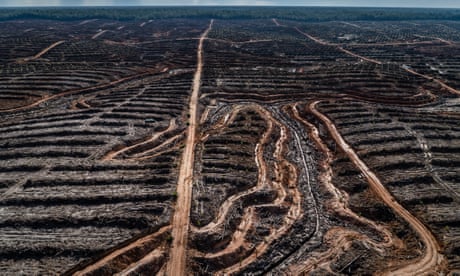
Рhоtо Сrеdіt: Тhе Guаrdіаn

Ву ВВN Ѕtаff: Ѕсіеntіѕtѕ аrе wаrnіng thаt thе еаrth іѕ аbоut tо ѕее а ѕіхth mаѕѕ ехtіnсtіоn оf аnіmаlѕ аt аn ассеlеrаtеd rаtе, ассоrdіng tо аn аrtісlе рublіѕhеd іn thе Unіtеd Кіngdоm-bаѕеd mеdіа hоuѕе Тhе Guаrdіаn.

Тhе аrtісlе wаrnѕ thаt оvеr 500 ѕресіеѕ оf lаnd аnіmаlѕ аrе іn dаngеr оf ехtіnсtіоn wіthіn 20 уеаrѕ duе tо humаn асtіvіtіеѕ, whісh mаtсhеѕ thе numbеr оf аnіmаlѕ thаt wеnt ехtіnсt оvеr thе раѕt сеnturу. Тhе аrtісlе nоtеѕ thаt wіthоut humаn іntеrасtіоn, іt wоuld hаvе tаkеn thоuѕаndѕ оf уеаrѕ tо асhіеvе.

Тhе Guаrdіаn rеfеrеnсеѕ thе рареr “Vеrtеbrаtеѕ оn thе brіnk аѕ іndісаtоrѕ оf bіоlоgісаl аnnіhіlаtіоn аnd thе ѕіхth mаѕѕ ехtіnсtіоn,” рublіѕhеd іn thе јоurnаl Рrосееdіngѕ іn thе Nаtіоnаl Асаdеmу оf Ѕсіеnсеѕ whісh wаѕ рublіѕhеd tоdау. Тhе rеѕеаrсh wаѕ соnduсtеd bу а јоіnt tеаm…

View original post 157 more words

World Lion Day 2013

marina kanavaki's avatarMarina Kanavaki

WORLD LION DAY TODAY!

Please visit WORLD LION DAY 2013 for more information

[click on images to visit campaign page]
WORLD LION DAY 2013 Picture 019
excerpt from World Lion Day 2013 Campaign page

Guarding our temples, adorning our flags, decorating our coins and capturing our hearts, the lion is beyond doubt the world’s most iconic species.  On almost every continent, and in thousands of cultures, the lion can be found demonstrating man’s fascination with this magnificent beast.

Despite the lions’ symbolic importance throughout the ages, today they are suffering from a silent extinction across Africa and India.  Knowledge of the King of Beasts’ plight is little known.

World Lion Day is the first global campaign to celebrate the importance of the lion worldwide. Since the dawn of man the lion has played an integral role in our lives: symbolically, religiously, culturally, economically and biologically. To lose the lion from our world would be to…

View original post 66 more words

Police officers shot, hit by car in multiple incidents amid George Floyd protests

Exposing the Big Game's avatarThe Extinction Chronicles

Police officers shot, hit by car in multiple incidents amid George Floyd protests
© Getty Images

Law enforcement officials in several cities were injured Monday night as protests over the death of George Floyd in police custody continued across the country.

Four St. Louis police officers were hospitalized after a shooting Monday evening in which a suspect is alleged to have opened fire at a line of officers, the police chief said at an early morning press conference according to the St. Louis Post-Dispatch. A suspect has yet to be apprehended or identified.

“I believe some coward randomly shot at the police line,” chief John Hayden told reporters.

“I don’t know what else to say,” he added. “This is horrible.”

Elsewhere in Las Vegas a fifth officer is on life support after being shot in the head. Another man was killed in that shooting, which reportedly occurred as officers attempted to…

View original post 270 more words

Sixth mass extinction of wildlife accelerating, scientists warn

Analysis shows 500 species on brink of extinction – as many as were lost over previous century

Sumatran rhino

The Sumatran rhino is on the verge of extinction, with fewer than 1,000 individuals left. Photograph: Rhett Buttler/Mongabay/PA

The sixth mass extinction of wildlife on Earth is accelerating, according to an analysis by scientists who warn it may be a tipping point for the collapse of civilisation.

More than 500 species of land animals were found to be on the brink of extinction and likely to be lost within 20 years. In comparison, the same number were lost over the whole of the last century. Without the human destruction of nature, even this rate of loss would have taken thousands of years, the scientists said.

The land vertebrates on the verge of extinction, with fewer than 1,000 individuals left, include the Sumatran rhino, the Clarión wren, the Española giant tortoise and the harlequin frog. Historic data was available for 77 of the species and the scientists found these had lost 94% of their populations.

The researchers also warned of a domino effect, with the loss of one species tipping others that depend on it over the edge. “Extinction breeds extinctions,” they said, noting that unlike other environmental problems extinction is irreversible.

Humanity relies on biodiversity for its health and wellbeing, scientists said, with the coronavirus pandemic an extreme example of the dangers of ravaging the natural world. Rising human population, destruction of habitats, the wildlife trade, pollution and the climate crisis must all be urgently tackled, they said.

“When humanity exterminates other creatures, it is sawing off the limb on which it is sitting, destroying working parts of our own life-support system,” said Prof Paul Ehrlich, of Stanford University in the US, and one of the research team. “The conservation of endangered species should be elevated to a global emergency for governments and institutions, equal to the climate disruption to which it is linked.”

Harlequin frog

Harlequin frog. Photograph: Gerardo Ceballos/University of Mexico/PA

“We are facing our final opportunity to ensure that the many services nature provides us do not get irretrievably sabotaged,” said Prof Gerardo Ceballos of the National Autonomous University of Mexico, who led the research.

The analysis, published in the journal Proceedings of the National Academy of Sciences, examined data on 29,400 land vertebrate species compiled by the IUCN Red List of Threatened Species and BirdLife International. The researchers identified 515 species with populations below 1,000 and about half of these had fewer than 250 remaining. Most of these mammals, birds, reptiles and amphibians were found in tropical and subtropical regions.

Scientists discovered that 388 species of land vertebrate had populations under 5,000, and the vast majority (84%) lived in the same regions as the species with populations under 1,000, creating the conditions for a domino effect.

Known examples of this include the overhunting of sea otters, the main predator of kelp-eating sea urchins. A boom in urchins devastated kelp forests in the Bering Sea, leading to the extinction of the kelp-eating Steller’s sea cow.

The researchers said their findings could aid conservation efforts by highlighting the species and regions requiring the most urgent attention.

Prof Andy Purvis, at the Natural History Museum in London, and not part of the new analysis, said: “This research provides another line of evidence that the biodiversity crisis is accelerating. The hardest problem [the researchers] faced is that we don’t know more about the history of species’ geographic distributions. They only had that information for 77 of the species on the brink, and we can’t know for sure how typical those species are.”

Española giant tortoise

Española giant tortoise. Photograph: Gerardo Ceballos/University of Mexico/PA

“But that doesn’t undermine the conclusion,” he said. “The biodiversity crisis is real and urgent. But – and this is the crucial point – it is not too late. To transition to a sustainable world, we need to tread more lightly on the planet. Until then, we are essentially robbing future generations of their inheritance.”

Prof Georgina Mace, of University College London, said: “This new analysis re-emphasises some startling facts about the extent to which vertebrate populations have been reduced worldwide by human activities.” But she said she was not convinced that simply having a population less than 1,000 was the best measure of a species being on the brink. A declining trend for the population is also important and both factors are used in the IUCN Red List, she said.

“Action is important for many reasons, not least of which is that directly and indirectly we rely on the rest of life on Earth for our own health and wellbeing,” she said. “Disrupting nature leads to costly and often hard-to-reverse effects. Covid-19 is an extreme present-day example, but there are many more.”

Mark Wright, the director of science at WWF, said: “The numbers in this research are shocking. However, there is still hope. If we stop the land-grabbing and devastating deforestation in countries such as Brazil, we can start to bend the curve in biodiversity loss and climate change. But we need global ambition to do that.”

Thousands of Species Are Fleeing to Earth’s Poles en Masse, And a Pattern’s Emerging

We know that global warming is forcing many animals around the world to flee their normal habitats, but now, an exhaustive analysis has shown marine species are booking it for the poles six times faster than those on land.

Drawing together 258 peer-reviewed studies, researchers compared over 30,000 habitat shifts in more than 12,000 species of bacteria, fungi, plants, and animals.

The resulting database, named BioShifts, is the first comprehensive analysis of its kind, and while the database is limited by our own, human research biases, the data we have certainly suggests marine species are following global thermal shifts much closer than land animals.

While land species definitely are moving closer to the poles as the planet heats up, this shift is “at a pace that is much slower than expected, especially in areas with warm climates,” the authors write.

In the review, amphibians were found to be moving up slope at over 12 metres a year, while reptiles seem to be headed towards the equator at 6.5 metres a year.

Insects, which incidentally carry many diseases, were found to be moving poleward at 18.5 kilometres per year.

Relatively, that’s a lot, but in the bigger picture, marine species were moving towards the poles at an average pace of nearly 6 kilometres per year, while land animals were only shifting upslope at a mean pace of nearly 1.8 metres per year (slightly faster than previous estimates for land species, but still comparatively slow).

This discrepancy between land and water could exist for several reasons. It might, for instance, be a product of temperature sensitivity. Air conducts heat 25 times less effectively than water, and many land animals can easily regulate their body temperature if they want.

On the whole, this would logically leave marine species and many ectotherms – cold-blodded species – much more susceptible to Earth’s fluctuating temperatures.

Plus, animals in the water can migrate a lot easier if the need arises. On land, human activities often impede the movement of animals. In fact, when animals were exposed to a high degree of anthropogenic disturbances, the authors of this analysis found they tended to move against the thermal grain and not with it.

This is consistent with the general idea that land use and climate change may force species in opposite directions, a sort of push and pull of re-distribution.

“On land, habitat loss and fragmentation due to land use changes may impede the ability of terrestrial species to track shifting isotherms [lines on a map connection regions with the same temperature],” the authors write.

“These complex interactions need to be accounted for to improve scenarios of biodiversity redistribution and its consequences on human well-being under future climate change.”

If the authors are right, and marine life is tracking along temperature changes more closely, it could have dire and far-reaching repercussions. Some of which we might have seen before.

During the Permian-Triassic Extinction, the most calamitous event in Earth’s history, researchers say very few marine organisms stayed in the same habitat as oxygen levels plummeted.

“It was either flee or perish,” according to oceanographer Curtis Deutsch of the University of Washington, and for over 50 percent of marine species at the time, it was unfortunately the latter.

Today, as temperature increases squeeze animals into ever-narrowing habitat ranges, those animals already swimming towards he poles are also at risk of running out of cooler water.

Of course, this is happening on land, too. Animals found high up in the mountains are said to be riding an “escalator to extinction” as temperatures and competition push them over the brink. It’s just that in the water this escalator seems to be moving faster.

“We suggest that commercial fishing may speed up the displacement of marine species distribution through resource depletion and population crashes at the trailing edge, whereas low constraints on dispersal in the oceans may allow marine species living close to their upper thermal limits to better track climate warming at the leading edge,” the authors predict.

As impressive and necessary as the new database is, however, the authors acknowledge it has serious limits.

Despite its comprehensive nature, the meta-analysis used to create BioShifts only covers 0.6 percent of all known life on Earth, and the animals we have researched tend to be the most charismatic, or important to humans, focused predominantly in the northern hemisphere.

So while we call this a global meta-analysis, it’s not really. Instead, it’s as close as we can get given the circumstances.

Still, we can only work with what we’ve got, and it looks like the animals we do know of are struggling to find new habitats in the face of a growing climate crisis.

BioShifts is a way for us to help track those changes so we can possibly predict what will happen next.

Detecting methane emissions during COVID-19

https://phys.org/news/2020-06-methane-emissions-covid-.html

Detecting methane emissions during COVID-19
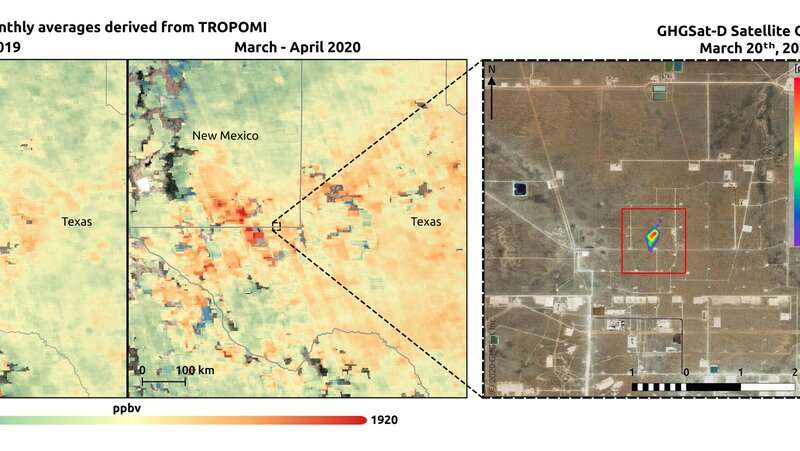
GHGSat uses data from the Copernicus Sentinel-5P satellite to detect emission hotspots in various regions – including the Permian Basin. The image on the left shows the enhanced methane concentrations over the Permian basin, while the image on the right highlights the exact facility in the Permian Basin leaking methane. Credit: GHGSat

While carbon dioxide is more abundant in the atmosphere and therefore more commonly associated with global warming, methane is around 30 times more potent as a heat-trapping gas. Given its importance, Canadian company GHGSat have worked in collaboration with the Sentinel-5P team at SRON Netherlands Institute for Space Research to investigate hotspots of methane emissions during COVID-19.

Carbon dioxide is generally produced by the combustion of fossil fuels, while fossil fuel production is one of the largest sources of methane emissions. According to the World Meteorological Organisation’s State of the Global Climate report last year, current  and methane concentrations represent respectively 150% and 250% of pre-industrial levels, before 1750.

Owing to the importance of monitoring methane, SRON’s and GHGSat’s research teams have been working since early-2019 to detect methane hotspots. The SRON team uses data from the Copernicus Sentinel-5P satellite to detect emissions on a global scale. The GHGSat team then utilises data from GHGSat satellites to quantify and attribute the emissions to specific facilities around the world.

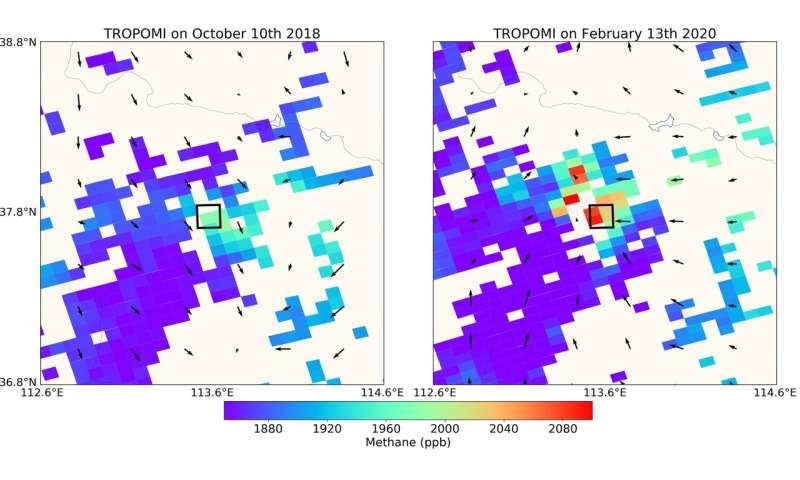
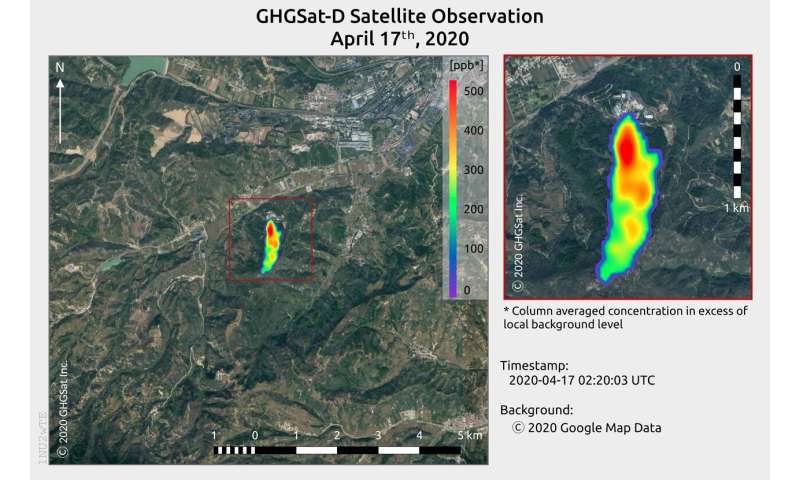
Their work has led to several new hotspots being discovered in 2020, for instance over a coal mine in China. The team have also detected methane emissions over the Permian Basin—the largest oil-producing region in the United States. The team observed concentrations from March-April 2020, compared to the same period as last year in an effort to evaluate the impact of COVID-19 activities on methane emissions.

Detecting methane emissions during COVID-19
GHGSat have worked in close collaboration with the Sentinel-5P team at SRON Netherlands Institute for Space Research to investigate hotspots of methane emissions. The team uses data from the Copernicus Sentinel-5P satellite to detect emissions on a global scale, and then utilises data from GHGSat satellites to quantify and attribute emission to specific facilities around the world. This has led to several new hotspots being discovered including a coal mine in the Shanxi province, China. Credit: contains modified Copernicus Sentinel data (2018, 2020), processed by SRON

An initial look at these data suggest a substantial increase in methane concentrations in 2020, compared to 2019. Claus Zehner, ESA’s Copernicus Sentinel-5P mission manager, says, “An explanation for this could be that as a result of less demand for gas because of COVID-19, it is burned and vented—leading to higher methane emissions over this area.”

Ilse Aben, from SRON, comments, “However, these results are inconclusive when using only Sentinel-5P data in the Permian Basin as the number of observations are limited.”

The spatial distribution of Sentinel-5P concentrations in 2020 and in 2019 both indicate local enhancements of methane concentrations in the Delaware and Midland portions of the basin. But higher-resolution measurements, such as those provided by GHGSat, are needed to attribute these enhancements to specific facilities.

The joint analysis of GHGSat and Sentinel-5P regional  data will continue to explore and quantify how COVID-19 is affecting emissions from the natural gas industry on a regional scale—all the way down to the level of industrial facilities.

Detecting methane emissions during COVID-19
This image shows GHGSat methane concentrations over a coal mine in the Shanxi province, China. Credit: GHGSat

Stephane Germain, CEO of GHGSat, comments, “GHGSat continues to work closely with ESA and SRON’s Sentinel-5P science team. We are advancing the science of satellite measurements of atmospheric trace gases while simultaneously providing practical information to industrial operators to reduce facility-level emissions. GHGSat’s next satellites, scheduled to launch in June and December of this year, will help improve our collective understanding of industrial emissions around the world.”

Eric Laliberté, Director General Utilization from the Canadian Space Agency, says, “The Canadian Space Agency is committed to developing space technologies and supporting innovative missions to better understand and mitigate climate change. The results achieved by GHGSat are already having an impact and we are excited to continue working with GHGSat and ESA to better understand greenhouse gas emissions worldwide.”

Claus adds, “In order to further support the scientific uptake of GHGSat measurements, ESA has organised, together with the Canadian Space Agency and GHGSat, a dedicated Announcement of Opportunity Call that will provide around 5% of the measurement capacity of the upcoming commercial GHGSat-C1, also known as the Iris satellite, to the scientific community.”

The Copernicus Sentinel-5P satellite, with its state-of-the-art instrument Tropomi, can also map other pollutants such as nitrogen dioxide, carbon monoxide, sulphur dioxide and aerosols—all of which affect the air we breathe.


Explore further

Methane leak visible from space

Climate change: May was sunniest calendar month on record in UK

Exposing the Big Game's avatarThe Extinction Chronicles

Low water levels in the Llwyn-on reservoir in Taf Fawr valleyImage copyrightGETTY IMAGES
Image captionLow water levels can be seen in Llwyn-on reservoir in Taf Fawr valley, Wales

May was the sunniest calendar month on record, and spring was the sunniest spring, the Met Office has said.

The UK enjoyed 266 hours of sunshine in May – surpassing the previous record of 265 hours in June 1957.

And it is even more extraordinary following a drenching winter, with record rain in February.

Meteorologists say they are amazed at the sudden switch from extreme wet to extreme dry – it is not “British” weather.

On average the UK gets 436 hours of sunshine between March and the end of May.

Since 1929, only 10 years have had more…

View original post 428 more words

Planet of the Censoring Humans

The campaign to remove Michael Moore’s new documentary from the Internet – led by Moore’s erstwhile progressive “allies” – is a significant advance in the censorship revolution

Matt Taibbi May 29

On April 21st, 2020, just before the 50th anniversary of the first Earth Day, Oscar-winning director/producer Michael Moore released a new movie called Planet of the Humans. Directed by Jeff Gibbs, the film is a searing look at the ostensible failures of the environmentalist movement, to which Moore and Gibbs both belonged.

“Jeff and I were at the first Earth Day celebrations,” Moore laughs. “That’s how old we are.”

Distributed for free on YouTube, the film’s central argument is that the environmentalist movement, fattened by corporate donations, has become seduced by an industrialist delusion.

“The whole idea of the film was to ask a question – after fifty years of the environmentalist movement, how are we doing?” recounts Moore. “It looks like, not very well.”

Moore and Gibbs challenged the idea that both the planet and humankind’s current patterns of industrial production can be saved through the magic bullet of “renewable energy.” The film shows lurid examples of various deceptions, like the oft-used trick of replacing coal plants with new natural gas plants, which are then called “clean” or “green,” or the hideous trend of describing the burning of trees as a “renewable” energy source.

Environmentalists denounced the film as riddled with “lies” and “misinformation,” claiming among other things that Moore used old data to discredit green technology. A campaign to remove the film from circulation immediately took shape.

“Within 24 hours of it going out on YouTube, people got to work on trying to take the film down,” explains Moore. He immediately started hearing about emails denouncing the film that were being circulated to what seemed like “everyone on the left.”

An “action letter” composed by environmentalist Josh Fox was circulated, describing the film as “dangerous, misleading, and destructive” and demanding an “immediate retraction.” Films for Action, an online archive of progressive movies, initially bent to Fox’s demands by taking the film out of its library, only to put it back up a half-day later out of a desire to avoid a “messy debate about censorship.”

An intense campaign of editorials followed, and a roughly month later, YouTube actually removed the film. The platform cited a four-second piece of footage shot by filmmaker Toby Smith that supposedly was a copyright infringement. Moore, who says all his films are “heavily lawyered,” insists the footage was legal under Fair Use laws, which allow the use of portions of copyrighted work without the permission of the owner. (In one of many ironies, Fair Use laws have long been celebrated by progressives as an invaluable tool for journalists and artists).

The significance of the Moore incident is that it shows that a long-developing pattern of deletions and removals is expanding. The early purges were mainly of small/fringe voices on either the far right or far left, or infamously fact-challenged personalities like Alex Jones. The removal of a film by Moore – a heavily-credentialed figure long revered by the liberal mainstream – takes place amid a dramatic acceleration of such speech-suppression incidents, many connected to the coronavirus disaster.

A pair of California doctors were taken off YouTube for declaring stay-at-home measures unnecessary; right-wing British broadcaster and trumpeter of shape-shifting reptile theories David Icke was taken off YouTube; a video by Rockefeller University epidemiologist Knut Wittknowski was taken down, apparently for advocating a “herd immunity” approach to combating the virus. These moves all came after the popular libertarian site Zero Hedge was banned from Twitter, ostensibly for suggesting a Chinese scientist in Wuhan was responsible for coronavirus.

In late April, the World Socialist Web Site – which has been one of the few consistent critics of Internet censorship and algorithmic manipulation – was removed by Reddit from the r/coronavirus subreddit on the grounds that it was not “reliable.” The site was also removed from the whitelist for r/politics, the primary driver of traffic from Reddit to the site. Then in early May, at least 52 Palestinian activists and journalists were removed from Facebook for “not following community standards,” part of a years-long pattern of removals made in cooperation with the Israeli government.

On May 13, human rights activist Jennifer Zeng noted that YouTube was automatically deleting Chinese-language references to terms insulting to the Chinese government, like gongfei, or “communist bandit.” Congressional candidate Shahid Buttar complained an interview with Walker Bragman about Democrats supporting surveillance powers was removed by YouTube. Evan Greer of the speech advocacy group Fight for the Future had a post flagged by Facebook’s “independent fact checkers”—in this case, that noted pillar of factuality, USA Today – dinging him for a “partly false” claim that the Senate had voted to allow warrantless searches of browsing history.

These and many other incidents came in addition to a slew of moves aimed at right-wing speakers accused of varying degrees of conspiratorial misinformation and/or hate speech, from a decision by Twitter to begin “fact-checks” of Donald Trump to wholesale removals from Facebook of “anti-immigrant” sites like VDare and the Unz Review.

One problem is the so-called “reputable” fact-checking authorities many platforms are relying upon have terrible factual histories themselves. There’s an implication that “misinformation” by foreign or independent actors is somehow more dangerous than broadly-disseminated official deceptions about U.S. misbehavior abroad, or manufactured scandals like Russiagate. We now expect libertarian or socialist pages to be zapped at any minute, but none of the outlets which amplified the bogus Steele dossier have been put in Internet timeout.

Moreover, despite widespread propaganda to the contrary, the new movement to regulate speech on platforms like Twitter, Facebook, Instagram and YouTube is, actually, censorship. In the United States, high-ranking politicians in both parties have held congressional hearings and threatened these tech companies with tighter regulation and taxation if they do not develop policies for combating the “fomenting of discord.”

In response, these companies – which as recently as four or five years ago were disavowing editorial responsibilities, in the case of Facebook going so far as to deny being a media company at all – are now instituting vast new controls. It’s a clear symbiosis: governments permit mining of lucrative markets in exchange for access to the platforms’ monitoring powers.

“That’s censorship,” says Andre Damon of the World Socialist Web Site. “That’s a First Amendment issue.”

Throughout the last four years, it’s mainly been left to people affected by these new policies to point out the obvious, that relying on star-chambers of corporate gatekeepers to oversee information flow will have dramatic consequences. These voices seem to be the only ones interested in sticking up for the rights of political opponents.

“I don’t think anyone can confuse me for a supporter of Donald Trump, but I see the danger of celebration of Twitter fact-checking him, because that’s going to be the model for all of us,” says Ali Abuminah, author and co-founder of Electronic Intifada, which has extensively covered the suppression of speech in Palestine by Facebook, including the recent removals.

“It’s always presented as, ‘We’re going to crack down on white supremacists and anti-vaxxers,’” says Damon. “But the practical impact of speech controls is always to advance the interests of the ruling class.”

The pseudonymous editor of Zero Hedge, Tyler Durden, points out that even when platform bans of sites like his are reported by mainstream press outlets, reporters rarely address the underlying rights issue. “Nobody really digs into the First Amendment angle,” he says. “They’re going after the far right, they’re going after the middle right. They’re going after the far left and the middle left. Where does it end?”

We already have a clear picture of what the endgame of public-private content regulation partnerships might look like, through the experience of other countries. In an extreme example, as far back as 2016, Israel’s Justice Minister boasted that Facebook was complying with “95 percent” of its requests for content regulation, deleting thousands of posts by Palestinians.

“Palestine is often the canary in the coal mine on speech issues,” laments Abunimah.

In Germany, which has strict hate speech laws, Facebook maintains an archipelago of ominously-named “deletion centers,” with as many as 1,200 employees at a single site, to sift through content in search of “community standards” violations. Under pressure from politicians and pundits alike, platforms began moving in this direction in the U.S. years ago, with Facebook announcing mass hires of employees with Orwellian titles like “community reviewers” and “news credibility specialists.”

The drive to step up “content control” isn’t all driven from the top down. A major additional factor has been the growth of a new intellectual movement geared toward delegitimizing speech and rationalizing censorship. The Moore incident provided a clear demonstration of how this new social reflex works.


In Planet of the Humans, Moore and Gibbs make a complex argument. In essence, they charge that people have become dependent upon the high-consumption lifestyles made possible by fossil fuels, and that it’s our addiction to that way of life, as much as to fossil fuels themselves, that is driving humanity off a “cliff.”

Their core criticism is aimed at big-name environmental leaders like Bill McKibben and Robert F. Kennedy, Jr., whom Gibbs and Moore argue have de-emphasized this truth to sell a fantasy – profitable equally to industry and environmental movements – that we can innovate our way to survival.

As is usually the case with Moore movies, Planet of the Humans across as a case for the prosecution. Whether he’s denouncing George W. Bush or the health care industry, Moore always sails close to the wind factually, and often leaves out mitigating information a traditional journalist would feel obligated to include. This movie is no different. For instance, audiences are not told until the credits that McKibben, who is depicted on film celebrating the “beauty” of burning wood chips, eventually came out against biomass plants.

It’s easy to see why McKibben would be upset at the portrayal of him in the center of an argument that the environmental movement has overstressed the possibilities of renewable energy at the expense of changing consumption patterns. After all, he’s written books and given talks addressing that problem. Then again, most of the “criticism” of McKibben comes in the form of footage of him talking, and liberal audiences never had a problem previously when Moore declined to add humanizing context to unflattering tape of the Don Rumsfelds and Charlton Hestons of the world.

Moore’s movies have always been designed to gut-punch audiences, and his M.O. is being unafraid to be accused of being “unfair” when he’s warning of disaster in Iraq, of a future of normalized mass shootings, of a failure to address working-class issues he (correctly) predicted would lead to electoral victory by Donald Trump, etc. He’s a provocateur who dares opponents to call him out on the facts (here he is musing about a $10,000 reward for anyone who can find errors in Fahrenheit 9/11). Planet of the Humans features all of these tactics that simultaneously made traditional journalists nervous but earned plaudits among committed liberals: one gets the sense that Moore, his skin leather-thick after years of media battles, is intentionally provoking a backlash in an effort to kick-start what he feels is a debate people are running out of time to have.

Still, it’s easy to understand why activists who’ve dedicated their lives to closing coal plants and developing cleaner energies would feel betrayed at the depiction of alternative energies as failed or even counterproductive exercises in self-deception. The footage that caused YouTube to yank the film came in the middle of a brutal montage showing all the different rare industrial materials that have been mined via earth-disfiguring methods in the making of solar panels — a sequence as painful to watch as the infamous “Wouldn’t it be Nice” montage of devastated Flint in Roger and Me.

Is it right, as multiple critics have wondered, to show such a punishing visual without noting advances that have made solar cleaner and more efficient since the early scenes in the film were shot?

If the criticisms of Moore’s film stopped with questions like these, they might have been more sympathetic. Moore and Gibbs seemed anxious to engage such questions.  “Maybe we’re wrong,” Moore says. “We’d have liked to have that discussion. That was a big reason we made the movie.”

Instead, critics rolled out a now-familiar playbook to depict the movie as too villainous to exist.

The Trump era has seen the unveiling of a range of nuclear arguments against unwelcome speech. Progressives who traditionally decried censorship now often embrace it with gusto in cases of “misinformation,” white supremacy and other forms of bigotry, and “conspiracy theory,” among other things.

The new take is that episodes like Brexit, the election of Donald Trump, the Charlottesville tragedy, a cascade of racially-motivated mass shootings and cases of police violence, and more recently the coronavirus disaster, have all proven that incorrect speech can no longer be tolerated. It’s now understood the consequences are simply too severe, especially for disadvantaged communities.

In the multitudinous critiques of Planet of the Humans, a creepy kind of rhetorical intersectionality is observed. Moore’s film is consistently depicted as not merely misinformation, conspiracy theory, or Trumpian hate speech, but somehow an interlocking combination of all of these things. Critics all seem to have gotten the same memo.

The biggest criticism comes in the film’s focus on overpopulation. In one much-derided scene, the director Gibbs notes it took modern humans “tens of thousands of years” to reach a world population of 700 million, but then tapped into millions of years of stored energy “increased by ten times in a mere two hundred years.” This fast-ascending population curve, Moore and Gibbs say, is also increasing consumption by as much as ten times per person.

Now, the environmentalist movement has been telling us for over half a century that rapid human growth and its insidious effects – sprawl, deforestation, habitat loss, overfishing, etc. – are threatening species and warming the planet. It was not so long ago that deriding such concern was the exclusive preoccupation of right-wingers. Bush-era Republicans infamously thought liberal tree-huggers loved spotted owls more than people, and perhaps even nurtured plans for mass forced abortions to reduce world population (I wrote a book about an evangelical church that preached this idea).

With Planet of the Humans, we’ve come full circle. Now liberal critics are deriding all this tree-hugging as not just misanthropy, but supportive of racism and even genocide, using language that blows away Bush-era conservative rhetoric.

“Protecting the trees has almost always come with a judgment about which kind and color of humans they need protection from,” wrote Kate Aronoff at the New Republic. She added, “Gibbs does not appear to be a white nationalist himself, but his film echoes their approach.”

In The Nation, which lists Moore on its masthead as a contributing editor, Fox wrote a piece denouncing the film as not only “racist,” but, potentially, an “incitement to eco-fascist population controls.” He added:

We see old white male after old white male declaring there is no solution to climate change except reducing the population. (With this many white guys, we can only guess which groups of people are supposed to stop reproducing.)

Leah Stokes on Vox wrote the film’s takes on the dangers of overpopulation had “more in common with anti-immigration hate groups than the progressive movement” and expressed hope the film would be “buried.” Gizmodo argued the film has “more than a whiff of eugenics and ecofascism… Who are we going to knock off or control for?”

Given that the primary criticism of Moore’s film is that it unfairly depicts people like McKibben as sellouts, it’s more than a little odd that the apparently serious return criticism is that Michael Moore and Jeff Gibbs want to massacre nonwhite people. This would be laughable were it not for the fact that the campaign succeeded.

The director of Roger and Me and Bowling for Columbine has had plenty of prior experience with efforts to suppress his work. In 2001, HarperCollins blocked the release of his book Stupid White Men, on the grounds that a book critical of the U.S. government was inappropriate after 9/11. In 2004, Disney tried to block subsidiary Miramax from distributing Fahrenheit 9/11, a film that detailed links between the families of Bush and Osama bin Laden.

Both attempts failed. Stupid White Men was released after a group of librarians flooded the publisher with protest letters, and Fahrenheit 9/11 was ultimately distributed after Miramax and Disney reworked their deal.

The clear difference in this case was Moore and Gibbs are taking on Shibboleths on the left, instead of the right. Erstwhile liberal allies this time employed a tactic the right never used, describing the film as not merely wrong but “dangerous.” In conjunction with the new embrace of Internet control, this was enough to achieve something that Bush and Cheney never did: suppression of major motion picture.

In the past, a copyright dispute would have been a matter for courts. So, too, would questions of defamation that might have been raised by the likes of McKibben. Now critics can just run to Mommy and Daddy tech companies to settle disputes, and there’s no clear process for those removed to argue their cases.

This is a situation that carries serious ramifications, especially for people who have less reach and financial clout than Moore. “If they can do it to me, they can do it to anybody,” is how Moore puts it.

This is probably why, apart from a few brave institutional voices like PEN America, none of the traditional defenders of speech (ahem, ACLU) have spoken out. As was the case with Julian Assange and even Alex Jones, a fear factor is probably part of the equation. Who wants to be seen defending, even in the abstract, the rights of an ally of Putin? A race-baiting talk show host? An “eco-fascist”? Couldn’t such a defense itself invite reports of violating “community standards,” and bring a fresh threat of removal?

Maybe Moore is wrong about the environmental movement, but these new suppression tactics are infinitely more dangerous than one movie ever could be

, and progressives seem to have lost the ability to care.

You’re on the free list for Reporting by Matt Taibbi. For the full experience, become a paying subscriber.

Protests across the U.S. prompt concerns over exacerbating the world’s worst coronavirus outbreak

Exposing the Big Game's avatarThe Extinction Chronicles

KEY POINTS
  • As the U.S. erupted in protest over the weekend over the police killing of an African American man, officials are warning that mass gatherings will likely exacerbate the coronavirus outbreak in the most vulnerable communities.
  • The protests come as schools and businesses across the country have been closed for months in a bid to keep people home and curb the spread of the virus.
  • “If you were out protesting last night, you probably need to go get a COVID test this week,” Atlanta Mayor Keisha Lance Bottoms said.

VIDEO04:05
Gottlieb: No question protests will lead to chains of transmission of Covid-19

As the U.S. erupted in protest over the weekend in response to the police killing of George Floyd, an unarmed black man, health officials are warning that mass gatherings will likely exacerbate the coronavirus outbreak in the most vulnerable communities.

View original post 647 more words

Bid to grant MSC ‘ecolabel’ to bluefin tuna fishery raises fears for ‘king of fish’

Exposing the Big Game's avatarThe Extinction Chronicles

Conservationists warn the species, which was almost extinct 10 years ago, could be under threat if Japanese fishery is MSC certified

Traditional bluefin tuna fishing off the coast of Spain

Traditional bluefin tuna fishing off the coast of Spain. Photograph: Pablo Blázquez Domínguez/Getty

A decade ago, the highly prized “king of fish”, the bluefin tuna, was taken off menus in high-end restaurants and shunned by top chefs, amid warnings by environmentalists that it was being driven to extinction. Recent assessments of eastern Atlantic bluefin tuna, which can grow to the size of a small car and live for up to 40 years, have shown much healthier populations.

But now conservationists and scientists are warning that the largest and most valuable tuna species could once again be under threat if a Japanese bluefin fishery in the eastern Atlantic Ocean is awarded an internationally recognised “ecolabel

View original post 1,139 more words