2 Northern California men plead guilty to poaching 8 bears, more animals at night
Reply

Article Information
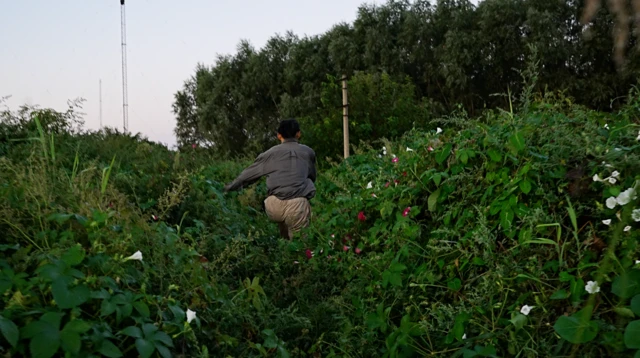
Silva Gu’s eyes dart back and forth across miles of tall grassland, scouring it for signs of life in the darkness.
He speaks in less than a whisper as we try to find a spot to hide in the fields. Behind us, the vast metropolis of Beijing has yet to wake. As we wait, we hear only our own breath.
And then, as the sky starts to lighten ahead of sunrise, we hear footsteps. The poachers are here.
Slim and stealthy, Silva heads out first. We eventually follow with our cameras.
Slowly, we tread through a line of trees, into a small clearing. We only spot the bird net when it is a few inches from our faces.
Each year, tens of thousands of birds are caught in nets across China for the pet trade, or for meat.
The pandemic and a property crisis have turned the economy sluggish – so catching and selling songbirds on the black market is a low-cost and often low-risk way of making a large profit.
A pretty songbird, such as a Siberian rubythroat, can often sell for nearly 2,000 yuan (£210; $280), which is more than many farmers earn in a month.
“I want to protect them on this Earth controlled by humans,” Silva says. Birds, for him, are a passion.
“I often dream. And in my dreams, I’m always flying.”
In the skies above us, billions of birds, many so small that they can fit in the palm of your hand, are migrating south for winter.
They have taken advantage of the long summer days in Siberia, or Mongolia, feasting on bugs and berries. As the year comes to a close and icy winds bring the first frosts of winter, they are flying to warmer places to nest and feed.
This was back in October, when flying through China is the equivalent of rush hour for migratory birds heading to Australia, New Zealand or southern Africa.
China is home to 1500-plus bird species, which is about 13% of the global population – more than 800 of those are migratory birds. Four of the nine major routes they follow intersect in China.
These are long, often perilous journeys, where the birds navigate through storms and evade predators, while looking for the ideal spot to spend the night.
The patch of grassland where we were, on the outskirts of the Chinese capital, is an oasis for small birds – any further and the city skies offer few options to rest among towering rows of concrete.
It is also an oasis for the poachers and their “mist nets”, so thin you can barely see them.https://web-cdn.api.bbci.co.uk/ws/av-embeds/articles/cdxw7593x9zo/p0mqgssp/en-GB/amp#amp=1Video caption,Watch the moment BBC stumbles upon bird poachers in Beijing
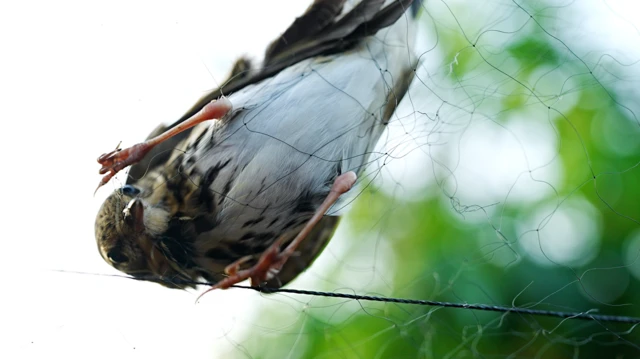
The one we nearly walked into was stretched across half the length of the field and propped up with bamboo poles. In the middle, a small finch was desperately trying to free his legs, but the more it moved, the more its claws became tangled.
It was a meadow pipit, a protected bird in China, and an important “indicator species” – that means if its numbers are thriving, so is its environment.
The poacher spotted us and started to run. From a small pouch on his hip, he threw around half a dozen small birds into the air before sprinting deeper into the shrubs.
Our cameras caught the moment he was stopped by Silva whose years of experience have taught him how to detain poachers while he calls the police. He stops the poacher from leaving, simply by continuing to block his path.
“At the beginning I had no experience and at that time I was quite afraid,” he later says. “But if you really want to do something, those fears will all be forgotten.”
The police arrived about 40 minutes later to arrest the poacher.
Silva, who in his 30s, does this work for free using his own savings. He has given up on many nights of sleep to set songbirds free, and he has spent the last 10 years persuading the police in Beijing to take this crime seriously.
“Back in 2015, no-one cared,” he says.
So he recruited volunteers who did care and launched a group called the Beijing Migratory Bird Squad. He held public meetings and invited the heads of the local police and forestry bureau. These small and persistent acts of persuasion appear to have worked. The police discovered that catching poachers also led to tracking down other kinds of criminal activity in Beijing.
“We found our goals were partially aligned,” Silva says, adding the caveat that enforcement is still patchy.

Silva’s love of birds started in childhood. He grew up in the 1990s in a very different Beijing – grand and imposing, but not the capital of an economic giant.
He remembers roaming through the grasslands on the city’s edges where he found birds, frogs and snakes. “But starting from the 2000s, everything changed.”
China’s booming economy brought millions of rural workers to cities as they sought jobs in factories or in construction. This rapid urbanisation meant grasslands were seen as empty places to build,not sanctuariesto conserve.
The change stunned Silva. The grasslands began to shrink, as did the habitats they supported.
“I decided back then to work in conservation and I took this path,” he says.
It has not been an easy life.
One of Beijing’s biggest bird dealers found out he was being investigated by Silva and retaliated.
“He gathered several of his accomplices who surrounded me and beat me up,” Silva recalls. He says he went to the police but those responsible were not brought to justice.
He has also lost his army of volunteers over the years. This work requires stealth and sleepless nights to stalk poachers in the dark. Silva says few people are willing to take on the difficult – and sometimes dangerous – job.
“I do this full-time,” he says. “I made it a project because if you want to solve this big problem, you must devote yourself wholeheartedly. You can’t do it part-time.”
He says fundraising pays for some of the costs – more than 100,000 yuan, $14,000 a year – but donations have dipped because of the slowing economy.
So he has found new ways to hunt the hunters.
He studies satellite imagery to find the paths worn away by the poachers through large fields and grasslands. He maps those against the bird’s migratory routes and looks for areas where they may stop for the night. The satellite images can even show lines of net traps which can catch hundreds of small birds at night.
That’s what the mist nets do. They trap a variety of small birds even if the poachers are after prized versions, like the Siberian rubythroat.
“Siberian rubythroats and bluethroats sell for a high price,” Silva says. “In big cities like Beijing and Tianjin, those who want to keep birds are now quite wealthy.”
Although there are wildlife laws in place, Silva reckons the fines to punish the crime do not outweigh the financial benefits of catching and selling songbirds.
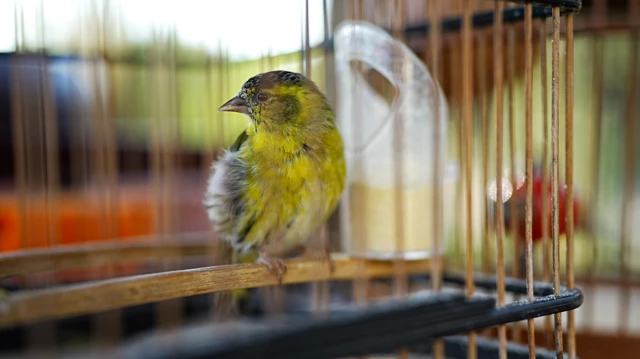
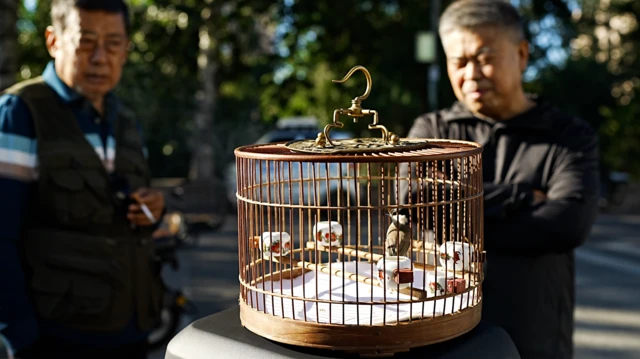
Owning a pet bird was – and for some generations in China, still is – a status symbol. This dates back to the Qing dynasty, which ruled China from the mid-17th to early 20th Century. Nobles and elites would build ornate bamboo cages for their birds to display their elegance and wealth.
It’s a tradition that continues mainly among retired men in their 60s or 70s. Silva says older Chinese people don’t realise they are committing a wildlife crime, or understand that so many more birds had to die in a trap so they could buy a caged bird.
“This generation didn’t even have enough to eat growing up. Now with a little money, they have inherited the habit and custom of caging birds,” he says. “China developed so fast, there was no time to educate people about ecology and once adults values are formed, they’re really hard to change. Maybe they can’t be changed in a lifetime.”
Silva feels alone in this fight.
“Sometimes, I am so tired. I want to find someone, maybe a group of people and we could combine our strength – but right now there is no-one.”
On a long low wall alongside the Liangshui river in Beijing, a trader has several small cages with tiny twittering birds.
Another man stands outside the nearby vegetable market holding a bird cage shrouded in a black veil. He tells passers-by quietly that his songbird is rare, worth nearly 1900 yuan, or about $270.
This is a glimpse of an old Beijing where small unofficial traders have created their own market.

The path by the river stretches for several miles and on a sunny weekday morning, there were shoppers browsing everything from vintage jewellery to false teeth, all laid out at makeshift stalls.
We were told we would be able to buy a wild songbird in a small park just off the path. It was easy to find.
Music was blasting from a speaker under the low trees where a troop of elderly ladies were choreographing a fan dance routine. Nearby several men, all over 50, had gathered with bird cages – some had two or three in their hands. Most were covered in dark cloth.
But today there would be no sales because the police had arrived. They were questioning the bird owners and taking names. Defiant, one man said he was taking his caged bird for a walk. This does happen in many Beijing parks, where songbird owners gather with their caged pets to chat and compare notes.
This police visit was part of a wider campaign by the Ministry of Public Security that was announced earlier in the year.

Wildlife trade is big business. Interpol estimates the illegal portion of the trade to be worth nearly $20bn and, according to Animal Survival group, China is the largest consumer of wildlife products, both illegal and legal.
Officials in Beijing have repeatedly denied accusations that the Covid-19 pandemic originated through animal-to-human transmission at a wet market in Wuhan, where wildlife was also being sold. Conservation groups have been pressuring the Chinese government to ban trade in wildlife.
This year, Chinese state media described the protection of wild birds as crucial for safeguarding ecosystems vital to human survival.
This shift in authorities’ attitudes is also why Silva has had success working with the police.
That day in the field outside Beijing, Silva managed to keep the poacher at arm’s length until the police arrived. The man appeared to be in his 50s and was wearing old construction overalls. Don’t move, Silva warned him.
The poacher offerered to kneel and apologise, telling Silva that he only came to the field to look at birds. But Silva grabbed his phone, where he found photos and videos of dozens of caged birds.
Later, when Silva and the police searched his home, they found them all still there, waiting to be sold.
Many of the wildlife poaching rings in China are much bigger. In Dalian earlier this year, the police arrested 13 suspects, and seized more than 12,000 yellow-breasted buntings, a wild bird with the highest protection level in China.
Silva worries that despite the renewed efforts to catch poachers, they face few penalties. But he is also encouraged. He has rescued more than 20,000 birds on site for the past 10 years and disrupted the nets of countless poachers.
“I think there’s hope,” he says, pinning his on a generational change – when more young people will understand and appreciate China’s rare songbirds and the need to protect them.
Until then, he says, he will keep at it himself: “This is my ideal. If you have this ideal, you must persist. You can’t not.”
And so each night during the annual migration, he will patrol the fields of Beijing in the hope that he can bring back the dulcet tones of songbirds to the city’s skies – he wants his city to sound like it did in his childhood.

