Appeals court agrees HPAI-hit ostriches should be culled
Reply


By Brittany Hobson, The Canadian Press
Posted Aug 23, 2025 6:00 am.
WINNIPEG — Some trappers are expecting “catastrophic losses” to their food and financial security this year, as Canada’s second-worst wildfire season on record sent swaths of remote boreal forest up in flames.
The latest figures from the Canadian Interagency Forest Fire Centre suggest fires have torn through 78,000 square kilometres of land, with most of the fires on the Prairies.
“These are humongous fires … (the) majority of the traplines will be affected in a big way,” said Ron Spence, a trapper from Nisichawayasihk Cree Nation in northern Manitoba.
“I’m sure there’s portions of my line that are going to be affected.”
Roughly 20,000 square kilometres of land have burned this year, considered Manitoba’s worst wildfire season in at least 30 years. It’s more than double the area from the second-worst season in the province in 2013.
For trappers who call the land their office, it’s a waiting game until they can see how their traplines, equipment and cabins have fared.
Spence, a councillor in the community, oversees a portion of traplines as vice-president of the Manitoba Trappers Association. Aside from Nisichawayasihk, he looks after other areas dealing with fires and evacuations, including Tataskwayak and O-Pipon-Na-Piwin Cree Nations.
His registered trapline, a “fair size” horseshoe shape, runs between Nelson House and South Indian Lake.
Fires to the west and south have threatened portions of the line and a cabin, and flames and smoke mean it will be a while before he can go in and assess any damage.
“No one’s been able to get out. We were not allowed,” Spence said.
In Manitoba, there are roughly 900 registered traplines. Some, like Spence’s, have been passed down through generations. He can remember being raised on the land by his grandparents.
For many, trapping is their only source of income, with the season typically running from November to May.
Traplines can vary in size, with some accessible by foot and snowshoe and running 25 to 30 square kilometres. Others stretch more than 1,000 square kilometres, with multiple cabins along them.
This wildfire season could result in some operations losing hundreds of thousands of dollars, factoring in the destruction of infrastructure, equipment and vehicles like snowmobiles, said Bill Abercrombie, president of the Alberta Trappers Association.
“There’s been some really extreme losses on some of the traplines out in the bush this year,” he said.
“The fires came so fast and so hot and burned huge areas. I know trappers that have just basically lost everything — trapping families that have been there …for generations. It’s been a very, very tough year.”
Abercrombie expects it will take a big effort to get into some of the remote areas in the fall and winter. Access is dependent on creeks and lakes freezing up and, in some cases, bridges and groomed trails have burned.
Some trappers may have insurance, said Abercrombie, but many can’t afford the high premiums.
His association offers compensation to members, he added, but it’s a small amount compared with what total losses could look like.
There’s also the loss of income.
Spence catches a variety of animals on his trapline: wolves, fishers, minks, lynxes, beavers and martens. The weasel-like martens, popular with Manitoba trappers, can net $50 to $150 for each animal, with one line catching hundreds.
The Manitoba government said some traplines are likely to be more affected by the fires than others, but the impact has yet to be fully determined. Many furbearer populations are naturally cyclical and have adapted to fire dependent ecosystems, the province added.
For Indigenous trappers like Spence, trapping is more than an industry. It’s a way of life.
“It’s not just a trapline … we gather medicine, we hunt,” he said.
Traplines are also a place where Indigenous youth participate in land-based learning that’s important to their culture.
It’s part of the reason Grand Chief Garrison Settee with Manitoba Keewatinowi Okimakanak, an advocacy group representing some communities in northern Manitoba, would like to see the development of a First Nations disaster financial assistance program.
He said governments need to engage directly with First Nations leadership to ensure emergency policies reflect Indigenous realities and rights.
“You’re not just losing property … these spaces are there to sustain our way of life. So we need the province to recognize that the traditional harvesting infrastructure is not optional.”
Spence can recall a time in the early ’80s when his family cabin on the trapline burned. They received some help from the province, and it helped in the long run, he said.
It’s something he would like to see implemented again.
He compared the loss many trappers will experience this season to what farmers go through with natural disasters.
A Manitoba government spokesperson said in an email that “compensation is not available for losses related to trapping ability or infrastructure on registered traplines, as traplines are considered an opportunity for harvest rather than a guarantee of success.”
Alberta has assisted trappers in the past, said Abercrombie, and he expects there could be some compensation this year — but to what extent is unknown.
“The reality is it’s pretty much up to us to take care of our own problems,” he said.
This article is more than 6 months old
This article is more than 6 months old
Renewed program would allow hunters to eliminate up to 80% of the animals on 20,000 acres of state land
Tom PerkinsMon 20 Jan 2025 07.00 ESTShare
Alaska is set to resume the aerial gunning of bears and wolves as a population control measure aimed at boosting caribou and moose herd numbers, even as the state’s own evaluation of the practice cast doubt on its effectiveness.
The renewed program would allow hunters to eliminate up to 80% of the animals on 20,000 acres (8,000 hectares) of state land. Environmental groups opposed to what they label a “barbaric” practice of shooting wildlife from helicopters is more about sport than scientific practice in part because hunters want caribou populations to increase because they are trophy animals.
“Alaska’s practice of indiscriminately strafing predators is both inhumane and inane,” said Rick Steiner, a former University of Alaska-Fairbanks ecologist now with Public Employees for Environmental Responsibility (Peer), which opposes the practice. “There is no scientific evidence that this carnage will boost populations of moose and caribou, and there is a growing body of evidence that it disrupts a healthy predator/prey balance in the wild.”
The report comes after the Biden administration effectively upheld Trump era rules that allowed for other inhumane hunting practices on federal lands in Alaska, like killing cubs in dens.
Alaska’s “intensive management” allows Alaskan game agents to kill any brown bear, black bear or wolf on some state lands. Nearly 100 bears, including 20 cubs, were killed by helicopter in 2023.
The latest program would allow aerial hunters to kill 80% of wolves (until the population is reduced to 35), 80% of black bears (until the population is reduced to 700) and 60% brown bears (until the population is reduced to 375).
Though the practice’s supporters say eliminating the predators helps boost sagging caribou populations, an October state report that examined predator kill practices came to a different conclusion.
“The goal of the project was to increase caribou calf survival by removing all bears and wolves from the calving grounds,” the report reads. “Data does not exist to evaluate whether the goal was achieved.”
The largest factors in caribou herd decline were “disease, nutrition, and winter severity”, the report states. About 65% died from starvation or dehydration.
Critics say the state also notes that it doesn’t know the practices’ full impact on bear populations because it did not estimate brown bear numbers before allowing the kills. More than half of the brown bears killed in 2024 were adult females, raising further questions about the population’s ability to rebound.
Meanwhile, the state refuses to allow photographs of the slaughter, independent observers to be present, or to subject the program to scientific review by the federal government.
The practice has had other consequences: the National Park Service has ended a more than 20-year study of wolf behavior in the nearby Yukon-Charley national preserve because the resident wolf population has fallen so low.
Meanwhile, it has reduced tourism in the area because the ability of visitors to view intact wolf packs inside adjacent Denali national park, one of the state’s major tourist draws, has plummeted. The state has said the hunting program raises revenue from hunters, but critics called it the “epitome of pound foolish”.
“The amount of tourist dollars from people seeking to view these predators in the wild dwarfs any incremental increase in hunting fee revenue the state hopes to realize,” said Peer executive director Tim Whitehouse.
ShareShare on FacebookPostShare on XShareShare on LinkedIn
For Immediate Release:
August 20, 2025
Contact:
Sara Groves 202-483-7382
Newberry, Mich. – A bear in obvious psychological distress was denied veterinary care at Oswald’s Bear Ranch and other bears were fed animal feed that expired in 2022, unsuitable restaurant scraps, and sugary snacks, which led them to become overweight or obese, according to a just-released report from the U.S. Department of Agriculture (USDA). Following a PETA complaint, a federal veterinarian inspected the facility on July 15 and documented that the young female black bear was repeatedly tossing her head, suddenly pacing in different directions, and exhibiting other signs of deep distress—and a staff member admitted that they had noticed the behavior but hadn’t bothered to do anything about it.
Oswald’s has a long history of ignoring the federal Animal Welfare Act. Among other violations, in 2021, the facility was cited by the USDA for feeding bears restaurant scraps and dog food, causing them to become overweight, and was instructed to consult a veterinarian to develop a diet plan—a directive Oswald’s appears to have ignored. That year, the USDA also ordered Oswald’s to pay a $2,400 penalty to settle a USDA complaint stemming from a tip from PETA that the roadside zoo had lied about the circumstances surrounding the death of a young black bear named Sophie, who was shot dead by a local sheriff after escaping her enclosure.
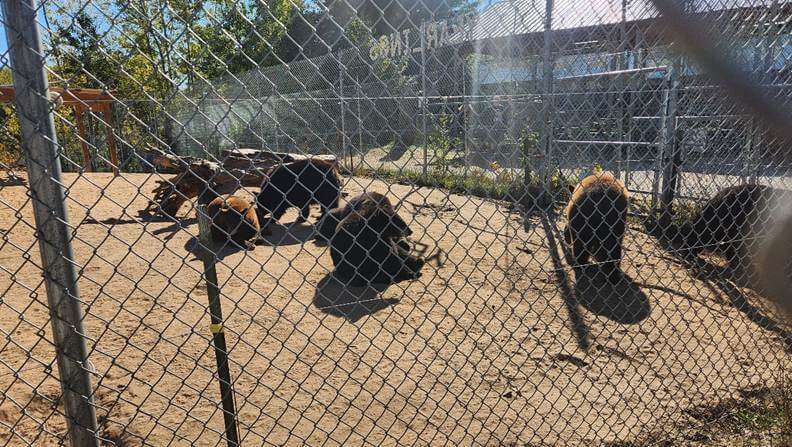
“Bears trapped at Oswald’s are sick and distressed, having been torn away from their mothers as infants, treated as props for tourist photos, and spending their lives behind a chain link fence instead of being able to be bears,” says PETA Foundation Associate Director of Legal Advocacy Jonathan Morris. “PETA urges everyone to stay far away from roadside zoos like Oswald’s that sentence animals to lives of illness and misery.”
Bears allowed to be bears love to climb and explore, can travel more than 20 miles in a day, and have been seen maneuvering tree stumps to gather out-of-reach food and using rocks as “exfoliators” to shed excess fur. In nature, black bear cubs stay with their mothers for up to two years, but Oswald’s Bear Ranch—which falsely markets itself as a “rescue”—acquires weeks-old cubs from out-of-state breeders so it can sell cub-petting sessions. When the cubs become too large and dangerous to be handled, they’re crammed into a small, mostly dirt pen where all they can do is pace.
PETA—whose motto reads, in part, that “animals are not ours to use for entertainment”—points out that Every Animal Is Someone and offers free Empathy Kits for people who need a lesson in kindness. For more information, please visit PETA.org or follow PETA on X, Facebook, or Instagram.
 Exposing the Big Game