‘Safety most important thing’: South Cariboo hunting season just around the corner
Reply

Media Contacts:
Chris Smith, WildEarth Guardians, 505-395-6177, csmith@wildearthguardians.org
Nadia Steinzor, Project Coyote, 845-417-6505, nsteinzor@projectcoyote.org
HELENA, Mont. — Today, 458 wolves in the state of Montana received a death sentence from the Montana Fish & Wildlife Commission. 458 is the quota of wolves to be hunted and trapped during the 2025-2026 season—the highest quota the state has set since wolves in the Northern Rockies lost Endangered Species Act protections in 2011. The quota of 458 applies statewide with the exception of carve-outs for the region adjacent to Yellowstone National Park. Montana Fish, Wildlife, & Parks (FWP) data (page 44) indicates that a hunting and trapping quota of 450 could drop the population to below sustainable levels within one year; FWP defines a ‘sustainable level to be over 450 wolves, or enough wolves to maintain 15 breeding pairs.
“The regulations approved today defy science and ethics–they greenlight a season of unrelenting wolf extermination,” said Lizzy Pennock, carnivore coexistence attorney for WildEarth Guardians. “As Montana sentences a record number of wolves to be slaughtered this year, it is clearer than ever that the state will drive these keystone predators to extinction unless they are federally protected. We are considering all avenues to protect wolves.”
“Today’s cruel, senseless wolf-killing vote proves that Montana is stuck in the distant past, when extermination rather than sound management was the goal,” said Nadia Steinzor, carnivore conservation director at Project Coyote. “Montana’s wildlife agency is supposed to protect natural resources for the benefit of all–but its own Commission just did the opposite by limiting public participation and pushing through an ecologically devastating proposal.”
Montana is already under fire in court for its record of mismanaging the state’s wolf population. Earlier this month, a federal district court pointed to the inadequacies of Montana’s wolf management as a key part of its ruling that the U.S. Fish and Wildlife Service violated the Endangered Species Act when it determined that gray wolves in the Western U.S.—including wolves in Montana—do not warrant federal protections. The ruling detailed “serious concerns” about Montana’s wolf population estimate model, iPOM, which experts say overestimates the wolf population (see here and here) and described “negative public attitudes” which are “undisputedly expressed in the legislative body governing Montana.”
In addition to the total kill quota of 458, the Commission also approved increased killcounts for each hunter and trapper. This season, a single hunter is permitted to kill 15 wolves and a single trapper can also kill 15 wolves, meaning that a single person could kill 30 total wolves this season. Fortunately, the Commission voted down proposals to extend the wolf hunting season that would have allowed killing even during pup rearing season.
The statewide quota applies to all of Montana with the exception of Region 3, adjacent to Yellowstone National Park, which limits wolf hunting and trapping to 60 animals, with Wildlife Management Units 313 and 316 on the border of the Park each limited to three wolves. The regulations keep in place limitations on wolf trapping in grizzly bear habitat secured by WildEarth Guardians and the Flathead-Lolo-Bitterroot Citizen Task Force in a 2024 legal settlement.
The Commission also approved an additional 100 wolves to be killed as “controlled removals,” which includes killing by USDA’s Wildlife Services at the behest of livestock producers and killing by private citizens who determine wolves are a “potential threat” to livestock, dogs, or people. Accounting for this approval, the total number of wolves the Commission approved to be killed this season in Montana is 558.
Under the recent federal court order, the U.S. Fish & Wildlife Service must re-analyze whether Western gray wolves require Endangered Species Act protections. Even as it does so, WildEarth Guardians, Project Coyote, Footloose Montana, and the Gallatin Wildlife Association are in the midst of a lawsuit against Montana in state court which the groups filed in 2022. That lawsuit challenges the ongoing regulations and legislation targeting wolves as a violation of several state laws and the state constitution.
###
Other species exhibit capabilities that were once thought to be exclusive to Homo sapiens
By Kate Wong edited by Seth Fletcher
September 2025 IssueEvolution
We’re celebrating 180 years of Scientific American. Explore our legacy of discovery and look ahead to the future.
It was the telegram exchange that sparked an identity crisis for humankind. In 1960 a young Jane Goodall working in a remote forest in Tanzania observed a chimpanzee she named David Greybeard using blades of grass and twigs to fish nutritious termites out of their nest. The primatologist wrote to her mentor, Kenyan paleoanthropologist Louis Leakey, to tell him about her observation, which flew in the face of the conventional wisdom that held that only humans made tools. Leakey replied: “Now we must redefine tool, redefine man, or accept chimpanzees as human.”
For decades—centuries, even—scholars have attempted to draw a hard line between our kind and the other organisms with whom we share the planet. They have argued that only humans have culture—sets of learned behaviors, such as toolmaking, that are passed down from generation to generation. They have proposed that only humans think symbolically, using signs to represent objects or ideas. That our species alone is self-aware, capable of planning for the future and experiencing emotions such as joy and fear, love and grief. That only humans are conscious, possessed of an inner world of subjective experience.
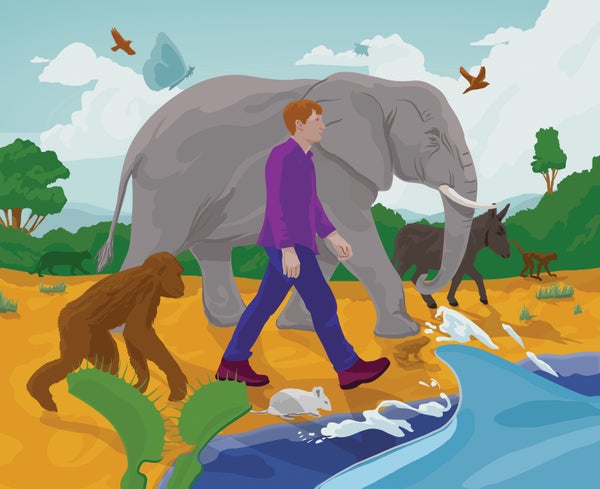
For his part, Charles Darwin, writing in the late 1800s, opined that nonhuman animals have the same cognitive abilities and emotions that humans have and that any differences were a matter of degree and not kind. In the absence of any way to reliably read animal minds, however, scientists who studied animal behavior and cognition took the position that ascribing human thoughts, feelings and motivations to animals—anthropomorphism—was a cardinal sin. But in recent decades examples of other species demonstrating these capabilities have emerged from across the tree of life. The findings have spurred fresh thinking about what, exactly, distinguishes Homo sapiens, with our vaunted intellect, from every other species on Earth.
Let’s look first at our evolutionary nearest and dearest. We H. sapiens possess much larger brains than our closest living relatives, the chimps and bonobos, do—around three times as large. The brain requires 20 percent of our energy budget despite making up only 2 percent of our body mass. Naturally, anthropologists have wondered why we evolved such energetically expensive brains. At the same time, we know that H. sapiens is the sole surviving member of what was once a diverse group of humanoids. Surely our big brains and all the clever things they allow us to do were a major reason for our success as a species, a vital factor in why we alone went on to spread across the globe and thrive in every ecosystem we set our sights on, outcompeting other branches of humanity until we were the last hominin standing.
Yet virtually every trait that anthropologists have identified as one that might have set our kind apart has subsequently been found in another member of the family. Our closest evolutionary cousins, the Neandertals, left behind decorations that suggest they used symbols, which may indicate a capacity for language. The same goes for our smaller-brained relative Homo erectus. And some 3.3 million years ago, long before brain size began to expand in our lineage, an unknown hominin—possibly Australopithecus afarensis—shaped basalt cobbles into cutting tools, demonstrating an understanding of the material properties of stone and a vision for how to transform a lump of rock into a useful implement.
It’s not just our closest hominin and great ape relatives that share our powers of cognition. Humans were long thought to be the only moral animals, uniquely equipped with a sense of right and wrong. But we now know that is not the case. The late primatologist Frans de Waal and Sarah F. Brosnan found in laboratory experiments that brown capuchin monkeys would decline a reward of a slice of cucumber if they observed another monkey receiving a better treat (a grape) for the same task. The monkeys’ rejection of unequal payment for equivalent work demonstrated that they have a sense of fairness and experience moral outrage when they get a raw deal.
Other animals exhibit other elements of morality—including empathy. Mice, for instance, can share the emotional state of another individual, exhibiting increased sensitivity to pain if they see a companion showing signs of pain. Dogs recognize distress in their owners and will offer consolation. Rats will sacrifice their own gains to alleviate the suffering of a conspecific, forgoing a food reward if taking the food means inflicting pain on another rat.
Empathy and other complex emotions were long considered beyond the experience of nonhuman creatures. But mounting evidence indicates that they are widespread among mammals. Some of the most striking examples involve emotional responses to death. In 2018 an orca known as Tahlequah made headlines around the world when she carried her dead calf with her for 17 days while she swam 1,000 miles across the Salish Sea. In 2024 Tahlequah lost another calf. This time she held on to its corpse for at least 11 days before releasing it. Researchers characterized the mother orca’s reaction to these losses as grief.
Apes, monkeys and elephants have been observed to mourn the loss of bonded individuals, too. It’s not just large-brained mammals that appear to express sorrow, however. Barbara King, who is known for her research and writing on animal cognition and emotion, has described compelling examples of grief in peccaries, donkeys and ferrets, among others.
Our fellow mammals are not the only animals to show signs of thinking and feeling as humans do. The Eurasian Magpie, a species of bird, can recognize itself in the mirror—a sign of consciousness. Fish feel pain, another conscious experience: when given an injection that causes discomfort, lab zebra fish will vacate their preferred habitat, which has been decorated with pleasing rocks and vegetation, to visit a barren habitat whose water is infused with a pain reliever. And studies of bees and other insects suggest that they may experience both pain and joy. That is, these creatures, too, may be sentient.
Although the evidence for consciousness in fish, reptiles, insects, and other invertebrates has yet to accumulate to the degree that it has in mammals and birds, researchers are taking the possibility far more seriously than they have in the past. In 2024 dozens of scientists signed a declaration acknowledging that species quite different from humans may have experiences of consciousness and that this possibility needs to be considered in decisions that affect these animals. The document could help shape policies governing animal research ethics and welfare.
One more group of organisms deserves mention. In recent years researchers have increasingly begun to explore the idea that plants—traditionally viewed as noncognitive beings—can learn, remember, make decisions, communicate and experience the world uniquely. In this way, some investigators propose, they are conscious. Consider the Venus flytrap, a carnivorous plant that catches flies, ants, and other insects when they brush against the sensory hairlike structures in the plant’s trap. The plant remembers when it has been touched. After two touches, the trap closes and imprisons the insect prey; after five touches, it produces the enzymes needed to digest its catch. Other plants sense when they are being munched by hungry insects and emit chemical signals that summon predators of their attackers.
We might not be as unique as we thought we were. But we needn’t feel demoted. There’s something marvelous about finding a common thread between flytrap and ferret, bee and human. We’re not separate from nature, we’re connected to it, part of the weave of life, in all its dazzling diversity.
 Exposing the Big Game