Forestry minister faces public criticism, debate challenge from photographer over cougar death
Reply

Mass deaths of elephant seals recorded as bird flu sweeps across the Antarctic
This article is more than 1 year old
This article is more than 1 year old
Researchers warn of one of ‘largest ecological disasters of modern times’ if the highly contagious disease reaches penguin colonies
The age of extinction is supported by

Phoebe WestonFri 8 Dec 2023 00.00 ESTShare
Bird flu is spreading in the Antarctic, with hundreds of elephant seals found dead, and fears it could bring “one of the largest ecological disasters of modern times” if the highly contagious virus reaches the remote penguin populations.
The virus was first reported among brown skua on Bird Island, off South Georgia. Since then, researchers and observers have reported mass deaths of elephant seals, as well as increased deaths of fur seals, kelp gulls and brown skua at several other sites. Cases have been confirmed 900 miles (1,500km) west of South Georgia, among southern fulmar on the Falkland Islands.
Dr Meagan Dewar, chair of the Antarctic Wildlife Health Network, told the Guardian that the situation among southern elephant seals was concerning. “At some sites we’ve had mass mortalities, where we are getting into the hundreds,” she said. “There is a likely chance it could be avian influenza.”
So far tests have confirmed bird flu deaths at eight sites across the Antarctic, and the disease is suspected with confirmation from tests still pending at 20 further sites where animals have died.
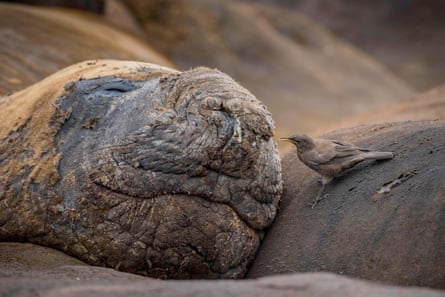
Researchers reported that a number of elephant seals had been exhibiting symptoms of avian flu, such as difficulty breathing, coughing and accumulations of mucus around the nose. Lethargy, spasms and an inability to fly are symptoms in birds.

00:00
03:12
Read More
While a number of seabird cases have been confirmed, many – including the elephant seals – are still classed as suspected, pending lab results.
So far there are no recorded cases on the Antarctic mainland – home to unique ecosystems that are some of the world’s most isolated – but the disease is expected to arrive in the coming months as birds move.
Dewar said: “It’s devastating to watch that happen and recording all the cases we’re getting.”
Penguins are starting to cluster together as the breeding season starts, and this close contact makes them particularly vulnerable. Previous outbreaks in South Africa, Chile and Argentina show they are susceptible to the disease.
“If the virus does start to cause mass mortality events across penguin colonies, it could signal one of the largest ecological disasters of modern times,” researchers wrote in a pre-print research paper last month.
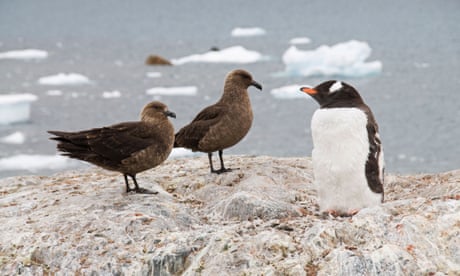
Many species in the Antarctic are found nowhere else, so the consequences for the region of highly pathogenic avian influenza (HPAI) spreading are unknown.
The Scientific Committee on Antarctic Research said recently: “Given the dense breeding colonies of wildlife in the Antarctic and sub-Antarctic regions, HPAI is expected to have devastating impacts on the wildlife and to lead to catastrophic breeding failure and mortality events in the region.”
The virus has killed an estimated 20,000 sea lions in Chile and Peru. Dewar said: “If we start to get outbreaks similar to what we’ve seen in South America that could have very big impacts. Emperor penguins and chinstrap penguins have been taking significant declines, so if we get large outbreaks in those species, that could cause further pressure on those colonies.”
The current outbreak of the highly infectious variant of H5N1 – which started in 2021 – is estimated to have killed millions of wild birds. The strain spreading in Antarctica is clade 2.3.4.4b, which has decimated bird populations across the UK, continental Europe, South Africa and the Americas, with seabird colonies experiencing losses of 50% to 60%. The H5N1 strain has not yet reached Oceania
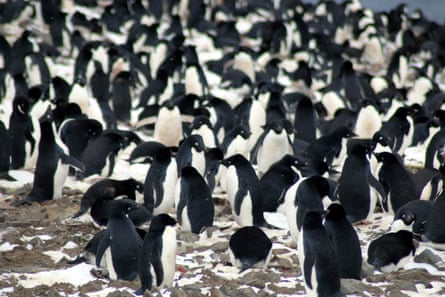
Dr Michelle Wille, from the Centre for Pathogen Genomics and the University of Melbourne, who is helping to record deaths, said: “It’s terrible news that it’s now in the sub-Antarctic, and we are very worried about viral spread into the Antarctic. In addition to negative affects on animals, the ‘removal’ of vast numbers of animals from the Antarctic ecosystem may have long-term ecosystem effects.”
Researchers from the British Antarctic Survey and the British government’s Animal and Plant Health Agency are identifying possible cases, testing them and sharing data. It is challenging to record what is happening because of the size of Antarctica and the small number of people monitoring it. A number of reports of mass deaths have come through tour vessels.
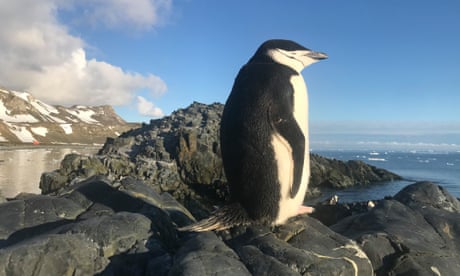
Many places in South Georgia are now closed to tourists and even researchers have to go through a number of procedures to get there in a bid to stop the disease spreading, said Dr Michael Wenger, who trained as a marine biologist and has been working as a guide in Antarctica for 18 years.
He added: “It’s already hard to estimate numbers in normal situations, because the area is huge and there are a lot of animals. Now with the areas closed, it’s even harder.”
This article was amended on 11 December 2023 because Dr Michelle Wille is at the University of Melbourne, not Sydney as an earlier version said.

Share:
With egg prices in the United States soaring because of the spread of H5N1 influenza virus among poultry, the U.S. Department of Agriculture (USDA) yesterday conditionally approved a vaccine to protect the birds. President Donald Trump’s administration may therefore soon face a fraught decision on whether to join the ranks of other nations—including China, France, Egypt, and Mexico—that vaccinate poultry against H5N1.
Although many influenza researchers contend that vaccination can help control spread of the deadly virus, the U.S. government has long resisted allowing its use because of politics and trade concerns that many contend are unscientific. The USDA approval may signal a shift in policy linked to the Trump administration’s worries about egg prices. Even with the conditional approval, USDA must still approve its use before farmers can start to administer the vaccine because special regulations apply to H5N1 and other so-called highly pathogenic avian influenza (HPAI) viruses.
The vaccine, made by Zoetis, contains a killed version of an H5N2 variant that the company has designed to work against circulating variants of the H5N1 virus that have decimated poultry flocks and have even jumped to cows and some humans. (The “H” in both variants stands for hemagglutinin, the surface protein of the virus, and antibodies against it are the main mechanism of vaccine-induced protection.) Researchers at the U.S. Centers for Disease Control and Prevention reported yesterday that three cow veterinarians harbored antibodies to the H5N1 virus in dairy cattle. None had symptomatic disease, they noted in the Morbidity and Mortality Weekly Report, suggesting the virus may be more widespread in humans than previously thought.
The latest news, commentary, and research, free to your inbox daily
Zoetis CEO Kristin Peck announced the approval yesterday on CNBC. “The decision to vaccinate commercial poultry flocks rests solely with national regulatory authorities in consultation with their local poultry sector,” said Zoetis in a statement, which noted it has approval for similar vaccines in other countries. Zoetis also had an earlier version approved in 2016 that was in the National Veterinary Stockpile until 2021, but it was never used.
HPAI strains such as the current H5N1 have for decades been stamped out largely by culling affected flocks and enforcing strict biosecurity measures. But that strategy has failed since the February 2022 emergence in the U.S. of an H5N1 virus that belongs to a lineage known as clade 2.3.4.4b. Many scientists now worry the virus cannot be eradicated from the U.S. poultry flock, which means it has become endemic rather than epidemic.
“The future of H5 in the Americas isn’t entirely clear, but endemicity looks likely,” says Richard Webby, a bird flu investigator at St. Jude Children’s Research Hospital. “Updated and quality H5 vaccines for poultry must be a big part of future responses if this is indeed the case.”
Tony Wall
February 15, 2025 •08:00am

https://imasdk.googleapis.com/js/core/bridge3.686.0_debug_en.html#fid=goog_166491714Play Video
02:20
Fear kōkako population diminishing in Te Urewera (Video first published 2022)
VIDEO CREDIT: CHRISTEL YARDLEY/STUFF
It was once the site of a “mainland island” conservation project to protect rare species such as the kōkako. But visitors to northern Te Urewera have been shocked by what they’ve seen: rotting animals hanging from abandoned traps; brand new pest control equipment lying in the burnt-out remains of old huts and possums everywhere. What’s going on? Tony Wall investigates.
The creature hanging from the trap looks like something out of vampire flick Nosferatu, its innards exposed and its clawed hands wrapped around a tree trunk.
The fossilised animal, believed to be a possum, though it’s hard to tell, was photographed on the Otamatuna Ridge Track in northern Te Urewera by tramper Dan Lodge in January.

He posted the image, and others showing the burnt-out remains of a former Department of Conservation hut at Otamatuna, on the Save Our Te Urewera Huts Facebook page.
“It was pretty sad to see so many traps unchecked or not reset for the last two years, and the old, locked DOC hut built for conservation staff full of brand new traps … burnt down,” Lodge wrote.
ADVERTISEMENT
ADVERTISEMENT
“This area was once trapped extensively as part of a mainland island project, to protect the kōkako and other birds, so it was sad to see all this effort go to waste.”
Dozens of people have left comments such as “shameful”, “tragic” and “disgusting”.
Te Urewera is recognised in law as a living person and is governed by a board with Crown and Tūhoe representatives.
Day-to-day operations are handled by Te Uru Taumatua (TUT), Tūhoe’s tribal authority, with support from DOC, which gives TUT about $2m a year to help manage the forest.
In 2022, TUT controversially burnt down 29 huts, including DOC biodiversity huts, as part of its plan to decommission DOC infrastructure and replace it with new buildings.
A High Court injunction stopped the destruction, and it was later found to be unlawful.
While the injunction was in place, several huts, including the Otamatuna hut containing DOC biodiversity equipment, were burnt down, in what were believed to be acts of arson unconnected to TUT.

ADVERTISEMENT
ADVERTISEMENT
More than two years later, the remains of the Otamatuna hut lie in situ, dozens of gas canisters and brand new traps amongst the debris.
Lodge used to visit Te Urewera as a child but now lives in the South Island. He and his family went camping in the Waimana Valley over the Christmas holiday period and were shocked by the state of the place.
“There were obvious signs of no maintenance whatsoever,” he told Stuff. “There’s traps everywhere that haven’t been checked, they’re all covered in moss, clear signs they haven’t been checked in years – dead things hanging out of traps, things not re-set.
“It’s sad to see the state of it … with the conservation efforts that had been going on in the past.”
His family did hear a couple of kōkako, however.
Prior to management of Te Urewera changing hands in 2014, the area around Otamatuna was extensively trapped as part of a DOC “Mainland Island” project that brought the threatened kōkako back from the brink of disappearing.
Stuff first drew attention to concerns about a lack of predator control in the forest in 2022.
At that point, TUT said it was doing things differently than before, focusing on a wider area of the forest than DOC did.
ADVERTISEMENT
ADVERTISEMENT
Now, it’s refusing to engage on the issue at all, failing to respond to a list of questions about predator control in Te Urewera sent through a public relations firm that it has worked with in the past.

Stuff asked DOC whether it was concerned about the message that images of neglected traps and the burnt remains of the hut sent to visitors.
It said in a statement: “DOC doesn’t see these images as reflecting the experience that Te Urewera Board and Te Uru Taumatua, as the lead in operational and management of Te Urewera, aim to share with manuhiri (guests).”
But it emphasized that it only had a support role, and questions were best put to TUT as the lead entity.
Kirsti Luke, TUT’s chief executive, told Stuff in 2022 that pest control involved trade-offs.
For example, she said, the biggest increase in kōkako numbers in Waimana Valley came in the early 2000s, using toxins now banned on the New Zealand mainland because of their impact on the ecosystem.
Luke said Tūhoe had access to “high levels of expertise” in pest control, including kaimahi (workers) who’d worked with DOC on the Mainland Island project, as well as experts in local bushcraft and ecosystems.
ADVERTISEMENT
ADVERTISEMENT
The organisation had permanent staff teams, bush crews and contractors working on pest control in Te Urewera, Luke said, and was in discussions with Predator Free 2050 and other experts on “cutting edge technology and methodology”.

Tāmati Kruger, chair of TUT as well as the Te Urewera Board, said in a press release last year that the organisation accepted the initial burning of the DOC huts was unlawful, as there was no annual operating plan in place as required under the Te Urewera Act.
That had been rectified, and TUT would continue decommissioning the huts in a “safe and responsible way”, he said at the time.
New, fit-for-purpose facilities within Te Urewera were part of that conversation, Kruger said.

“There is now a suite of knowledge to help us provide for Tūhoe members and kaimahi [workers], to support pest control and biodiversity work, and to make Te Urewera accessible and hospitable to manuhiri.”
But conservationist Pete Shaw, who used to manage DOC’s Mainland Island project in the Waimana Valley, is damning of TUT’s efforts, saying it has “switched off” pest control entirely.
ADVERTISEMENT
ADVERTISEMENT
He believes kōkako numbers will be “crashing” without intensive trapping.
“They switched off 20,000 hectares of possum control. They just stopped doing it.
“From what I can gather from people who’ve been up there, there’s possums everywhere.
“Possums prey directly upon kōkako – they kill the nesting females, they kill the chicks and they eat the eggs.

“Signing the Te Urewera Act signed the death warrant on kōkako in northern Te Urewera, it’s as simple as that.”
And it’s not just the kōkako under threat, Shaw says – pest control in a kiwi sanctuary at Lake Waikaremoana in the southern Te Urewera has also lapsed.
Stuff asked DOC if it’s concerned by pest numbers in Te Urewera.
ADVERTISEMENT
In a statement, Huia Forbes, responsible for Treaty relationships advice and oversight for DOC, said the department supported TUT to lead pest management “in a way that benefits Te Urewera and is in accordance with [guiding document] Te Kawa o Te Urewera”.
She confirmed DOC gave an annual grant of $2m to TUT each year to help with operational management of Te Urewera, but couldn’t say how much of that was spent on pest control.
“The Department does not oversee how this grant is spent, other than at a high level.”
Forbes said DOC was also unable to provide information about the state of kōkako in the forest, as it hadn’t monitored them since 2014.
As for what ongoing role DOC had in Te Urewera around pest management, Forbes said it provided support at TUT’s request and was currently involved in goat control work on the eastern and southern borders of the forest.
It’s understood private conservation groups who want to do pest control work in Te Urewera need a permit from TUT, but none have been issued.

Sam Gibson, a trapper and conservationist involved in a project to protect the whio, or blue duck, in the upper Waioeka Gorge, which borders Te Urewera, says he’d love to work with TUT on a trapping programme in the forest.
ADVERTISEMENT
ADVERTISEMENT
“Some of the rivers in Te Urewera flow into the upper Waioeka … [and] the birds we are supporting to breed are spilling over into those rivers.
“We see great potential in a relationship with TUT to support, if it was wanted, with predator control.”
Gibson is an ardent supporter of mana whenua taking over management of their land.
“It’s not for anyone who isn’t Tūhoe to comment on what should be done.
“[But] it would really be a shame for us to lose kōkako out of Te Urewera, it would be a shame for us to see the slow degradation of the whio population and the kiwi populations.
“I do share concerns that if action is not taken shortly, we run the risk of losing species out of Te Urewera.”
– Stuff

