Injured hunter rescued in Buffalo County
Reply

“Not only is the fire burning on top of the ground, it’s burning under the ground,” New Jersey Forest Fire Service Chief Bill Donnelly said.
RESIDENTIAL NEIGHBORHOODS.
>> YOU HAD 60 MILES AN HOUR
0 seconds of 3 minutes, 1 secondVolume 0%
Dangerous wildfires rage across California and New England
Nov. 11, 2024, 3:42 AM PST
Firefighters from coast to coast are battling wildfires even as the country begins to prepare for the holiday season, with fires in New Jersey covering thousands of acres in tinderbox conditions created by a historic drought.
In California, the so-called Mountain Fire in Ventura County has grown to 20,000 acres, or 31 square miles, and was only 26% contained Sunday night, the Ventura County Fire Department said in an update. Threats remains there to critical infrastructure, highways and communities as the fire “continues to creep and smolder in steep rugged terrain,” a public information officer said.
The blazes in the Northeast have claimed at least one life: Dariel Vasquez, an 18-year-old New York Parks employee, was killed Saturday by a falling tree while battling a fire in Sterling Forest, in New York’s Orange County. A memorial service will be held for him at Ramapo High School on Monday.
The Jennings Creek Wildfire in Passaic County, New Jersey, close to the New York state line, had grown from 2,500 to 3,000 acres — about 4.6 square miles — and was only 10% contained as of 6.30 p.m. Sunday, the New Jersey Forest Fire Service said. At least 25 structures are threatened.
While there was a small amount of rain Sunday night, authorities warn it will not be enough.
“Make no mistake, though, precipitation is forecasted [but] that’s not going to solve the problem that we have here with this wildfire. It’s inevitable that this fire is going to continue to burn up until it reaches our control line,” New Jersey Forest Fire Service Chief Bill Donnelly said at a news conference Sunday.
He said the fire would likely burn through the end of this week, when the service hopes it can secure its control lines and contain the blaze. More than 200 local volunteers joined 75 wildland firefighters yesterday in attempts to battle the flames.
But he added that it was unlikely homes would need to be evacuated.
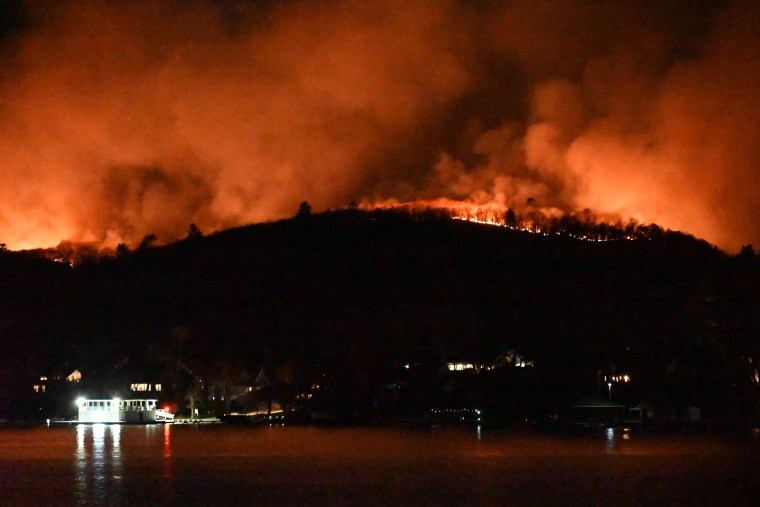
The fire department in Warwick, New York, told residents on Cliff Road, east of Greenwood Lake, to leave but stopped short of a mandatory evacuation order. Power was shut down Sunday night in Greenwood Lake Village as a preventive measure and a local shelter was set up by the American Red Cross, the force said.
“Not only is the fire burning on top of the ground, but it’s burning under the ground, so it’s very labor intense,” he said. “To put these fires out takes a lot of time and energy, and you can see by those numbers, we’ve been running our folks ragged”
Historically dry conditions and strong winds have created the perfect conditions for fires to thrive. Three counties in New Jersey are experiencing a rate “extreme” drought, while the rest of the state has severe or moderate drought conditions, according to the U.S. Drought Monitor at the University of Nebraska-Lincoln.


Donnelly called it the driest fall in New Jersey since records began.
The result is Donnelly’s teams have been called to 537 reports of wildfires in New Jersey alone since Oct. 1, burning through a total of 4,500 acres, or 7 square miles. In New York state, the total is 60 wildfires covering 2,100 acres in the same timeframe.
One blaze, the Hill Fire in Burlington County, has been burning since July 5, he said. Elsewhere, the 181-acre Cannonball 3 Wildfire was 100% contained Sunday.
There was some rain across the tristate area Sunday night, but less than half an inch, the National Weather Service in Mount Holly said.
Much of the Northeast has been experiencing a record lack of rain, with some areas such as Philadelphia without any precipitation for 42 days until Sunday’s shower.
USA TODAY
0:28
0:30
More than half of the monkeys that escaped a primate research facility last week in South Carolina have been recaptured, according to police.
Of the 43 monkeys that broke loose from Alpha Genesis, officials managed to recover 25 of them between Saturday and Sunday, leaving 18 of the animals still at large in Yemassee, a small town about 60 miles west of Charleston. The primates, a bare-faced species known as rhesus macaques, made a break for it Wednesday when a caretaker at the research center failed to lock the doors after a feeding.
Police in Yemassee said Sunday on Facebook that “a sizable group remains active” near the research center’s fence line and had “bedded down in the trees for the night.”
The post, which quoted Alpha Genesis CEO Greg Westergaard, said the company’s recovery process “will continue until all animals are safely recovered.”
43 monkeys on the loose:Animals escaped research facility in South Carolina
Since their escape, the monkeys have been spotted in trees among the woods surrounding the 100-acre Alpha Genesis facility.
Alpha Genesis, which houses about 5,00 monkeys of a variety of species at two South Carolina sites for biomedical studies and scientific research, has identified the animals as young rhesus macaques females weighing no more than 7 pounds.
The company, along with law enforcement, has been baiting the primates with food.
Download USA TODAY’s app to get to the heart of newsAre giant rats the future in sniffing out wildlife trafficking? Watch the rodents at workWyoming officials approve $100 million sale of Grand Teton National Park land to governmentMonkeys still on the loose in South Carolina as authorities scramble to recapture them‘I was in total shock’: Woman wins $1 million after forgetting lotto ticket in her pursePie, meet donuts: Krispy Kreme releases Thanksgiving pie flavor ahead of holidays

The monkeys that escaped have not yet been used for testing due to their size and young age, and do not pose a risk to the public since they are too young to carry disease, according to Alpha Genesis.
Still, the town’s 2,200 residents have been asked to keep their doors and windows closed. Anyone who spots the monkeys are warned against approaching the “skittish” animals and are asked to instead call 911, according to police.
Get the Daily Briefing newsletter in your inbox.
The day’s top stories, from sports to movies to politics to world events.
Delivery: DailyYour Email
The first monkey was caught Saturday, followed by the recapture of 24 others on Sunday, Yemassee police said. Officials have not said where the monkeys have been recovered.
Veterinarians who have evaluated the animals have their capture have indicated that the the recovered monkeys were ‘in good health,’ according to police.
The department’s Facebook post also urged residents not to fly drones in the area after a recent incident “led to the primates becoming spooked, which not only increased their stress but also complicated efforts for their safe return.”
This is not the first time monkeys have escaped Alpha Genesis.
In 2016, 19 monkeys escaped from Alpha Genesis and were captured almost six hours later, according to The Post and Courier.
Two years prior to that, 26 monkeys escaped in December 2014 and were recaptured within two days. The company was later fined $12,600 by the U.S. Department of Agriculture for failures to contain the animals.
Contributing: Saman Shafiq, Ahjané Forbes, USA TODAY
By
Published Nov. 9, 2024, 7:32 p.m. ET19 Comments
Today’s Video Headlines
0 seconds of 54 secondsVolume 0%
A handsome reward is being offered for information about the shooter who gunned down a California sea lion in Huntington Beach.
The National Oceanic and Atmospheric Administration has offered up $20,000 to anyone who can lead them to the seal lion-shooting culprit.
NOAA has been working on the case with the Orange County Sheriff’s Department since Aug. 7, when the sea lion was discovered clinging to life on Bolsa Chica State Beach.

A rescue group tried to save the animal, but it died a day later.

Across 20 U.S. states, there are 16.4 million acres of public land that are effectively off-limits to the public. In Minnesota and Wisconsin alone, there are over 300,000 inaccessible public acres, meaning there isn’t a legal way for Americans to reach these places – to hike, hunt, camp, forage, or fish – without trespassing on private property.
We call these places “landlocked.” Some are islands of public land, completely surrounded by private land with no public roads or trails to access them.
Other parcels are “corner-locked,” bordered by private land, but touching other public lands at one or more corners, like squares of a checkerboard. Because of the legal gray area surrounding the practice of walking from one corner of public land to the other, these acres are considered off limits.
About half of all landlocked land is corner-locked, and this type of inaccessible public land is in the national spotlight right now, as a Wyoming case currently awaits a ruling in the 10th Circuit Court. It’s likely that the ruling will be appealed to the Supreme Court. Yet, litigation around inaccessible corner-locked lands isn’t new. Decades of court cases have yet to affect any change. And a court decision could take years.
MORE COVERAGE FROM OUTDOOR NEWS:
Wisconsin 10-year-old tags Sawyer County bull, also age 10
New York’s Southern Zone crossbow season to commence as ADA permit usage continues to climb
From gel cells to lithium batteries, keep your modern ice electronics working
While the legality of corner crossing remains in limbo, we can take a different approach to improving access to public land. Through our work at onX, I’ve seen first-hand how successful we can be when we forge public-private solutions that recognize the common values held by both recreationists and private landowners alike.
This work is often led by a nonprofit or conservation organization. Yet, the strategies they employ need renewed support and attention from our federal government. These strategies include creating access easements, making outright acquisitions, and participation in seasonal landowner incentive programs.
The first two solutions – greater easements and land acquisitions – are stymied by an outdated appraisal process. Access easements – or deeded rights of way – allow the public to legally cross private land to reach inaccessible public land. Landowners interested in negotiating an easement expect to be fairly compensated for this privilege. They are, after all, allowing the public to cross their land for an amount of time, which could range from a few years into perpetuity.
But the groups paying for the easement – commonly state or federal agencies or nonprofit groups – can only make an offer at or below the appraised value. That value is based on the same calculations used for a power line or fiber optic cable, not access to a finite recreational resource.
According to a nonprofit that works closely with landowners in these negotiations, these appraisals often come in thousands of dollars below landowner expectations. When public access values are factored into an appraisal, however, landowners are more likely to say “yes.”
Private land acquisitions face similar challenges. When a piece of privately-owned land that has exclusive access to inaccessible public acres comes up for sale, a land management agency, a conservation nonprofit, or a land trust may look to acquire that chunk of land with the goal of improving public access.
To do so, they also must acquire the property at or below the appraised value, via a strict federal appraisal process. But there isn’t an established dollar amount an appraiser can put on that connected recreational access like they can for extractive uses like mining, grazing, and subdivision.
As a result, the appraised value can be far below market value. Once again, the private owner might hold out for a higher offer from a private buyer. To solve this, the federal government must establish a valuation system for recreational access to our public lands. It would give a land management agency or a conservation nonprofit the ability to make a compelling offer to landowners to establish access, so landowners aren’t forced to choose between goodwill and financial practicality.
The third solution is to expand federal funding for programs that already compensate landowners for allowing access to their property for specific purposes such as seasonal hunting and angling. In many states, these are called walk-in programs.
RELATED STORY FROM OUTDOOR NEWS: Report from onX shines light on important but fragile private-lands access programs
Many state programs receive funding in part from a provision of the Farm Bill, which is currently in congressional limbo. By improving the incentives offered to landowners who engage in these programs, we can ensure their enrollment, and the additional access they provide, for years to come.
Americans have the ability to enjoy a vast reserve of public lands. But with millions of acres beyond the reach of Americans, can they really be considered public?
They’re trapping the cats. They’re trapping the dogs. They’re trapping the pets in B.C., says group.
Stefan Labbé
about 23 hours ago
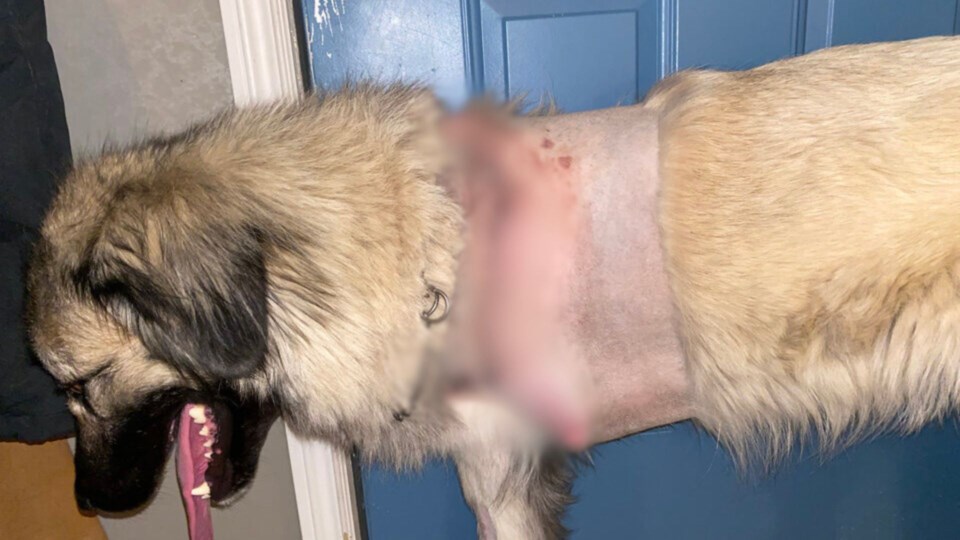
At least 100 cats and dogs have been caught in animal traps across B.C. since 2015, provincial records show.
The data, which comes from documents obtained through a freedom of information request made by the animal charity group The Fur-Bearers and seen by Glacier Media, show wildlife traps caught between eight and 15 pets a year between 2015 and 2023.
“The actual number is probably much higher. People aren’t reporting it to conservation officers,” said Aaron Hofman, the group’s director of policy and advocacy.
Documents show incidents in 2023 alone span a number of communities in B.C.’s north and central regions, from Dawson Creek to Smithers.
Further south, dogs were found trapped in a number of communities — in Fernie near the Alberta border, in Vernon in the Okanagan and in Abbotsford on the south coast.
Incidents of cats getting caught in wildlife traps, meanwhile, were reported in the South Okanagan region of Grand Forks, and the coastal communities of Delta, Nanaimo and Gabriola Island.
One incident report from the BC Conservation Officer Service in Pemberton describes a caller scared of an individual who caught dogs in baited wolf traps and erected fencing to trap domestic and wild animals.
“He also has pit traps in his backyard,” reads the heavily redacted report. “He has already trapped [redacted] … cat.”
In one incident report that involved a number of cats getting trapped, “the caller suspects the same person is continuing to set snares to harm domestic animals.”
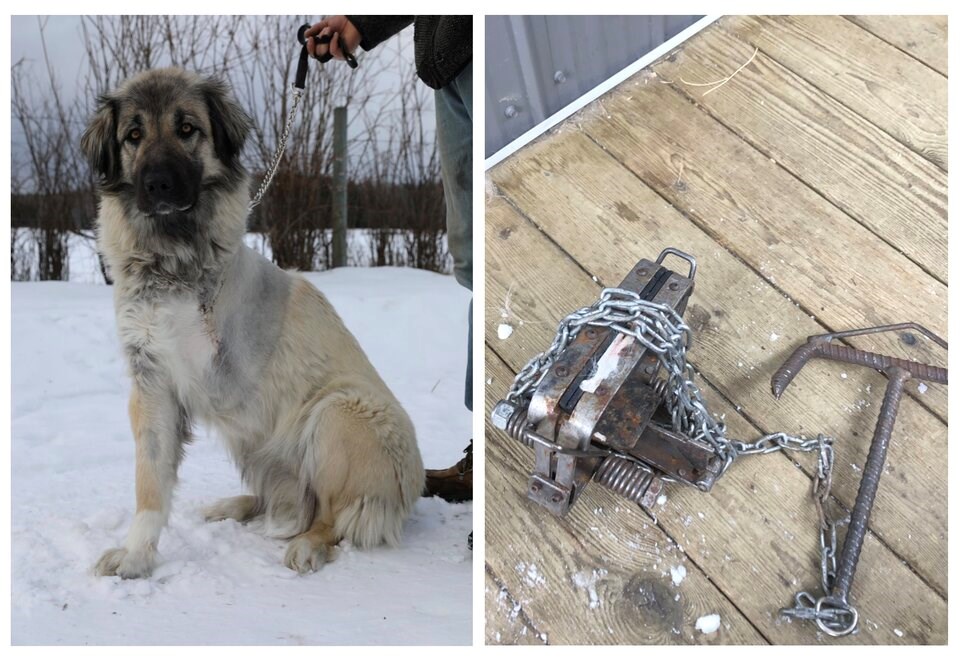
Elsewhere, one caller reported their dog was killed by a 10- to 12-inch trap placed on Crown land.
“Caller would like information on what can be done to warn people about this,” the incident report states.
And in another case, a dog and “fairly old cougar” were both caught in snares dead a few feet from each other.
Nine of the incidents resulted in investigations while five dogs were killed by the traps over the past two years.
Hofman said that while the overall number of pets trapped and killed is relatively small, the numbers appear to be going up in recent years.
“They’re not big numbers but they have weight for the families impacted by it,” he said.
“Anyone that’s out with their dog and they hear something and they find their dog in a trap — that trauma is pretty real. For those families… it’s losing a family member.”
The heavily redacted documents show incidents across Crown and municipal land, as well as off trails on neighbours’ properties. Of the 26 incidents in the past two years, only two charges appear in the documents.
Hofman said a lot of the incidents are preventable and could be avoided by regulatory changes. He pointed to increasing a mandatory setback from dwellings beyond the current 200 metres, and introducing new measures so trappers have to keep their distance from trails and roads.
“The most important is mandatory warning signs,” Hofman said. “We’ve been trying to get this change through the Ministry of Water, Land and Resource Stewardship because they’re in charge of wildlife.”
A spokesperson for that ministry said she was unable to respond until a new cabinet is sworn in.
B.C.’s incumbent NDP government recently won an electoral majority by a razor-thin margin. That prompted three judicial recounts and an associated delay in forming the next government.

