As fall creeps up, slip back into squirrel hunting
Reply

14 hours agoShare https://www.bbc.com/news/articles/cwy93x5k091o
Olivia Richwald & Grace Wood
BBC News
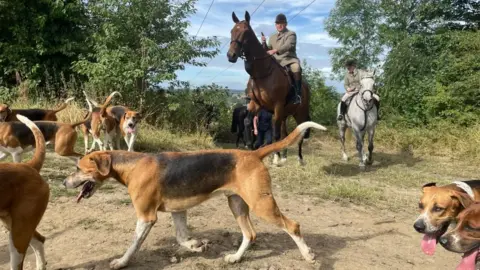
Trail hunters held open days this weekend to protest against claims the sport is cruel to animals, after the Labour government promised to ban the activity.
In South Yorkshire, at the British Hound Sports Association (BHSA) open day near Doncaster, members encouraged the public to see trail hunting for themselves.
They say a ban would be “devastating” as hunting creates jobs and business for rural communities and is enjoyed by “thousands of people from across the country”.
But campaigners argue the sport is a “smokescreen” for illegal fox hunting, is dangerous for animals and local communities do not support it.
According to the BHSA, after the fox hunting ban in 2004, many hunters decided to continue the tradition by developing a sport that did not involve live foxes.
A trail layer travels ahead of the pack of horses and dogs, laying a scent for them to follow. Once he has finished, the field master releases the dogs who follow the scent.
The average time for a hunt to be completed is 10 minutes. When the trail ends the dogs stop and await instruction from the field master.
At the Doncaster open day, trail layer Tom Gaythorpe – an agricultural worker from Tadcaster – said the method simulated a traditional hunt.
“We have a natural-based scent which we lay on a rag tied to the back of a quadbike,” he said.
“We just have to put it in a sealed plastic bag when we are done so they (the hounds) don’t follow me everywhere else that I go.”
Campaigners say trail hunting is a “facade” for fox hunting, claiming that trail hunters actively pursue foxes.
They also claim trail hunting is dangerous for horses and dogs.
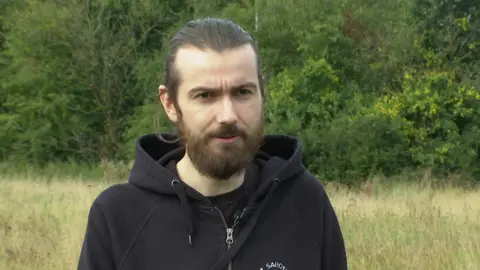
Rob Taylor, volunteer for the Hunt Saboteurs Association, said he had seen foxes being chased and killed, and had seen dogs harmed in the process.
He said: “The year before last a hunt lost control of their pack of dogs and the hounds ran across a busy A-road. One of them was hit by a car and unfortunately passed away.”
The organisation said the open days were a way for hunters to masquerade their activities.
“If it was the case they were trail hunting every time they go out like they say, then there wouldn’t need to be a specific day for it, people could go out on one of their hunts on any other day.
“But if you were to, you would find that the hunts are not very keen on being filmed or watched at all, which is why there is a specific day when people can go and watch.”
BHSA spokesperson Helen Walsh said accidents did happen but were very rare.
She said: “I know there has been incidents in the past, but if you think over the last 20 years since the ban has come into place there has been about 250,000 days of hunting and under 25 convictions under the hunting act – that’s under 1%.”
There have been reports of dogs losing track of the trail and causing harm to other animals.
In 2020, West Yorkshire Hunt Saboteurs recorded footage near Askham Richard in North Yorkshire that showed dogs mauling a roe deer.
At the time, a spokesperson for the York and Ainsty South Hunt said the incident was a “direct result of the actions of the anti-hunting activists”.
“These hunt saboteurs were blowing a hunting horn and distracting the hounds which took a few of them off the trail which had been laid for them to follow,” they said.
Those who support trail hunting say a ban would be a loss to the rural community and many people are employed in hunting or businesses that support it.
Ms Walsh said hunting provided work in the winter months when there was less equestrian activity.
“There are many businesses that rely on hunting,” she said.
“Hunting happens in the winter, so you could feed merchants and farriers and businesses that provide starting points for meets – all that would stop.”
Others say it is a long-held tradition and fun for all the family.
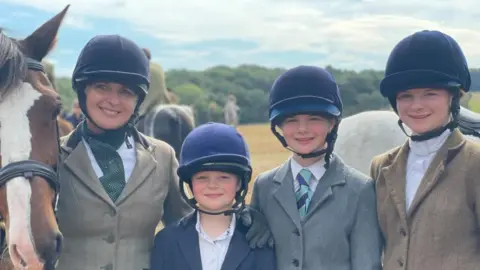
At the Doncaster open day, mum Julia from York said she had brought her three children to teach them about riding safely and build confidence.
She has encouraged her children Gilbert, nine, Lila, 12, and Amelia, 15, to ride from a young age.
“It’s a great, fun activity for all the family,” she said.
“I have brought them out one at a time as they have got old enough to get out in the countryside so we can all do it together.”
Farmer and landowner William Warde-Norbury said despite not riding himself he enjoyed being part of the day.
“I am delighted to have the trail hunting here in the grounds. I think it’s a fantastic sport in its current guise and it’s good to support them,” he said.
The government’s pre-election manifesto said it would ban hunting.
It said: “Labour will improve animal welfare. We will ban trail hunting and the import of hunting trophies.”
In June, then shadow environment secretary Steve Reed tweeted that Labour would “end trail hunting that allows for the illegal hunting of foxes, deer, and hares to continue”.
Following the Labour win, Reed became Secretary of State for the Environment, Food and Rural Affairs, but no legislation has yet been passed to end trail hunting.
Mr Taylor said he believed the government was “reasonably committed” to the ban.
“The Labour government should definitely implement a ban and they stated they would in the run-up to the general election.
“A ban has already been implemented in Scotland which has been effective and it’s just a case of implementing that same ban in England and Wales.”
But Ms Walsh said she was unsure.
“I don’t know if I feel like it is going to be banned, I feel it would be a real shame if it was,” she said.
“I want to remain positive and hope there are many people across the country who understand what trail hunting is and that includes the government, politicians and members of parliament.”
Listen to highlights from South Yorkshire on BBC Sounds, catch up with the latest episode of Look North or tell us a story you think we should be covering here.
Topics
AnimalsWildlife HabitatConservation Innovation GrantsRegional Conservation Partnership Program
Publish Date
September 16, 2024

Conservation Innovation Grant Helps Landowners Reduce Conflicts with Predators on Working Lands in the West
By Brandon O’Connor, FPAC External Affairs
After being hunted to near extinction in the early 1900s and listed as endangered species in the 1970s, the grizzly bear and wolf populations have rebounded throughout the American west.
While their numbers still pale in comparison to their heydays, nearly 2,000 grizzly bears and more than 5,000 wolves are now estimated to reside in Montana, Idaho, and other nearby states. As their populations have increased in recent years, so have their impact on working lands.
The first confirmed livestock loss to a grizzly bear in Montana’s Blackfoot Valley occurred in 1998. In the nearly 30 years since, the search has been on for effective solutions to protect the livestock raised on western ranches, those working the land and the predators themselves.

That work received a major boost in 2020 when the Heart of the Rockies Initiative, along with organizations including the Western Landowners Alliance, partnered with USDA’s Natural Resources Conservation Service (NRCS) through a Conservation Innovation Grant (CIG) focused on predator conflict reduction. Heart of the Rockies and their partners were awarded nearly $900,000 over three years for their project “Landowner collaborative strategies for nonlethal predator control,” to work with landowners in Arizona, California, Idaho, Montana, New Mexico, Oregon and Washington.
The project’s goals were to study effective non-lethal solutions for reducing conflict between working lands and predators, educate landowners in the area about the available solutions and form new place-based collaborations in the West focused on predator conflict reduction.

The work focused on helping landowners implement range riding, carcass management and fencing to reduce conflicts between grizzly bears, wolves and livestock. As a direct result of the work completed during the CIG, carcass management and fencing are now eligible for NRCS financial assistance as components of existing conservation practices. NRCS technical assistance is also available to help producers implement range riding on their land.
“Many producers, they’re hesitant to implement any practice where they are not assured of consistent, reliable funding that will help them sustain this over the course of many years,” said Nathan Owens, policy director for Heart of the Rockies Initiative. “Now we have that to be able to offer them and what we’re seeing is the interest increase exponentially.”

Over the course of the CIG, Heart of the Rockies and their partners worked with researchers from Colorado State University, Montana State University, Utah State University and USDA’s National Wildlife Research Center to determine the effectiveness of the chosen practices and incorporate the on-the-ground knowledge of impacted producers.
They also hosted five webinars to educate producers about the practices and developed guides on how to implement range riding, carcass management and fencing on working lands as well as build place-based collaborations focused on reducing conflicts.
“It’s important that [producers] have the resources to be able to address some of the challenges of sharing space with these species, because it’s so important to keep these private lands intact for a whole host of things — food, fiber, habitat for wildlife, and vibrance of rural communities,” said Matt Collins, Working Wild Challenge manager, Western Landowners Alliance. “These resources can help folks manage these conflicts and prevent these conflicts that can really affect their bottom line.”

Following the success of the CIG, Heart of the Rockies and the Western Landowners Alliance applied for and were awarded additional funding through NRCS’s Regional Conservation Partnership Program (RCPP). More than $22 million was awarded through two separate RCPPs to provide cost-share assistance to landowners in Montana, Oregon, Colorado, New Mexico, and Arizona to implement non-lethal predator conflict reduction practices on their land. The goal, Collins said, is to develop additional RCPPs to include Wyoming, Idaho, Washington, California, and Nevada in the near future as they better streamline the process for implementing the conflict reduction practices.
“It is a massive effort,” Owens said, “and it has taken a lot of partners to help us get to this point, but we’re excited to find out what the possibilities are when you have resources that you can deploy to help support wider implementation of these practices.”
The ongoing partnership between USDA and local organizations to reduce conflicts was the focus of a June 2024 visit to Montana by USDA leadership including USDA’s Under Secretary for Farm Production and Conservation Robert Bonnie and NRCS Chief Terry Cosby. During their trip, they toured multiple ranches and spoke to producers who have implemented the identified practices leading to reduced conflicts between their livestock and predators including grizzly bears and wolves.
For more information about how NRCS can help you implement these and other practices on your land, contact your local service center.
The wolves did what they were asked to do and were victims of their own success. The loss of this beautiful family group is unforgivable and shameful.

Image: patrice schoefolt/Pexels
https://www.all-creatures.org/wildlife/wildlife-wolf-pack-decimated.html
A brief introduction and an interesting cryptic telephone call
Like many people across Colorado and around the world, I’ve been eagerly waiting to learn more about Colorado Parks and Wildlife’s (CPW) operation to capture and relocate the individuals comprising what has come to be called the Copper Creek pack—a tight knit family group consisting of a mother, a father, and their four children.
On Friday August 23, 2024, before the CPW operation was announced, I received a cryptic phone call from someone out of state who asked me a number of questions including: Would I be okay if some wolves were killed to save others, to which I answered no, killing is off the table. I also was asked if I would support trapping and relocating wolves from where they were causing a problem and I said I’d prefer that they were left alone, but if that wasn’t an option and they had to be relocated the entire pack had to be kept intact and they could only be moved to another wild location.
Thinking back on this phone call, I felt like was being played, being tested, because the person who called well knew my position of leaving the lupine family alone and had to know what I’d say.
When the announcement of the trapping and relocating operation was made on August 27th, I once again thought about the surprising phone call and it felt as the caller knew something was coming down the turnpike and was warning me, offering a premonition of what was to come, and wanted to see if perhaps I’d change my views.
We now know the Copper Creek pack made their den on the property of a rancher who wanted them dead, but was denied a chronic depredation permit because they did little to deter the wolves from preying on their sheep, and perhaps even encouraged it by leaving unburied carcasses in an exposed ‘kill pit.’
Please read the ENTIRE ARTICLE HERE, including:
Posted on All-Creatures.org: September 12, 2024
https://www.all-creatures.org/wildlife/wildlife-wolf-pack-decimated.html
Return to Wildlife Articles
Read more at Legislation/Policy Articles
Read more at Meat and Dairy Articles

Supporters of a ballot initiative that seeks to ban the hunting of mountain lions, bobcats and lynx are citing a recently-released report saying mountain lions play a critical role in reducing the spread of a fatal, incurable neurological disease affecting deer and elk.
According to the report “Big Cats as Nature’s Check Against Disease” by Dr. Jim Keen, a veterinarian and infectious disease expert, mountain lions prey on deer and elk afflicted with chronic wasting disease, an illness caused by proteins called prions and spread through urine, feces, saliva, or contact with a contaminated environment.
Symptoms of the disease include behavioral changes, weight loss, tremors, confusion, teeth grinding, and drooling. The disease has a 100% fatality rate.
The Teddy Roosevelt Conservation Partnership, a nonprofit organization dedicated to increasing federal funding for conservation and preserving access for hunters and fishermen, called chronic wasting disease “the biggest threat to the future of deer hunting.”
“With no vaccine or cure for Chronic Wasting disease, wildlife managers are struggling to find solutions,” Keen said.
“Perhaps the best policy response at the moment in Colorado is to stop killing 500 or so mountain lions a year that conduct population cleansing at no cost to the state and that protect the long-term health and viability of cervid populations.”
The report also references field studies conducted in Colorado suggesting that coyotes, mountain lions, and bobcats can inactivate the prions that cause chronic wasting disease during digestion, reducing environmental contamination. According to the report, if not ingested by a predator, prions can survive in an environment for years.
Banning the hunting of big cats will benefit the deer hunting industry by reducing the spread of chronic wasting disease, Keen also claimed.
“If you want to protect hunting and other forms of wildlife-associated recreation associated with deer and elk, then protect mountain lions and allow them to deliver their gratis predator-cleansing services,” said Keen. “Mountain lions are a deer and elk hunter’s best friend.”
Some wildlife experts, however, are unsure whether mountain lions significantly impact the spread of chronic wasting disease in deer and elk populations.
Larry Desjardin, president of the conservation nonprofit Keep Routt Wild, said he used to believe mountain lions “could be the key” to controlling the disease, but has since changed his position on the matter.
According to Desjardin, mountain lions tend to prey on CWD-positive deer in the later stages of the disease’s progression, when it has become strongly symptomatic. However, for most of the disease’s progression, which can take up to two years before becoming fatal, the infected deer or elk show no symptoms but continue to shed infectious prions, which can spread to other animals.
“There is no evidence that areas with large lion populations have significantly fewer CWD infected deer,” said Desjardin. “Thinking of the extreme case is a good thought experiment about this mechanism- imagine that lions selectively cull all CWD-positive deer one day before they were going to die anyway. Of course this would have no impact, as the vast majority of prions would already be shed.”
Desjardin says hunting is the only tool shown to impact CWD levels in mule deer, because the disease occurs at a much higher rate in males, and a study where hunters were issued more tags for bucks than does showed a subsequent drop in CWD.
“I once advocated for a reduction of lion tags in a local game unit to grow the lion population and therefore reduce CWD,” said Desjardin. “In retrospect, I was wrong. I learned about the timing of lion culls by studying more literature. It’s up to all of us to follow the science and look for realistic methods that could control this terrible disease.”


Surprising quartet of four southern state congressional representatives unite to sponsor a bill pushed by former Humane Society of the United States’ leader Wayne Pacelle.
by Mike KoshmrlSeptember 12, 2024

Share this:
FacebookXWhatsAppMessengerEmailShare
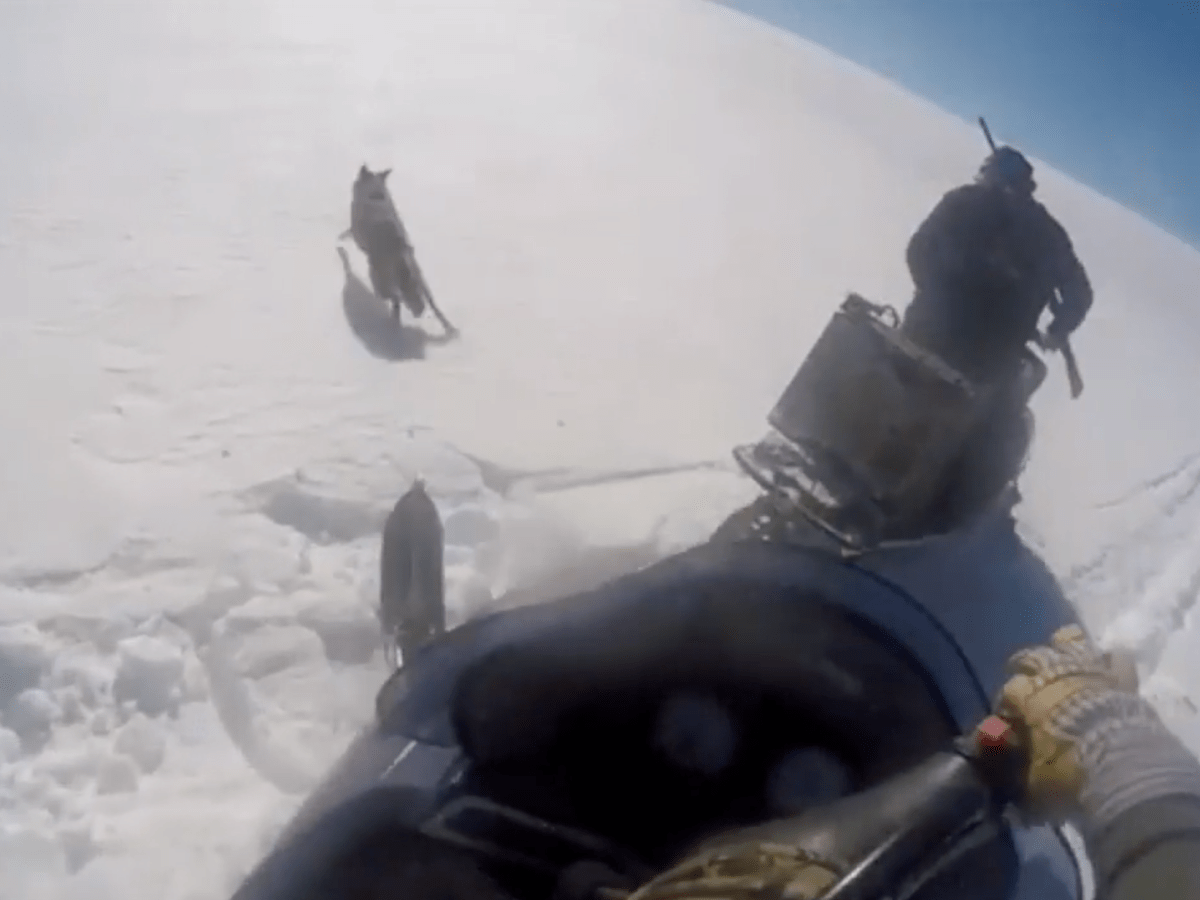
The fallout from the infamous incident involving a Wyoming wolf that was run down by Daniel man on a snowmobile, badly injured and paraded into a bar now includes federal legislation aimed at banning the practice.
Rep. Nancy Mace (R-South Carolina) was the lead author of a bill that’s been dubbed the Snowmobiles Aren’t Weapons Act, which would prohibit running over and killing wildlife with motorized vehicles on some classes of federal land. The bipartisan measure was introduced on Thursday, according to Gabrielle Lipsky, a staffer for the South Carolinian congresswoman, who shared a statement on behalf of her boss.
“Our federal lands are not battlegrounds for reckless and belligerent behavior,” Mace said. “This bill will preserve the safety and beauty of our natural spaces and ensure wildlife can thrive without the threat of harm from motor vehicles.”

Co-sponsors include three congressmen from southern states that aren’t exactly known for their snowmobiling: Reps. Don Davis (D-North Carolina), Matt Gaetz (R-Florida) and Troy Carter (D-Louisiana). The bill materialized after months of lobbying from animal rights and environmental organizations, and it was shepherded chiefly by Wayne Pacelle, a former president of the Humane Society of the United States who now leads a group called Animal Wellness Action.
“We have allowed state authorities plenty of time to handle the situation on their own,” Pacelle told five members of the Wyoming media in a press call on Thursday. “That’s why we’re turning here.”
Simultaneous to the bill that will be considered by Congress, the Wyoming Legislature will have a shot at enacting legislation in response to the February torture of a wolf in Sublette County. In its current form, the state-level legislation would explicitly maintain the legality of running over species classified as predators with motorized vehicles, with the caveat that they must be swiftly killed after being struck.
A daily must-read news update for and by Wyoming.Subscribe for free!

Pacelle also shopped the bill to one member of Wyoming’s congressional delegation: U.S. Sen. Cynthia Lummis, who was not on board.
“With all due respect to my southern colleagues, we do not need members from districts that do not even drive snowmobiles trying to regulate our western way of life,” Lummis told WyoFile in a statement.
Efforts to regulate running over animals with snowmobiles have been contested by the livestock industry.
“I’ve talked with a number of livestock producers across the state — in particular, sheep producers — who have said that they view it as one of their most effective tools” for predator management, Wyoming Stock Growers Association Executive Vice President Jim Magagna told WyoFile in July.
Lobbying nationally, Pacelle also ran into resistance from industry groups. Early in the summer he was working with Rep. Troy Nehls (R-Texas) on sponsoring the legislation, who was “poised” to bring it, but it died while being vetted.
“I do believe it was the Texas Farm Bureau and perhaps the Safari Club International,” Pacelle said.
Although Safari Club International is a hunting organization, hook-and-bullet conservation groups have generally advocated for a prohibition on running over animals with snowmobiles, which is a recreational activity in some portions of Wyoming.
In Pacelle’s view, broad support for addressing animal cruelty helps explain why what could be considered strange congressional bedfellows have united to sponsor the Snowmobiles Aren’t Weapons Act.
“These are lawmakers who are keenly interested in animal welfare,” he said. “Ultimately, their decision to introduce the bill today is an affirmation of their view that cruelty to animals is wrong.”

The framework of the SAW Act is based on a single-sentence state statute from Minnesota that dates to 1986: “A person may not use a motor vehicle to intentionally drive, chase, run over, kill, or take a wild animal.”
The SAW Act, however, has more layers. It would impose a fine of up to $5,000 and up to one year imprisonment for intentionally using a motor vehicle to “run over, strike, or kill a wild animal on public lands.”
There are also exceptions. A snowmobiler or motor vehicle user would not be liable if they struck wildlife to “avoid injury or death to themselves or another person” or to “avoid the destruction of personal property.” Wildlife officials who run over animals “pursuant to a preexisting wildlife management plan” would also not be in violation.
As it’s written, the SAW Act defines public land as those managed by the U.S. Department of the Interior. That provision would exclude U.S. Forest Service managed property — which is under the U.S. Department of Agriculture’s purview. Federal land managers in Wyoming told the Jackson Hole News&Guide this spring they lack the jurisdictional authority to prohibit killing wildlife with snowmobiles. Absolute primacy over wildlife policy is debated, however, and there are federal laws that prohibit certain types of hunting, such as the Airborne Hunting Act.