Gigantic Wave in Pacific Ocean Was The Most Extreme ‘Rogue Wave’ on Record
Reply

Environment minister says country has more elephants than it needs while critics of hunt say they are a major tourist drawcard
Agence France-Presse in Harare
Sat 14 Sep 2024 01.50 EDTShare https://www.theguardian.com/world/2024/sep/14/zimbabwe-orders-cull-of-200-elephants-amid-food-shortages-from-drought
Zimbabwe will cull 200 elephants as it faces an unprecedented drought that has led to food shortages, a move that tackle a ballooning population of the animals, the country’s wildlife authority has said.
Zimbabwe had “more elephants than it needed”, the environment minister said in parliament on Wednesday, adding that the government had instructed the Zimbabwe Parks and Wildlife Authority (ZimParks) to begin the culling process.
The 200 elephants would be hunted in areas where they had clashed with humans, including Hwange, home of Zimbabwe’s largest natural reserve, said the director general of ZimParks, Fulton Mangwanya.
Zimbabwe’s environment minister, Sithembiso Nyoni, told Voice of America: “We are having a discussion with ZimParks and some communities to do like what Namibia has done, so that we can cull the elephants and mobilise the women to maybe dry the meat, package it, and ensure that it gets to some communities that need the protein.”
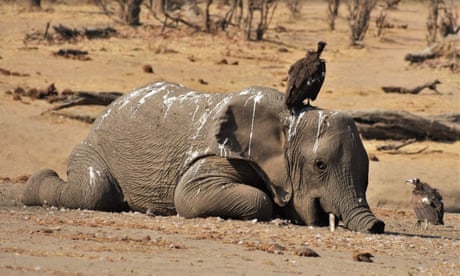
Zimbabwe is home to an estimated 100,000 elephants – the second-biggest population in the world after Botswana.
Due to conservation efforts, Hwange is home to 65,000 of the animals, more than four times its capacity, according to ZimParks. Zimbabwe last culled elephants in 1988.
Neighbouring Namibia said this month that it had already killed 160 wildlife animals in a planned cull of more than 700, including 83 elephants, to cope with its worst drought in decades.
Zimbabwe and Namibia are among a swathe of countries in southern Africa that have declared a state of emergency because of drought.
About 42% of Zimbabweans live in poverty, according to UN estimates, and authorities say about 6 million will require food assistance during the November to March lean season, when food is scarcest.
https://imasdk.googleapis.com/js/core/bridge3.666.0_en.html#goog_991468998
https://imasdk.googleapis.com/js/core/bridge3.666.0_en.html#goog_991468999
https://imasdk.googleapis.com/js/core/bridge3.666.0_en.html#goog_991469000
The move to hunt the elephants for food was criticised by some, not least because the animals are a major draw for tourists.
“Government must have more sustainable eco-friendly methods to dealing with drought without affecting tourism,” said Farai Maguwu, director of the nonprofit Centre for Natural Resource Governance.
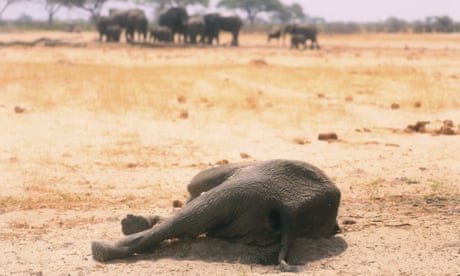
“They risk turning away tourists on ethical grounds. The elephants are more profitable alive than dead,” he said.
“We have shown that we are poor custodians of natural resources and our appetite for ill-gotten wealth knows no bounds, so this must be stopped because it is unethical.”
But Chris Brown, a conservationist and CEO of the Namibian Chamber of Environment, said elephants had a “devastating effect on habitat if they are allowed to increase continually, exponentially”.
“They really damage ecosystems and habitats, and they have a huge impact on other species which are less iconic and therefore matter less in the eyes of the Eurocentric, urban armchair conservation people,” he said.
“Those species matter as much as elephants.”
Namibia’s cull of elephants has been condemned by conservationists and the animal rights group Peta as shortsighted, cruel and ineffective.
But the government said the 83 to be culled would be only a small fraction of the estimated 20,000 elephants in the arid country, and would relieve pressure on grazing and water supplies.
by Olivia Kelleher, KUTVFri, September 13th 2024 at 11:32 AM
Updated Fri, September 13th 2024 at 6:27 PM

https://imasdk.googleapis.com/js/core/bridge3.666.0_en.html#goog_705162543
0 seconds of 2 minutes, 27 secondsVolume 90%


Residents of the SunRiver community are concerned after images of neatly lined up animal carcasses at a local dog park circulated online. (KUTV)

…

ST. GEORGE, Utah (KUTV) — Residents of the SunRiver community near St. George are concerned after images of neatly lined up animal carcasses at a local dog park began circling online.
Faith Jolley of the Utah Division of Wildlife Resources confirmed in a statement that DWR officials found 31 animals — including 26 jack rabbits, four skunks and a racoon.
“All three of these species are not protected under Utah state law, meaning you do not have to possess a valid hunting or trapping license to harvest them and the method of harvesting them is not regulated,” said Jolley.
READ NEXT:Four arrested after deputies recover $147K worth of copper stolen from Rio Tinto Kennecott
The carcasses were found behind the SunRiver golf course, near an adjacent dog park. Another larger animal, potentially a coyote, was also found nearby.
Amazon’s Worst Nightmare: Thousands Canceling Prime for This Clever Hack (It’s Unbelievable)Online Shopping Tools
Jolley also said that, “Upon further investigation the (DWR) officer determined the animals were removed on behalf of the golf course to prevent nuisance issues and property damages.”
Larry Ricketts, a representative from the SunRiver golf course, said the golf course has been closed.
“We are shut down for our annual overseed, so nothing was killed by our staff,” he said.
He said that, when they were notified of the animals by residents, they buried them.
“We find dead animals all the time on the golf course killed by birds of prey or foxes or coyotes, so that is our normal approach to dead animals on the course,” said Ricketts.
He reiterated that the animals were not killed by any staff member of the course.
Jolley said the animals were killed by an air rifle.
Officials did not confirm when or by who the animals were shot and said that the incident is still under investigation.
Columbus Dispatch
0:07
2:03
https://imasdk.googleapis.com/js/core/bridge3.666.0_en.html#goog_849290048
It is legal to hunt Canada geese in Ohio.
A photo posted on an online forum in July showing a person carrying a seemingly dead goose on Cleveland Avenue in Columbus went viral recently. Social media accounts and politicians spread the photo last week, falsely claiming it was taken in Springfield, Ohio.
The photo sparked debate about whether people locally are hunting and eating geese, wildlife and even pets — after public figures amplified rumors that Haitian immigrants in Springfield are doing so.
The Ohio Department of Natural Resources got a complaint in March and one in August about Haitians stealing birds from local parks and trails, but investigations didn’t find evidence to back up the reports, according to records obtained by USA TODAY Network Ohio.
Goose photo from Columbus:Columbus man regrets taking goose photo he says is being weaponized against immigrants
Springfield resident Anthony Harris also told Springfield city commissioners in August that Haitian migrants were decapitating ducks.
Though it is legal to hunt geese in Ohio, there is a very small window of time during which it can be done.
If someone hunts or kills a goose or any other wild animals in the wrong way and is convicted of doing so, they can face up to 30 days in jail and a $250 fine.
It is a fourth-degree misdemeanor to kill a Canada goose, as they are protected by the U.S. Fish and Wildlife Service and by Ohio law.
Get the Evening Update newsletter in your inbox.
Stay up-to-date with the latest news from around Columbus
Delivery: DailyYour Email
ODNR allows hunting of Canada geese Sept. 7-15 this year in Ohio, with a daily limit of five.
It’s annual hunting and trapping regulations were published Sept. 1 and use a federal framework from the U.S. Fish and Wildlife Service.
Active duty military personnel and veterans can also hunt geese Sept. 28-29.
Other geese can be hunted at different times depending on the part of the state. Guidelines can be found at www.ohiodnr.gov.
Those interested in hunting Canada geese must have a valid Ohio hunting license and a Harvest Information Program certification on their license.
They will also need an Ohio Wetlands Habitat Stamp endorsement if older than 18 and a signed federal Migratory Bird Hunting Stamp if older than 16, according to ODNR.
Illegal hunting methods include killing geese with a crossbow, trap, snare, net, rifle, pistol, swivel gun, shotgun larger than 10-gauge, punt gun, battery gun, machine gun, fish hook, poison, drug, explosive or stupefying substance.
Legal methods include a 10-gauge or smaller shotgun with nontoxic shot, muzzle-loading shotguns and longbow.
It’s also illegal to hunt geese outside of the permitted time frame.
September 13, 2024 By Merritt Clifton 3 Comments
https://www.animals24-7.org/2024/09/13/wolves-mountain-lions-are-dog-cats-too-voters-warn-western-states/?fbclid=IwY2xjawFSoEdleHRuA2FlbQIxMAABHXupJQ4RCpzpthltD3x8wPZ-cZQqQWc4sgpyl3a74XCYFcanUoC7WKu3ZQ_aem_6WDS3nCLLdWoTlqfytANpg
CHEYENNE, DENVER––Continuing failures on the part of the Wyoming Game & Fish Department and Colorado Parks & Wildlife to respond to public outrage over cruelty to wolves, pumas, bobcats, and other predators invited an initiative to ban puma and bobcat hunting that will be the 2024 Colorado state ballot, and now may bring federal intervention against “wolf-whacking” with snowmobiles in neighboring Wyoming.
“Today, after inaction by Wyoming officials, Animal Wellness Action and the Center for a Humane Economy worked with a bipartisan group of lawmakers to introduce national legislation to ban the intentional targeting of wolves and coyotes on our federal lands with snowmobiles and other motorized vehicles,” announced Wayne Pacelle, president of both Animal Wellness Action and the Center for a Humane Economy, on September 12, 2024.
Pacelle thanked Congressional representatives Nancy Mace, Don Davis, Matt Gaetz, and Troy Carter, respectively two Republican from South Carolina, a Republican from Florida, and a Democrat from Louisiana, “for introducing this anti-cruelty measure.
“To be sure,” Pacelle said, “Cody Roberts,” the offender in a February 29, 2024 “wolf-whacking” case that infuriated Americans nationwide, “showed sadism in running over and torturing” his victim, “but he’s not alone,” Pacelle warned.
“There is a subculture of people who take pleasure in crushing animals with snowmobiles. Stay tuned,” Pacelle suggested, “for a bill number.”
(See Snowmobile wolf lynching puts Wyoming, Idaho, & Montana on trial.)
Cody Roberts. (Facebook photo)
Countered Wyoming U.S. Senator Cynthia Lummis, a Republican, in an email to the Cowboy State Daily, “With all due respect to my southern colleagues, we do not need members from districts that do not even drive snowmobiles trying to regulate our Western way of life.”
Fellow Republican Harriett Hageman, the lone Wyoming member of the House of Representatives, called the federal anti-“wolf-whacking” bill “poorly thought-out legislation pushed by radical activists and sponsored by members of Congress who have minimal to nonexistent federal land, snow or wolves in their district.”
Responded Pacelle, “Minnesota—which has far more wolves than Wyoming, Idaho, and Montana combined—has a law that forbids the use of any motorized vehicles to chase, torment, run into, or crush wolves or other wildlife. That law has been in place since 1986, and ranchers, hunters, and other stakeholders have no problem with it at all.”
The federal anti-“wolf-whacking” bill has little chance of advancing by itself in what remains of the 118th Congress before the November 5, 2024 national election and a brief “lame duck” session to end on January 3, 2025.
The introduction now, however, may permit adding the anti-“wolf-whacking” bill as a rider to a last-minute budget bill.
Failing that, introduction now helps to build momentum for a reintroduction in the 119th Congress.
The federal anti-“wolf-whacking” bill comes after “An ad-hoc working group was formed after the [Cody Roberts] incident went viral with the direction to see what could be done to mitigate further incidents,” recounted Jonathon Klein for RideApart.com, a website focused on motorcycles and offroad vehicles.
“With that directive,” Klein explained, “many believed that ‘wolf-whacking’ would be outlawed.
“But the group met for the last time last week,” the second week in September 2024, “and in its proposed draft update to Wyoming law, not only did it not ban the practice, but said it was still absolutely okay to engage in.”
“Wolf-whacking,” Klein continued, is “a method of predator control that is explicitly legal in the state of Wyoming,” which “became a topic of worldwide discussion” because “Cody Roberts of Daniel, Wyoming, ran the animal down, tied her up after she had been severely injured, brought her to a local bar, paraded her around, had patrons take pictures with the wounded animal, and then ultimately killed her behind said bar.
“The only repercussion Roberts faced was a $250 fine.”
Holly Harns Roberts, wife of Cody Roberts, killed a puma. (Facebook photo)
The working group, apparently dominated by Wyoming Stock Growers Association executive vice president Jim Magana, proposed only amending Wyoming law to provide that, “Any person who intentionally injures or disables a predatory animal by use of an automotive vehicle, motor-propelled wheeled vehicle, or vehicle designed for travel over snow shall upon inflicting the injury or disability immediately use all reasonable efforts to kill the injured or disabled predatory animal.”
In other words, Wyoming “wolf-whackers” would now be encouraged to circle back and run over an injured wolf again and again until dead.
Marc Bekoff & friend, in this case a wolf.
Meanwhile, blogged Colorado ethologist and evolutionary biologist Marc Bekoff, “On December 18, 2023, five wolves were released into the mountains of Colorado, and five more were released over the following three days. Because the people of Colorado voted directly to authorize this reintroduction, opponents began referring to it pejoratively as ‘ballot box biology.’
“In reality,” Bekoff contends, “it’s ‘ballot box morality,’” but Colorado Parks & Wildlife does not appear to have understood the memo from the people of the state.
Bekoff denounced “Colorado Parks & Wildlife’s operation to capture and relocate the six individuals comprising what has come to be called the Copper Creek pack—a tightly knit family group consisting of a mother, a father, and their four children.”
“Unfortunately,” Bekoff related, “the pack established their den on the property of a rancher who wanted them dead, but who was previously denied a chronic depredation permit because he did little to deter the wolves from preying on his sheep, and perhaps even encouraged it by leaving unburied carcasses in an exposed ‘kill pit.’
“Most unfortunately,” Bekoff continued, “when Colorado Parks & Wildlife finally released details about their avoidable and ill-fated plan, it was disclosed that the father died four days after he was captured using a leg-hold trap.
“He previously had a wounded and infected leg. According to Colorado Parks & Wildlife,” Bekoff wrote, “’It is unlikely the wolf would have survived much longer in the wild.’ Of course they don’t know this, and the male was likely stressed, having been trapped and taken away from the family he was trying to care for. This could have contributed to his demise.”
One day after Bekoff posted his blog, Colorado Parks & Wildlife on September 12, 2024 confirmed the death on September 9, 2024 of yet another male wolf from among the 10 who were reintroduced in December 2023.
Only one of the four introduced male wolves remains alive.
The first to fall was apparently killed by a puma, also commonly called “mountain lion” and “cougar,” in Larimer County in April 2024.
The Colorado ballot initiative to ban “trophy hunting and commercial trapping of mountain lions, bobcats, and Canada lynx,” as the Cats Aren’t Trophies campaign committee summarizes it, on September 10, 2024 was officially named Proposition 127.
“We are now the ‘YES on 127’ campaign!” exulted Pacelle, whose Animal Wellness Action and Center for a Humane Economy initiated the initiative.
Initiative 127 was immediately endorsed by both former U.S. Representative Tom Tancredo, a Republican, and former U.S. Senator Mark Udall, a Democrat.
Said Tancredo, “I led efforts in Congress to combat animal fighting, and I don’t like the idea of the open-air fights that result when packs of dogs corner or overtake a lion or bobcat. Nor do I like the unsporting nature of shooting a lion or a bobcat out of a tree for a trophy or strangling a bobcat in a trap to take the fur.
“I far prefer that Colorado Parks and Wildlife handle wildlife management matters,” Tancredo emphasized, “but Coloradans have petitioned the Colorado Wildlife Commission and appealed to the General Assembly to enact these popular reforms and have been turned away. The ballot initiative should be used very sparingly, but this to me is a proper application of this constitutional option.”
Agreed Udall, “This measure conserves our ecologically valuable apex feline predators, by protecting both lions and bobcats from commercial trophy hunting. The sole purpose of such hunting is to sell the heads and fur of these remarkable and inspiring animals for selfish profit. There have been no legitimate reasons to continue the commercial killing of cats and lions for many decades. Now is the time to enshrine that undeniable truth into law.”
Reviewing the possible outcomes if Initiative 127 passes, Denver Post writer Elise Schmelzer on September 8, 2024 observed that, “The number of mountain lions in Colorado is difficult to determine because of their elusive and solitary nature. Colorado Parks & Wildlife biologists estimate between 3,800 and 4,400 adult lions live in the state and say the population has grown since the species was classified as a big game species in 1965.
“State biologists do not have an estimate for how many bobcats live in Colorado, but they believe the population is healthy and may be increasing in some areas.
“Neither mountain lions nor bobcats are listed as federally threatened or endangered,” Schmelzer noted. “An estimated 20,000 to 40,000 mountain lions live in the U.S., as do more than 1.4 million bobcats.
“In the 2022-2023 hunting season — the most recent for which Colorado Parks & Wildlife data is publicly available — 2,599 people bought mountain lion hunting licenses and hunters killed 502 lions, making for a 19% success rate,” continued Schmelzer.
Retired former Colorado Parks & Wildlife carnivore biologist Jerry Apker told Schmelzer, Schmelzer summarized, that “Populations would likely spike in the first years after hunting ends, before increased mortality rates temper that growth.
“Eventually, mountain lion populations tend to reach a stasis and fluctuate based on what food and habitat is available.
“The felines have larger litters with higher survival rates when more resources are available, but in times of stress, they have smaller litters and more mortalities.”
Apker also predicted, Schmelzer wrote, that “A cessation in hunting would also likely increase human interactions and conflicts with lions,” as an increased puma population would send more young pumas wandering into human habitat on their way to establishing their own home ranges.
California, Schmelzer mentioned, has prohibited puma hunting since 1972. Yet among the eleven westernmost continental states, 10 of which allow puma hunting, “California has similar cougar population densities and similar average deer densities to the other states,” along with “the third-lowest rate of cougar-human conflicts per capita, similar rates of cattle depredation, and lower rates of sheep depredation.”
California pumas, however, have not exactly been helping their Colorado cousins to win legal protection.
On March 23, 2024, a puma near Georgetown in El Dorado County, California, killed 21-year-old Taylen Brooks and injured his 18-year-old brother Wyatt Brooks while the men were searching for fallen elk antlers, apparently in the vicinity of a recent puma kill.
That was the first puma-inflicted fatality in California since 2004.
On September 1, 2024, a puma mauled a five-year-old boy, who survived, “while he was playing near his family’s picnic table at Malibu Creek State Park,” the California Department of Fish and Wildlife said.
The pumas in both cases were tracked and shot.


