A bird flu outbreak is spreading among cows in the US. Scientists are hunting for answers
Reply

September 4, 2024
You can help all animals and our planet by choosing compassion on your plate and in your glass. #GoVeg
22 hours agoShare
https://www.bbc.com/news/articles/cewlqp7q0rwo
Adrienne Murray
BBC News
Reporting fromNuuk, Greenland

A court in Greenland has ruled that anti-whaling activist Paul Watson must remain in custody pending a decision to extradite him to Japan.
The veteran campaigner, who has featured in the reality television show “Whale Wars”, was apprehended by police in July as his ship docked in Greenland’s capital, Nuuk.
They were acting on a 2012 Japanese warrant which accuses him of causing damage to a Japanese whaling ship, obstructing business and injuring a crew member during an encounter in Antarctic waters in February 2010.
Officials in Japan argue that whaling and eating whale meat is part of the country’s culture and way of life. However, it has been heavily criticised by conservation groups.
Dressed in jeans and a white shirt, Mr Watson sat beside his defence lawyers and listened to proceedings through an interpreter as several of his supporters looked on.
“This is about revenge for a television show that extremely embarrassed Japan in the eyes of the world,” he told the small courtroom.
“What happened in the Southern Ocean is documented by hundreds of hours of video,” Mr Watson said.
“I think a review of all the video and of all the documentation will exonerate me from the accusations.”
However the prosecution argued that the defendant was a flight risk, and the judge concluded he should remain in custody until 2 October.
Paul Watson is the former head of Sea Shepherd Conservation Society, which he left in 2022 to set up the Captain Paul Watson Foundation.
He was also a founding member of Greenpeace, but they parted ways in 1977, amid disagreements over his radical tactics.
The 73-year old Canadian-American campaigner has been a controversial figure known for confrontations with whaling vessels at sea.
Mr Watson’s vessel, called the M/Y John Paul DeJoria, had been heading to the North Pacific with a crew of 26 volunteers on board, in a bid to intercept a new Japanese whaling ship when it docked to refuel in Nuuk on 21 July.
He was arrested and led away in handcuffs, and has been held at the local prison for the last seven weeks.
His defence team have appealed against the decision to keep him in custody before Greenland’s High Court.
Greenland is an autonomous territory of Denmark and, although the court in Nuuk is overseeing the custody hearings, the decision about Mr Watson’s extradition lies with Danish authorities in Copenhagen.
Last month, Japan asked Denmark to hand Paul Watson over, even though there is no extradition treaty between the two countries.
Police in Nuuk are carrying out an investigation before handing their findings to Denmark’s ministry of justice and a decision could be expected within the next few weeks.
“It’s a serious case, and it has to have some serious consideration. It has a deep impact on Mr Watson if we get to the point that he has to be extradited. So I will take the time needed to do it properly,” Greenland chief prosecutor Mariam Khalil told the BBC.
At the defence’s request, the judge granted permission for a video clip to be played, which appeared to show a zodiac-type speedboat sailing alongside a Japanese ship and firing a stink bomb.
However, Mr Watson’s lawyers say a second video clip, which was not shown, proves no-one was on deck at the time.
“We have video footage of a stink bomb being shot on to the ship, and the position that the Japanese claim the sailor should be in, he simply isn’t there,” Jonas Christoffersen told BBC.
“There’s no evidential basis for the allegation that somebody got got injured.”
Lyon-based international police body Interpol has confirmed the existence of an outstanding red notice for the arrest of Mr Watson.
In 2012, Paul Watson was also detained in Germany, but left the country after learning that he was sought for extradition by Japan.
Masashi Mizobuchi, assistant press secretary for the Japanese ministry of foreign affairs, told the BBC that Japan had not yet received any response from the Danish authorities.
“We will continue to take appropriate measures, including necessary outreach to the relevant countries and organisations,” Mr Mizobuchi said.
Japan withdrew from the International Whaling Commission and resumed commercial whaling in 2019, after a 30-year hiatus. However, it had continued whaling for what it said were research purposes.
French President Emmanuel Macron’s office has asked Denmark not to extradite Paul Watson, and there has been vocal support from legendary actress turned animals rights activist Brigitte Bardot.
Meanwhile a petition calling for Mr Watson’s release has surpassed 120,000 signatures.
Let me tell you the truth about this mad plan: It’s costly, inhumane, and doomed to fail.
It is the largest-ever massacre of raptors ever proposed in any country in the world.
The plan is in motion because barred owls, who for eons have occupied enormous portions of the North American continent, have over the last century moved into the same forests where northern spotted owls live.
The barred owls, driven by land management actions by people and also by the effects of climate change, have adapted and expanded their range.
Barred owls are protected as a North American native species under the federal Migratory Bird Treaty Act. They are being scapegoated because human-driven habitat loss has had adverse effects on spotted owl communities.
Barred Owls and Spotted Owls Are Look-Alikes
Range expansion by species is as natural as the sun rising or the clouds forming. That’s how ecological systems work, and it’s occurring every day, with hundreds of species. Barred owls and spotted owls are already interbreeding and producing hybrid offspring that will be more adaptable to a changing ecosystem. That, again, is nature at work.
Our own government is creating a dangerous and ugly precedent by planning a mass killing of a North American native species. Do we want agency personnel knee-deep in the business of killing native species to protect other native species, in a world where we’ve scrambled the workings of all manner of land and ocean ecosystems?
Imagine if, because of climate change and other human impacts on the environment, orcas off the Pacific Northwest coast began migrating to Hawaii’s coastal regions. There, to meet their caloric needs, they started eating highly endangered Hawaiian monk seals. Would it be right for the U.S. Fish and Wildlife Service or some other agency to gin up a plan to start shooting and killing the migrating whales to prevent occasional seal predation, or to enlist whaling ships to send explosive harpoons at the killer whales?
Sure, let’s intervene where we can and when there is a helpful way forward to protect threatened spotted owls and other species in peril. But not this way. Mass killing of North American native species should be off the table.
If the U.S. Fish and Wildlife Service goes down this road of managing social interactions between animals, where will it end? There are more than 1,300 federally listed threatened and endangered species, and you can be sure that there are thousands of other species competing with them every day in our nation.
We cannot victimize animals for adapting to human disturbances of the environment. Smarter, more strategic, less violent uses of the agency’s limited time and resources are what’s needed.
Biden Administration Must Abandon This Killing Plan
The Biden Administration hasn’t lifted a finger to stop state-run wolf massacres in Wyoming, Idaho, and Montana. The Administration has been opening more and more national wildlife refuges to sport hunting and is even allowing continued use of toxic lead ammunition for hunting on hundreds of refuges, poisoning countless owls, eagles, foxes, and other scavengers that consume the spent lead. And it’s been rounding up wild horses and burros at a break-neck pace on our federal lands even though there’s a law that calls for their protection in the West.
Recently, we stopped the National Park Service from rounding up wild horses at Theodore Roosevelt National Park in North Dakota. We’re fighting in the courts and in Congress to protect wolves. And now we must stop the Fish and Wildlife Service from massacring barred owls.
We’re not the only ones who consider the plan overreaching and unworkable. The Vancouver Columbian, a newspaper in the heart of forest owl habitat in southwest Washington state, also opposes the owl-killing plan, noting “officials would trigger a never-ending cycle” of barred owls “moving into new habitat.” It will be impossible to stop in-migration of barred owls living in adjacent habitats. And in an editorial, The Los Angeles Times also urged the agency to scrap the plan: “Maybe the government should consider what one biologist who has long studied spotted owls has suggested: Let nature take its course and leave it to the owls.”
New report reveals mountain lions limit spread of brain-wasting disease in deer and elk and protecting them may save billions in outdoor recreational activities in Colorado
By Wayne Pacelle
Mountain lions are hell on zombie deer and elk roaming the Rockies.
The map below tells the story of mountain lions and their disease-cleansing work on the iconic deer and elk herds that are emblems of the mile-high ecosystems in the Rocky Mountain State and other parts of the West.
Colorado has had a long-running epidemic of Chronic Wasting Disease (CWD), an incurable, fatal neurological disease, akin to Mad Cow Disease. It is a plague for cervids (i.e., deer, elk, and moose) — infecting 42 out of 51 deer herds and 17 of 42 elk herds in the state.
CWD eats away at the brain of an infected animal, disorients it, and ultimately kills the victim. The disease first emerged 50 years ago in cervid populations kept in captivity by researchers at Colorado State University. Wild deer and elk mingled with the captive cervids, and the genie has been out of the bottle ever since.
It’s horrible for the animals, and it’s bad news for the state of Colorado. Deer and elk license sales alone account for two-thirds of hunting revenue for Colorado Parks and Wildlife. The related economic activity is a boon for rural communities throughout the state. If deer and elk herds were to be dramatically depleted in the decades ahead, as some predict, it would send the rural economy into a tailspin.
CWD also has zoonotic disease potential, with some scientists concerned that it can infect hunters and their families if they eat diseased animals. The U.S. Centers for Disease Control and Prevention advises against consuming deer or elk meat harvested from CWD-infected animals because of its potential to infect humans. The human form of CWD is Creutzfeldt–Jakob disease.
Fortunately, nature has in place a check against unmitigated spread of CWD among those animals. A new report by Jim Keen, DVM., PhD, a former USDA veterinarian and infectious disease scientist and the director of veterinary science for the Center for a Humane Economy, reveals that mountain lions play a key role in reducing the spread and the incidence rate of CWD in deer and elk. Since the disease is incurable, the predatory behavior of mountain lions, bobcats, and wolves may be the only way to arrest its spread and cleanse the wild deer and elk populations.
Lions on the Hunt for CWD-Infected Deer and Elk
Dr. Keen’s report, Big Cats as Nature’s Check Against Disease, outlines how mountain lions preferentially prey on sick deer and elk, bringing major ecological and economic benefits to Colorado. Their predation, which can reduce the incidence of CWD, underscores the ability of native cats to cleanse deer and elk herds of the brain-wasting disease.
“With no vaccine or cure for Chronic Wasting disease, wildlife managers are struggling to find solutions,” notes Dr. Keen. “Perhaps the best policy response at the moment in Colorado is to stop killing 500 or so mountain lions a year that conduct population cleansing at no cost to the state and that protect the long-term health and viability of cervid populations.”
The report details at least four lines of evidence supporting predator cleansing:
The new report implicitly calls into question the long-standing practice of trophy hunting of mountain lions in Colorado. Animal Wellness Action and the Center for a Humane Economy are helping lead a coalition, consisting of 100 organizations, that has qualified an initiative for the November 2024 ballot.
Trophy Hunting of Lions Is a Ruthless, High-Tech Enterprise
Trophy hunting of mountain lions has become high-tech and highly commercialized, with guides guaranteeing kills of trophy cats, mainly for out-of-state hunters. The hallmark of trophy hunting is to kill a large-bodied animal, with the seasonal take being about 500 lions a year (with 53% male and 47% female in the 2023-24 season).
One guide advertising on-line charges $8,500 for a “[n]ear 100% opportunity” to kill a “mature cat.” Deploying “trucks, snowmobiles, and other off highway vehicles,” he and his team “start our days very early driving roads looking for mountain lion tracks. Once we have a track located, we release hounds and catch your cat. Using GPS technology we track the hounds and precisely locate where they treed your trophy. We then determine the easiest route to take you into your trophy.”
The guide notes that “[m]ost hunts will be based out of our home where clients will have their own private bed, bath and living room area. Weeks where we choose to travel to further hunting areas, lodging will be based out of a nice toy hauler RV, or possible motels in the nearest town. Some areas we will stay in a rustic modern cabin with most of the luxuries of home.”
In short, Colorado has become a commercial playground for out-of-state hunters who outsource the chasing and cornering of the animal. The “hunt” is reduced to shooting a terrorized animal from a tree, with no escape possible. It’s an arboreal canned hunt. The kills are guaranteed, and the lions don’t have a chance.
The killing of mature adult males removes the most efficient animals skilled at killing traditional prey. And the annual killing of as many as 250 females, many of them with kittens who become orphaned and die, impairs the collective work of lions to target CWD-infected sick deer and elk.
“You don’t have to be a wildlife biologist like me to understand that mountain lions play a critical role in Colorado and western ecology,” said Elaine Leslie, Ph.D., a wildlife biologist in Durango and former Chief of Biological Services for the National Park Service. “These animals are an antidote to disease in deer and elk, selectively removing animals that threaten to spread disease and ensuring the protection of Colorado’s biodiversity, and a key part of our rural economy.”
Even major hunting groups that have fallen in line with their brethren to oppose the ballot measure have previously recognized the long-term threat of CWD to the health of prey populations. CWD is “the biggest threat to the future of deer hunting,” according to the Teddy Roosevelt Conservation Partnership, while the National Deer Association calls CWD “the most serious long-term threat to the future of wild deer and deer hunting that we face today.”
Still, because of their long-held hostility to mountain lions and other native carnivores, these groups oppose the ballot measure to halt cruel and unsporting commercial killing of native cats.
“These predators are often seen as competitors with hunters, but they appear to play a vital role in stemming more extreme spread of CWD,” noted Dr. Keen. “If you want to protect hunting and other forms of wildlife-associated recreation associated with deer and elk, then protect mountain lions and allow them to deliver their gratis predator-cleansing services. Mountain lions are a deer and elk hunter’s best friend.”
When CWD becomes highly prevalent in deer and elk populations, as it has in parts of Colorado and dozens of other states, it threatens to slowly erode cervid productivity and may make deer and elk hunting unsustainable. According to population models, CWD may, over a 50-year horizon, substantially reduce or even end hunter take of cervids in large parts of Colorado. The direct economic value of deer and elk hunting and wildlife-watching likely exceeds a billion dollars annually in Colorado. That means that passing a lion-hunting ban, and allowing the animals to do their work, would provide billions in practical services and value in the decades ahead to rural Colorado.
“Since all human efforts to control CWD to date have failed, maintaining ecologically viable apex predator populations represents our best hope at controlling CWD,” noted Col. Thomas Pool, DVM, MPH, a lifelong hunter and rancher from southwest Oklahoma and former chief of the U.S. Army Veterinary Command. “Ending trophy hunting of mountain lions in Colorado is critical to maintaining the billion-dollar deer and elk hunting and wildlife watching economies across Colorado.” Dr. Pool is now senior veterinarian with Animal Wellness Action.
The Colorado ballot measure is about stopping the killing of lions and bobcats for their heads and beautiful coats. It’s also about protecting the big cats who keep nature in balance. Coloradans have a 100-percent guaranteed chance to stop the unacceptable abuse of these remarkable animals who play such a vital role in keeping other wildlife, central to the economy and culture of the state, healthy and robust.
Go to www.CatsArentTrophies.org for more information.
For the animals,
| Wayne Pacelle President Animal Wellness Action |
https://phys.org/news/2024-08-antidepressant-pollution-rewiring-fish-behavior.html#google_vignette
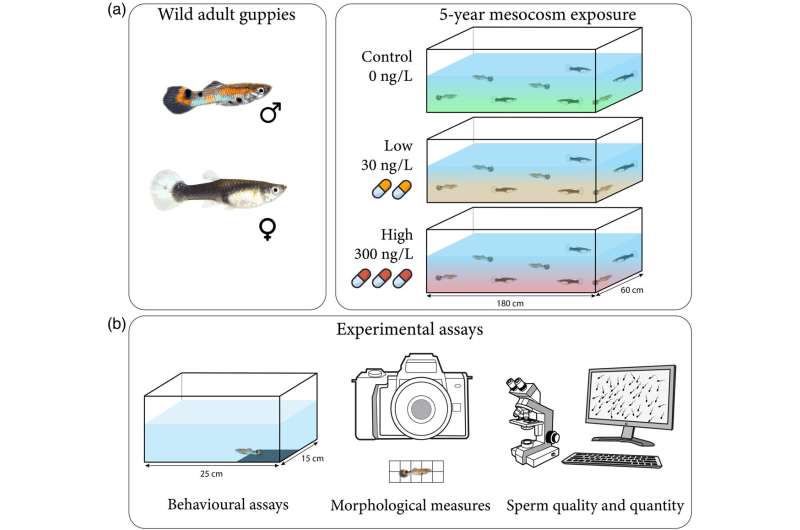
An international study led by biologists from Monash University and the University of Tuscia has revealed how long-term exposure to pharmaceutical pollutants is dramatically altering fish behavior, life history, and reproductive traits.
The five-year investigation, focusing on wild-caught guppies exposed to the widely prescribed antidepressant fluoxetine (Prozac), highlights the profound and interconnected effects of this pollutant on aquatic ecosystems.
The study, led by Dr. Upama Aich from the Monash University School of Biological Sciences and Assistant Professor Giovanni Polverino from the University of Tuscia, is published in the Journal of Animal Ecology.
Pharmaceutical pollutants, especially antidepressants like fluoxetine, have become a pervasive issue in water bodies worldwide. These pollutants, often introduced through wastewater discharge, persist at low levels in rivers, lakes, and oceans.
Despite their widespread presence, the full impact of these chemicals on aquatic wildlife, particularly on behavior and reproductive success, has remained unclear.
“Even at low concentrations, fluoxetine altered the guppies’ body condition and increased the size of their gonopodium, while simultaneously reducing sperm velocity—an essential factor for reproductive success,” said Dr. Aich, from the Monash University School of Biological Sciences.
“Fluoxetine exposure also significantly reduced the behavioral plasticity of guppies, leading to a lower capacity of the individuals to adjust their own activity and risk-taking behaviors across contexts,” said Assistant Professor Giovanni Polverino, from the University of Tuscia.
To explore the effects of antidepressant pollution, the research team exposed guppies to three environmentally relevant concentrations of fluoxetine over multiple generations. The team then meticulously tested fish behavior, physical condition, and reproductive health after five years of pollutant exposure.
Male guppies were the focus due to their heightened sensitivity to environmental shifts, particularly in traits tied to behavior, body condition, and reproduction. Researchers measured key life-history traits such as body condition, coloration, and gonopodium size (a modified anal fin used as a reproductive organ in males), along with critical sperm traits including vitality, number, and velocity.
Fluoxetine exposure disrupted the natural correlations between key traits. For instance, the expected link between activity levels and body condition, and between gonopodium size and sperm vitality, was altered. This disruption indicates that the pollutant is interfering with the natural trade-offs fish make between survival and reproduction.
The study reveals the extensive and nuanced impacts of pharmaceutical pollutants on aquatic life.
“The disruption of behavioral plasticity and the altered correlations between critical traits could undermine fish populations’ ability to adapt to environmental challenges, threatening their long-term survival,” said Professor Bob Wong, from the School of Biological Sciences and senior author of the study.
These findings emphasize the need for a more comprehensive approach to evaluating the ecological and evolutionary consequences of pharmaceutical pollution. As human activities continue to introduce new pollutants into the environment, understanding their effects on wildlife is crucial for preserving biodiversity and ensuring the health of ecosystems.
This research offers vital insights into how chronic exposure to common pharmaceutical pollutants like fluoxetine can fundamentally alter the traits that fish rely on for survival and reproduction.
The findings highlight the need to address pharmaceutical pollution and implement stricter regulations to protect aquatic life from this threat.
More information: Upama Aich et al, Long‐term effects of widespread pharmaceutical pollution on trade‐offs between behavioural, life‐history and reproductive traits in fish, Journal of Animal Ecology (2024). DOI: 10.1111/1365-2656.14152
Journal information: Journal of Animal Ecology
Provided by Monash University
Explore further
Antidepressants polluting the water can change fish behavior
Published: Sept 4, 2024, 10:04 a.m. MDT

View 45 Comments

Share
https://www.deseret.com/faith/2024/09/04/teaching-evolution-in-schools-lawsuit/
Kelsey is an assistant managing editor for the Deseret News. She covers religion, sports and the Supreme Court.
Atheists may support the theory of evolution, but that doesn’t mean public school lessons on evolution unlawfully promote atheism, according to a new ruling from a federal district court.
The decision dismissed a lawsuit brought by Christian parents in Indiana, who were fighting to force changes to Indiana’s state standards for science education and to get books referencing evolution out of public school classrooms.
The family’s main argument was that teachers violate religious freedom law when they promote “the atheist religion” by teaching students about evolution.Report ad
The court ruled that evolution is not a religious concept and allowed the science education standards to remain in place, per Religion Clause.
Related
Schools asked students about religion, gender and race. Then federal officials intervened
It’s not new for religion to play a key role in court battles over science lessons in public schools.
Throughout the 20th century, supporters of evolution education used religious freedom law to push back against policies barring teachers from tackling the topic.
These families argued that efforts to block evolution lessons unlawfully prioritized Christianity in the public school setting, as Pew Research Center noted in its overview of the evolution debate.
The recent case out of Indiana stands out because it features a very different religious freedom argument — the claim that teaching evolution violates the Constitution by promoting atheist beliefs.
The parents who filed the lawsuit, Jennifer and Jason Reinoehl, argued that schools that teach evolution essentially choose sides in a faith-based debate, thereby violating the First Amendment’s prohibition on government establishment of religion.
“Because the atheistic Theory of Evolution specifically attacks the Judeo-Christian origin story it has the purpose and effect of advancing the atheist religion,” the lawsuit claimed, per WISH-TV in Indianapolis.
Federal District Court Judge Sarah Evans Barker wrote in her ruling that the Reinoehls’ had misinterpreted the establishment clause.
“Despite Plaintiffs’ assertions to the contrary, the purported similarities between evolution and atheism do not render the teaching of evolution in public schools violative of the Establishment Clause, which has never been understood to prohibit government conduct that incidentally ‘coincide(s) or harmonize(s) with the tenets of some or all religions’,” Barker wrote, per WISH-TV.
The U.S. Supreme Court has previously come out against efforts to restrict lessons on evolution in cases dealing with faith-based science lessons.
In Epperson v. Arkansas in the late 1960s, the justices unanimously said that an Arkansas law banning instruction on evolution in public schools, including state universities, was unconstitutional because its purpose was to promote theological claims.
45
Comments
The Epperson case “put an end to state and local prohibitions on teaching evolution,” Pew reported.
Then, in Edwards v. Aguillard 20 years later, the Supreme Court disrupted another effort to promote religious ideas about human creation by ruling that Louisiana could not require teachers to pair lessons on evolution with lessons on creation science.
Justices in the 7-2 majority decided that legislators’ goal in passing the requirement was to advance a religious viewpoint, per Pew.
Pew’s article noted that these past Supreme Court rulings do not prevent schools from addressing the Bible’s creation stories in other contexts, such as a world literature class.


