Steven Buchecker surrendered to authorities after an arrest warrant was issued for him on charges including felony animal abuse, making threats and witness intimidation.
By Deanna Durante• Published August 5, 2026 • Updated on August 6, 2026 at 9:15 am
Log in or create a free profile to save articlesBOOKMARKER
PlayPause
Ad: 0:00UnmuteShare
An arrest warrant is out for Steven Buchecker of North Wales, wanted for severely injuring a cat. A woman has been arrested in connection with the case. NBC10’s Deanna Durante has the exclusive story.
A North Wales man accused in what Upper Gwynedd Township police describe as a disturbing animal abuse case has turned himself in.
Steven Buchecker surrendered to authorities after an arrest warrant was issued for him on charges including felony animal abuse, making threats and witness intimidation. Another person, Meredith Ziemba, has already been arrested in connection with the case.
According to court documents, officers responded June 11 after receiving a report of an abused cat behind a home on North Wales Road. A tipster alerted police to the badly injured animal.
Investigators say the cat had been shot in the eye with a pellet, another pellet was lodged in its back and one of its paws was caught in a bear trap.
Court documents allege Ziemba knew the cat’s paw was caught in the trap and that Buchecker had shot the animal.
Police say Ziemba initially told officers there were no cats on the property. Officers searched the area and found the injured cat still caught in the bear trap.
Investigators estimate the cat had been trapped for several days in temperatures above 90 degrees.
Local
Breaking news and the stories that matter to your neighborhood.
Officers cut the chains attached to the trap and took the cat to a veterinarian. Police say the cat lost one eye and part of one paw had to be amputated.
According to court documents, Ziemba and Buchecker discussed the cat with others and the possibility that it would die in the yard.
Police also allege Buchecker threatened the tipster who reported the abuse, leading to additional charges related to making threats and witness intimidation.
A check of court records also shows prior arrests on drug- and alcohol-related charges.
The cat has since been named Harvey and has been rehomed, police said.
Australia is now confronting an outbreak of a deadly bird flu strain. As of Monday, the highly pathogenic H5N1 virus had been detected in 78 wild birds across mainland Australia. Until now, there had been no evidence of a large-scale outbreak.
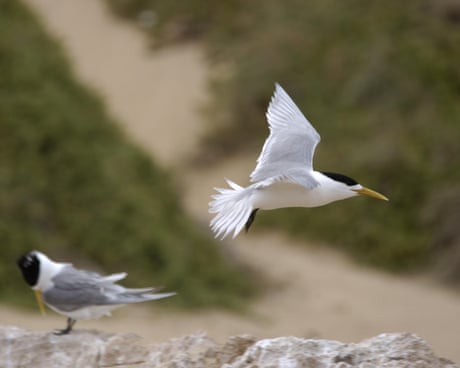
But authorities have confirmed the first instance of mass death caused by H5N1 among dozens of greater crested terns off South Australia’s southeast coast. They are also conducting further testing on a cluster of sick and dead terns in southwest Victoria.
As H5N1 spreads across the country, researchers, wildlife managers and the broader public are increasingly concerned about the risks it may pose beyond birds.
Recent outbreaks have threatened aquatic mammals, including southern otters, dolphins and porpoises. H5N1 has also decimated pinniped populations around the globe, including in South America. Pinnipeds are marine mammals that live in the sea and form colonies but spend extended periods on land, such as sea lions, fur seals and elephant seals.
As the risk of a broader outbreak rises, Australia must protect its wildlife by drawing on lessons from other continents already battling bird flu.
H5N1 poses an urgent threat to wildlife worldwide. Since 2021, this fatal strain of bird flu has spread to every continent and infected poultry flocks, dairy cattle, wild birds and a growing range of wild mammals. In June, it finally reached Australia, first detected in a sick brown skua.
This strain has been particularly devastating in South America. In late 2022, H5N1 spread rapidly from infected seabirds into pinniped colonies. At least 30,000 South American sea lions died in Peru, Chile, Argentina, Uruguay and Brazil during the subsequent outbreak. In some areas, major breeding colonies lost up to one-third of their population within a single breeding season.
Current evidence suggests H5N1 also caused mass deaths in southern elephant seals—the same species as Neil the seal—with more than 17,000 pups dying at Península Valdés in Argentina. Scientists still don’t know how many adults died.
Our team of researchers—from the Universidad Nacional del Comahue in Argentina and Deakin University in Australia—documented a dramatic decline in the number of seals in northern Patagonia following the 2022–23 outbreak.
Subsequent studies across South America show infected pinnipeds developed severe neurological and respiratory disease. Symptoms include lethargy, tremors, impaired coordination and labored breathing, among others. Affected animals showed severe respiratory disease and neurological signs, and postmortem examinations revealed marked lung lesions. Many animals died within a short period after clinical signs appeared.
Discover the latest in science, tech, and space with over 100,000 subscribers who rely on Phys.org for daily insights. Sign up for our free newsletter and get updates on breakthroughs, innovations, and research that matter—daily or weekly.
Australian mammals at risk
Although concerning, the South American outbreak gives us crucial insight into how H5N1 spreads, which species may be most vulnerable and what strategies could reduce its impacts.
Each time H5N1 infects and replicates in a mammal, the virus becomes better at adapting to mammalian hosts. Monitoring how efficiently it spreads between mammals is therefore essential for protecting wildlife. It also allows us to assess the risk of human infection—which currently remains low—and the potential for a broader pandemic.
For now, H5N1 has not yet reached Australia’s pinniped colonies, which are already under pressure from fishery nets and hooks, pollution, habitat destruction and climate change.
So we still have time to protect them from H5N1. Authorities should start with Kangaroo Island, where infected seabirds have been found near the breeding habitat of the endangered Australian sea lion.
Other threatened marine mammals may also be vulnerable. This includes the rare Burrunan dolphin, of which there are fewer than 200 individual animals swimming around Victoria’s Port Phillip Bay and Gippsland regions.
As Australia’s number of confirmed H5N1 cases rises, urgent action is needed to protect our vulnerable marine mammals.
Australian authorities can learn from the South American outbreak by:
frequently conducting population censuses to detect unusual deaths and sudden changes in the size of seal and sea lion colonies
closely monitoring live animals and taking samples of any dead animals to track how the virus is circulating before any mass deaths occur
removing all carcasses, particularly near tourist areas, to prevent scavenging birds, dogs and other animals from being exposed to infected animals
ensuring researchers, wildlife managers and tourism operators stick to strict biosecurity protocols, such as wearing appropriate personal protective equipment when handling sick or dead wildlife and disinfecting boots and equipment between sites
tightening biosecurity measures around food production, particularly intensive poultry farms where commercial poultry may be exposed to infected wild birds
The public can also help protect our vulnerable pinnipeds by:
not approaching any sick wildlife
keeping pets away from wildlife
reporting any sightings of sick or dead birds, seals, sea lions or other animals to the 24-hour Emergency Animal Disease Hotline by calling 1800 675 888, noting details about the date, location, type and number of animals
As the number of infected seabirds rises, so does the threat of a H5N1 outbreak among Australia’s marine mammal colonies. South America reveals how devastating this virus can be for entire ecosystems. Australia should heed that warning while there is still time to protect its pinnipeds.
Most Australian animals are found nowhere else in the world. This means the potential impacts of H5 bird flu are hard to predict.
All birds and mammals are at some risk of H5 bird flu. We have developed a H5 bird flu risk analysis to better understand the potential impacts of the virus on our native birds and mammals. The analysis is also used to identify high risk sites where most at-risk species occur in higher numbers. It has been co-developed with leading bird and mammal experts from BirdLife Australia and Charles Darwin University.
This information is guiding planning and action underway across Australia to prepare for the potential spread of H5 bird flu.
We are leading the work in partnership with:
state and territory governments
key conservation organisations.
By identifying species which may be most impacted by an outbreak, we can:
focus efforts to safeguard our most at-risk species as effectively as possible
support their recovery.
The analysis complements other sources of information informing our biodiversity preparedness and resilience work. This includes:
AviFluMap(external link) developed by Deakin University with BirdLife Australia and Wildlife Health Australia
scientific literature
additional susceptibility and risk assessments undertaken by a number of jurisdictions
local and cultural expertise and values.
The analysis represents our current understanding of Australia’s native species. It is based on the best available information and insights from overseas experience. We recognise that predicting potential impacts will almost always have uncertainties. It is especially challenging to apply findings from species exposed to H5 bird flu overseas to the very different species found in Australia.
The analysis is a living document. It will be updated as we learn more about H5 bird flu. Visit the website for updates on the analysis.
Calculating risk
The analysis estimates relative risk of species level impacts from H5 bird flu.
Risk is defined as the predicted national population decline of a species in the event of an outbreak considering:
susceptibility
vulnerability.
Susceptibility includes factors that influence the likelihood of infection with H5 bird flu and local-level impacts to a species. For example:
habitat
species ecology
behaviour
impacts experienced by similar species overseas.
Vulnerability of a species refers to the factors which may predispose a species to a higher risk of national-scale impacts. This is assessed by:
national conservation status (listing under the Environment Protection and Biodiversity Conservation Act 1999)
if the species has a restricted range and/or a small national population size.
Almost 400 native Australian bird and mammal species have been assessed as being at a high risk – or worse – from the deadly H5N1 bird flu virus, a federal government assessment has revealed.
Some of Australia’s most beloved animals – including species of penguins, fur seals, quolls, dolphins, more than 300 birds and the Tasmanian devil – are considered at least high risk from the virus, meaning they could suffer “severe reduction in population size or viability” or worse if it reached them.
Five species are considered at extreme risk, meaning “unlikely to survive where the virus occurs”.
These are all birds that breed in single islands or groups of islands, such as the endangered Christmas Island frigatebird and the critically endangered herald petrel, which only breeds on Raine Island in the far north of the Great Barrier Reef.
More than 80 endangered and critically endangered species are also considered to be facing at least a high risk from an infection, suggesting that the H5N1 strain of bird flu will push them further towards extinction.
The federal government released the results of the assessment of more than 2,000 native species, carried out with Charles Darwin University and BirdLife Australia, on Tuesday evening. Nearly one in five have been rated as facing extreme, very high or high risk.
Australian sea lions, whose populations have declined by 60% in four decades, are at very high risk of H5N1. Photograph: Brad Leue/Alamy
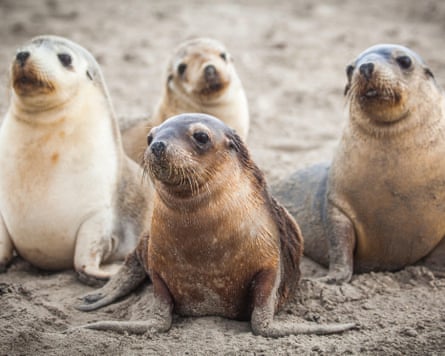
Australia’s three resident seals – the Australian fur seal, the New Zealand fur seal and the Australian sea lion – are all considered at very high risk. The Tasmanian devil and the eastern quoll, both assessed as high risk, are the land mammals at greatest threat.
The extent of the analysis and the number of species considered at high risk underlines expert fears for the threat to local wildlife.
Prof John Woinarski, a leading conservation scientist at Charles Darwin University who helped devise the analysis, said: “This has sketched out a more bleak picture than perhaps we considered previously.
“We are going to get major consequences for many species and our bird and mammal diversity is likely to suffer substantial impacts from this disease.”
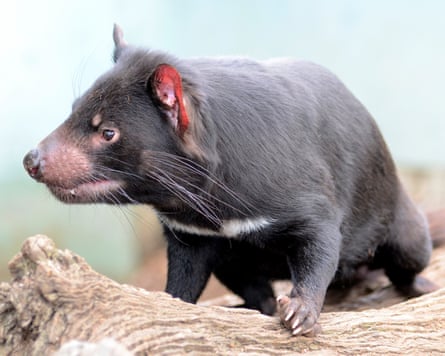
Tasmanian devils and eastern quolls are the land mammals at greatest threat. Photograph: Eric J Woehler
Prof Hugh Possingham of the University of Queensland, a lead councillor at the Biodiversity Council, said the analysis was “a good first cut” but it should have been released two years ago.
“A year ago we needed a priority action list and we should have been taking action then because everyone knew that it was coming,” he said.
Kate Millar, the chief executive of BirdLife Australia, said while the list of species at high risk or worse was “long” and “incredibly confronting” it also meant Australia could “prioritise and take action protecting the species most at risk”.
Jack Gough, the chief executive of the Invasive Species Council, said the “list of doom” revealed “the true extent of the disaster facing Australian wildlife”.
He said it demanded a “serious response” from the government “but instead we have had cuts to on-ground environment programs nationally”.
“Almost one in five Australian mammals and birds has been rated by the government as at risk of severe population reductions or even extinction,” he said. “This includes quolls, parrots, seals and pelicans.”
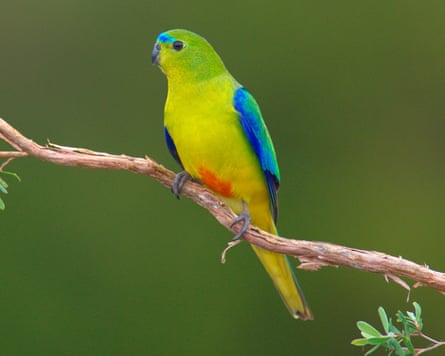
The critically endangered orange-bellied parrot is among several parrot species at high risk of bird flu. Photograph: Minden Pictures/Alamy
The council is among several conservation groups calling for the government to fund a $200m package to scale up on-ground efforts to protect wildlife, including feral animal controls.
The government has said it has committed $113m to prepare for bird flu, including $47m “to accelerate protective action” for threatened species and biodiversity.
The environment minister, Murray Watt, said the risk analysis had already informed investments to protect captive animal populations, removing feral threats and inoculating against more common diseases.
“We have been investing in these types of projects across the country for several years in preparation for a bird flu outbreak, and as a result, our native species are in a better position to withstand the H5 incursion.”
Jess Abrahams, national nature campaigner at the Australian Conservation Foundation, said: “Australia is already in the midst of an extinction crisis and we need to be prepared for just how harrowing this could get.
“Australians love nature and we all need to be emotionally prepared for the onslaught that could occur and know what to do if they come across a sick, dying or dead animal.”
The H5N1 virus has killed millions of birds and mammals since it spread from Europe in 2021 to every continent on the planet.
Australia was the final continent to be breached six weeks ago, when infected Antarctic and subantarctic migratory seabirds were found dead and sick in Western Australia and South Australia.
The virus has now been confirmed in more than 100 individual birds and air surveillance has recorded the first mass mortality event from the disease, in South Australia. Detections have also been confirmed in Victoria, New South Wales and Queensland.