Fresh case of H5N1 bird flu raises confirmed cases to 9 in Cambodia so far this year
Reply

From: animalwellnessaction.org
This week, the Colorado Secretary of State gave us official word that our ballot measure campaign in Colorado – flying under the banner of Cats Aren’t Trophies (CATs) – won official approval for placement on the November ballot.
Will you donate today to help Animal Wellness Action fight for bobcats, mountain lions and other animals?
That means that there will be a straight up-or-down vote on whether the state of Colorado should enact a statute to forbid the unsporting, inhumane targeting of these animals for their body parts and for bragging rights.
To be specific, this week we learned that the submission of nearly 188,000 signatures – accumulated over six months of one-on-one talks with more than one million Coloradans – met the threshold for qualifying for a place on the November ballot.
To be sure, this marks a milestone in our campaign to stop the needless trophy hunting and commercial fur trapping of the native big cats of Colorado for their heads and beautiful coats.
This issue will be in the national spotlight for the next 100 days and the effort will culminate with a vote of the people in the state.
It’s our greatest hope that the people of Colorado will vote to stop high-tech hounding and the bloody fights that result when a pack of dogs overtakes a solitary and badly outnumbered cat.
To stop “guaranteed kills” of “trophy lions” offered up to out-of-state trophy hunters by hunting guides.
To stop trapping, then strangling or stomping bobcats to kill them and then to take their fur to sell the pelts to China.
Even though volunteers talked to a million Coloradans over the past six months, many people in the state still have no idea that trophy hunters slay up to 600 lions a year in inhumane and unsporting kills. And they have no idea that trophy hunters and commercial trappers can kill an unlimited number of bobcats during a single season, resulting in thousands of cats killed for their beautiful fur coats.
Colorado has a once-in-a-generation opportunity to stop animal cruelty by passing a statewide ballot initiative. It will set the tone for how all animal protection policy initiatives will be viewed in Colorado and throughout the West in the years to come.
We ask you to dig deeper than for any other cause or campaign because an outcome looms. In less than three months, with your help, Colorado can usher in a new policy to protect native cats in the state from cruelty.
Our New Report Released on Mountain Lions and Their Ecological Role
Just two weeks ago, we released a new report, “A Scientific Review of Mountain Lion Hunting and Its Effects,” by Jim Keen, D.V.M. and Ph.D., that gives us insight into the beneficial role of lions in ecosystems and the utter falsehood from the trophy hunting crowd that head-hunting for inedible lions does anything but deliver detrimental effects to Colorado. (You can read the report here.)
Dr. Keen is a former USDA researcher and former faculty member at the University of Nebraska College of Veterinary Medicine and Biological Sciences.
His report shatters the false claim by trophy hunters that they are doing something good for lions by shooting them for their heads. The truth is, trophy hunters often target large, dominant males. This disrupts the social structure of mountain lion populations. Younger, less experienced males take over the vacated territories. These younger males are more prone to come into conflict with people because they have less knowledge of their territory and prey availability.
California banned trophy hunting of mountain lions in 1972. And when there are cases of individual lions coming into conflict with people, the state has primarily managed those conflicts with non-lethal methods like hazing and relocation, with just 10 problem lions killed in the entire state last year. California’s approach is working, sustaining a healthy mountain lion population and maintaining human-lion conflict rates that are similar or even lower than states that permit trophy hunting.
Mountain lions play a crucial role in the ecosystem by removing sick and weak animals. This can help slow the spread of diseases like the brain-wasting illness of Chronic Wasting Disease (CWD) in deer, elk, and moose herds.
So let’s be clear: trophy hunting of essentially inedible animals delivers no benefits for Colorado. It enriches a handful of hunting guides who use high-tech hounding strategies for fee-paying trophy hunters. It creates chaos and disrupts the balance of nature, causing downstream adverse effects with deer and elk populations and creating a population of lions more likely to come into conflict with.
5 min read
Fasten your reading glasses, or pour yourself a cup of coffee or glass of wine, because this blog will take a good while, and a few good turns.
I’ve been involved in wolf recovery efforts, since the late 1980s, and there’s not much I haven’t heard or seen: good and bad; inspiring and disappointing; and lots and lots of bewildering. But what we’re witnessing today is particularly disturbing—an epidemic of pure, unbridled cruelty, and a rekindling of the prejudice and persecution that essentially extirpated wolves from mainland America back in the early 1900s. It presents a significant risk to one of our nation’s greatest conservation successes. I wrote about it in this piece, recently published in the Washington Post.

Wolves have centuries of mythology and misrepresentation working against them, which shape beliefs about wolves that science can’t easily shake. I’ve spoken to ranchers who believe that wolves, if given the chance, will attack their children, and frankly, I’m confident if a pack of wolves was running around suburban Montgomery County, Maryland, where I live, semi-rabid packs of PhD parents would be having a collective fit. If you don’t believe it, I can show you posts from NextDoor where seemingly highly educated folks are demanding action from “animal control” because someone posted a picture of a fox walking down the street in front of their home. But I digress.
Years ago, I spent some time with a rancher, in Montana. He was a great partner in grizzly bear conservation, so I asked about wolves and got a cold, steely look back. Then, with a slow, deliberate tone, he said, “Dan, it’d just be better if we don’t talk about wolves. My grandfather helped drive them out of this county and I just can’t tolerate the thought of them being back.” End of conversation.

When I began my U.S. Fish and Wildlife Service career, in 1995, the agency Director was the first-ever woman to hold the job, the late Mollie Beattie. Mollie was passionate about all wild life, but especially wolves. That’s her in this iconic photo with Interior Secretary Bruce Babbitt. In the crate is the first wolf to set paw into Yellowstone National Park since 1926.
About a year later, Mollie and I were in the offices of Montana’s Democratic Senator Max Baucus. Some Montana ranchers were upset about a wolf pack that had taken up residence in the midst of several U.S. Forest Service grazing allotments. The ranchers wanted the Service to authorize USDA Wildlife Services to “remove” the wolves. Since they hadn’t killed any cattle, and were actively denning, Mollie declined.
A week later, we found out that USDA had “made the ranchers happy” by killing several dozen coyotes in the area. I remember Mollie fuming about the “abject cruelty,” and she said she felt like going up there and planting a monument to those coyotes “who had given their lives in support of wolf recovery.”
We’ve come a long, long way in the 25 years since then. Or so I’d thought, until recently. Last year Wisconsin held a poorly organized and managed hunt, just weeks after wolves were removed from Endangered Species Act protections. The state issued nearly 2,400 permits with a quota of 119 animals. It was a literal bloodbath, with at least 218 wolves killed in less than 72 hours. Recently published research indicates that related poaching likely killed another 100 animals, so in total, a third of Wisconsin’s wolves have been killed less than a year after losing ESA protection.
And then the Idaho legislature took matters into their own hands, presumably because they were unsatisfied with Fish and Game Commission harvest regulations that had only resulted in 570 wolves being killed from July 2019 to July 2020. They passed legislating regulations to give every conceivable advantage to “hunters” with the goal of reducing the population by as much as 90 percent.
Montana has followed suit. Almost certainly, Wyoming and Utah will join. Unless the federal government puts a halt to this mayhem. Decades of progress will vanish.

A hallmark of our Association of Zoos and Aquariums community is our abiding and overriding concern for the welfare of animals—animals in our care, for sure, but animals everywhere. If we’re going to live this, and make it an enduring part of our community culture, I believe we must stand strongly against animal cruelty, and especially the rebirth of brutal and relentless persecution of wolves that we’re witnessing today. The Rev. Martin Luther King said,
“Injustice anywhere is a threat to justice everywhere.”
Our concern for animals, and intolerance for cruelty, can’t stop at a perimeter fence.
That’s why I’d like to enlist you to do a few things:
Every AZA member who holds an advanced degree in science, please consider adding your name to this petition.
I’ve added my name, but don’t let that discourage you. You’ll be in good company with the likes of Jane Goodall, E.O. Wilson, and Tom Lovejoy.
Members and member-employees who are not scientists, please consider signing this petition.

Consider sending a letter to Interior Secretary Deb Haaland asking her to exercise her discretionary authority under the Endangered Species Act and put in place an emergency listing of wolves in Idaho and Montana in order to counteract the deliberate efforts of these states to undermine wolf recovery. Make sure to note that the actions of these states constitute a “a significant risk to the well-being” of wolves. That’s the ESA’s standard for emergency listing.
Consider asking your conservation partners, board members, and members to take these actions. And consider using your social media accounts to amplify concerns about this threat to wolf recovery.
Animals in AZA-accredited facilities receive the best care of animals anywhere. This is a moment when we can add our voices to howls of condemnation about actions of abject cruelty towards wolves and show our concern for animals everywhere.
Montana Public Radio | By John Hooks
Published August 2, 2024 at 5:07 PM MDT
Listen • 1:12

Wildlife officials in Montana and Wyoming are shipping bears across ecosystems in an attempt to meet court-imposed conditions to delist their grizzly populations and take over management from the federal government.
A federal court in 2019 ruled Yellowstone’s grizzlies could not be delisted until they achieved reliable genetic exchange with bears in and around Glacier National Park.
Scientists say roaming grizzlies are only a few years away from connecting the ecosystems themselves. But Montana, Idaho and Wyoming are not waiting. The three states signed an agreement this year promising to transfer at least one bear per generation from Glacier down to Yellowstone.
The first transfers this week relocated one young male and one young female. In a statement, Gov. Greg Gianforte said the transfer demonstrated the states’ commitment to grizzly conservation and called on the federal government to delist their populations.
The U.S. Fish and Wildlife Service is reviewing the endangered status of grizzly bears, and says it expects to have a decision by January 2025.
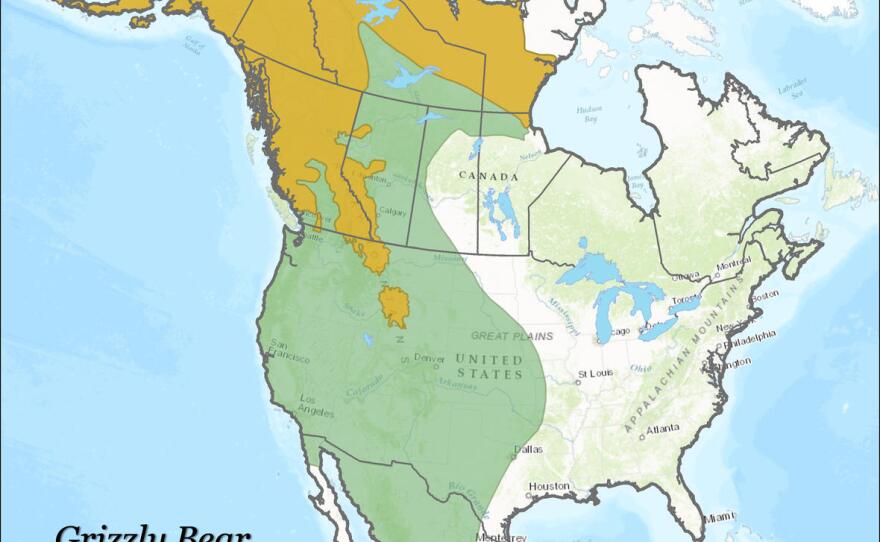
Timeline: A History Of Grizzly Bear Recovery In The Lower 48 States
At their peak, grizzly bears numbered more than 50,000 in the Lower 48. They roamed from the West Coast to the Great Plains, from northern Alaska to…

