Footage shows hunt blocking badger setts to stop foxes escape
Reply

KTVU Staff
Tue, September 3, 2024 at 6:58 AM PDT
https://www.yahoo.com/news/gray-wolves-making-historic-comeback-135821553.html
Scroll back up to restore default view.
https://s.yimg.com/rx/ev/builds/1.7.15/pframe.html
SACRAMENTO, Calif. – After being on the verge of extinction in California, the gray wolf is making an historic comeback to the state.
The last gray wolf in California was killed in 1924.
But wolves started coming from Oregon in 2011, and now the gray wolf population in California has grown. to a current count of 44.
The animals have now spread as far south as Tulare County in the Central Valley.
September 4, 2024
You can help all animals and our planet by choosing compassion on your plate and in your glass. #GoVeg
22 hours agoShare
https://www.bbc.com/news/articles/cewlqp7q0rwo
Adrienne Murray
BBC News
Reporting fromNuuk, Greenland
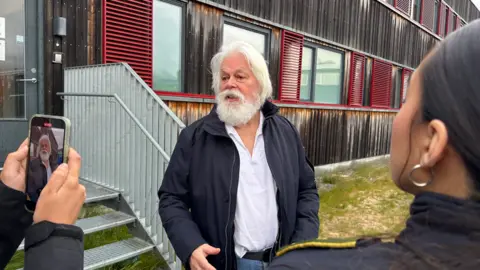
A court in Greenland has ruled that anti-whaling activist Paul Watson must remain in custody pending a decision to extradite him to Japan.
The veteran campaigner, who has featured in the reality television show “Whale Wars”, was apprehended by police in July as his ship docked in Greenland’s capital, Nuuk.
They were acting on a 2012 Japanese warrant which accuses him of causing damage to a Japanese whaling ship, obstructing business and injuring a crew member during an encounter in Antarctic waters in February 2010.
Officials in Japan argue that whaling and eating whale meat is part of the country’s culture and way of life. However, it has been heavily criticised by conservation groups.
Dressed in jeans and a white shirt, Mr Watson sat beside his defence lawyers and listened to proceedings through an interpreter as several of his supporters looked on.
“This is about revenge for a television show that extremely embarrassed Japan in the eyes of the world,” he told the small courtroom.
“What happened in the Southern Ocean is documented by hundreds of hours of video,” Mr Watson said.
“I think a review of all the video and of all the documentation will exonerate me from the accusations.”
However the prosecution argued that the defendant was a flight risk, and the judge concluded he should remain in custody until 2 October.
Paul Watson is the former head of Sea Shepherd Conservation Society, which he left in 2022 to set up the Captain Paul Watson Foundation.
He was also a founding member of Greenpeace, but they parted ways in 1977, amid disagreements over his radical tactics.
The 73-year old Canadian-American campaigner has been a controversial figure known for confrontations with whaling vessels at sea.
Mr Watson’s vessel, called the M/Y John Paul DeJoria, had been heading to the North Pacific with a crew of 26 volunteers on board, in a bid to intercept a new Japanese whaling ship when it docked to refuel in Nuuk on 21 July.
He was arrested and led away in handcuffs, and has been held at the local prison for the last seven weeks.
His defence team have appealed against the decision to keep him in custody before Greenland’s High Court.
Greenland is an autonomous territory of Denmark and, although the court in Nuuk is overseeing the custody hearings, the decision about Mr Watson’s extradition lies with Danish authorities in Copenhagen.
Last month, Japan asked Denmark to hand Paul Watson over, even though there is no extradition treaty between the two countries.
Police in Nuuk are carrying out an investigation before handing their findings to Denmark’s ministry of justice and a decision could be expected within the next few weeks.
“It’s a serious case, and it has to have some serious consideration. It has a deep impact on Mr Watson if we get to the point that he has to be extradited. So I will take the time needed to do it properly,” Greenland chief prosecutor Mariam Khalil told the BBC.
At the defence’s request, the judge granted permission for a video clip to be played, which appeared to show a zodiac-type speedboat sailing alongside a Japanese ship and firing a stink bomb.
However, Mr Watson’s lawyers say a second video clip, which was not shown, proves no-one was on deck at the time.
“We have video footage of a stink bomb being shot on to the ship, and the position that the Japanese claim the sailor should be in, he simply isn’t there,” Jonas Christoffersen told BBC.
“There’s no evidential basis for the allegation that somebody got got injured.”
Lyon-based international police body Interpol has confirmed the existence of an outstanding red notice for the arrest of Mr Watson.
In 2012, Paul Watson was also detained in Germany, but left the country after learning that he was sought for extradition by Japan.
Masashi Mizobuchi, assistant press secretary for the Japanese ministry of foreign affairs, told the BBC that Japan had not yet received any response from the Danish authorities.
“We will continue to take appropriate measures, including necessary outreach to the relevant countries and organisations,” Mr Mizobuchi said.
Japan withdrew from the International Whaling Commission and resumed commercial whaling in 2019, after a 30-year hiatus. However, it had continued whaling for what it said were research purposes.
French President Emmanuel Macron’s office has asked Denmark not to extradite Paul Watson, and there has been vocal support from legendary actress turned animals rights activist Brigitte Bardot.
Meanwhile a petition calling for Mr Watson’s release has surpassed 120,000 signatures.


