Earth’s Disastrous 10th Tipping Point Has Been Identified
Reply

By Anay Mridul Published on Jul 15, 2024 Last updated Jul 15, 2024

4 Mins Read
Pinky Cole’s Slutty Vegan is coming to the world’s busiest airport. Passengers travelling through the Hartsfield-Jackson Atlanta International Airport will be able to dine at the plant-based fast-food eatery by the end of 2024.
The restaurant chain – which is also headquartered in Atlanta, Georgia – has begun construction on what looks like a large site at the airport’s Concourse B, Cole announced last week on Instagram.
“I literally started in a shared kitchen 6 years ago and now Slutty Vegan will be the FIRST EVER vegan restaurant in the busiest airport in the world,” she wrote. “Slutty Vegan and a full bar in CONCOURSE B sounds like flights will be missed.”
The new location will also feature a bar, and was first teased in September last year. Cole announced the move on Instagram after winning a bid for the site at the international airport.
“I have the most ICONIC announcement of my professional career,” wrote Cole. “Slutty Vegan will be a PERMANENT LOCATION in Atlanta Hartsfield-Jackson Airport! WE JUST WON THE BID.”
She added: “Y’all, this is the busiest airport in America, and my restaurant will be there!”
Hartsfield-Jackson has been the busiest airport every year since 1998 (barring the pandemic-hit 2020), and welcomes over 104.6 million passengers annually. But while it has restaurants that offer vegan-friendly food, including P.F. Chang’s, Lottafrutta and Grindhouse Killer Burgers, this will be the first time it will have a fully plant-based restaurant.
Slutty Vegan’s outpost will also become one of the only 100% vegan eateries at airports across the world. Los Angeles International Airport previously had a Real Food Daily location, but it has now closed.
“Given that Atlanta Airport is the busiest airport in the country, with high foot traffic, we expect it to be one of our busiest locations,” Slutty Vegan founding partner and chief revenue officer Jason Crain told Food Chain Magazine in February. “We are thrilled to be at the forefront and showcase what Atlanta has to offer through our vegan menu.”
While having a location at an airport has its challenges, it’s a shrewd move on Slutty Vegan’s part. Most travellers are routinely disappointed at the lack of diversity and quality of meat-free options at airports, yet everybody eats during their journeys. A 9,000-person global survey this year found that only 2% of passengers never eat or drink at the airport.
It also revealed that the popularity of sit-down dining and bar options has increased, with 41% preferring this option. That bodes well for Slutty Vegan and its bar.
Cole, a former TV producer, first founded Slutty Vegan in 2018 as a food truck, two years after her previous restaurant in Harlem, New York was destroyed by a fire. Her first brick-and-mortar location opened its doors just outside of Atlanta in 2019, and in the years since, she has built it into one of America’s most popular vegan chains.
In 2022, the business raised $25M at a $100M valuation, led by Shake Shack founder Danny Meyer’s Enlightened Hospitality Investments and Essence Ventures CEO Richelieu Dennis’ New Voice Fund. The capital was to be used for Slutty Vegan’s expansion to 20 locations – at the time, it had five restaurants, and it now has 11 currently in operation.
The eatery chain is known for its extensive social media marketing and brand partnerships. It hosts residencies in different cities throughout the year, and announced two collaborations in the last week alone. Along with Bar Vegan, its sister bar chain, Slutty Vegan teamed up with whole-cut meat producer Chunk Foods to add a brisket sandwich and 4oz steak entrée to the menu at some of its locations.
Additionally, it extended its ongoing link-up with shoe designer Angela Simmons, bringing Vegan Fried Oreos to select locations, featuring a mix from their original collaboration, Angela’s Cakes.
Slutty Vegan – known for menu items like the One Night Stand bacon cheeseburger, Hollywood Hooker cheesesteak and fries with its signature Slut Dust seasoning – has made a name for itself through provocative and highly effective marketing.
“You want to be able to tell a story to the people who are watching. Telling their story will make people come into your business and support it. That’s the reason why we get people to come through the doors and support our brand,” Cole told Forbes in May.
This approach is what has made the chain stand out where others have failed. For example, despite being the world’s largest restaurant chain, McDonald’s said its McPlant trial had failed in the US, blaming a lack of demand. But some have argued that its marketing and rollout left a lot to be desired.
“The McPlant is at best, boring. At worse, worthy. Let’s remember the average American has never heard the term ‘plant-based’,” Jennifer Woollford, founder of marketing community Neon Leaders, who has held executive roles at Mars and Perfect Day, told Green Queen last month.
“So what are they expected to feel about a McPlant, especially one with a green leaf on the box? Compare [this] to Slutty Vegan – full of energy, excitement and building an experience out of eating plants.”
The illnesses, all in farm workers, have been relatively mild — a contrast to the flu’s deadly effect on many birds and some mammals.
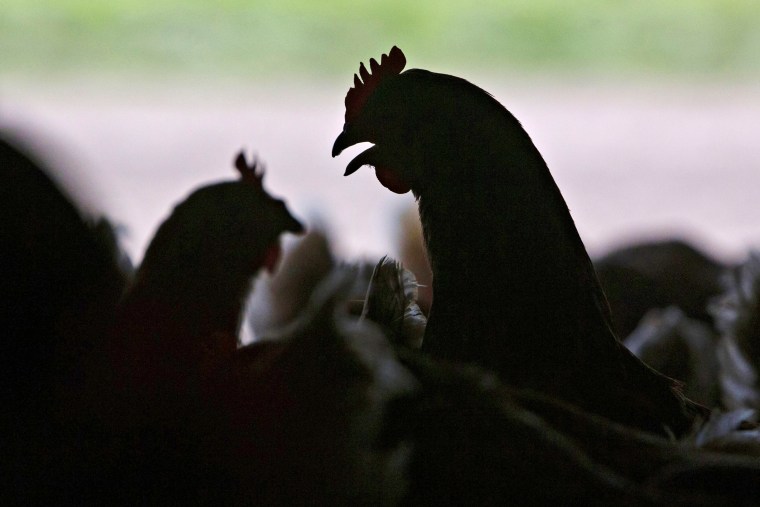
The cases stem from a global outbreak of H5N1, a particular strain of bird flu that took off in 2020.Daniel Acker / Bloomberg via Getty Images file
July 18, 2024, 3:30 AM PDT
By Aria Bendix
Four poultry workers in Colorado who recently contracted bird flu bring the total of human cases in the U.S. to at least nine.
Though that number is small, disease researchers say commonalities between the cases — all but one of which were reported in the last four months — are enough to start assembling a picture of how the virus may affect people.
The U.S. cases have been relatively mild and limited to farm workers who had handled infected animals — a sign that the virus in its current state isn’t a major threat to humans.
Some patients have reported typical flu symptoms such as fever, chills, cough, sore throat or runny nose. Several have had conjunctivitis or pink eye.
“One thing that we can conclude is that the current strain of the virus isn’t well adapted for human infection, and may not even be well adapted for infecting the lower respiratory tract,” said Matthew Binnicker, director of the Clinical Virology Laboratory at the Mayo Clinic.
The cases stem from a global outbreak of H5N1, a particular strain of bird flu that took off in 2020 and has hit poultry and dairy farms in the U.S.
The country’s first human case was reported in April 2022, in a prison inmate who had culled birds at a farm in Colorado and whose only symptom was fatigue. Texas reported the second case in April, followed by two in Michigan and five in Colorado — the four most recent of which were confirmed over the weekend.
The cases’ mild nature stands in contrast to the flu’s effect on birds and some mammals — including seals, sea lions, foxes, skunks and cats — that have died from the virus. Since January 2022, more than 99 million wild aquatic birds, commercial poultry and backyard flocks in the U.S. have been affected, which means they either died of the virus or were culled to prevent further transmission. And roughly 160 dairy cow herds have been struck since the virus was first detected in cows in March.
This H5N1 strain is considered highly pathogenic, a term that, when used in the context of bird flu, means it has a high potential to kill chickens.
Hearing about such a virus “really scares people, but that term is really a USDA term for what happens in poultry,” said John Lednicky, a research professor of environmental and global health at the University of Florida. “Just because it’s highly pathogenic in birds doesn’t mean it’s highly pathogenic in mammals or humans.”
Lednicky added that some strains of H5N1 are deadly in humans, while others are not.
Of the more than 900 total cases of H5N1 strains in people reported globally since 1997, around half have been fatal. But in the last two years, the global mortality rate has been lower: around 27%. And even then, those numbers largely reflect just the people who were sick enough to seek treatment.
Dr. Peter Palese, a microbiology professor at the Icahn School of Medicine at Mount Sinai, said patients in that tally are those who’ve “been hospitalized and who, in retrospect, have been in contact with large amounts of virus.”
Palese’s 2012 research, which examined blood samples from 12,500 people without a documented bird flu infection, found that 1% to 2% of them may have previously been infected with H5N1.
Experts still worry, though, that the virus could someday mutate into a version that causes more severe disease or that spreads from person to person. (So far, all transmission has been from animals to humans.)
“The concern is that as more animals are infected, and then more people are infected, the virus will change,” Binnicker said.
Of the nine U.S. bird flu patients, at least four reported pink eye.
That was true in at least one of the recent cases in Colorado, which were linked to an outbreak at a commercial farm in Weld County. The workers had been culling poultry.
The state reported earlier this month that another patient there, a dairy worker who had been exposed to infected cattle, also developed pink eye.
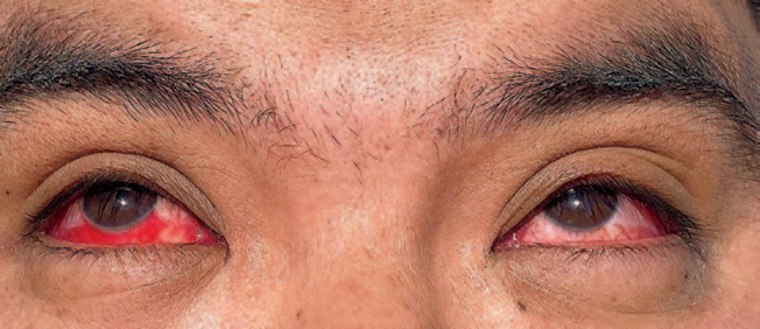
Texas’ one case involved conjunctivitis without other symptoms. That person worked with dairy cows and developed redness and discomfort in their right eye in March. According to a case study in the New England Journal of Medicine, the person reported wearing gloves but no eye protection on the job.
Conjunctivitis isn’t the most common symptom of bird flu in humans, but it has been documented in some people infected with different strains, such as in a 2003 outbreak of H7N7 in the Netherlands.
Scientists said a few factors could explain the symptom’s recent prevalence. One is that farm workers aren’t consistently covering their eyes when dealing with sick animals. As a result, dairy workers could get raw milk — which has been shown to carry the virus — in their eyes.


That’s likely what happened to a dairy worker in Michigan who developed mild conjunctivitis and was confirmed to have bird flu in May.
The virus may also enter people’s eyes through respiratory droplets or aerosols (tiny airborne droplets). Or, some workers could have touched their eyes after handling infected animals or contaminated raw milk.
“The receptor on the cells that the virus needs to bind to is pretty prevalent in cells in the eye, and that could be one explanation as to why we’re seeing conjunctivitis in individuals infected with avian flu,” Binnicker said.
The Centers for Disease Control and Prevention recommends treating people with bird flu with antivirals. Some of the U.S. patients have received Tamiflu, a drug also used to treat seasonal influenza.
“The studies that have been done so far have shown that Tamiflu is effective at treating the currently circulating strain of avian influenza,” Binnicker said. “It usually needs to get administered within 48 hours of symptom onset to be most effective.”
The reason that all but one of the U.S. cases have been reported since April, scientists say, may come down to two factors. First, the virus is spreading at a rapid clip among birds and sporadically infecting other animals, such as domestic cats, thereby increasing the odds of human exposure. Second, health departments have started monitoring and testing people exposed to infected animals if they develop symptoms.
The CDC estimates that at least 10,600 people have been monitored for bird flu and at least 375 have been tested since the outbreak in commercial poultry started in 2022.
“There probably is a much higher amount of virus out there today compared to a year ago, but we’re also picking up more cases because we’re testing more,” Binnicker said.
Dr. Natasha Bagdasarian, chief medical executive for the state of Michigan, said local health departments there have been screening for even the faintest of symptoms.
“I think that’s why we’re seeing the mild cases,” she said. “It’s because of this active symptom monitoring that we’re doing.”
The Michigan worker who had conjunctivitis, for instance, didn’t even seek out a doctor before being tested for bird flu. Michigan’s other case was a farmworker working with infected cows, who reported a sore throat, cough and congestion to local health officials.
Bagdasarian said the fact that Michigan has only seen two cases after testing roughly 60 people suggests humans need lots of exposure to get sick. The workers who tested positive also weren’t wearing full personal protective equipment and had been involved in tasks like milking cows or administering fluids to them, she said.
“We’re not talking about folks who had transient contact with these animals, who walked past a barn or a pen,” Bagdasarian said. “We’re not talking about people who just touched a cow once.”

Library image.
Eleven horses have died and others were injured in a motorway accident involving a horsebox in France.
The lorry, which had come from the UK, was travelling on the A16 motorway, south of Amiens in the Somme region, yesterday afternoon (17 July), carrying polo ponies from Britain to Spain.
A spokesperson for the Préfet de la Somme, the local government authority, told H&H this afternoon that 11 horses have died. Five survived and have been taken to a veterinary clinic for treatment.
Pictures show the trailer element of the HGV tipped to one side, on to the central reservation. It has been reported that some of the horses were thrown clear of the vehicle and others were trapped beneath the trailer.
A spokesperson for the Hurlingham Polo Association told H&H: “The HPA is devastated to hear of the accident in France involving several polo ponies and we will be working to support the owners in any way we can.”
A week ago, the Préfet de la Somme released figures showing that there had been a “sharp increase” in the number of accidents on the region’s roads this year; a 64% increase in the number of human fatalities from 2023.
From the start of the year to 11 July there had been 158 road accidents, causing 23 deaths, compared to 129 accidents and 14 fatalities in the same period last year.

Follow
325.1K Followers
Story by Darren Orf
• 9h • 3 min read

A new study uncovers aquatic deoxygenation as Earth’s 10th tipping point, threatening ecosystems and humanity’s future. Can we still save the planet?© William Grammenos – Getty Images
“Climate change” is a scary, catch-all term that summarizes all the anthropogenic degradation humans are inflicting on the planet. In reality, climate change is only one of the many threats facing the planet.
https://www.msn.com/en-us/weather/topstories/earth-s-disastrous-10th-tipping-point-has-been-identified/ar-BB1qdOKm?ocid=msedgdhp&pc=ENTPSP&cvid=262eeb761cba49dc855a07c48e397afa&ei=39
First introduced in 2009, the Planetary Boundary (PB) concept identifies nine unique thresholds that could spell disaster if humanity crosses them. While climate change is one of the nine boundaries, the list also includes things like biosphere integrity, ozone depletion, ocean acidification, freshwater change, and more. (Of course, what we think of as climate change exacerbates all of these issues, so in a sense, it remains Public Enemy No. 1.)
Now in a new study, scientists are arguing that a 10th boundary could be added to the list—aquatic deoxygenation. Some bodies of water in the world (such as basins in the Black Sea, the Baltic Sea, and various fjords) are naturally anoxic, meaning that they contain little or no oxygen. But widespread deoxygenation is different, as it affects previously oxygenated bodies of water globally and to varying degrees.
www.expedia.com/airfares/ParisFlight Prices to Paris – Airline Tickets, Airfare Deals
According to the researchers, lakes and reservoirs have experienced oxygen losses of 5.5 percent and 18.6 percent respectively in the past 45 years, and the oceans have dropped by 2 percent—a jaw-dropping amount of oxygen when you consider the collective size of the oceans. One of the most dramatic examples of deoxygenation is in midwaters off the coast of California, where oxygen levels have dropped by a staggering 40 percent since 1960. The results of this study were published in the journal Nature Ecology & Evolution.
Andreas Oschlies—co-author of the study and professor of Marine Biogeochemical Modelling at GEOMAR Helmholtz Centre for Ocean Research in Kiel, Germany—gives a detailed description in a press release about how rising temperatures and land (mis)use can cause this kind of rapid deoxygenation:
The causes of aquatic oxygen loss are global warming due to greenhouse gas emissions and the input of nutrients as a result of land use. If water temperatures rise, the solubility of oxygen in the water decreases. In addition, global warming enhances stratification of the water column, because warmer, low-salinity water with a lower density lies on top of the colder, saltier deep water below. This hinders the exchange of the oxygen-poor deep layers with the oxygen-rich surface water. In addition, nutrient inputs from land support algal blooms, which lead to more oxygen being consumed as more organic material sinks and is decomposed by microbes at depth
Ocean-dwelling animals needed oxygenated water to survive, and as such, these deoxygenated waters can significantly impact fish, mussels, and crustaceans. This subsequently reverberates up the food chain and threatens ecological collapse. And if that wasn’t enough, deoxygenated water can also produce nitrous oxide and methane—two notoriously terrible greenhouse gasses—via microbiotic processes. In other words, losing oxygen in Earth’s bodies of water can unleash an absolute deluge of climate disasters that could spell doom for our planet.
sherumThie New AC Cooler That Works Anywhere Is Sweeping Washington
“Dissolved oxygen regulates the role of marine and freshwater in modulating Earth’s climate. Improving oxygen concentrations depends on addressing the root causes, including climate warming and runoff from developed landscapes,” Kevin Rose, a professor at the Rensselaer Polytechnic Institute in New York and lead author on the study, said in a press statement. “Failure to address aquatic deoxygenation will, ultimately, not only affect ecosystems but also economic activity, and society at a global level.”
Humanity has already crossed six of the nine boundaries enumerated in the original PB concept, and now a tenth boundary could be quickly joining that notorious club. Luckily, there is a solution, and it’s one that’s been with us for more than a century—eliminate emissions, save the planet.