At least 87 people feared dead in stampede at religious event in India, NDTV reports
Reply

Story by Reuters
• 48m • 1 min read

Family members react outside the Etah Hospital after a stampede at a religious event in Etah, Uttar Pradesh, India, July 2, 2024. ANI/ Via Reuters TV© Thomson Reuters
NEW DELHI (Reuters) -At least 87 people were feared dead in a stampede at a Hindu religious gathering in India’s northern state of Uttar Pradesh on Tuesday, broadcaster NDTV reported.
The stampede happened in a village in Hathras district, about 200 km (125 miles) southeast of the national capital New Delhi, where authorities said a large crowd had gathered on an area of open ground in response to a call from a local religious leader.
brain boosterThose Who Live The Longest Mostly Sleep In This Position (Watch Now)
District police spokesperson Manish Chikara put the death toll at about 60 people, but said that figure may rise.
Videos on social media showed bodies piled up on the ground outside a local hospital. Reuters could not immediately verify the images.
“The incident happened due to overcrowding at the time when people were trying to leave the venue,” Hathras district administrator Ashish Kumar told reporters.
An unidentified witness told broadcaster India Today that there was a narrow exit at the venue: “As we tried to exit towards a field, suddenly a commotion started, and we didn’t know what to do.”
Uttar Pradesh is India’s most populous state with more than 200 million people. Its Chief Minister Yogi Adityanath ordered an investigation.
“Instructions have been given to the concerned officials to conduct relief and rescue operations on war footing and to provide proper treatment to the injured,” he posted on X.
(Reporting by Saurabh Sharma, Sudipto Ganguly, Shivam Patel; Editing by YP Rajesh and Sharon Singleton)
Least Impressive College Football Stadiums in America!
Worst College Football Stadiums
Fed’s Powell says more evidence of falling inflation needed before rate cuts
Euro zone ‘very advanced’ on disinflationary path – ECB’s Lagarde
US Supreme Court rejects teen sex abuse victim’s bid to revive Snapchat lawsuit
How To Borrow From Your Home Without Touching Your Mortgage
Simple Trick To Clean Driveway 10x Faster (In Under 5 Minutes)
Borrow from Your Home, Not the Bank (e.g. $25k for $168/mo)

At least 60 are dead and scores are injured after a stampede at a religious event in northern India
18


Inside the world’s hottest town where locals live daily lives in blistering 135F heat
54


Massive landslide in India sees chunk of mountain crumble onto road
8

The Most Dangerous Beach in the World
44

Woman accused of killing husband, 8-year-old child before shooting herself in Louisiana
4

The Deadly Toll of Air Pollution: 135 Million Lives Lost and Rising
17

Nine dead after car crashes into crowd of people
34
Utah fire captain dies in whitewater rafting accident at Dinosaur National Monument
60
Who was Nyah Mway? New York 13-year-old shot, killed after police said he had replica gun
17
00:53
Floods and landslides triggered by heavy rains in India’s northeast kill at least 16
1

Antarctica Plummets Into Record Lows During Worldwide Heat Surge
90
18:23
15 Scary & Massive Dams Caught On Camera
20

Dog, Cat Food Recall Sparks Nationwide Warning to Pet Owners
81


The Associated PressFollow
675.7K Followers
1d
Play Video

Deadly weekend storms cause extensive flooding and landslides in Switzerland and ItalyUnmute
0
Storms in Switzerland and northern Italy caused extensive flooding and landslides, leaving at least four people dead, authorities said Sunday.

TOP STORIES
 ReutersAt least 27 dead in stampede at religious event in north India
 ABC NewsBiden says SCOTUS decision sets ‘dangerous precedent’
 NBC NewsBiden campaign tells donors president can recover from subpar debate performance
NEW DELHI (Reuters) -At least 87 people were feared dead in a stampede at a Hindu religious gathering in India’s northern state of Uttar Pradesh on Tuesday, broadcaster NDTV reported.
The stampede happened in a village in Hathras district, about 200 km (125 miles) southeast of the national capital New Delhi, where authorities said a large crowd had gathered on an area of open ground in response to a call from a local religious leader.
brain boosterThose Who Live The Longest Mostly Sleep In This Position (Watch Now)
District police spokesperson Manish Chikara put the death toll at about 60 people, but said that figure may rise.
Videos on social media showed bodies piled up on the ground outside a local hospital. Reuters could not immediately verify the images.
“The incident happened due to overcrowding at the time when people were trying to leave the venue,” Hathras district administrator Ashish Kumar told reporters.
An unidentified witness told broadcaster India Today that there was a narrow exit at the venue: “As we tried to exit towards a field, suddenly a commotion started, and we didn’t know what to do.”
Uttar Pradesh is India’s most populous state with more than 200 million people. Its Chief Minister Yogi Adityanath ordered an investigation.
“Instructions have been given to the concerned officials to conduct relief and rescue operations on war footing and to provide proper treatment to the injured,” he posted on X.
(Reporting by Saurabh Sharma, Sudipto Ganguly, Shivam Patel; Editing by YP Rajesh and Sharon Singleton)
by: Associated Press
Posted: Jul 1, 2024 / 10:44 PM CDT
Updated: Jul 1, 2024 / 10:46 PM CDT
SHARE https://whnt.com/entertainment-news/ap-entertainment/ap-2-men-were-arrested-on-a-road-within-oprahs-hawaii-ranch-theyre-suspected-of-illegal-hunting/
KULA, Hawaii (AP) — Two men arrested last month on a public road within Oprah Winfrey ‘s property on the Hawaiian island of Maui are suspected of illegal night hunting, state officials said Monday.
The two Maui men, both 19, were arrested just before midnight on June 21 after officers found them using a hunting spotlight on a public road that runs through Winfrey’s ranch in Kula, the state Department of Land and Natural Resources said in a news release.
While they were not caught actively hunting, officers found a loaded shotgun and a loaded rifle in the pair’s truck, and Winfrey’s ranch surrounds the road where they were stopped, the state said.
ADVERTISING
The men were arrested on suspicion of hunting on private lands without permission, not having a hunting license and other violations. One of them was also arrested for an unregistered semi-automatic rifle.
Invasive axis deer run rampant on Maui and other islands of Hawaii.
Maui County prosecutors will review the case and determine if there will be charges. Records show the men were released pending investigation, county officials said.
“Last month, DLNR reached out to Upcountry ranchers regarding their efforts to prevent illegal poaching throughout the area and we agreed to cooperate. The arrests did not happen on the property,” Winfrey’s production company, Harpo, said Monday in an emailed statement.
•https://studyfinds.org/humans-ancient-giants-extinction/
Reviewed by Steve Fink
Research led by Jens-Christian Svenning, Aarhus University
Jul 01, 2024
FACT CHECKED
SHARE:

Prehistoric humans hunt a woolly mammoth. More and more research shows that this species – and at least 46 other species of megaherbivores – were driven to extinction by humans. (CREDIT: Engraving by Ernest Grise, photographed by William Henry Jackson. Courtesy Getty’s Open Content Program)
AARHUS, Denmark — Imagine a world where elephants roamed across Europe, giant ground sloths lumbered through the Americas, and car-sized armadillos burrowed in South American grasslands. This wasn’t some fantastical realm from a Hollywood movie — it was Earth just 50,000 years ago. But then something happened. These megafauna — animals weighing over 100 pounds — began to disappear. By 10,000 years ago, most were gone forever.
What caused this mass extinction event that reshaped life on our planet? It’s a question that has puzzled scientists for over 200 years. Now, an international team of researchers has conducted an exhaustive review of the evidence, concluding that prehistoric humans were likely the primary culprits behind the downfall of Earth’s giants.
The study, led by scientists from the Danish National Research Foundation’s Center for Ecological Dynamics in a Novel Biosphere (ECONOVO) at Aarhus University, analyzed patterns of megafauna extinctions across continents and time periods. They found that large animals began vanishing shortly after humans arrived in new regions, with extinction rates highest where humans were most novel.
“The large and very selective loss of megafauna over the last 50,000 years is unique over the past 66 million years. Previous periods of climate change did not lead to large, selective extinctions, which argues against a major role for climate in the megafauna extinctions,” says Professor Jens-Christian Svenning, the study’s lead author, in a statement.
The researchers point out that climate change, long considered a potential cause of the extinctions, doesn’t adequately explain the patterns observed. While the late Pleistocene epoch did see significant climatic shifts, these were no more extreme than previous glacial cycles that didn’t result in mass extinctions.
“Another significant pattern that argues against a role for climate is that the recent megafauna extinctions hit just as hard in climatically stable areas as in unstable areas,” Svenning adds.
Additionally, the megafauna losses were highly selective, primarily affecting only the largest species. Smaller animals, plants, and marine life were largely unaffected. This size bias matches what we’d expect from human hunting pressure, not climate change.
The study reveals that at least 161 species of mammals were driven to extinction during this period, based on the remains found so far. The largest animals were hit the hardest — land-dwelling herbivores weighing over a ton, known as megaherbivores. Fifty thousand years ago, there were 57 species of megaherbivores. Today, only 11 remain, with even these survivors experiencing drastic population declines.
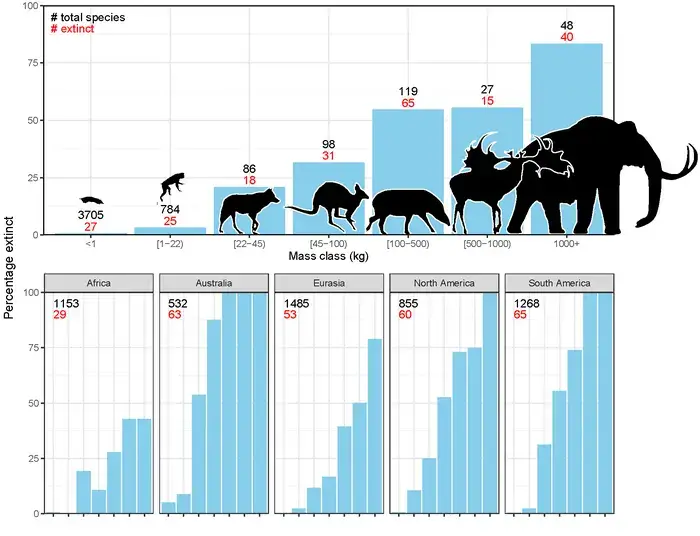
Interestingly, regions where humans had a longer evolutionary history with large animals saw less severe extinction events. In Africa and parts of Asia, where hominins had been present for millions of years, fewer megafauna species went extinct compared to the Americas and Australia. This suggests animals in Africa and Asia may have developed behaviors to avoid human predators over time. The researchers found evidence of human hunting prowess in the archaeological record.
“Early modern humans were effective hunters of even the largest animal species and clearly had the ability to reduce the populations of large animals,” notes Svenning. “These large animals were and are particularly vulnerable to overexploitation because they have long gestation periods, produce very few offspring at a time, and take many years to reach sexual maturity.”


Echo Pop Kids Disney Princess with Echo Glow
4
$32.99
$79.98

59% off With Prime


The loss of these ecosystem giants had profound impacts that are still shaping our world today. Large herbivores like mammoths and ground sloths played crucial roles in maintaining open habitats and dispersing nutrients across landscapes. Their disappearance likely contributed to the spread of forests and changes in fire regimes in many regions.
“Species went extinct on all continents except Antarctica and in all types of ecosystems, from tropical forests and savannas to Mediterranean and temperate forests and steppes to arctic ecosystems. Many of the extinct species could thrive in various types of environments. Therefore, their extinction cannot be explained by climate changes causing the disappearance of a specific ecosystem type, such as the mammoth steppe – which also housed only a few megafauna species,” Svenning emphasizes.
The authors argue that understanding this extinction event is crucial as we face a biodiversity crisis today. By recognizing humans’ long history of impacting animal populations, we can better inform conservation efforts. They even suggest “rewilding,” reintroducing large animals to restore lost ecological functions, as a potential conservation strategy.
“Our results highlight the need for active conservation and restoration efforts. By reintroducing large mammals, we can help restore ecological balances and support biodiversity, which evolved in ecosystems rich in megafauna,” Svenning concludes.
The study is published in the journal Cambridge Prisms: Extinction.
The researchers conducted an extensive literature review, examining evidence from paleontology, archaeology, genetics, and ecology. They analyzed patterns of megafauna extinctions across different continents, time periods, and body size classes. The team also evaluated various hypotheses for the extinctions, including climate change and human impacts, against the observed patterns. Their review incorporated several research fields, including studies on the timing of species extinctions, animal dietary preferences, climate and habitat requirements, genetic estimates of past population sizes, and evidence of human hunting.
The study found that megafauna extinctions were global in scope but varied in intensity across regions. They were strongly biased towards the largest species and temporally linked to human arrival in new areas. The extinctions were not well-explained by climate change alone. The researchers observed that at least 161 species of mammals were driven to extinction during this period, with land-dwelling herbivores weighing over a ton (megaherbivores) being the most severely affected.
Among possible limitations of this study, the fossil record is incomplete, especially for smaller species, which can bias our understanding of extinction patterns. The dating of extinction events and human arrivals can be imprecise, making it challenging to establish exact temporal relationships. Additionally, complex interactions between humans, climate, and ecosystems are difficult to fully disentangle, especially over such long time scales.
The researchers conclude that human hunting and ecosystem modification were likely the primary drivers of late Quaternary megafauna extinctions. They argue this event marks an early example of human-driven environmental change on a global scale. The study emphasizes that humans have been shaping ecosystems for tens of thousands of years and that large animals are particularly vulnerable to human impacts. The loss of megafauna had cascading effects on landscapes and ecosystems, altering vegetation structures, seed dispersal patterns, and nutrient cycling. The authors stress the importance of understanding past extinctions to inform modern conservation efforts. They suggest that rewilding with large animals may help restore lost ecological functions and support biodiversity in ecosystems that evolved with megafauna.
https://www.aol.com/group-butterflies-flew-2-600-153115900.html?guccounter=1
TAYLOR NICIOLI, CNN
July 1, 2024 at 8:31 AM
Sign up for CNN’s Wonder Theory science newsletter. Explore the universe with news on fascinating discoveries, scientific advancements and more.
Painted lady butterflies venture far and wide with their impressive migratory patterns that stretch for thousands of miles — but they often travel across land, so they can stop to rest.
Scientists have now found evidence that a group of the winged travelers flew over 2,600 miles (about 4,200 kilometers) across the Atlantic Ocean without stopping, according to a new study published June 25 in the journal Nature Communications.
The finding ends a decade-long mystery that began when entomologist and lead study author Dr. Gerard Talavera came across around 10 painted lady butterflies, known by the scientific name Vanessa cardui, on a beach in French Guiana in October 2013. The insects, which are not usually found in South America, were worn out with holes and tears in their wings.
“They looked exhausted. They even couldn’t fly very much — they kind of jumped instead of flying,” said Talavera, a Spanish National Research Council senior researcher at the Botanical Institute of Barcelona. “The only explanation that came to my mind was that these were long-distance migrants.”
But crossing an entire ocean was unheard of for butterflies, even ones as worldly as the painted ladies. Talavera, along with his colleagues, had to rule out a few factors before concluding that these butterflies accomplished what was previously thought impossible.
An October 2016 study that Talavera coauthored found that painted ladies from Europe migrate in great distances of around 2,500 miles (about 4,000 kilometers) to sub-Saharan Africa, facing obstacles such as the Mediterranean Sea and Sahara Desert. But even so, the butterflies remain mostly over land where they can “stop and refuel, feed on flowers and then get energy to keep going,” Talavera said.
Crossing the Atlantic would take a painted lady butterfly five to eight days, depending on different variables, according to the new study.
Based on analyses of the energy constraints, researchers concluded that the butterflies could fly a maximum of 485 miles (780 kilometers) or so without stopping, but favorable wind conditions are what allowed them to complete the lengthy journey, Talavera said.
“This is actually kind of a record for an insect, especially for a butterfly, to perform such a long flight without possibilities to stop,” said Talavera, who also leads the Worldwide Painted Lady Migration Project, a global citizen science project that tracks the migratory routes of the insects.
There have been other instances in which experts suspect butterflies and other migratory insects of traveling longer distances than usual, turning up on boats, remote islands or countries where they are not usually found, Talavera said.
The researchers believe that these butterflies took part in their annual migration south from Europe but got lost when the wind blew them into the ocean, he added. The butterflies then likely rode out the trade winds, which blow east to west near the equator, until they reached land in South America.
“Getting suspended in the air column at just the right height to take advantage of the trade winds is nothing short of remarkable,” said Dr. Floyd Shockley, collections manager for the department of entomology at the Smithsonian National Museum of Natural History in Washington, DC, who was not part of the new study. “It kind of begs the question, have they been doing this for a long time, and we just never documented it because we weren’t looking for it in South America?”
The discovery of around 10 out-of-place butterflies, versus the occasional discovered singleton that was likely caught up in storms, could be sufficient evidence that this was a coordinated migratory event for the group of insects, Shockley said.
Researchers took a few crucial steps to confirm these out-of-place butterflies really did travel across the ocean.
First, to rule out that the insects did not travel over land from North America, the researchers analyzed their DNA, finding it to match with that of European-African populations. Next, the team used a technique known as isotope tracing that looks at the composition of the butterflies’ wings for evidence of the types of plants they ate as caterpillars, said study coauthor Dr. Megan Reich, a postdoctoral fellow at the University of Ottawa in Ontario. By this method, the scientists concluded the butterflies’ birthplace to be in either Western Europe, North Africa or West Africa, she added.

But the real key to finding the route the butterflies took was a method first described in a September 2018 study led by Talavera that found that pollen clinging to butterflies can be telling of their migratory journey through the plants on which they fed. The butterflies spotted in October 2013 had the pollen of two West African plants, Guiera senegalensis and Ziziphus spina-christi. The tropical shrubs flower through August and November, according to the study, and this blooming season lines up with the timeline of the butterflies that Talavera discovered in South America.
Additionally, an analysis of weather data from 48 hours before the discovery of the beached butterflies had shown to be “exceptionally favorable for the butterflies to disperse across the Atlantic from West Africa,” the authors noted in the study.
If the insects traveled from their likely birthplace of Europe, then to Africa and South America, the butterflies’ journey could have consisted of 4,350 miles (7,000 kilometers) or more.
“A lot of people think of butterflies as really fragile creatures. I think this really shows how strong and resilient they are and these amazing journeys that they take — they really shouldn’t be underestimated,” Reich said.
The researchers hope to use the same techniques to investigate the migration patterns of other species of butterflies, she added.
“This is just the first step in sort of a long process of trying to understand why this happened and how this happened,” Shockley said.
If future research finds that the butterflies’ journey is likely a regular migration pattern, it’s among the longest insect migrations in the world, he added.
For more CNN news and newsletters create an account at CNN.com