Wolf quota reached in hunting and trapping region north of Yellowstone National Park
Reply

By FOX 13 News Staff
PublishedNovember 21, 2023
 article
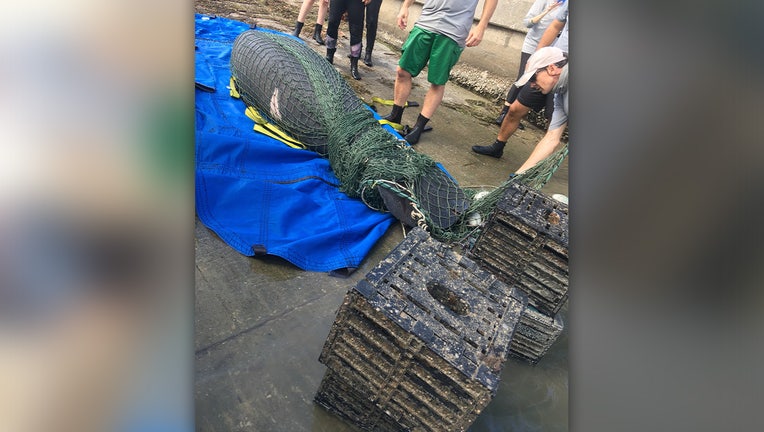
CLEARWATER, Fla. – A manatee that was entangled in rope and crab traps in Clearwater Bay was rescued last week by multiple agencies, including the Florida Fish and Wildlife Commission.
According to FWC, they were alerted on Thursday to a manatee that was entangled in line wrapped several times around its peduncle within a mile of the Clearwater Marine Aquarium at Island Estates.
Three Winthrop Banks Are Paying Record High Interest Rates – See the ListSavings Pro|
READ: Armed burglary suspect shot to death by Pasco County resident: Deputies
Due to rain and bad weather conditions, teams weren’t able to respond. The next day, FWC’s Marine Mammal Pathobiology Laboratory (MMPL) tagged the 9.5-foot animal with a radio tag, and members of the CMA team tried to rescue it. Due to the number of other manatees in the area, though, their efforts were unsuccessful.
“We continued to assist with scouting for the animal over the weekend and tracking reports, and the animal was consistently reported in waters within or nearby Island Estates,” said Hannah Rogers, Senior Rescue Biologist at CMA.
On Monday, officials with the aquarium were told of a possible animal in the Mandalay channel but couldn’t see any entanglement, buoy, or tag, according to FWC.
A rescue team member in a kayak was able to see the radio tag under the surface of the water and verified this was the entangled manatee.
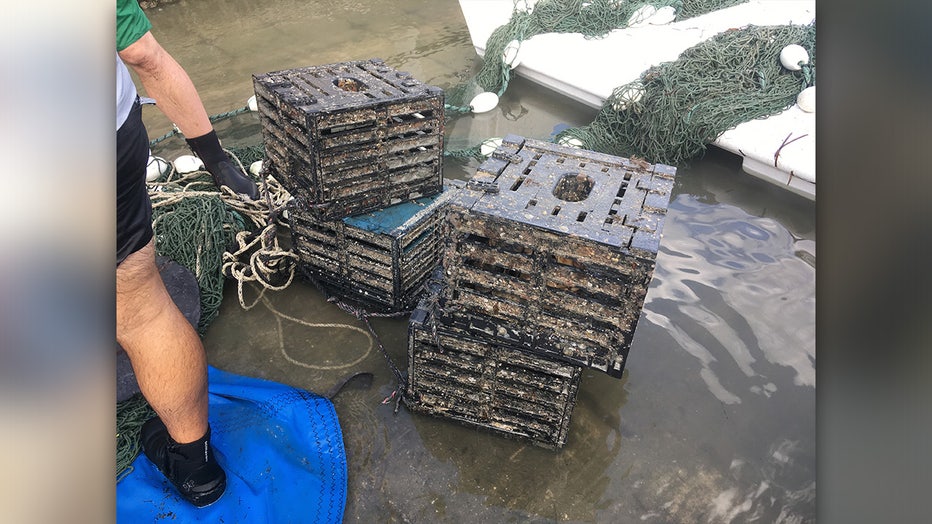
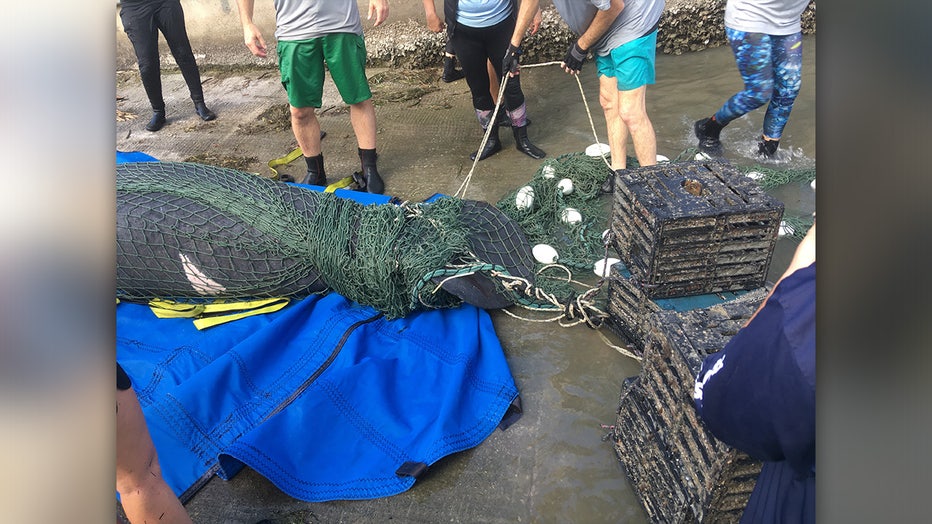
Crews then found that in addition to its entanglement by rope, the line holding the manatee was attached to four stone crab traps. FWC disentangled the animal, completed a workup of the animal, and then released it.
Ban will protect people, pets and wildlife from indiscriminate M-44 devices used for predator control on BLM land EUGENE, OR – Predator Defense is pleased to announce that the U.S. Department of the Interior has banned the use of M-44 devices, commonly known as ‘‘cyanide bombs,’’ on lands administered by the Bureau of Land Management (BLM). This includes over 245 million acres, roughly a tenth of the nation’s land mass. M-44s are spring-loaded ejectors armed with cyanide powder long used by government agents for predator control. They have injured many people to date, and inhumanely killed thousands of animals every year, including endangered species and pets. “I am immensely relieved that countless people and animals will now be spared death and poisoning on a huge portion of the American landscape,” said Brooks Fahy, executive director of Predator Defense, a national wildlife advocacy group. “Working with victims of M-44 tragedies for over 30 years, I’ve seen what these indiscriminate devices do to families who have lost beloved pets, been poisoned themselves, or potentially lost a child. I commend the Interior Department for making BLM lands immeasurably safer.” BLM is the only agency within the Interior Department that uses M-44s to target predators like coyotes. They are not used on lands administered by the National Park Service, the U.S. Fish and Wildlife Service or the Bureau of Reclamation. However, M-44 use continues on U.S Forest Service lands, which are managed by the U.S. Department of Agriculture (USDA) and span 193,000,000 acres. They are also placed on private property by owner request. Most M-44s are placed by agents of Wildlife Services, the USDA’s animal-killing program. According to Wildlife Services’ data, in 2022 the program poisoned approximately 6,000 animals with M-44s in 10 states: Colorado, Montana, Nebraska, Nevada, New Mexico, North Dakota, Oklahoma, Texas, West Virginia and Wyoming. State agencies in South Dakota, Montana, Wyoming, New Mexico and Texas are also authorized to use M-44s. The public repeatedly expresses surprise that these dangerous devices continue to be used, especially after a well-known tragedy in 2017 in Pocatello, Idaho. Canyon Mansfield was 14 years old when he inadvertently triggered an M-44 device, thinking it was a sprinkler head. The M-44 had been illegally set on BLM land on a hill behind his home. It killed Canyon’s dog, Kasey, and injured him. Canyon was believed to have been spared from death because of the wind’s direction. The Mansfield family is thrilled by the BLM ban on M-44 use, but continues to push for a comprehensive ban. “We are so happy to finally see one federal government department banning another’s reckless and indiscriminate actions, telling Wildlife Services their use of these barbaric and antiquated devices must stop,” said Dr. Mark Mansfield, Canyon’s father. “We celebrate this critical move forward–ridding BLM lands of cyanide bombs. But there is more to do. Congress must enact ‘Canyon’s Law’ as a final act to ban M-44s on all public lands in America.” The current version of Canyon’s Law, which originated in 2019 in response to the Mansfield family’s tragedy, would ban M-44s on all public lands–federal, state and local. It was reintroduced in both houses of Congress in June 2023. Today’s BLM ban came about in response to a formal letter to Interior Secretary Deb Haaland, sent in October 2022 by U.S. Rep. Jared Huffman (D-CA) and former Rep. Peter DeFazio (D-OR) at the urging of Predator Defense. In it the Congressmen noted that the Interior Department had expressed openness to banning M-44s in their testimony to a Congressional subcommittee. The Congressmen urged they take immediate action to prevent future tragedies. Rep. Huffman followed up on this letter in 2023 after receiving status queries from Predator Defense, as the letter had appeared to languish. This month the Interior Department finally formalized their decision. Initial notice from Interior Department | Rep. Huffman’s press release Boosting work at the federal level, public demand for a ban has increased over time and is largely attributed to major media coverage of M-44 tragedies and popular statewide bans on the West Coast. Concurrent pressure has been applied by conservation organizations, e.g., the 2023 APA petition jointly filed by Predator Defense and the Center for Biodiversity and signed by over 70 conservation groups. “We are deeply grateful to Representative Huffman for pushing the BLM ban over the finish line,” said Fahy. “And since the Interior Department sees the wisdom of banning cyanide bombs, surely the USDA can, too. It’s high time our government steps up and stops putting people’s and animals’ lives at risk. They could save a lot of time, money and suffering by banning all M-44 use immediately.” |
| # # # Predator Defense is a national nonprofit advocacy organization devoted to protecting essential native predators, helping people learn to coexist with wild animals, and ending America’s war on wildlife.They have been championing native predators with science, sanity and heart since 1990. |
| Predator Defense | predatordefense.org |
December 26, 2023 – 3 min read


In 2023, factory farming and animal policy made the news more than ever before. In December, the UN’s climate conference had an entire day dedicated to food and agriculture for the first time. Rewinding to October, the USDA announced new organic farming standards, including stronger animal welfare provisions.Play
00:00
-13:19MuteSettingsEnter fullscreen
One major theme of 2023 was investigations. Multiple undercover investigators used spy cams to film how factory farms really operate, and media outlets took notice. Here’s some of the best coverage:
Wired published an in-depth look at DxE’s operation manual, while National Geographic published an explainer on open rescue.

A Tyson employee was recorded admitting that “free-range” chickens never see the outdoors.
In the UK, a welfare certified group’s staff were caught on camera kicking and throwing hens.
Investigators on a pig farm caught footage of workers feeding a mixture of diseased intestines and feces to adult breeding pigs — a standard practice in the industry.
Here’s the month-to-month breakdown:
In a move foreshadowing one of the year’s main themes, Hawai’ian state officials temporarily shut down an octopus farm in January for operating without permits. Meanwhile, in landlocked Utah scientists warned that the Great Salt Lake is expected to dry up in five years, due to the unsustainable use of water to grow hay and alfalfa for farmed animal feed. And: in a trend that will surely continue, Veganuary 2023 broke records with more than 700,000 participants.
To read more of the top stories from January 2023, click here.
During February, a report on working conditions alleged that meat producers ignore unions and fail to provide enough sick benefits to reduce the risk of injury and illness. Meanwhile, 95 percent of the fish on a Canadian Arctic char farm died when “extreme cold” knocked out power and a generator that kept oxygen pumping through their tanks. Plus, Census Bureau data showed that climate-fueled natural disasters displaced 3.4 million U.S. residents in 2022.
Check out more stories from February.
Research released in March found that the production of food alone — particularly meat, dairy and rice — could jeopardize the international climate goal of limiting warming to 1°C. Two activists were acquitted for taking chickens worth $16 total from a farm in California. And, avian flu caused the cost of eggs to spike, hitting $4.25 per dozen.
For more March stories, read this.
In April, the slaughter of Cedar the goat by Shasta County Fair Officials — despite the pleas of the child who raised him — sparked outcry as the story went viral. Vermont dairy workers demanded better working conditions, as 40 percent are paid below minimum wage and 28 percent work 7-hour shifts without a break. The food safety considerations of cultivated meat and conventional meat are the same, claimed the World Health Organization in a report released this month.
To read more factory farm and animal policy coverage from April, click here.
The now-infamous Aubrey Plaza “wood milk” commercial premiered in May, immediately sparking backlash. Journalists probed Tyson’s USDA-backed, “climate-friendly” Brazen Beef trying to figure out what about it was better for the environment, but they came up empty handed. Plus: new in-egg sexing technology could end the slaughter of billions of chicks.
Click here to see how journalists covered food system news in May.
In June, a report from the World Bank revealed that agriculture, fisheries and fossil fuels get $7 trillion in subsidies every year — money that could be spent fighting climate change instead of fueling it. Cargill increased its focus on plant-based meat due to projects that demand for protein will rise by 70 percent over the next 30 years. And, an investigation revealed over 800 million Amazon trees were cut down for beef production in just six years.
Check out other top stories on factory farming and animal policy from June.
An analysis warns that the Gulf Stream could collapse as soon as 2050 if we don’t cut carbon emissions — potentially disrupting rains billions rely on for food. Also in July, extreme heat ravaged the country wreaking havoc for farmers and livestock alike. Plus: Tyson dropped its ‘no antibiotics ever’ label, resuming its use of ionophores — drugs not considered medically important to humans.
Click here for more stories from July.
In August, Tokitae — the orca some called Lolita — died after five decades in captivity at the Miami Seaquarium. As avian flu continued to spread Finland announced that they were culling 50,000 mink and foxes impacted by the virus. Plus, the CDC identified a new strain of E. coli tied to foodborne illnesses in the past few years.
For more coverage from August, click here.
A child makes September headlines when their arm is mangled at a meat processing plant leading to investigations of Perdue and Tyson. As once-vibrant fisheries become desolate, large-scale fishers turn toward new waters and bring their illegal gear with them. Plus, British academics called on universities to adopt plant-based menus.
Read more September animal policy and farming news by clicking here.
In October scientists revealed that they had successfully used CRISPR gene-editing to make chickens more resistant to avian flu. Top FAO officials alleged that they faced years of sabotage from within the organization for trying to shed light on the massive emissions attributable to livestock. And, British chefs turn against farmed salmon due to welfare and sustainability concerns.
Read more news on factory farms from October by clicking here.
Bird flu was identified among wild birds in the Antarctic in November while Singapore turned to cultivated meat as a means to produce more food domestically. In an attempt to produce livestock feed more sustainably, some companies are turning to insect factories.
Want to read more coverage from November? Click here.
In the final month of the year, cattle industry associations in Colorado sued the state and the Department of Fish and Wildlife to prevent the reintroduction of gray wolves. Research suggested that many people are less likely to choose food products without meat and dairy if they’re labeled as “vegan” or “plant-based.” Plus: federal investigators determined that the deaths of six poultry workers from a gas leak was “completely preventable.”
Read more December coverage of factory farms and policy by clicking here.


