Missouri teen shot, killed by hunting group member, MDC officials say
Reply

Dec 07, 2023 at 7:09 AM EST01:00
US Government Wants Hunters to Shoot 500,000 Owls
By Jess Thomson
Science ReporterFOLLOW
https://www.newsweek.com/invasive-species-barred-owl-cull-pacific-northwest-1850348
175
The U.S. Fish and Wildlife Service wants hunters to shoot more than 500,000 barred owls to help protect other native species.
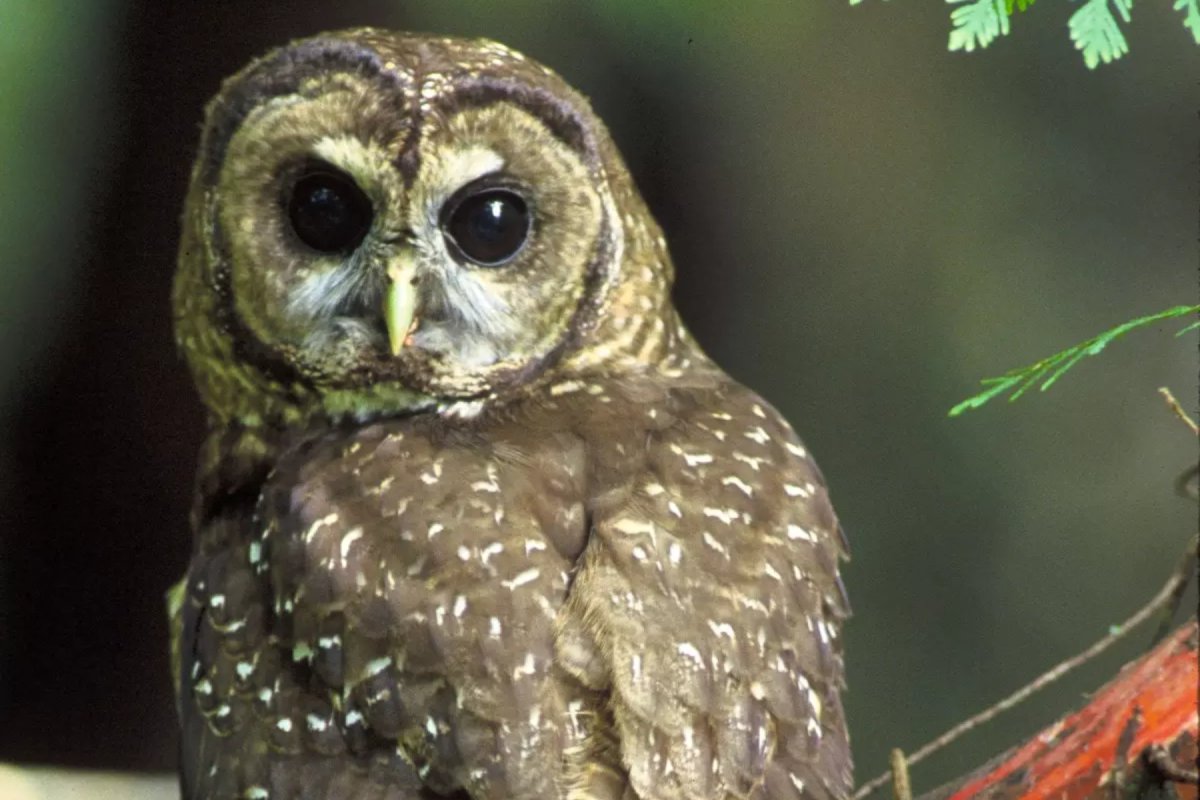
Barred owls are an invasive species in the Pacific Northwest, originating on the U.S. East Coast, and they pose a huge threat to native protected species, including northern spotted owls.
As part of a draft management plan, the U.S. Fish and Wildlife Service (FWS) wants to cull these invasive owls, and hopes to enlist hunters to shoot half a million of them over the next 30 years.
Barred owls have been in the Pacific Northwest since the 1950s, and they now outnumber northern spotted owls across Washington, Oregon and California. They pose such a threat to northern spotted owls as they are more aggressive and have a more varied diet, eating anything from insects and amphibians to fish and other birds. They are also larger and more territorial than the native owls, meaning that they displace the northern spotted owls, disrupting their nesting, competing with them for food, and even attacking them when they come too close.
In areas where barred owls are present in higher numbers, northern spotted owl populations are declining rapidly. They are now listed as threatened under the Endangered Species Act, with populations having declined by between 35 percent and 80 percent over the last 20 years.

 NEWSLETTER
The Bulletin
Your daily briefing of everything you need to know
“They have dramatic impacts on northern spotted owl populations. A recent study found that northern spotted owl populations in areas that received experimental Barred owl control (removal) declined at an average rate of 0.2 percent per year, whereas northern spotted owl populations in areas that did not receive barred owl control declined at an average rate of 12.1 percent per year,” Jeffrey R. Dunk, a conservation lecturer at Humboldt State University, told Newsweek. “The former rate of 0.2 percent is essentially a stable population, but a population declining at a rate of 12.1 percent per year is dramatically declining. If that 12.1 percent rate of decline was maintained, a population would be reduced by half in only 5.7 years, and half again in another 5.7 years. Essentially, the difference in these rates represents the impacts of barred owls on northern spotted owls.”
Meanwhile, there are now over 100,000 barred owls in the northern spotted owls’ territory across Washington, Oregon and Northern California. They are also slowly moving south and into the territory of California’s spotted owls, which are also facing population declines.
READ MORE
To save northern spotted owls from the barred owl onslaught, the FWS said in a draft environmental impact statement that they plan to initially cull around 20,000 of the owls in the first year, followed by 13,397 birds a year in the first decade, 16,303 a year in the second, and 17,390 birds each year in the third decade. This is due to start possibly as early as 2025.
“Debate over ‘best’ option(s) for recovery planning/actions is a BIG topic. Culling barred owl is one option, but needs to go hand-in-hand with habitat protection,” Jared Hobbs, a senior biologist and ecological consultant, told Newsweek. “The US Endangered Species Act (ESA) motivated the Pacific Northwest Forest Management Plan and essentially ceased logging Spotted Owl habitat in the Pacific Northwest. In BC/Canada we have the federal Species-at-Risk Act (SARA) but the provincial government is negligent in its duties to comply with legal requirements for protection of Critical Habitat (CH) under SARA.”
Sign up for Newsweek’s daily headlines
“This is the most important of three ‘pillars’ (habitat protection, barred owl control and captive breeding). To define ‘best’ is impossible; all three are necessary at this point as spotted owl populations have been so heavily impacted by forestry/logging that recovery without barred owl management is less likely,” he said.
The plan details that landowners or land managers could apply for a permit to kill the owls, and that a large-bore shotgun would be the choice weapon, to be substituted for capture and euthanasia when people are close.
Not everyone supported the plan, however.
“Are we going to do more harm than good? Do we really want a bunch of people in the woods shooting at what are otherwise protected birds?” Bob Sallinger, executive director of Bird Conservation Oregon, told the Seattle Times. “I nearly always opposed these sorts of programs.
“I do put the highest priority on preventing extinction, and there is science that shows us this is probably necessary. But this is really a no-win, awful situation we created for ourselves. It is appalling we have to consider these kinds of measures, and incredibly sad.”
Experts are confident that this program will successfully protect the spotted owls, however, as studies have found that killing barred owls stabilized spotted owl populations. The management plan hopes to only eradicate around 30 percent of the total barred owl population, which should be enough to take the pressure off the spotted owls.
“We know we can’t fully eradicate them, but we know we can create [refuge] areas with much lower barred owl density that allows spotted owls to survive and thrive,” Kessina Lee, state supervisor for the Oregon office of FWS, told the Seattle Times.
Posted December 7, 2023 | Reviewed by Gary Drevitch
kevin turcios / Unsplash
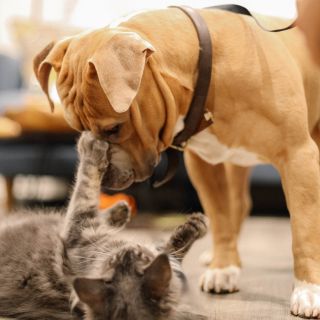
The most popular domestic pets in America are dogs and cats. Dogs are somewhat more popular overall, with 38 percent of households in the U.S. having a dog while 25 percent of households have a cat. The number of actual animals is a bit more evenly matched since people who own cats are more likely to own more than one; there are about 77 million dogs and 58 million cats. Any conversation between dog and cat owners is almost inevitably bound to bring up the question of the relative intelligence of the two species.
A recent research report by a group of Hungarian researchers headed by Attila Salamon at Eötvös Loránd University in Budapest has revisited the question of dog-vs.-cat intelligence, focusing on the issue of whether dogs or cats understand human communication gestures better. Technically this refers to the relative “social cognitive ability” of canines and felines.
In many respects, evolution and the history of the domestication of cats and dogs should give us a clue as to the likely outcome of this comparison. From some 14,000 years ago—a likely estimate of when domesticated dogs began to appear—dogs have worked in close association with people. They assisted in hunting, guarding, and herding, as well as becoming close companions with humans. All of this requires some sort of interaction and communication. Dogs had a genetic leg up when it comes to such behaviors because the ancestors of dogs lived in close family groups and packs that had a system of complex social interactions. Furthermore, it seems likely that the dogs which responded most readily and accurately to human communicative signals would be appreciated more and thus better cared for, and would be more likely to be bred. Thus a sort of seat-of-the-pants applied genetics would ultimately sort out dogs so that those who had inherited good social cognitive and communication abilities would begin to dominate the species.
The domestication of cats came later, probably beginning around 7000 years ago, when organized agriculture was becoming important for humans. Now the growing of grain was carried out in a more systematic way, and granaries stored the wheat, barley, and rye following the harvest, thus providing a food supply throughout the year. Rats and mice soon discovered these food reserves. Unfortunately, these rodents do not simply eat some of the food, but they foul much of the remainder making it not fit for consumption. Because of this, cats were a godsend. Working in almost complete independence of human guidance, cats protected the granaries and fed themselves on the rats and mice.
article continues after advertisement
While dogs were living socially and dependently with people, it was not so with cats. The ancestor of the cat was a strongly territorial, mostly solitary animal with minimal contact between individuals except during reproductive periods. In essence, the newly domesticated cat only had a weak social association with humans, although their territories often included human settlements. It is only in the last few hundred years that cats became companion animals, living more socially and interactively with humans.
A common test of social cognition involves pointing. By the age of two, human children recognize that pointing is a communication gesture indicating the direction of something of interest. For animals, a pointing test is quite simple: First, the animal is brought into a testing room and shown a bowl that contains a bit of a treat, which it is then allowed to eat. This is done for several trials. Next, two identical bowls are put down, one to the experimenter’s right and the other to her left, and she points to one container. The experimenter always points to the container containing the treat. If the animal recognizes that this is a communication gesture they go to the container with the treat and get to consume it. A successful trial is obviously one in which the animal goes to the container which was pointed to. An error would be going to the wrong container, or failing to make any choice at all.
For dogs, laboratory testing was a breeze. They all rapidly became comfortable in the lab, and all made a choice when the experimenter pointed her finger. If the experimenter held her finger pointing at one container all of the dogs in the group (except one) chose accurately at a rate well above the level which would indicate simply guessing.
For cats, the situation was much more difficult. When it comes to simply habituating to the lab, so that the cat would be calm, take food, and interact with the experimenter, this research team found that cats are really difficult subjects. In the first set of tests, 60 percent of the cats failed to calm down enough to be tested. They simply couldn’t handle it.
article continues after advertisement
The researchers concluded that the territorial nature of the cats was such that they were at a disadvantage in the unfamiliar environment of the laboratory. So they reran the tests in the cat’s usual home. Now a higher percentage of the cats proved to be testable but still 40 percent had to be dropped from the study because they wouldn’t habituate to the presence of the experimenter, even in their own home. That meant that they didn’t respond, refused to make any choices, hid behind furniture, or even bit the hand of the experimenter.
The performance of the cats was rather poor even for those select individuals who could be tested and did make choices. To quote the experimenters, “If you count failing to make a choice as an error cats did not perform significantly above chance.”
Remember, these felines were not simply representative of all cats, but as the experimenters note, “We acknowledge that the cats in our study were probably more sociable than typical cats due to the requirement to interact with the experimenter during the habituation process.”
The accuracy of the cats was abysmal, even using a relaxed criterion for scoring (namely not counting a failure to respond as an error). The experimenters summarized their overall performance: “Only three cats (7 percent) made a choice at least half of the time and were above chance at home and in the lab.” That means that the remaining 93 percent of the group of cats tested were guessing, rather than gathering information about where the treat was based on where the experimenter was pointing.
Although these results do not resolve the issue as to whether dogs or cats are the more intelligent overall, it certainly indicates that when it comes to social cognition and the ability to respond to human communication, the performance of cats lags well behind that of dogs—even when you take into account the fact that many cats simply refuse to engage in the testing process.

